




This content contains affiliate links. When you buy through these links, we may earn an affiliate commission.
Many people say we should all read the classics, and in many cases, that is true. There were some really great words born out of the books and other works that came before us. But much like we’re grateful to The Beatles for writing “With a Little Help From My Friends,” so Joe Cocker could give us his spectacular (and highly superior, don’t @ me) cover, we have to be grateful to the authors of a few excellent classics for giving us the source material of some even better stories.
Recently, I noticed a minor trend that felt like it had been written specifically for me.
I read a surprisingly low amount of classic literature in English in high school and college, but I introduced myself to a few Big Books after library school, when I could read whatever I wanted. I had relatively low expectations, but came out of the other side of all three of these books with a newfound appreciation for the authors, their writing, and the stories they told—even if the general sentiment while reading was, “These people are AWFUL, tell me more.” But if there’s something I will always love about a classic, it’s someone retelling it; you’re looking at the person who spent years reading Pride and Prejudice fanfiction.
So, of course, there’s a singular delight that comes out of new stories born out of the bones of classic novels. And there’s an even larger delight when those stories center people with some of my own identities, including Black and African Diaspora characters and queer characters. Write those stories in the time the books were originally written, highlighting the existence of non-white, non-straight people? Put it in my eyeballs. And on top of that, you’re writing about teenagers, for teenagers, the people who most need to see themselves in fiction?
Yes. Please.
Past Tense
Sign up for our weekly newsletter about historical fiction!
Let’s examine a few of these magical texts and their source materials.
If you’re of a certain age, there are likely three or four places you might have been introduced to Dr. Jekyll and Mr. Hyde: a random episode of Wishbone, the movie Mary Reilly, or a really bad pro-shot of the Jekyll and Hyde musical starring none other than David Hasselhoff. (OH! Or maybe the League of Extraordinary Gentlemen, where Hyde is more like a Victorian-gentleman version of The Hulk.) But how many of us have sought out the original text? If you do, you’ll discover that beneath the Gothic horror, imposing dread, and mystery in the story of Gabriel Utterson and his friend Henry Jekyll lies an investigation of philosophy, ethics, and the present state of being.
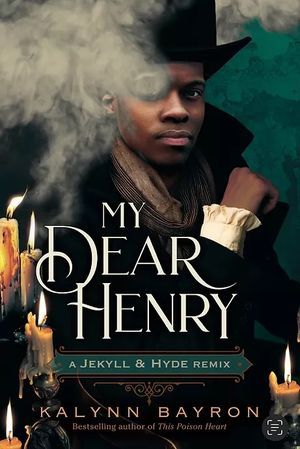
The Retelling: My Dear Henry by Kalynn Bayron
Oftentimes, when we think of retellings of classics, especially when they center historically and systemically excluded groups like Black and/or queer folks, we expect them to be set in contemporary times. But the Remixed Classics series, of which My Dear Henry is an installment, offers new versions of familiar stories. Using the eerie story of Gabriel and Henry as they navigate the before and after of the London Medical School as Black, gay young men in 1880s England, Bayron explores the duality of racism and homophobia contrasted with first love and acceptance.
I tried to read Jane Eyre multiple times on my own, but I finally had to sit down and get past Part One that one time I attempted to pursue a second master’s degree right after library school. The benefit of every adaptation is that they don’t spend quite so much time with Jane’s depressing childhood, and we jump right to the “something strange is happening at Thornfield” story. The governess fell in love with her charge and her employer, long before Julie Andrews ran through the hills. That’s the story at the core of most adaptations. The book? Push through, friends. It’s worth it. Or don’t; I don’t care. Either way, if you are unfamiliar with the Big Reveal, turn back now. It plays a key role in the retelling.
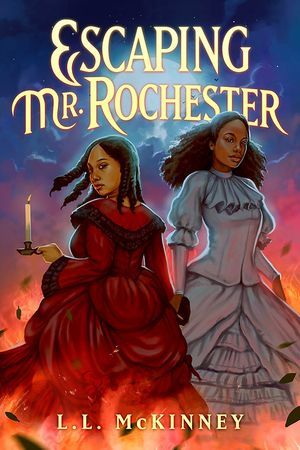
The Retelling: Escaping Mr. Rochester by LL McKinney
One of the questions that has plagued literary critics for over a century has been whether Edward Rochester is a true romantic hero. Modern sensibilities and reading would say: no. Absolutely not. L.L. McKinney takes it a step further: not only is he not a hero, but he is also an active villain. In Escaping Mr. Rochester, Jane and Bertha have to save themselves and each other from the horrors that await them if they choose to remain in Thornfield Hall. After an accidental meeting, they come to rely on each other, developing something more as they develop their plan for disavailing themselves of the incredibly creepy Mr. Rochester.
I remember exactly where I was when I read this book: sitting at a table in the large, airy room of the high school library where I worked alone. There were a few hours without class visits or meetings, leaving me to my own machinations. One of the English classes was reading The Great Gatsby, and I realized that I was fairly unfamiliar with the text. I might have seen both movies? Or maybe the Baz Luhrmann one was about to come out. But when I tell you I devoured this little book. Say what you want about Fitzgerald, the man could put words together. And these are the people you love to hate. (The only other classic I have had the “I HATE THEM THIS IS A TRAINWRECK GIVE ME MORE” experience with was Wuthering Heights). A lot of things happen, people party, people die, the green light glows.
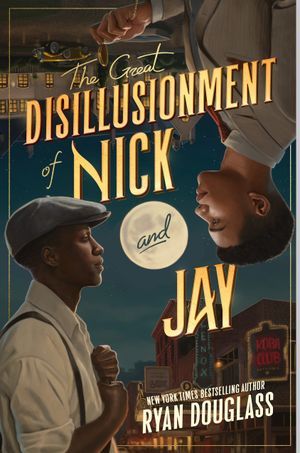
The Retelling: The Great Disillusionment of Nick and Jay by Ryan Douglass (January 27)
This book won’t be released for a couple of months, but I’m excited to get my hands on it. When Nick’s world is turned upside down by the Tulsa Massacre (I’m assuming, since the description specifically references Greenwood, Oklahoma), he winds up in Harlem, attending the fancy integrated West Egg Academy. It’s there he meets the founder’s son Jay, and well, we can imagine what comes next. Douglass’s prior work leans into both the horrific and the poetic, so I’m looking forward to seeing how language plays into this telling of the story.
While three isn’t a huge number, it’s still pretty incredible that we’ve got three Black retellings of classics centering queer teens, set in historical times. Now we just need a couple hundred more.