




This content contains affiliate links. When you buy through these links, we may earn an affiliate commission.
In the final installment of a trilogy of posts explicitly dedicated to comics censorship, we shift our focus from the history and legacy of burning and banning comics to the current state of affairs. You can catch up on the first two stories, which examine the appeal of comic book burnings in post-World War II America and the silver linings of that comic censorship, as groundwork for how we got where we are.
Comics have long been a contentious medium for those seeking to limit access to books. It began in the 1940s and 1950s with the fear that comics might lead to juvenile delinquency, continued throughout the rest of the century with complaints over “inappropriateness,” and in the early 2000s, saw a fresh wave of challenges as the medium grew in popularity and accessibility. The late 2000s were a time when comics became more prominent in libraries. By the time we reached the 2020s, not only are comics a staple in both public schools and public libraries, but they are also regularly honored among the best literature of the year.
Comics are a target because it’s a medium that requires a unique literacy to understand. Comic books make for easy targets because a person who has been infected by right-wing rhetoric can print the pages sitting on RatedBooks, Take Back the Classroom, or their predecessor BookLooks, and claim the comics are inappropriate without any context about the where, why, or how of that image within the book itself. Unfortunately, these people are not interested in learning literacy. By spreading these images without context, they inflame other people who don’t have the time or capacity to develop that literacy and actually “do their own research” on the matter. Comics are a collaborative dance between the words and the art. Young people with access to and exposure to comics are honing crucial intellectual skills while also enjoying creative, clever, fun, and educational stories.
Since 2021, comics have been among the top books banned in America. Many of these comics are far from new; they, too, are averaging the age of the typical high schooler. It’s worth taking a peek at the most banned comics since 2000 and seeing where and how they’re simply copied and pasted in 2021, 2022, 2023, 2024, and 2025, with the addition of primarily queer-focused comics and comics by creators of color.
PEN America released their comprehensive report on book bans in the 2024-2025 school year in October. This data includes book bans reported to the organization, as well as information collected by researchers with PEN. “Ban,” per PEN, is any action taken against a book that removes or makes it inaccessible from where it once was. This means that in situations where schools have elected to “review” materials following a complaint and do so by putting the books in an office, that’s a ban. Similarly, the outright removal of a book from a shelf is also a concern, particularly when it is done in response to a complaint or due to fears of a complaint.
Literary Activism
News you can use plus tips and tools for the fight against censorship and other bookish activism!
A look at PEN’s report is a look at where and how comics have been rising in their profile as among the most banned books. While the top nine most banned books did not include comics, the list of most frequently banned authors includes not one, but two comics creators: Yūsei Matsui and Atsushi Ohkubo. Matsui, creator of Assassination Classroom, saw 54 instances of his manga banned. Ohkubo, creator of Soul Eater and Fire Force, saw his manga banned 45 times. Were these one-shot manga, rather than series with numerous entries, Matsui would be the most banned author in America, with Ohkubo coming in at number two. Both would have had their manga banned twice as much as the number one most banned book in American schools for the 2024-2025 school year.
Carol Tilley is an associate professor in the School of Information Sciences at the University of Illinois, a comics scholar and a library educator. Last month, she took a deep dive into PEN’s data specifically to highlight the continued rise of censorship in comics. Here’s what she found:
- For the 2024-2025 school year, 601 comics were listed out of 6,719 total restrictions/bans (approximately 9% of the total). The preceding year, comics made up just about 6% of the list. Tilly’s definition of comics includes books about comics (such as Manga Dinosaurs), hybrid titles (such as Big Nate), and two specific comics-adjacent titles (those are In the Night Kitchen and The Absolutely True Diary of a Part-Time Indian). These titles accounted for fewer than 20 of the total number.
- Manga and manwha titles account for a little more than 40% of the 24-25 comics titles. It should come as little surprise, given that one of the big three topics book banners seek out are those by or about people of color.
- The top 5 comics and comics series on the list for 24-25 are Assassination Classroom (53 – primarily in Florida, Texas, and Tennessee), Soul Eater (41 – primarily Pennsylvania and Tennessee), Heartstopper (14 – primarily Florida and Texas), This One Summer (11 – primarily Florida and Texas), and a tie between Fairy Tale (10 – primarily Florida) and Lumberjanes (10, primarily at the Department of Defense Education Activity schools).
- Popular targets from earlier years, including Gender Queer, Flamer, The Handmaid’s Tale: The Graphic Adaptation, Let’s Talk About It: The Teen’s Guide to Sex, Relationships, and Being a Human, and Laura Dean Keeps Breaking Up with Me, are all still on the list, but each had fewer than 10 restrictions/bans. Why have those numbers gone down on previously banned titles? It’s simple–those books are no longer on school shelves to ban.
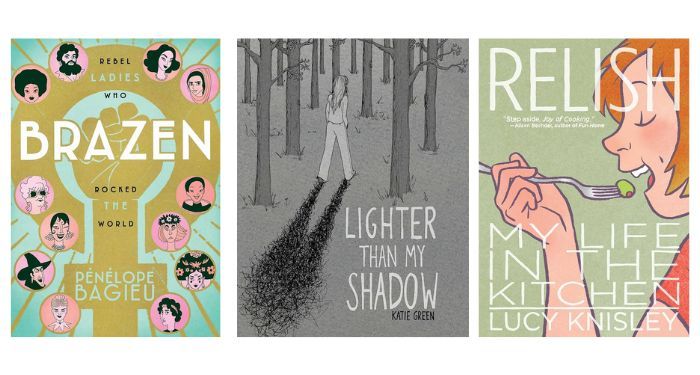
Tilley shared her data with me, and a few other things popped out that are worth noting:
- When the Department of Defense Education Activity issued its orders to ban books from military schools worldwide, comics were among the top targets on their list of 596 titles. There were 56 comics banned by the Department, which equates to approximately 10% of the total number of book bans.
- Wilson County Schools in Tennessee were responsible for the single most significant number of comic book bans in the nation, at 89 unique title bans.
- Other schools responsible for a noteworthy number of comics bans include North East Independent School District in Texas (69 bans); Hillsborough County Schools in Florida (57 bans), thanks in part to state pressure to remove titles; Oak Ridge Schools in Tennessee (53 bans); Union County Schools in Florida (38 bans), again thanks in part to state pressure; Katy Independent School District in Texas (35 bans); Knox County Schools in Tennessee (32 bans); Pennridge School District in Pennsylvania (31 bans); Lamar Consolidated Independent School District in Texas (27 bans); and Nacogdoches Independent School District (21 bans).
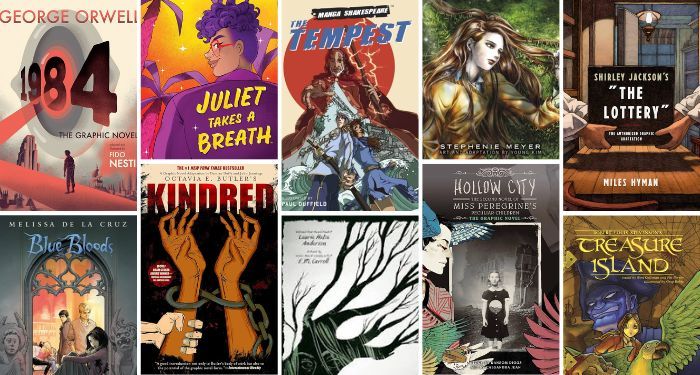
- Comic adaptations of narrative works continue to appear on the list, sometimes without their source materials accompanying them. Often, both are banned, but the comics tend to be banned at a higher and faster rate. There were 26 unique comic adaptations prohibited in the 2024-2025 school year; these are not retellings or remixes of original stories–those were banned, too–but instead, these are the titles as published, but in the comic format:
- 1984: The Graphic Novel by George Orwell, adapted by Fido Nesti
- The Absolutely True Diary of a Part-Time Indian by Sherman Alexie, adapted by Ellen Forney
- Anne Frank’s Diary: The Graphic Adaptation by Anne Frank, adapted by Ari Folman and David Polonsky
- Beowulf–two different adaptations have been banned, one adapted by Gareth Hinds and one by Santiago Garcia, David Rubin, Sam Stone, and Joe Keatinge
- Blue Bloods: The Graphic Novel by Melissa de la Cruz, adapted by Robert Venditti and Alina Urusov
- Brave New World by Aldous Huxley, adapted by Fred Fordham
- The Game of Thrones Graphic Novels by George RR Martin, adapted by Daniel Abraham and Tommy Patterson
- The Handmaid’s Tale by Margaret Atwood, adapted by Renee Nault
- Hollow City: The Graphic Novel by Ransom Riggs, adapted by Cassandra Jean
- The Iliad by Homer, adapted by Gareth Hinds
- The Invisible Man by H.G. Wells, adapted by Christophe Regnault
- Juliet Takes a Breath: The Graphic Novel by Gabby Rivera, adapted by Celia Moscote
- Kindred: A Graphic Novel Adaptation by Octavia Butler, adapted by Damian Duffy and John Jennings
- The Kite Runner Graphic Novel by Khaled Hosseini, adapted by Fabio Celoni and Mirka Andolfo
- Manga Shakespeare: The Tempest adapted by Paul Duffield
- Miss Peregrine’s Home for Peculiar Children: The Graphic Novel by Ransom Riggs, adapted by Cassandra Jean
- The Lottery by Shirley Jackson, adapted by Miles Hyman
- The Odyssey by Homer, adapted by Gareth Hinds
- Slaughterhouse-Five by Kurt Vonnegut, adapted by Ryan North and Albert Monteys
- Speak by Laurie Halse Anderson, adapted by E.M. Carroll
- Stamped From the Beginning: A Graphic History of Racist Ideas in America by Ibram X. Kendi, adapted by Joel Christian Gill
- The Time Machine by H.G. Wells, adapted by Mathieu Moreau
- Treasure Island by Robert Louis Stevenson, adapted by Wim Coleman, Pat Perrin, and Greg Rebis
- Twilight: The Graphic Novel by Stephenie Meyer, adapted by Yŏng-bin Kim
- Vampire Academy: A Graphic Novel by Richelle Mead, adapted by Leigh Dragoon and Emma Vieceli
- It’s no surprise that LGBTQ+ focused comics–especially works of nonfiction–were frequent ban targets. Some of the titles on the list include:
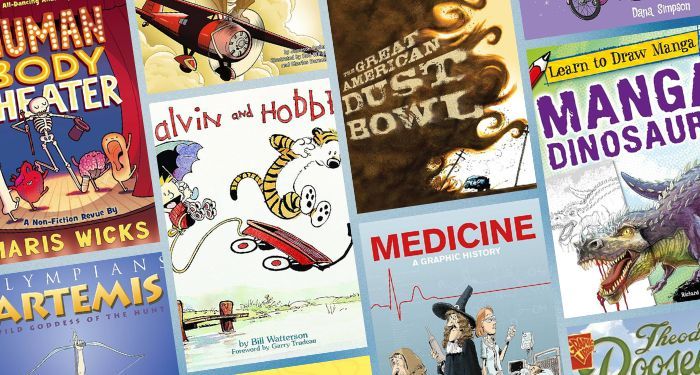
- Given that book censorship is done with little actual attention to the work at hand–and that goes both for those banning the books and the school districts attempting to follow whatever the latest update is from state or local policy–a lot of truly random stuff has been banned. Indeed, we can guess the reasons for the bans on these titles because five years into this censorship wave, there’s nothing new under the sun (the answers are almost always “DEI” or “gender” or “sexuality” or “social emotional learning”). But here’s a look at some of the strangest titles removed from schools in the 2024-2025 year:
We’ll see the American Library Association’s Most Banned Books list in the spring of 2026, and it’s not a stretch to believe that at least one comic will appear among the top ten. The same will be seen with PEN’s list next fall. We know these numbers are imperfect and only capture so much of what’s happening on the ground–and that the numbers here only reflect public school bans where information has been publicly shared and/or confirmed.
Comics are thriving as a format, and they are continuing to grow in numbers, as well as in accolades. That puts them in the target of those eager to revoke the rights of their fellow Americans–and especially young people–to read what they want to read and to hinder access to a wide array of materials in public and public school libraries.
Book Censorship News: December 26, 2025
- 20 states have filed an Amicus Brief in an appeal to the Eleventh Circuit in the Penguin Random House vs. Florida State Board of Education. This is the case from the U.S. Middle District Court of Florida, where the judge said none of the books that the state of Florida wants banned from public schools are obscene, in a major win for the right to read. The state is appealing, and this Brief is chilling–20 states want to curtail your right to books in libraries, and they’re hinging much of their argument on Little vs. Llano County. Further, the state’s initial brief can be read here, and it is a mess of mis- and dis- information. The state didn’t attempt to disprove Judge Mendoza’s declaration that none of the 23 titles named were obscene. Instead, they used examples from books that were not a subject of the lower court’s review. The state also misquote their own law on page 22 of the brief, claiming that HB 1069 prohibits “sexually depictive content,” which it does not. Here’s more on this story and what you can do, wherever you may live.
- PEN America published a brief on the bills across the country that are igniting book bans.
- South Carolina State Senator Carlisle Kennedy is proposing a bill for the new legislative year that would pull funding from any institution hosting drag shows or drag story times. We’ll see how this goes, given that a federal court overturned drag bans as unconstitutional earlier this year.
- Bloomberg’s headline about MAGA bringing back book bans right now is obnoxious, since this is a five year long endeavor at this point, but the story is worth reading.
- A prison in Arkansas just banned all outside books, magazines, and newspapers from those experiencing incarceration. Remember, prison censorship is the largest First Amendment violation in America.
- Sioux Center, Iowa, public library will now create a youth restricted library card, following the absolutely nonsensical complaints made by parents whose child borrowed an adult book from the adult collection and demanded it be removed (it was not). Adding another layer to this? Now potential funding increases for the library, along with several others, are in question.
- Hamilton County Schools (TN) banned use of The Kite Runner in classrooms. It wasn’t a formally assigned book. It was on a supplemental list.
- Here’s the latest update and information on the anti-book ban bill making its way through Massachusetts.
- One day after two conservatives were voted onto the Mesa County Library Board (CO), a white woman vandalized a pile of books related to transgender people.
- Fairhope Public Library (AL), which lost its state funding due to not removing LGBTQ+ books upon demand, has garnered almost $100,000 in private donations.
- In Boerne Independent School District (TX), a kindergarten holiday book swap was canceled because of the state’s laws on book bans. No, really.