




For me, 2025 was the Year of FECK, my acronym for Forgiveness, Empathy, Compassion and Kindness. These principles have proven more vital than ever amid such divisiveness, anger, and cruelty in our society. Even Santa gave a nod to the FECK principles with the Christmas ornament he added to my tree!
I truly believe, as Roger did, that art can be a healing and enlightening force by enabling us to experience the world through the perspectives of people different from ourselves. Thirty of my favorite films of the year are listed below in alphabetical order. Most are, in one way or another, empathy-generating machines that demonstrate what cinema can achieve at its highest level. Others are pure entertainment. And then one is just so much fun to watch that it is simply my Guilty Pleasure.
While at the Cannes Film Festival, I selected one film as a recipient for my Inaugural FECK FILM AWARD because it stood out in its ability to exhibit all four of my FECK Principles: That film is “It Was Just an Accident” by Iranian director Jafar Panahi. I watched in astonishment as Panahi’s film breathlessly took us through aspects of forgiveness, empathy, compassion, and kindness in unexpected ways. Back home, I saw another film to which I will grant a FECK Film AWARD. That film is “The Man Who Saves the World?” by American director Gabe Polsky. The journey in that film reminded me of our relationship with Mother Earth as seen through the eyes of Indigenous peoples in South America, and of how we are all connected.
Now, here in alphabetical order are my Top Thirty Films of 2025:
“Arco“—My favorite animated film of the year is French writer/director Uno Bienvenu’s visually stunning gem about a ten-year-old who uses a rainbow to time-travel back through the centuries. Upon arriving in the year 2075, he befriends a young girl, Iris, voiced in the English dub by the film’s producer, Natalie Portman. This is a film to seek out on the biggest screen possible.
“Avatar: Fire & Ash“—Aside from perhaps James Cameron’s groundbreaking first “Avatar” film, which was a complete surprise in its cutting-edge visual splendor, this is my favorite installment in the series to date. As our larger-than-life heroes, the Na’vi, find themselves pitted against a rival group. Cameron has once again crafted a timely and life-affirming parable for these increasingly difficult times. Some people assumed that the people in the Avatar films were AI creations. But before the press screening, Cameron hosted an introductory video detailing his intricate process for creating the Na’vi through motion capture, which I found utterly brilliant. Each character in the movie is played by a real-life actor. Though the film ran over three hours, I was never restless. By utilizing the best possible 3D, Cameron illustrates just how close cinema can come to immersing us in a parallel reality, one we may want to escape to whenever our own has become difficult to bear.
“The Ballad of Wallis Island“—One of 2025’s most endearing sleepers was this British comedy from director James Griffiths about a duo of folk singers, played by co-writer Tom Basden and Oscar-nominee Carey Mulligan, who travel to a Welsh island for a gig. Basden’s writing partner, Tim Key, plays the rich fan who encourages the duo to reunite for this performance. What follows is a film filled with big laughs and a startling amount of heart.
“Blue Moon“—The first of Richard Linklater’s two exceptional films this year stars Ethan Hawke in one of his best performances as Lorenz Hart, the songwriter who—with his partner Richard Rodgers—crafted some of the most iconic songs of his era. But when Rodgers scores a massive hit with his new writing partner, Oscar Hammerstein, Hart begins to feel his relevance coming to a close. Watching the film is akin to spending an evening with a witty, catty, supremely intelligent pal whose exuberance is tinged with melancholy.
“Bugonia“—Based on Jang Joon-hwan’s 2003 film, “Save the Green Planet!”, Yorgos Lanthimos’ latest collaboration with actress Emma Stone is a galvanizing apocalyptic satire. She plays a chilly pharmaceutical CEO abducted by an irate employee (played frighteningly by Jesse Plemons) who is convinced that she is an alien hellbent on conquering humanity. From one scene to the next, the film keeps us guessing about the true nature of its characters, eliciting laughs that occasionally get caught in the viewer’s throat.
“Die My Love“—I admire filmmaker Lynne Ramsay for never attempting to make her movies palatable for the masses. She remains true to the soul of her characters, even when their actions prove difficult to watch. As a wife and mother struggling to appear functional despite her mental illness, Jennifer Lawrence delivers a raw, fearless performance that earns our empathy despite her character’s occasionally repellent behavior. In a year filled with fierce work from veteran actresses, Lawrence is among the closest to the spirit of their late colleague, who set the bar, Gena Rowlands, in “A Woman Under the Influence.”
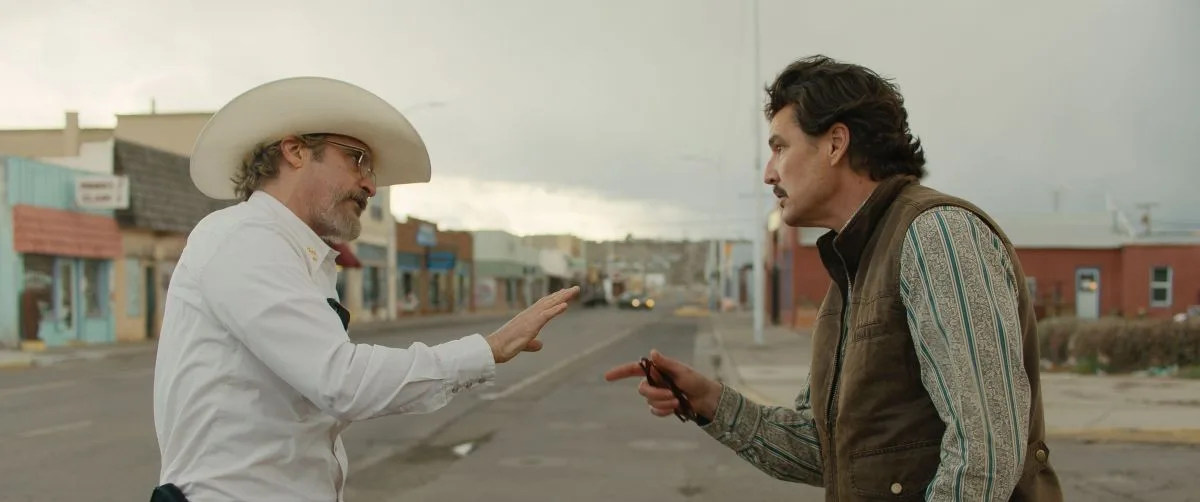
“Eddington“—This past summer, I had the pleasure of moderating a Q&A with director Ari Aster at the sold-out Chicago premiere of his polarizing new film. I began our onstage conversation by asking, “Who are you?”, and it wasn’t simply intended as a laugh line. To watch Aster’s work is to marvel at the imagination of a man who clearly sees the surrounding world but filters it through a lens unlike any other we’ve seen. In this seriocomic, startlingly violent parable on the divisiveness tearing our country apart at the seams, Joaquin Phoenix stars as a sheriff eager to run for mayor of his small town in New Mexico. His disbelief that COVID-19 will have any impact on his community is only one step he makes toward his Shakespearean undoing. The film is like a slow-motion car crash, and you cannot tear your eyes away from it.
“Frankenstein“—On the heels of Lanthimos and Stone offering their own feminist spin on Mary Shelley’s legendary horror novel with “Poor Things,” it makes sense that the modern master of creature features, Guillermo del Toro, would be eager to helm his own adaptation. Oscar Isaac plays the monstrous doctor whose creation, played beautifully by an unrecognizable Jacob Elordi, has a capacity for love that makes him instantly sympathetic. The Father-Son rivalry is also at play, and Guillermo del Toro, in interviews, acknowledges that theme. Mia Goth is cleverly featured here in a dual role, inhabiting the third corner of the film’s love triangle.
“Hamnet“— Chloé Zhao is back in top, tear-jerking form with this captivating adaptation of Maggie O’Farrell’s novel. Using fragments of history as their inspiration, Zhao and O’Farrell explore how the personal loss endured by William Shakespeare (played winningly by Paul Mescal) and his wife Agnes (Jessie Buckley, sure to be a Best Actress Oscar nominee) led the Bard to find catharsis in writing his immortal play, Hamlet. In an ingenious bit of casting, Noah Jupe plays the actor cast in a role inspired by Shakespeare’s son, who is portrayed in the film by Noah’s real-life brother, Jacobi.
“Highest 2 Lowest“—As a longtime professor at NYU, Spike Lee has been illuminating film history for the next generations of directors. One of his favorite filmmakers is Akira Kurosawa, whose 1963 masterpiece, “High and Low,” uses a suspenseful kidnapping plot to explore class divisions. Now Lee has remade the picture as only he could, re-teaming with his celebrated collaborator, Denzel Washington, who plays a wealthy mogul faced with an intimidating moral dilemma. The film is as much a celebration of Lee’s beloved New York City and Black culture as it is a gripping thriller, culminating with a wholly unexpected and soul-cleansing musical sequence.
“A House of Dynamite“—Possibly the most disquieting film of the year is Kathryn Bigelow’s film chronicling what would happen if a nuclear weapon were launched at an American city, which just so happens to be the one in which I live. Bigelow follows the events from three perspectives while stopping short of providing any closure, leaving us to contemplate and debate the moral quandaries at the heart of its narrative.
“If I Had Legs I’d Kick You“—Just as David Lynch externalized the anxieties of fatherhood with his nightmarish imagery in “Eraserhead,” filmmaker Mary Bronstein delivers a similarly bold vision with this portrait of a mother on the verge of a nervous breakdown. For much of the movie, the camera is uncomfortably close to Linda’s face (a sensational Rose Byrne) as she attempts to navigate an endless series of obstacles while caring for her ailing, perpetually offscreen daughter.
“Is This Thing On?“—After being front and center in his first two acclaimed directorial efforts, Bradley Cooper takes a backseat to leading man Will Arnett, who delivers the best work of his career as Alex, a stand-up comedian inspired by real-life British comic John Bishop. With his marriage to Tess (played empathetically by Laura Dern) at an end, Alex seeks solace in the limelight by embracing comedy as a form of therapy.
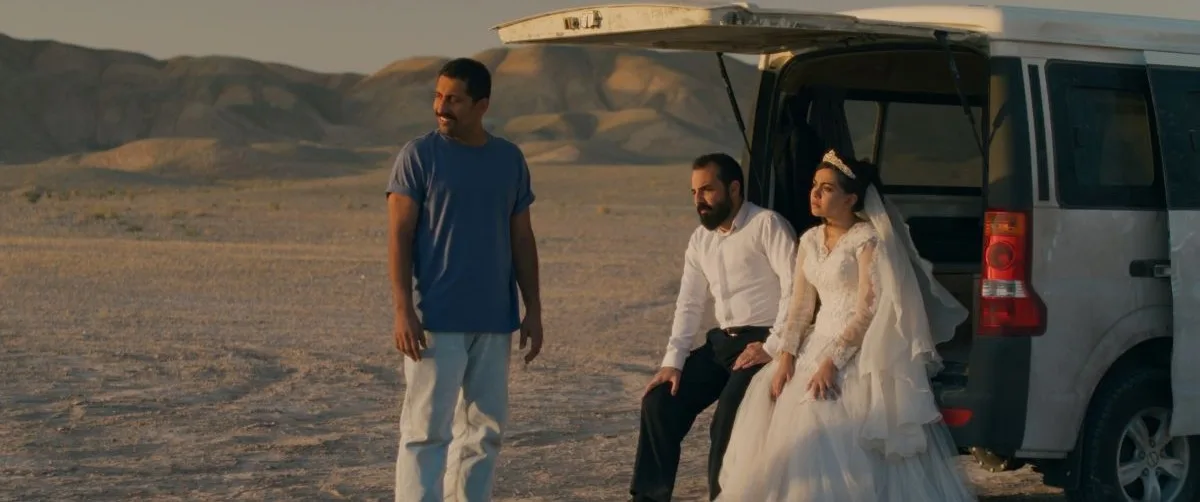
“It Was Just an Accident“—This year’s Palme d’Or winner is yet another courageous act of defiance from Iranian auteur Jafar Panahi. Despite being arrested multiple times, Panahi managed to make this cinematic rebuke against his country’s authoritarian regime without his government’s permission. When a man severely damaged from his years as a political prisoner spots the person he believes caused him such pain, a revenge plot is hatched. Yet rather than rely on easy payoffs, Panahi has the characters—and the audience—wrestle with their high-stakes moral choices. This film expertly displays all four FECK Principles (Forgiveness, Empathy, Compassion, and Kindness). Yet, it leaves you on the edge of your seat.
“Jay Kelly“—One question some have asked while watching Noah Baumbach’s new star-studded dramedy is just how close its titular character is to George Clooney, the man playing him. Like Clooney, Jay Kelly is an internationally celebrated actor who knows how to turn on the charm for the cameras. When a festival compiles footage from Jay’s career, their tribute montage consists of clips from Clooney’s own films. That makes the film’s exploration of the character’s troubled inner life, his broken family, and his relationship with his longtime manager (played by Adam Sandler) all the more intriguing. Adam Sandler gives a heart-tugging performance as the manager who sometimes has to put his client’s needs ahead of his own family’s.
“A Little Prayer“—Angus MacLachlan, who penned the script for one of Roger’s favorite films, 2005’s “Junebug,” wrote and directed this equally endearing gem about the strength of familial bonds during turbulent times. One of our finest character actors, David Strathairn, delivers a career-crowning performance as Bill, a devoted husband and father who attempts to offer his daughter-in-law, Tammy (Jane Levy), emotional support after learning that his son, David (Will Pullen), is having an affair. Our Managing Editor Brian Tallerico has been a tireless champion of this film since its Sundance premiere two years ago, and it deserves not to be forgotten during the current awards season. I love this film, and I had to give it another viewing to realize that the compassionate relationship between Straitharn as the father-in-law and the clear-eyed advice he provides his daughter-in-law is what caused the catch in my throat.
“The Man Who Saves the World?“—Former Ebertfest guest Gabe Polsky has crafted one of the year’s most compelling documentaries, following the life of a human subject who would have undoubtedly fascinated the director’s previous collaborator, Werner Herzog. The film centers on Patrick McCullom, a peace activist who believes he’s discovered an ancient prophecy that will enable him to save the Amazon by bringing together opposing Indigenous tribes in South America. Among the fascinating figures who appear in the film is the late primatologist Jane Goodall, whose ability to connect with other species will forever stand as a source of global inspiration.
“No Other Choice“—Korean director Park Chan-wook once again affirms himself as one of modern cinema’s most playful stylists with his Hitchcockian spin on Donald Westlake’s book, The Ax. After being unfairly ejected from his job in the paper industry, family man Yoo Man-su (played by Lee Byung-hun) decides he has to eliminate his competition by any means necessary to win his job back. His gradual loss of humanity is eerily reflected by his industry’s prioritization of AI over flesh-and-blood employees.
“Nouvelle Vague“—There are some films that are impossible for me to watch without wondering what Roger would have thought of them. I have a feeling he would have been utterly delighted by Richard Linklater’s meticulous recreation of the radically unconventional production days for Jean-Luc Godard’s profoundly influential 1959 masterpiece, “Breathless,” the picture often credited with birthing the French New Wave. Each legendary figure of the movement is so impeccably cast that there are times the film feels akin to time travel.
“One Battle After Another“—How could Paul Thomas Anderson have known how timely his long-in-the-works adaptation of Thomas Pynchon’s novel would be upon its release? In her film debut, Chase Infiniti, a graduate of Columbia College Chicago, stars as Willa, the daughter of an ex-revolutionary (played by Leonardo DiCaprio), who finds herself in the crosshairs of the same authoritarian thugs hunted by her parents. Reflecting on how today’s younger generations are fighting the same battles their parents did, Willa emerges as a beacon of hope through her bravery and ingenuity.
“Rental Family“—Hikari’s big-hearted crowd-pleaser is undoubtedly not a picture for cynics. Brendan Fraser stars as a struggling actor in Tokyo who finds employment in the city’s “rental family” business, where he is tasked with inhabiting roles in the everyday lives of clients. When he finds himself starting to care too deeply for the girl (newcomer Shannon Gorman) he’s pretending to father, the line between reality and artifice becomes hopelessly blurred. What starts as a seemingly broad comedy eventually reveals an emotional depth and resounding humanism that I found impossible to resist.
“The Secret Agent“—Another enormously timely highlight from 2025 is Kleber Mendonça Filho’s thriller about a man’s numerous attempts to outwit Brazil’s military dictatorship during its final years. Filho won the Best Director prize at Cannes, while its star, Wagner Moura, was named Best Actor. It must also be noted that the film now marks one of the late, dearly missed actor Udo Kier’s final screen appearances. (Besides his role as an actor, I have fond memories of him generously playing the piano and singing at my house in celebration of our Libra birthdays one October.)
“Sentimental Value“—Joachim Trier was a director whose career Roger was eager to follow. Wish he could have seen this riveting portrait of estranged family members brought back together, as in “Hamnet,” through art’s therapeutic power. A few years after suffering a stroke, Stellan Skarsgård delivers what may be the performance of his career as a director eager to work with his daughter (Renate Reinsve), a celebrated actress, on a personal project that hits extremely close to home.
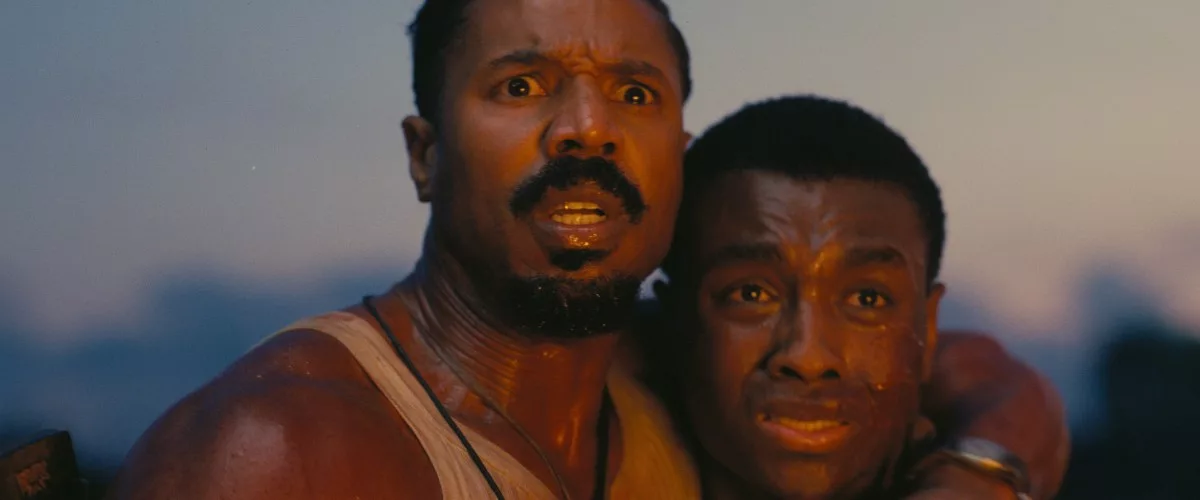
“Sinners“—Bravo to Ryan Coogler for creating this very original and ambitious genre-bending blockbuster that fuses horror tropes with a provocative meditation on race and blues music. No movie creates such a backdrop of a time and place that not only makes you want to drop in to one of the juke joints but also astonishes you with the parade of incongruous musicians when they pop up on the screen. I can’t describe it further without giving it away, but it is my favorite scene of any movie this year. Michael B. Jordan seamlessly portrays twin brothers who find themselves battling creatures whose unholy lifestyle proves to be seductive amidst the inhumanity of the Jim Crow South. Be sure to stick around until the very end of the credits for a scene with a Chicago Blues legend. It adds a further layer of depth to the picture.
“Song Sung Blue“—As he did with his 2019 gem, “Dolemite is My Name,” director Craig Brewer portrays another fact-based story about endearingly unconventional artists. Hugh Jackman and Kate Hudson portray singers from Wisconsin who mostly perform cover songs of famous singers. They join forces to tour as a Neil Diamond “Experience” (not imitator, as they stress). A quarter-century after her breakthrough role in “Almost Famous,” Kate Hudson plays “Thunder,” to Hugh Jackman’s “Lightning.” Brewer’s picture chronicles the highs and lows of their career and relationship, while providing numerous memorable musical numbers along the way.
“Sorry, Baby“—In addition to being one of the most acclaimed filmmakers working today, Barry Jenkins has been helping launch the careers of promising young directors through his production company, Pastel. This year, Jenkins produced the directorial feature debut of Eva Victor, who also stars in the picture as Agnes, a college student blindsided after a traumatic encounter with her professor. Victor mines a surprising amount of humor in Agnes’ predicament, as she attempts to heal while life moves on around her. In a sublime single scene, John Carroll Lynch plays a stranger who quickly empathizes with Agnes and intuits precisely how to remedy her suffering. Sometimes all we need is a compassionate ear—and a good sandwich—to anchor us back to Earth.
“The Testament of Ann Lee“—After co-writing last year’s Oscar-winner, “The Brutalist,” directed by her partner Brady Corbet, Mona Fastvold has helmed an epic musical unlike any I have ever seen. Amanda Seyfried fully transforms herself as the religious Shaker Movement leader, Ann Lee, whose belief in gender equality put her well ahead of her time. The score, composed by Academy Award-winning musician and composer Daniel Blumberg, is magically, organically woven into the film. The choreography by Celia Rowlson-Hall is an exhilarating spectacle of Shaker-inspired movements that propels the congregants into spiritual ecstasy—a must-see.
“Train Dreams“—After co-writing last year’s great prison drama, “Sing Sing,” Clint Bentley switches to the director’s chair for this equally life-affirming triumph. Based on Denis Johnson’s book of the same name, the film stars Joel Edgerton as Robert, a logger in Idaho whose work continuously takes him away from his devoted wife (Felicity Jones) and young daughter. Rather than follow a standard narrative formula, the film chronicles the ebb and flow of Robert’s life, with all of its unforeseeable twists and turns, culminating in a blissful moment of clarity and acceptance that is sublime to witness.
“Weapons“—Perhaps no film in 2025 had as striking a cultural impact—especially around Halloween—as Zach Cregger’s suspenseful, creepy, and explosively funny entertainment. Part of its appeal lay in the ambiguity of its marketing. All that the teaser and poster revealed was its narrative hook: the sudden disappearance of 17 children who all left their homes at the same time in the middle of the night. To say more would be spoiling the fun, though you’re more than likely to have already seen images of the cast’s surprise MVP, Amy Madigan, whose character of Aunt Gladys will likely be haunting costume parties for years to come.
“Young Mothers“—Two of cinema’s great humanists, the filmmaking duo of Belgian brothers Jean-Pierre and Luc Dardenne, have scored another winner with this drama centering on five impoverished mothers at a maternity shelter. They are all teens, yet their spirits are far from bleak. Winner of the Best Screenplay prize at Cannes, the film is another ode from the Dardennes to those hard-working, resilient souls often left out of mainstream blockbusters. There is no question in my mind that these brothers give a FECK.
And my one guilty pleasure…
“The Housemaid“—Paul Feig’s cheerfully macabre adaptation of Freida McFadden’s bestselling novel stars Sydney Sweeney as Millie, a troubled woman in need of employment, who finds it by nabbing a job as “housemaid” to a seemingly perfect wealthy family. The rich family employing her is headed by handsome husband, Andrew Winchester (Brandon Sklenar), and wife Nina (in a surprise performance by Amanda Seyfried that is light years away from her role in “The Testament of Ann Lee”). Nina’s happy exterior harbors untold demons. The film is photographed beautifully in full frame or large frame by John Schwartzman. To say more would be criminal, as the film’s numerous twists and turns are part of the fun. Just go with it.