




The second season of Jonathan Nolan & Lisa Gay’s “Westworld” often felt like it lacked focus as the writers figured out where to take their striking concept next. The second season of the similar “Fallout” (right down to the repeated Ramin Djawadi refrains) never lacks in confidence, but it does suffer from a similar diffusion of concept as characters are separated and sent on arcs that feel like they will never intersect.
On the one hand, it’s nice to see something this undeniably ambitious, a season that trusts its viewers to stay engaged across as many subplots as a season of “Game of Thrones.” But there’s a momentum that’s lost in the first half of this season, especially in how often the writing jumps back into the pre-fallout past to fill in details about how everyone got to this horrible future. While it’s arguable that we should give “Fallout” a pass for being a show that demands attention more than most streaming originals, this season lacks urgency, circling ideas and character development but taking too long to commit to any of it. Now a quarter of the season wasn’t screened for critics, and the show has already been renewed for a third season, so we’ve only seen part of the story. Maybe the lesson here is that the team behind this show is smart enough to get “Fallout” where it needs to be, and maybe we’ll all look back on this transitional season as the memorable journey, not the destination.
The end of the first season gave game fans a bit of a jolt by showing them the dilapidated skyline of New Vegas, a key location from the franchise. But don’t expect the new season to spend a whole lot of time there, at least not in present day. If there’s a center to the season narratively, it’s Lucy (Ella Purnell) and Cooper Howard (Walton Goggins) heading to Vegas to find lost family members. For Lucy, it’s her father Hank (Kyle MacLachlan), who betrayed the residents of their vault, and she learned has been behind much more than just that decision. For Cooper, it’s his wife, Barb (Frances Turner), who he’s convinced can still be alive in one of the vaults she helped design, along with their daughter. The Lucy/Cooper dynamic this season echoes tons of Western-influenced pop culture, the oil-and-water structure of a mercenary anti-hero, and the naïve traveling companion who happens to share a similar destination.
While they wander the desert and try to avoid creatures and warriors, including the appearance of Caesar’s Legion, a faction from the game “Fallout: New Vegas” and a way to get Macaulay Culkin a cool role, the show also tracks Norm (Moises Arias), who finds himself stranded in Vault 31, and becomes a new kind of leader as he learns about the true history and intent of the vaults. Arias is excellent, able to play observant and intellectual in ways that are often underrated. Norm is taking things one beat at a time, unsure of where he’s going next but certain that he’s tired of where he’s been.
It’s safe to say that Maximus (Aaron Moten) doesn’t have the same confidence as he finds himself a major player in what could be the start of a civil war. The arc of Maximus and the Brotherhood of Steel allows for a fantastic guest turn from Kumail Nanjiani, but feels like the most underdeveloped of the season, at least through the six episodes sent to press.
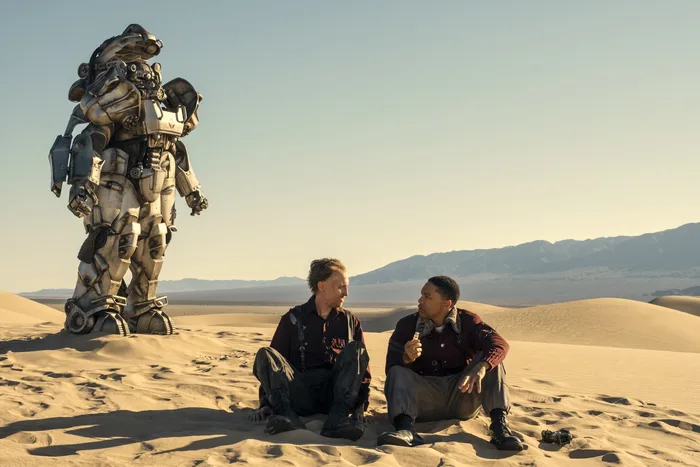
Nanjiani and Culkin are fun, but the best new face of the season is that of Justin Theroux, perfectly cast as the villainous Mr. House, a key to Cooper’s history and the end of the world as we know it. Played as both an old-fashioned genre villain and a riff on today’s monstrous billionaires, House is a sociopath, someone who sees human lives as mere lines on his financial returns. Theroux is perfect, but the way his story intersects with Cooper’s past pushes the new season too often into flashback. As great as Goggins and Theroux are in these long stretches of the show, especially the sixth episode, it feels like it makes for a show that lacks direction. “Fallout” would be wiser to do flashback episodes—full chapters set in the pre-fallout era or just tracking Maximus, for example, then to constantly be jumping around in a way that sometimes feels arbitrary. It’s never great for a show to jump away from a storyline just as it’s getting interesting to one that’s not as engaging.
Although there’s nothing about the new season of “Fallout” that’s a total misfire. If it lacks direction, that displacement sometimes feels like a product of the story that’s being told. This is a show about people trying to figure out how they got here in order to begin to figure out where to go next. Could it have more momentum? Sure, but fans will likely be more patient than they were with “Westworld,” especially given the wealth of video game easter eggs and potential lore left to explore from the source material. If the second season of “Fallout” feels like a show that’s lost in the desert outside New Vegas, there’s reason to believe the patience will pay off with a jackpot.
Six episodes screened for review. Starts tonight, December 16, on Prime Video.