




 BBC
BBCThis article contains distressing details and references to suicide. Some of the names have been changed to protect identities.
Kateryna cannot talk about her son, Orest, without tears. Her voice trembles with anger as she explains how she found out the news that he had died on the front line in the eastern Donetsk region of Ukraine in 2023.
According to the official investigation by the army, he died by a “self-inflicted wound”, something Katernya finds hard to believe.
Kateryna has asked for her and her late son to remain anonymous due to the stigma that surrounds suicide and mental health in Ukraine.
Orest was a quiet 25-year-old who loved books and dreamed of an academic career. His poor eyesight had made him initially unfit for service at the start of the war, his mother says.
But in 2023, a recruitment patrol stopped him in the street. His eyesight was re-evaluated and he was deemed fit to fight. Not long after, he was sent to the front as a communications specialist.


 EPA
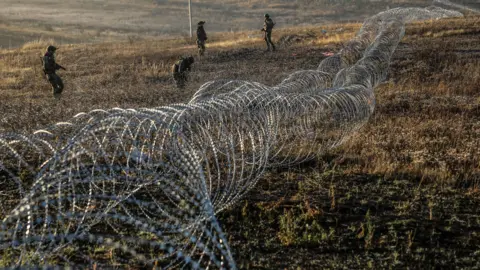
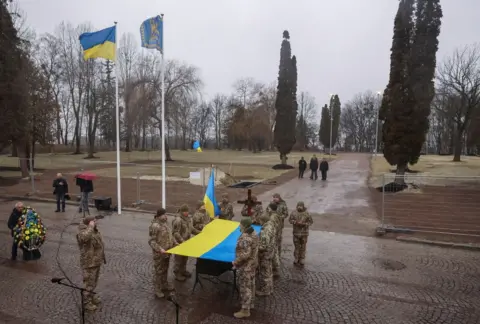
EPAWhile Ukraine collectively mourns the loss of more than 45,000 soldiers who have died since Russia’s full-scale invasion in 2022, a quieter tragedy unfolds in the shadows.
There are no official statistics surrounding suicide among soldiers. Officials describe them as isolated incidents. Yet human rights advocates and bereaved families believe they may be in the hundreds.
“Orest was caught, not summoned,” Kateryna says bitterly.
The local recruitment centre denied wrongdoing to the BBC, saying impaired vision made Orest “partially fit” during wartime.
Once deployed near Chasiv Yar in Donetsk, Orest became increasingly withdrawn and depressed, Kateryna recalls.
She still writes letters to her son every day – 650 and counting – her grief made worse by how Ukraine classifies suicide as a non-combat loss. Families of those who take their own lives receive no compensation, no military honours and no public recognition.
“In Ukraine, it’s as if we’ve been divided,” says Kateryna. “Some died the right way, and others died the wrong way.”
“The state took my son, sent him to war, and brought me back a body in a bag. That’s it. No help, no truth, nothing.”
 Reuters
For Mariyana from Kyiv, the story is heartbreakingly similar. She too wishes to keep her identity and her late husband’s hidden.
Her husband Anatoliy volunteered to fight in 2022. He was initially refused because of his lack of military experience but he “kept coming back until they took him”, she says with a faint smile.
Anatoliy was deployed as a machine-gunner near Bakhmut, one of the bloodiest battles of the war.
“He said that, after one mission, about 50 guys were killed,” Maryana recalls. “He came back different; quiet; distant.”
After losing part of his arm, Anatoliy was sent to hospital. One evening, after a phone call with his wife, he took his own life in the hospital yard.
“The war broke him,” she says through tears. “He couldn’t live with what he’d seen.”
Because Anatoliy died by suicide, officials denied him a military burial.
“When he stood on the front line, he was useful. But now he’s not a hero?”
Mariyana feels betrayed: “The state threw me to the roadside. I gave them my husband, and they left me alone with nothing.”
She has also felt stigma from other widows.
Her only source of support is an online community of women like her – widows of soldiers who took their own lives.
They want the government to change the law, so that their bereaved families have the same rights and recognition.
Viktoria, who we met in Lviv, still cannot talk about her husband’s death publicly for fear of condemnation.
Her husband Andriy had a congenital heart condition, but insisted on joining the army. He became a driver in a reconnaissance unit and witnessed some of the most intense battles, including the liberation of Kherson.
In June 2023, Viktoria received a phone call telling her Andriy had taken his own life.
“It was like the world had collapsed,” she says.
His body arrived 10 days later, but she was told she could not see it.
An attorney she later hired found inconsistencies in the investigation into his death. The photos from the scene made her doubt the official version of her husband’s death. The Ukrainian military has since agreed to reopen the investigation, recognising failures.
Now she is fighting to re-open the case: “I’m fighting for his name. He can’t defend himself anymore. My war isn’t over.”
Oksana Borkun runs a support community for military widows.
Her organisation now includes about 200 families bereaved by suicide.
“If it’s suicide, then he’s not a hero – that’s what people think,” she says. “Some churches refuse to hold funerals. Some towns won’t put up their photos on memorial walls.”
Many of these families doubt the official explanations of death. “Some cases are simply written off too quickly,” she adds. “And some mothers open the coffin and find bodies covered in bruises.”
Military chaplain Father Borys Kutovyi says he has seen at least three suicides in his command since the full-scale invasion began. But to him even one is too many.
“Every suicide means we failed somewhere.”
He believes that many recruited soldiers, unlike career servicemen, are especially psychologically vulnerable.
Both Osksana and Father Borys say those who died by suicide should be considered heroes.
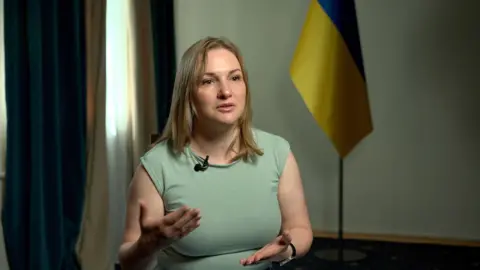
Olha Reshetylova, Ukraine’s Commissioner for Veterans’ Rights, says she receives reports of up to four military suicides each month and admits not enough is being done: “They’ve seen hell. Even the strongest minds can break.”
She says her office is pushing for systemic reform but it can take years to set up a good military psychology unit.
“Families have a right to the truth,” she says. “They don’t trust investigators. In some cases, suicides may cover up murders.”
When it comes to honouring theses soldiers as military heroes, she prefers to look to the future.
“These people were your neighbours, your colleagues,” says Ms Reshetylova. “They’ve walked through hell. The warmer we welcome them, there will be fewer tragedies”