




The “ice giants” of the Solar System – Uranus and Neptune – remain the least explored of any planets orbiting our Sun. Thanks to the sheer distance between them and Earth, the first probe to ever study them was the Voyager 2 probe, which remains the only mission ever to conduct a flyby. What this probe revealed led to numerous mysteries about both worlds, their systems of moons, and other characteristics. For instance, when Voyager flew past Uranus, it recorded a very strong electron belt of a much higher energy level than expected.
Since then, scientists have studied thousands of gas giants beyond the Solar System and made comparisons that have bolstered the mystery of how the Uranian system could support so much trapped electron radiation. In a recent study, scientists at the Southwest Research Institute (SwRI) have hypothesized that the *Voyager 2* observations may have been the result of a solar wind structure. Similar to how Earth experiences processes driven by solar wind storms, they believe a “co-rotating interaction region” was passing through the system when Voyager 2 made its historic flyby.
The research was led by Dr. Robert C. Allen, a space physicist and the Lead Scientist of the SwRI’s Space Sciences Division. He was joined by SwRI Lead Scientist Sarah Vines, and Senior Program Manager George C. Ho. The paper describing their research, “Solving the mystery of the electron radiation belt at Uranus: Leveraging knowledge of Earth’s radiation belts in a re-examination of Voyager 2 observations,” recently appeared in *Geophysical Research Letters*.
Diagram of the space weather impacts of a fast solar wind structure (first panel) driving an intense solar storm at Earth in 2019 (second panel) with conditions observed at Uranus by Voyager 2 in 1986 (third panel). Credit: Allen, R. et al (2025)
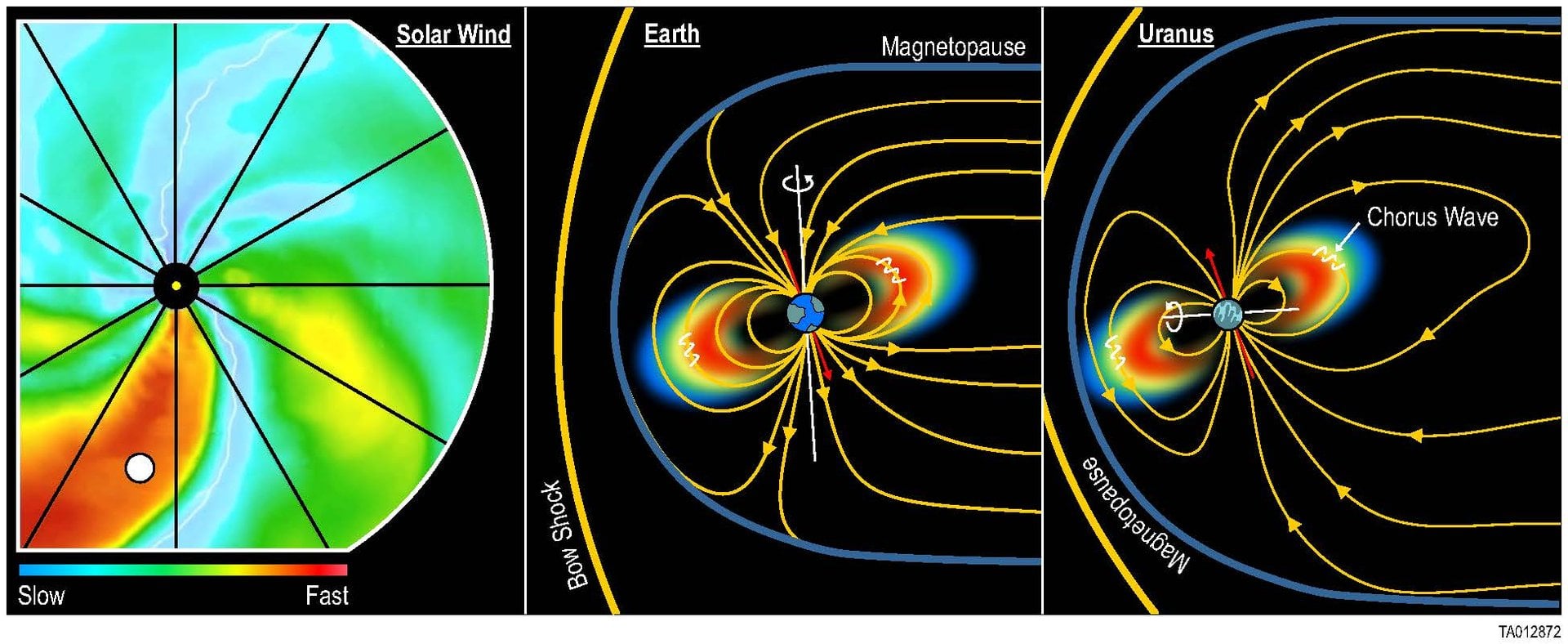
To date, the *Voyager 2* probe has provided the only direct measurements of the radiation environment at Uranus. This led to the predominantly accepted characterization of the system having a weaker ion radiation belt and a very intense electron radiation belt. However, when the team reanalyzed the probe’s data, they discovered hints that the probe’s observations did not occur during normal solar wind conditions. Instead, they suggest that the probe’s flyby coincided with a transient solar wind event passing through the system.
This event, they argue, produced the most powerful high-frequency waves observed during the Voyager 2 mission. At the time, scientists thought that these waves would scatter electrons that would be lost to Uranus’s atmosphere. However, scientists have since learned that, under certain circumstances, these waves can also accelerate electrons and add additional energy to planetary systems. To this end, the team compared the Voyager 2 observations to similar events observed at Earth and noted similarities.
“Science has come a long way since the Voyager 2 flyby. We decided to take a comparative approach, looking at the Voyager 2 data and compare it to Earth observations we’ve made in the decades since,” said Dr. Allen in an SwRI press release. “In 2019, Earth experienced one of these events, which caused an immense amount of radiation belt electron acceleration,” added Dr. Vines. “If a similar mechanism interacted with the Uranian system, it would explain why Voyager 2 saw all this unexpected additional energy.”
Their comparative approach suggests that interactions between solar wind and Uranus’ magnetosphere could have driven high-frequency waves capable of accelerating electrons to energies close to the speed of light. They also raise many additional questions about the fundamental physics behind these intense waves and the sequence of events that led to them. “This is just one more reason to send a mission targeting Uranus. The findings have some important implications for similar systems, such as Neptune’s,” said Dr. Allen.
Further Reading: SwRI, Geophysical Research Letters