




The power surging through transmission lines over the iconic stone walls of England’s northern countryside is pushing the United Kingdom’s grid to its limits. To the north, Scottish wind farms have doubled their output over the past decade. In the south, where electricity demand is heaviest, electrification and new data centers promise to draw more power, but new generation is falling short. Construction on a new 3,280-megawatt nuclear power plant west of London lags years behind schedule.
The result is a lopsided flow of power that’s maxing out transmission corridors from the Highlands to London. That grid strain won’t ease any time soon. New lines linking Scotland to southern England are at least three to four years from operation, and at risk of further delays from fierce local opposition.
At the same time, U.K. Prime Minister Keir Starmer is bent on installing even more wind power and slashing fossil-fuel generation by 2030. His Labour government says low-carbon power is cheaper and more secure than natural gas, much of which comes from Norway via the world’s longest underwater gas pipeline and is vulnerable to disruption and sabotage.
The lack of transmission lines available to move power flowing south from Scottish wind farms has caused grid congestion in England. To better manage it, the U.K. has installed SmartValves at three substations in northern England—Penwortham, Harker, and Saltholme—and is constructing a fourth at South Shields. Chris Philpot
The U.K.’s resulting grid congestion prevents transmission operators from delivering some of their cleanest, cheapest generation to all of the consumers who want it. Congestion is a perennial problem whenever power consumption is on the rise. It pushes circuits to their thermal limits and creates grid stability or security constraints.
With congestion relief needed now, the U.K.’s grid operators are getting creative, rapidly tapping new cable designs and innovations in power electronics to squeeze more power through existing transmission corridors. These grid-enhancing technologies, or GETs, present a low-cost way to bridge the gap until new lines can be built.
“GETs allow us to operate the system harder before an investment arrives, and they save a s***load of money,” says Julian Leslie, chief engineer and director of strategic energy planning at the National Energy System Operator (NESO), the Warwick-based agency that directs U.K. energy markets and infrastructure.
 Transmission lines running across England’s countryside are maxed out, creating bottlenecks in the grid that prevent some carbon-free power from reaching customers. Vincent Lowe/Alamy
The U.K.’s extreme grid challenge has made it ground zero for some of the boldest GETs testing and deployment. Such innovation involves some risk, because an intervention anywhere on the U.K.’s tightly meshed power system can have system-wide impacts. (Grid operators elsewhere are choosing to start with GETs at their systems’ periphery—where there’s less impact if something goes wrong.)
The question is how far—and how fast—the U.K.’s grid operators can push GETs capabilities. The new technologies still have a limited track record, so operators are cautiously feeling their way toward heavier investment. Power system experts also have unanswered questions about these advanced grid capabilities. For example, will they create more complexity than grid operators can manage in real time? Might feedback between different devices destabilize the grid?
There is no consensus yet as to how to even screen for such risks, let alone protect against them, says Robin Preece, professor in future power systems at the University of Manchester, in England. “We’re at the start of establishing that now, but we’re building at the same time. So it’s kind of this race between the necessity to get this technology installed as quickly as possible, and our ability to fully understand what’s happening.”
How is the U.K. Managing Grid Congestion?
One of the most innovative and high-stakes tricks in the U.K.’s toolbox employs electronic power-flow controllers, devices that shift electricity from jammed circuits to those with spare capacity. These devices have been able to finesse enough additional wind power through grid bottlenecks to replace an entire gas-fired generator. Installed in northern England four years ago by Smart Wires, based in Durham, N.C., these SmartValves are expected to help even more as NESO installs more of them and masters their capabilities.
Warwick-based National Grid Electricity Transmission, the grid operator for England and Wales, is adding SmartValves and also replacing several thousand kilometers of overhead wire with advanced conductors that can carry more current. And it’s using a technique called dynamic line rating, whereby sensors and models work together to predict when weather conditions will allow lines to carry extra current.
Other kinds of GETs are also being used globally. Advanced conductors are the most widely deployed. Dynamic line rating is increasingly common in European countries, and U.S. utilities are beginning to take it seriously. Europe also leads the world in topology-optimization software, which reconfigures power routes to alleviate congestion, and advanced power-flow-control devices like SmartValves.
 Engineers install dynamic line rating technology from the Boston-based company LineVision on National Grid’s transmission network. National Grid Electricity Transmission
SmartValves’ chops stand out at the Penwortham substation in Lancashire, England, one of two National Grid sites where the device made its U.K. debut in 2021. Penwortham substation is a major transmission hub, whose spokes desperately need congestion relief. Auditory evidence of heavy power flows was clear during my visit to the substation, which buzzes loudly. The sound is due to the electromechanical stresses on the substation’s massive transformers, explains my guide, National Grid commissioned engineer Paul Lloyd.
Penwortham’s transformers, circuits, and protective relays are spread over 15 hectares, sandwiched between pastureland and suburban homes near Preston, a small city north of Manchester. Power arrives from the north on two pairs of 400-kilovolt AC lines, and most of it exits southward via 400-kV and 275-kV double-circuit wires.
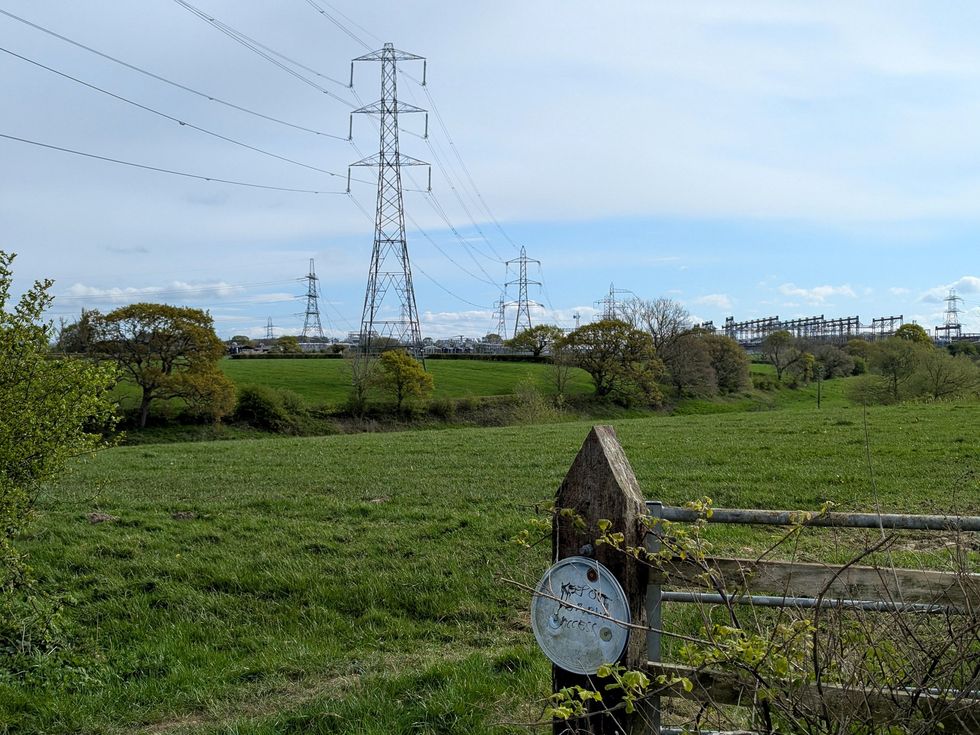 Transmission lines lead to the congested Penwortham substation, which has become a test-bed for GETs such as SmartValves and dynamic line rating. Peter Fairley
What makes the substation a strategic test-bed for GETs is its position just north of the U.K. grid’s biggest bottleneck, known as Boundary B7a, which runs east to west across the island. Nine circuits traverse the B7a: the four AC lines headed south from Penwortham, four AC lines closer to Yorkshire’s North Sea coast, and a high-voltage direct-current (HVDC) link offshore. In theory, those circuits can collectively carry 13.6 gigawatts across the B7a. But NESO caps its flow at several gigawatts lower to ensure that no circuits overload if any two lines turn off.
Such limits are necessary for grid reliability, but they are leaving terawatt-hours of wind power stranded in Scotland and increasing consumers’ energy costs: an extra £196 million (US $265 million) in 2024 alone. The costs stem from NESO having to ramp up gas-fired generators to meet demand down south while simultaneously compensating wind-farm operators for curtailing their output, as required under U.K. policy.
So National Grid keeps tweaking Penwortham. In 2011 the substation got its first big GET: phase-shifting transformers (PSTs), a type of analog flow controller. PSTs adjust power flow by creating an AC waveform whose alternating voltage leads or lags its alternating current. They do so by each PST using a pair of connected transformers to selectively combine power from an AC transmission circuit’s three phases. Motors reposition electrical connections on the transformer coils to adjust flows.
 Phase-shifting transformers (PSTs) were installed in 2012 at the Penwortham substation and are the analog predecessor to SmartValves. They’re powerful but also bulky and relatively inflexible. It can take 10 minutes or more for the PST’s motorized actuators at Penwortham to tap their full range of flow control, whereas SmartValves can shift within milliseconds.National Grid Electricity Transmission
Penwortham’s pair of 540-tonne PSTs occupy the entire south end of the substation, along with their dedicated chillers, relays, and power supplies. Delivering all that hardware required extensive road closures and floating a huge barge up the adjacent River Ribble, an event that made national news.
The SmartValves at Penwortham stand in stark contrast to the PSTs’ heft, complexity, and mechanics. SmartValves are a type of static synchronous series compensator, or SSSC—a solid-state alternative to PSTs that employs power electronics to tweak power flows in milliseconds. I saw two sets of them tucked into a corner of the substation, occupying a quarter of the area of the PSTs.
 The SmartValve V103 design [above] experienced some teething and reliability issues that were ironed out with the technology’s next iteration, the V104. National Grid Electricity Transmission/Smart Wires
The SmartValves are first and foremost an insurance policy to guard against a potentially crippling event: the sudden loss of one of the B7a’s 400-kV lines. If that were to happen, gigawatts of power would instantly seek another route over neighboring lines. And if it happened on a windy day, when lots of power is streaming in from the north, the resulting surge could overload the 275-kV circuits headed from Penwortham to Liverpool. The SmartValves’ job is to save the day.
They do this by adding impedance to the 275-kV lines, thus acting to divert more power to the remaining 400-kV lines. This rerouting of power prevents a blackout that could potentially cascade through the grid. The upside to that protection is that NESO can safely schedule an additional 350 MW over the B7a.
The savings add up. “That’s 350 MW of wind you’re no longer curtailing from wind farms. So that’s 350 times £100 a megawatt-hour,” says Leslie, at NESO. “That’s also 350 MW of gas-fired power that you don’t need to replace the wind. So that’s 350 times £120 a megawatt-hour. The numbers get big quickly.”
Mark Osborne, the National Grid lead asset life-cycle engineer managing its SmartValve projects, estimates the devices are saving U.K. customers over £100 million (US $132 million) a year. At that rate, they’ll pay for themselves “within a few years,” Osborne says. By utility standards, where investments are normally amortized over decades, that’s “almost immediately,” he adds.
How Do Grid-Enhancing Technologies Work?
The way Smart Wires’ SSSC devices adjust power flow is based on emulating impedance, which is a strange beast created by AC power. An AC flow’s changing magnetic field induces an additional voltage in the line’s conductor, which then acts as a drag on the initial field. Smart Wires’ SSSC devices alter power flow by emulating that natural process, effectively adding or subtracting impedance by adding their own voltage wave to the line. Adding a wave that leads the original voltage wave will boost flow, while adding a lagging wave will reduce flow.
The SSSC’s submodules of capacitors and high-speed insulated-gate bipolar transistors operate in sequence to absorb power from a line and synthesize its novel impedance-altering waves. And thanks to its digital controls and switches, the device can within milliseconds flip from maximum power push to maximum pull.
You can trace the development of SSSCs to the advent of HVDC transmission in the 1950s. HVDC converters take power from an AC grid and efficiently convert it and transfer it over a DC line to another point in the same grid, or to a neighboring AC grid. In 1985, Narain Hingorani, an HVDC expert at the Palo Alto–based Electric Power Research Institute, showed that similar converters could modulate the flow of an AC line. Four years later, Westinghouse engineer Laszlo Gyugyi proposed SSSCs, which became the basis for Smart Wires’ boxes.
Major power-equipment manufacturers tried to commercialize SSSCs in the early 2000s. But utilities had little need for flow control back then because they had plenty of conventional power plants that could meet local demand when transmission lines were full.
The picture changed as solar and wind generation exploded and conventional plants began shutting down. In years past, grid operators addressed grid congestion by turning power plants on or off in strategic locations. But as of 2024, the U.K. had shut down all of its coal-fired power plants—save one, which now burns wood—and it has vowed to slash gas-fired generation from about a quarter of electricity supply in 2024 to at most 5 percent in 2030.
The U.K.’s extreme grid challenge has made it ground zero for some of the boldest GETs testing and deployment.
To seize the emerging market opportunity presented by changing grid operations, Smart Wires had to make a crucial technology upgrade: ditching transformers. The company’s first SSSC, and those from other suppliers, relied on a transformer to absorb lightning, voltage surges, and every other grid assault that could fry their power electronics. This made them bulky and added cost. So Smart Wires engineers set to work in 2017 to see if they could live without the transformer, says Frank Kreikebaum, Smart Wires’s interim chief of engineering. Two years later the company had assembled a transformerless electronic shield. It consisted of a suite of filters and diverters, along with a control system to activate them. Ditching the transformer produced a trim, standardized product—a modular system-in-a-box.
SmartValves work at any voltage and are generally ganged together to achieve a desired level of flow control. They can be delivered fast, and they fit in the kinds of tight spaces that are common in substations. “It’s not about cost, even though we’re competitive there. It’s about ‘how quick’ and ‘can it fit,’” says Kreikebaum.
And if the grid’s pinch point shifts? The devices can be quickly moved to another substation. “It’s a Lego-brick build,” says Owen Wilkes, National Grid’s director of network design. Wilkes’s team decides where to add equipment based on today’s best projections, but he appreciates the flexibility to respond to unexpected changes.
National Grid’s deployments in 2021 were the highest-voltage installation of SSSCs at the time, and success there is fueling expansion. National Grid now has packs of SmartValves installed at three substations in northern England and under construction at another, with five more installations planned in that area. Smart Wires has also commissioned commercial projects at transmission substations in Australia, Brazil, Colombia, and the United States.
Dynamic Line Rating Boosts Grid Efficiency
In addition to SSSCs, National Grid has deployed lidar that senses sag on Penwortham’s 275-kV lines—an indication that they’re starting to overheat. The sensors are part of a dynamic line rating system and help grid operators maximize the amount of current that high-voltage lines can carry based on near-real-time weather conditions. (Cooler weather means more capacity.) Now the same technology is being deployed across the B7a—a £1 million investment that is projected to save consumers £33 million annually, says Corin Ireland, a National Grid optimization engineer with the task of seizing GETs opportunities.
There’s also a lot of old conductor wires being swapped out for those that can carry more power. National Grid’s business plan calls for 2,416 kilometers of such reconductoring over the coming five years, which is about 20 percent of its system. Scotland’s transmission operators are busy with their own big swaps.
 Scottish wind farms have doubled their power output over the past decade, but it often gets stranded due to grid congestion in England. Andreas Berthold/Alamy
But while National Grid and NESO are making some of the boldest deployments of GETs in the world, they’re not fully tapping the technologies’ capabilities. That’s partly due to the conservative nature of power utilities, and partly because grid operators already have plenty to keep their eyes on. It also stems from the unknowns that still surround GETs, like whether they might take the grid in unforeseen directions if allowed to respond automatically, or get stuck in a feedback loop responding to each other. Imagine SmartValve controllers at different substations fighting, with one substation jumping to remove impedance that the other just added, causing fluctuating power flows.
“These technologies operate very quickly, but the computers in the control room are still very reliant on people making decisions,” says Ireland. “So there are time scales that we have to take into consideration when planning and operating the network.”
This kind of conservative dispatching leaves value on the table. For example, the dynamic line rating models can spit out new line ratings every 15 minutes, but grid operators get updates only every 24 hours. Fewer updates means fewer opportunities to tap the system’s ability to boost capacity. Similarly, for SmartValves, NESO activates installations at only one substation at a time. And control-room operators turn them on manually, even though the devices could automatically respond to faults within milliseconds.
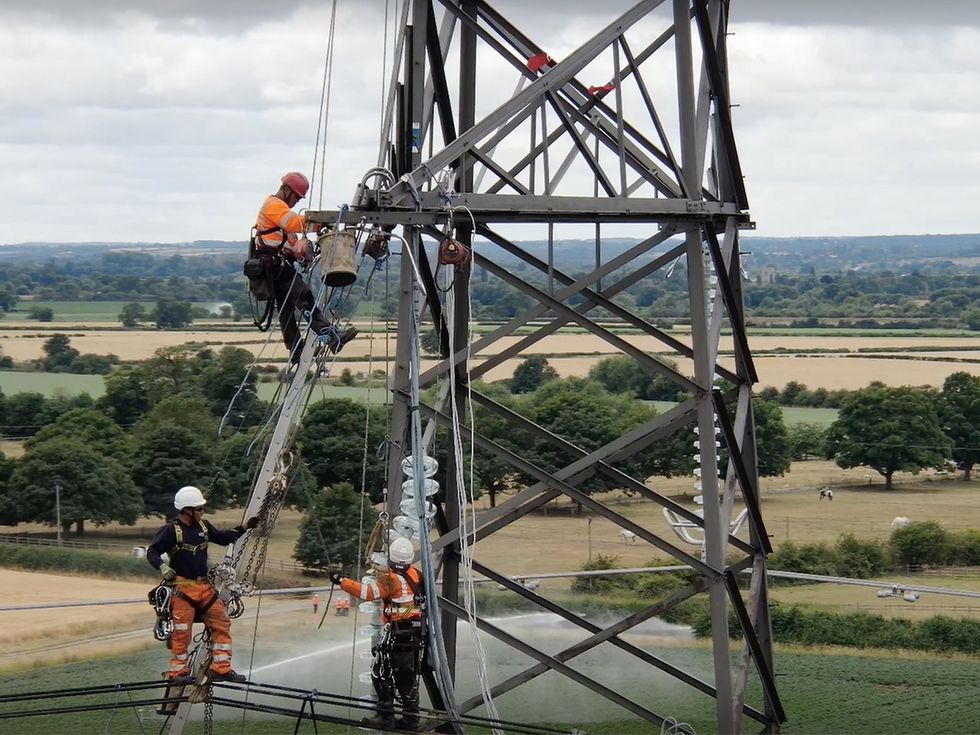 National Grid is upgrading transmission lines dating as far back as the 1960s. This includes installing conductors that retain their strength at higher temperatures, allowing them to carry more power. National Grid Electricity Transmission
Modeling by Smart Wires and National Grid shows a significant capacity boost across Boundary B7a if Penwortham’s SmartValves were to work in tandem with another set further up the line. For example, when Penwortham is adding impedance to push megawatts off the 275-kV lines, a set closer to Scotland could simultaneously pull the power north, nudging the sum over to the B7a’s eastern circuits. Simulations by Andy Hiorns, a former National Grid planning director who consults for Smart Wires, suggest that this kind of cooperative action should increase the B7a circuits’ usable capacity by another 250 to 300 MW. “You double the effectiveness by using them as pairs,” he says.
Operating multiple flow controllers may become necessary for unlocking the next boundary en route to London, south of the B7a, called Boundary B8. As dynamic line rating, beefier conductors, and SmartValves send more power across the B7a, lines traversing B8 are reaching their limits. Eventually, every boundary along the route will have to be upgraded.
Meanwhile, back at its U.S. headquarters, Smart Wires is developing other applications for its SSSCs, such as filtering out power oscillations that can destabilize grids and reduce allowable transfers. That capability could be unlocked remotely with firmware.
The company is also working on a test program that could turn on pairs of SmartValve installations during slack moments when there isn’t much going on in the control rooms. That would give National Grid and NESO operators an opportunity to observe the impacts, and to get more comfortable with the technology.
National Grid and Smart Wires are also hard at work developing industry-first optimization software for coordinating flow-control devices. “It’s possible to extend the technology from how we’re using it today,” says Ireland at National Grid. “That’s the exciting bit.”
NESO’s Julian Leslie shares that excitement and says he expects SmartValves to begin working together to ease power through the grid—once the operators have the modeling right and get a little more comfortable with the technology. “It’s a great innovation that has the potential to be really transformational,” he says. “We’re just not quite there yet.”
From Your Site Articles
Related Articles Around the Web