




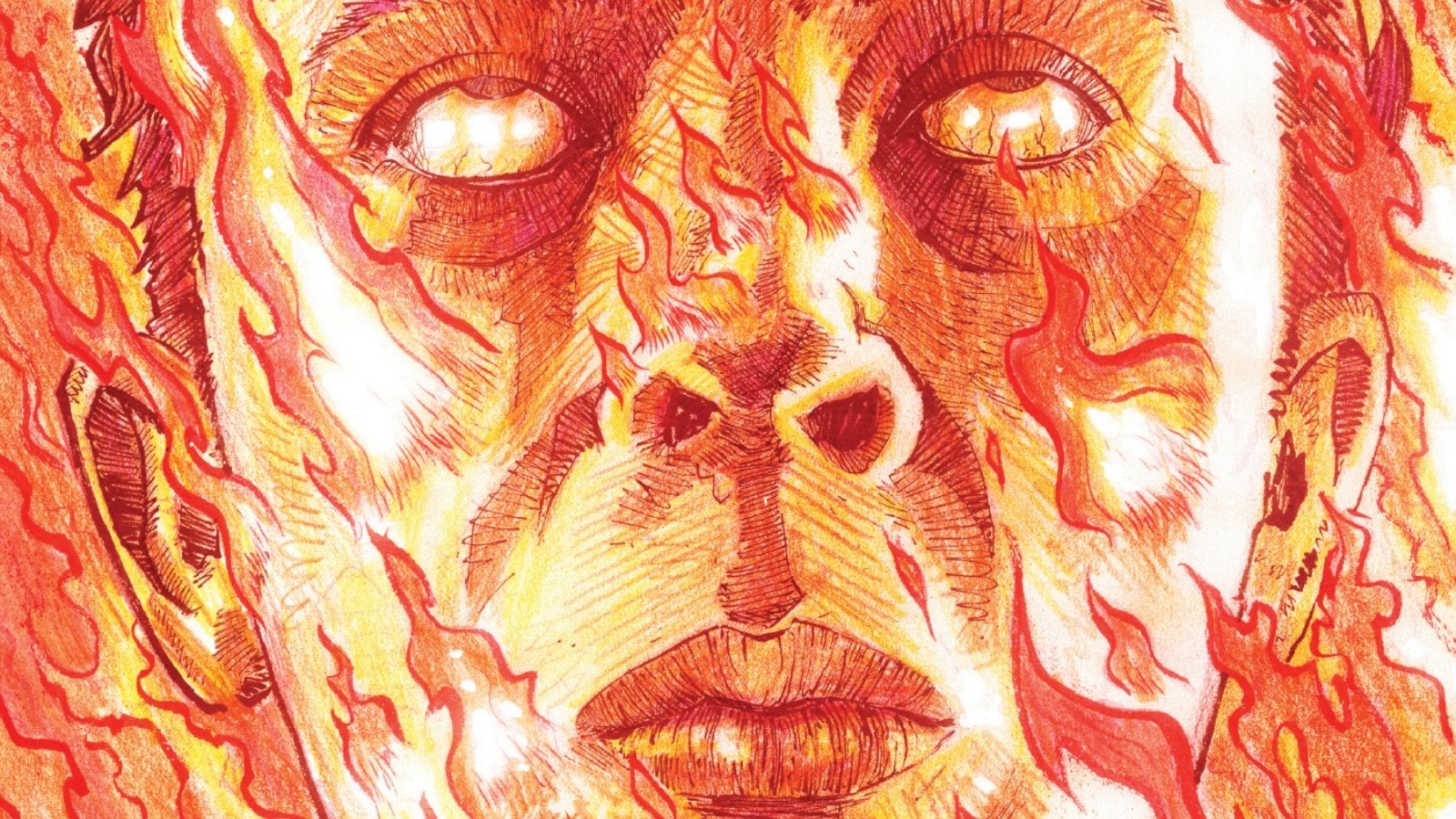
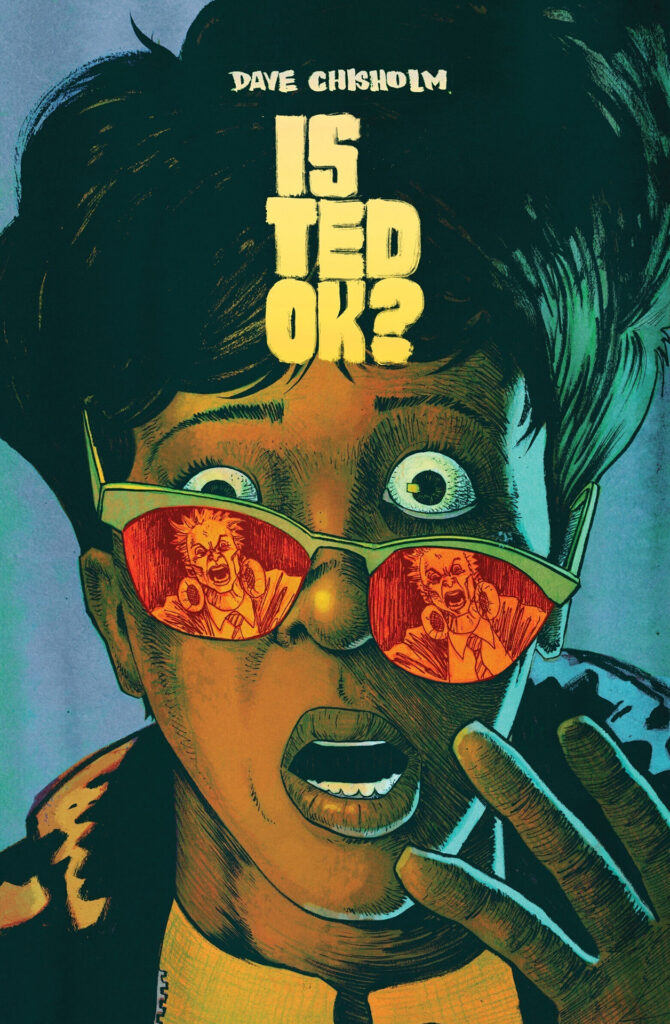
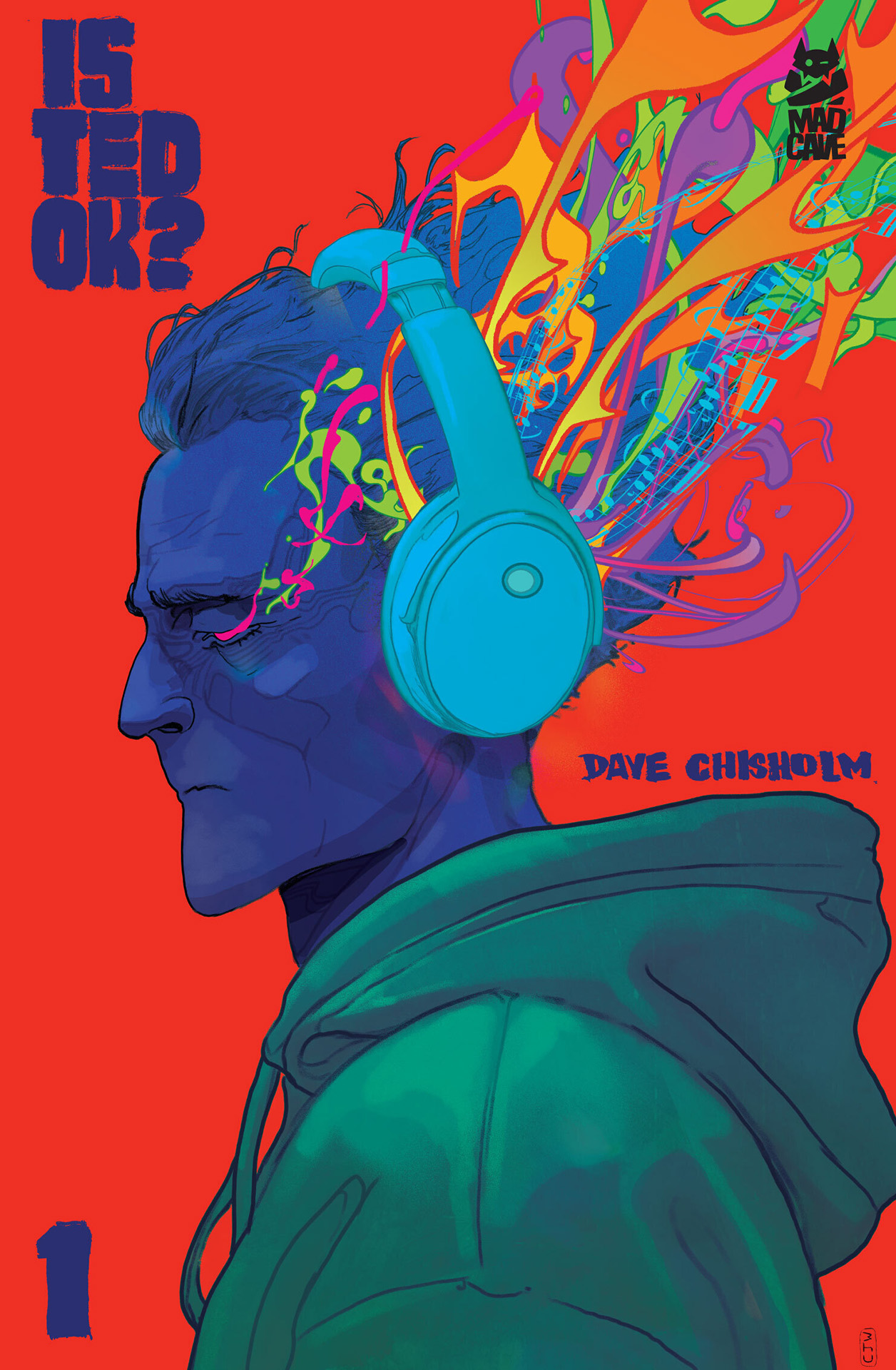
Is Ted OK? will go down as one of the boldest and most brilliant comics of the year. Dave Chisholm returns to sole creative duties with an exceptional effort, an exploration of paranoia and mental health in a dystopian world where megacorporations control every fiber of someone’s life and well-being.
As Ted’s mental state crumbles, it’s up to the voyeuristic Sarah to help him, and figure out what’s going on. Beautifully illustrated and surprising at every turn, Chisholm’s newest is a total home run. The Beat sat down with writer/artist Chisholm to discuss how the book came to be and what it all means.
This interview has been edited for clarity and brevity.
JARED BIRD: Is Ted OK? launches January 25, 2026 from Mad Cave Studios. To those unfamiliar, how would you describe Is Ted OK?
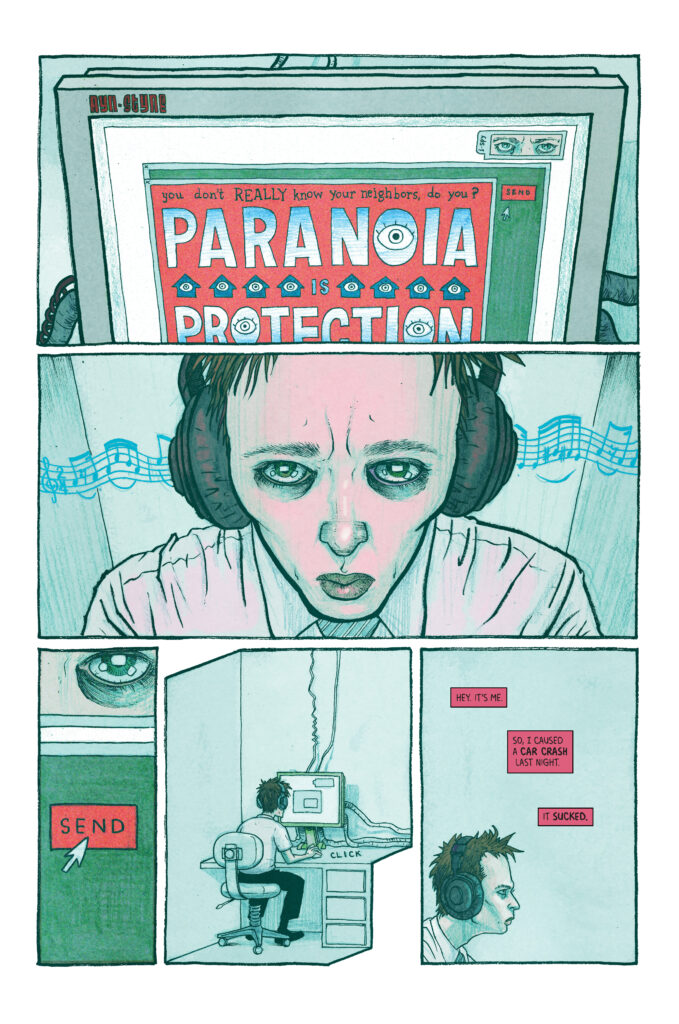
DAVE CHISHOLM: Is Ted OK? is a story about people who need and crave connection in a world that’s been designed to inhibit all connection between people by the powers that be. It’s about this guy named Ted, who works a high-pressure job at the biggest corporation in the world, and he’s kind of cracking a little bit. There is someone else named Sarah, whose whole job is to covertly spy on Ted to make sure he doesn’t hurt himself or anybody else because of the pressure he’s under. Sarah sort of becomes obsessed with Ted and tries to kind of overstep the boundaries of her job and intervene and help him, and when she does, it sends things spinning off into chaos. Things go horribly wrong, and over the course of this six-issue dystopian, semi-satirical series, it just gets more and more off the wall as Ted and Sarah, both individuals at a kind of rock bottom, collide into each other and in each other see the other person, who holds up a mirror for their own state.

BIRD: What inspired the concept of the series?
CHISHOLM: I don’t want to speak too much about other media influences, because I don’t want to spoil anything. In a lot of ways, this story is sort of in that Mystery Box tradition, where there’s an ever-increasing series of puzzles to solve. There are a bunch of mysteries at the heart of the story, and all of them will make sense by the end. Why is Ted so weird? What’s with this weird thing that Ted does? Who is Sarah leaving a voicemail for? What happened to that relationship? So on and so forth.
When I’m thinking about unpacking a story, I do start in a bit more of an abstract place. A few themes and a conceit get the ball rolling, and then those themes and conceits thicken and become characters. The key is to make a world that is sort of akin to a big funhouse mirror of those themes and characters, and then let the characters move through that world with honesty.
How do people learn empathy? Why is empathy key to humanity? What makes men violent? What’s the philosophy behind empathy and the philosophy behind violence, and how do these things kind of become at odds with each other? What makes someone step in and help during a time of need? These are the kind of big picture things that kind of get rolled into these characters. How do people learn? What’s the process like to look at another person and see yourself, or encounter a person for whom that’s a foreign concept?
BIRD: This is your second time publishing with Mad Cave Studios, if I understand correctly, after Spectrum with Rick Quinn. What’s it been like working with them?
CHISHOLM: Oh, man, I’ve really enjoyed working with Mad Cave Studios. It’s nice to have a place that has these books that are a little bit left of center, a little weird, maybe a little bit challenging for readers, and stuff like that, push the medium a little bit, but to have it in an outlet where they believe in it enough to pay the creators to make the book. I hate to be like a capitalist pig about it, but this stuff takes a long time to make. It’s nice to be able to make stuff that’s original and challenging, and get paid for it.
Mike Marts has been really great to interact with, and the editor of this book, Ryan Carroll, has been super helpful and supportive during the process of making it. It’s been awesome, and it’s also nice that Mad Cave has marketing and press. Sometimes, comics press is this squirrely, insular, ever-shrinking entity. I post a lot of video content on social media about comics, and I think the big challenge with putting out indie comics, or just comics in general, is that there are two mountains that you’re climbing at the same time.
One mountain to get every person who is a Wednesday Warrior or goes to the comic shop monthly. I want every person to know about this book and to be kind of salivating about it, to be so stoked about it before the final order cut-off. To have people think, “this looks rad, I’m going to get this.” That includes getting the hype for the book in front of comic shop owners and employees and the people who make orders.
But in the grand scheme of things, that’s a small wedge of the general population, and so the other mountain is much more challenging and harrowing. There’s no footpath at all. How do you get people who don’t read comics to take the chance and go to a comic shop or order directly from Mad Cave and say, “I want to get this book that’s coming out in February.”
A lot of that marketing stuff is really hard, and so I like to see myself as kind of part of the press team. I’m always looking for ways to kind of crack that nut, to kind of find a way to reach more people, and to get the book in front of more people. You always have to be trying stuff, and you have to be perpetually optimistic that the next one is going to be the one that will work. This one will be the one people are going to like, that will put my work on people’s radar. I’ll never be unappreciative of the people who picked up all of my previous books. It’s building a body of work. Everything is me chipping away to become a credible comics creator.


BIRD: You mentioned your previous body of work just now, and it’s quite impressive. Has working on this been different from any previous comics you’ve created?
CHISHOLM: There are really two answers. On one hand, they’re all in one continuous stream, steadily working into each other. I try to always build continuity, adding new techniques to my work and building new ideas into it. Adding vocabulary to my work. On the other hand, this one’s different. This is me going back to working solo on a book, which I haven’t done in some time. This is the first solo book I’ve done that’s not a licensed property, except for Canopus, which I did back in 2019, and it came out in 2020, which was for Scout Comics. This is the first original, non-licensed story that is totally me, that I’m being paid for, which is cool, and I’m proud of it.
Something else that makes it unique is that I really took an unusually long amount of time before properly starting it. I really sat on it for a long time and worked out all of the story and design, and put in several years to figure out what this is. I think I first had the inkling of an idea for it, days before Rick Quinn sent me the script for Spectrum, way back in 2021. Spectrum kind of scratched that itch for me, so when I finished it, I was like, maybe I’ll finally check this out. After I finished Miles Davis and The Search for the Sound, I did some work on Is Ted OK? and got it pretty far. I had plans for a 12-issue thing, and I scripted through six issues of that, and it just wasn’t there. I even started drawing it. I got 10 or 15 pages, drawn and colored, and I had to stop and be like, this isn’t happening. This isn’t working. The characters didn’t quite feel right, and it just wasn’t quite there yet. I decided to put all that stuff away. It sat in the back of my head still. I couldn’t shake the feeling like there’s something here. Then over the years, while working on Spectrum, I was kind of ruminating about it, and then while working on Plague House, it kind of clicked.
In Alan Moore’s masterclass, the funniest bit of advice he gives is to read bad stuff too. If you only read the classics, you might not ever have the courage to do anything right. Reading something that’s bad can actually motivate you to make something out of rage. I watched this show, and at times, I loved it. It was taking big swings. It’s well-made. The performances are good. By the end of the show, I hated it, and it was such a mess thematically. It became very frustrating and hollow, but the big swings were really cool, which made it worse that it was all a castle made of sand. I was watching it with my wife, and when we finished it, I looked at her and told her I had to bring Ted back. I gotta try this and take bigger swings with it. It almost felt like, at key moments, they asked “what outcome is the least likely thing?” and they always chose it. That makes it unpredictable and kind of fun, in a way. If I brought some of that energy to Is Ted OK?, it could work, so I’m thankful for that piece of media, even if I didn’t like it.
At that point, I kind of found it. I made the whole first issue, and then that was my pitch to Mad Cave alongside a one-page pitch document. They were really stoked about it, and it feels really good to have a publisher that’s good to work with, that believes in my work. It’s nice to feel like other people have confidence in what you’re doing as well. I’m really thrilled about it.

BIRD: At the center of the series is Ted and Sarah’s pretty unconventional dynamic, particularly Sarah’s emotional attachment to looking after and helping Ted. What advice would you give writers attempting to craft a sincere bond as the central threat of their story?
CHISHOLM: I can speak to this by talking about what the big challenge was with this book. You have to make sure that you aren’t using the bond as a prop for one of the characters. In my first draft of Ted, Sarah was just a prop to tell Ted’s story. It wasn’t until I really knew Sarah and really talked to my wife about this relationship and this bond between these two people, and just really went over it again and again in my head, writing draft after draft and listening to Fiona Apple. Why was she doing this? You need to make sure that any characters are moving through their predicament with authenticity and aren’t being pulled forward by a plot. They’re making their own decisions.
I teach college courses on making comics, and whenever students bring a big story to me, it’s usually something that they started writing when they were like 11. I always ask them, “How is every character broken at the start of the story? What’s their flaw? How are they cracked?” The key is that the healing has to come from their own agency, and not from magic, not from a sci-fi device. Is Ted OK? is very much full of these big ideas, but it was really important as I was working through the plot that towards the end of the story, whatever healing that happens for these characters happens because of the choices they make. That’s what makes something relatable for the reader. If the solution is to get inside of this magic bubble and stand there for five minutes, and you’ll be healed, that’s not really helpful for a reader, right?
It can be an added challenge when there’s a relationship at the core rather than one single character. That was one thing with this book. Who is the main character of this story? Is it the title character, or is it this other character who’s actually narrating most of it? Sarah’s taking on the role of the reader, in a sense, right? She’s looking at Ted’s life unfold in little boxes on her computer screen.
BIRD: An important aspect of the narrative is mental health and how people deal with it in particular, when there are elements worsening it that kind of feel out of your control. Is the subject of mental health something that you find yourself drawn to exploring in your work?
CHISHOLM: I suppose so. We all live in our minds, and it helps me understand my own shit to work through fictional characters. It’s definitely something that comes up. It’s kind of the same in songwriting; the notion of authenticity comes up a lot in songwriting discussions or writing discussions. “Write what you know.” There are a lot of very confessional autobiographical comics, but for me, an autobiographical comic would not be that interesting, and I’d question whether this would be better as a work of fiction, where you can take the authenticity and then pump up the drama a little bit. Use a kernel of an idea to maybe tell a story you have a little more control over, especially in relation to symbolism and formalism.
For me it’s always kind of like working through stuff, working through an idea. I work out a list of things I find interesting, or things about myself that I’m struggling with, and then compare it to a list of conceits and concepts and ideas that I have floating around in my head. You draw an arrow from here to here, and then you connect.

BIRD: The dystopian world of Is Ted OK? feels quite topical and timely to the state of the world right now. How did you go about crafting the kind of satirical and political aspect of the series?
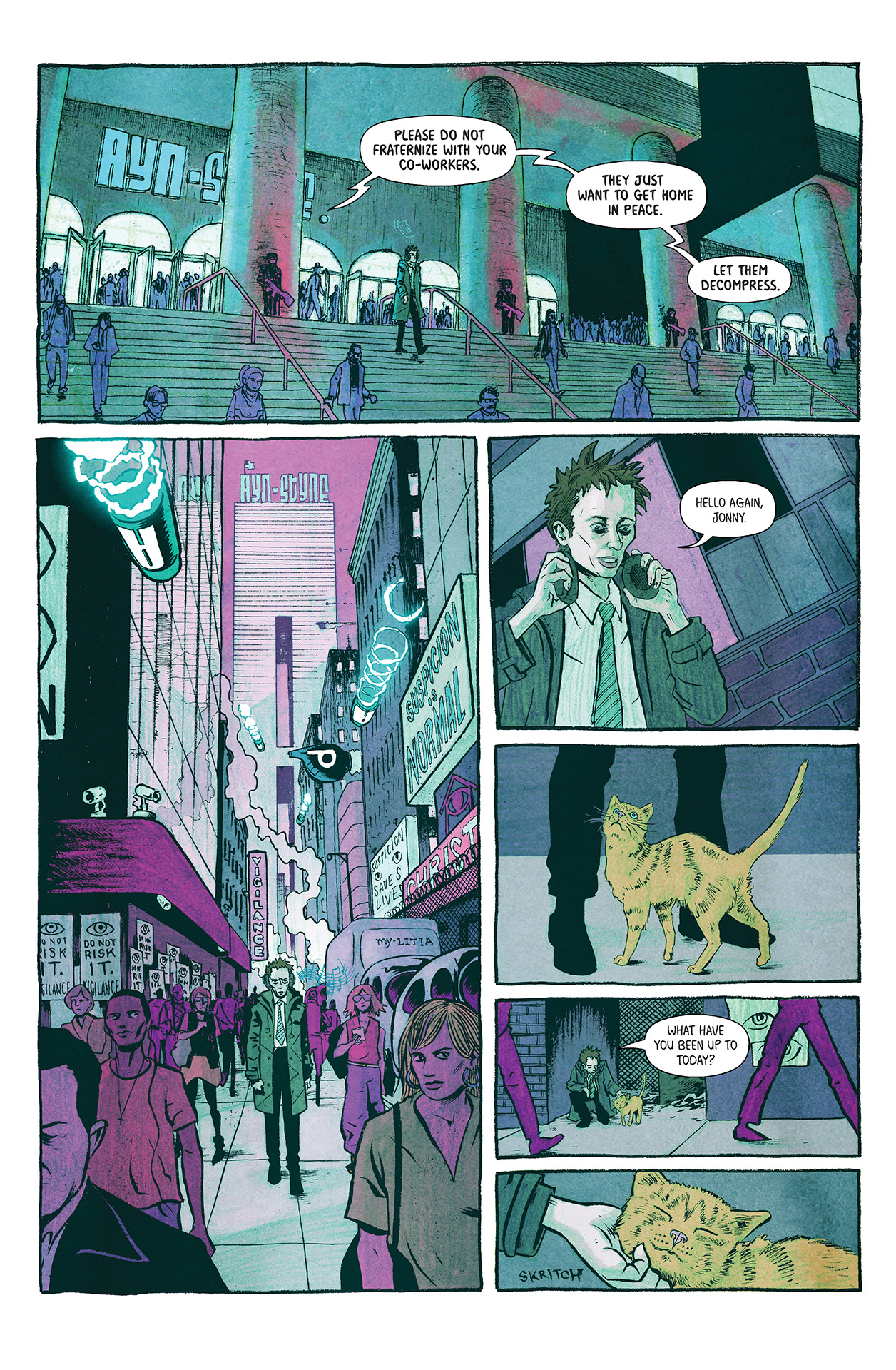
CHISHOLM: When I first started writing, it was very satirical, and since then, the world has caught up to my satire a little bit. Now, it feels almost too on the nose for the world. Has the world kind of lapped it now? Is it not relevant anymore, because we’ve moved on to some other horror in the real world? The biggest feature of that aspect is also kind of a reactive thing on my part to all these pieces of media that are humanizing monsters. Cruella de Vil’s backstory is not necessary because she kills puppies. There’s no backstory that you can tell me that redeems her. Not to be too overt or anything, but it’s very easy to see who the bad guys are in the world. That nuance doesn’t always exist in reality. I wanted to just let the people who are the antagonists in this book be kind of irredeemable. The protagonists in this are people who are under the boot of these terrible people without even realizing that they’re under the boot of these terrible people. It kind of relates to the proximity to power idea; if you are okay with the situation, it’s probably just because there are enough people beneath you that you feel like you can cushion yourself from the awfulness of those above you.
BIRD: Like all of your work, music plays a part in this series. What albums soundtracked the creation of the comic?
CHISHOLM: There are a bunch of songs that are really important to this book, but I don’t want to say too much and give it all away. I already mentioned Fiona Apple, but it’s basically just a handful of my favorite artists. There’s an artist named Angie McMahon. She’s an Australian singer-songwriter who has a record called Light, Dark and Light Again. There’s a line in the song Black Eye that made a really big impact on me, and I think it kind of does reflect Sarah’s kind of worldview.
I’m trying to insert myself, Like a vaccine into your arm. I didn’t know I was doing harm, But I don’t know what I am if I’m not your medicine
Radiohead’s music really has had the biggest impact on me, so there’s a lot of their DNA in this book. There’s a friend of mine, Jay William Henderson, and he has a song called You Will Be Called A Liar. That’s one song I’ve been stuck on a lot. Elliot Smith, some Nine Inch Nails stuff. There’s a song called Screamland by Father John Misty that has a verse in it that resonated.
And at this late hour, Won’t have to beg mercy for defeat, Just drop your hands the way love taught you. Ash white and voodooed, Deathless as a weed. Since I lied to keep you, I’m starting to feel Like how long can you love someone for the weakness they conceal.
I think that in a lot of ways that describes Ted. That’s about as detailed an answer as I could give without giving anything away.

BIRD: What other books of yours would you recommend to readers who enjoy Is Ted OK?
CHISHOLM: I guess it depends on why you like it. If people like it for the art, I think Spectrum is probably a good choice. I think if people like the kind of catharsis of it all, I think Canopus would be a good one, if you can find it. If the formal stuff is interesting, you might want to check out Miles Davis and The Search for the Sound. I’m standing behind all my books, though. I’d recommend picking up Plague House, because it’s really great. Fangoria made their list of Horror Comics to look out for in 2026, and Is Ted OK? was on it. Horror films are such a part of my DNA that I didn’t really think of it as a horror book until it actually came out.