




From New Jersey to California to the far reaches of the Pacific, these deadly encounters with great whites, tiger sharks, and oceanic whitetips are the worst shark attacks in recorded history.
Shark attacks have long held a particularly terrifying place in history, pop culture, and the collective imagination. Thanks to accounts, both true and fictional, of people’s harrowing encounters with these animals, they scare so many of us like few other beasts ever have.
Jaws, for one, certainly helped cement shark attacks in our nightmares and spread great fear about swimming in waters known to be home to sharks. But when the artifice of moviemaking is removed, how do real-life shark attacks tend to actually play out?
From fatal attacks, to losing limbs, to gnarly bites, sharks attacks can take many forms — all of them positively petrifying. From the 18th century to the present day, and from Australia to California, these are some of the worst shark attacks in recorded history…
History’s Worst Shark Attacks: The Harrowing Story Of The USS Indianapolis
Wikimedia CommonsThe USS Indianapolis was sunk in the final days of World War II.
Today, the story of the USS Indianapolis is fairly widely known as one of the worst shark attacks in history, in part because it was alluded to in Jaws. The ship was sunk by two Japanese torpedoes while sailing near the Philippines on July 30, 1945, in the final days of World War II.
While 900 of the 1,196 crew members survived the initial sinking, they then had to survive a whole new dangerous obstacle: the shark-infested waters they were now stranded in.
Sharks were drawn to the wreckage of the Indianapolis by the noise and smell of blood from the crew members who had already perished. In order to survive, the remaining men had to be extremely careful to not attract more sharks.
The crew members were likely being terrorized by oceanic whitetip sharks and possibly tiger sharks as well. Oceanic whitetips are known to be some of the most aggressive towards humans.
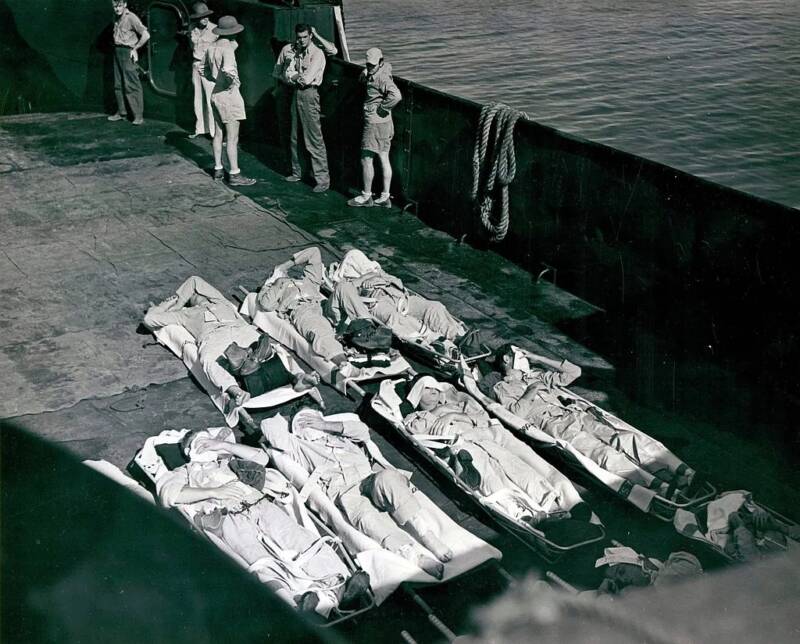
Wikimedia CommonsRescued survivors of the sinking of the USS Indianapolis.
“Every now and then, like lightning, [a shark] would come straight up and take a sailor and take him straight down,” Loel Dean Cox, a survivor of the incident, told the BBC in 2013. “One came up and took the sailor next to me. It was just somebody screaming, yelling or getting bit.”
Cox also recalled that the sharks would often feed on the dead bodies of his fellow soldiers. He said he was “constantly in fear” because he could see shark fins in the water every few minutes.
By the time a rescue crew finally came on August 2, only 316 crew members were left. A majority of the men died from dehydration and exposure, but approximately 150 of them were killed by the sharks.