




Bernd Debusmann Jr,at the White Houseand
Nick Beake & Kayla Epstein
Donald Trump wants to take Greenland – and the White House has confirmed that all options are on the table, including the use of force.
While a military operation is just one of a range of economic and political options being considered, since it would be an attack by one Nato member on another, such a move would represent a nightmare scenario for the Nato alliance, and likely an existential one.
Trump has repeatedly said that Greenland is vital to US national security, claiming without evidence that it is “covered with Russian and Chinese ships all over the place”.
With the expertise of US, British and Danish experts, we consider the various options the president may be looking at, and the possible justification for each one.
Military Action
Defence analysts say that a lightning operation to take Greenland could be done relatively easily, but the fallout would be monumental.
While geographically massive, Greenland’s population is only around 58,000, about a third of which is concentrated in Nuuk, the capital, with the bulk of the rest living on its western coast.
The territory does not have its own military and Denmark is responsible for its defence, but it has limited air and naval assets in place to cover such a huge territory.
Large swathes of it are policed only by Sirius Patrol, a Danish special operations unit that relies primarily on dog sleds.
Denmark has, however, significantly upped defence spending in the Arctic and North Atlantic regions, including Greenland, in the past year.
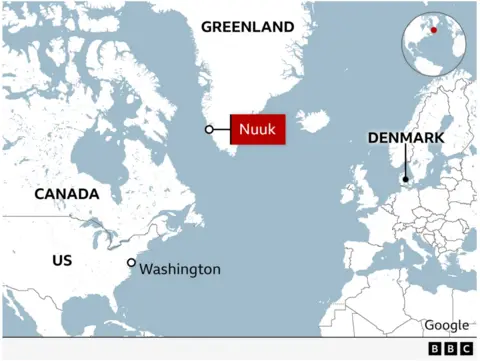
Its vast size, small population and lack of military would make it a ripe target for the US, which already has more than 100 military personnel permanently stationed at the Pituffik facility in Greenland’s north-western tip.
That facility could in theory serve as a logistical base for future operations.
The base has existed since World War Two, when US troops deployed to the island to establish military and radio stations after the Nazis occupied Denmark during the conflict.
Hans Tito Hansen, a Danish security expert and CEO of Risk Intelligence, outlined how a US operation to take Greenland could take place.
According to Hansen, the Alaska-based 11th Airborne Division – which includes two Arctic brigades capable of parachute or helicopter-borne missions – would be the “primary capability” in any invasion, “supported by Air Force and naval assets”.
His assessment was echoed by Justin Crump, a British Army Reserve Officer who heads the risk and intelligence company Sibylline.
“The US has overwhelming naval power and it has the ability to lift pretty large numbers of troops,” he said. “You could easily fly in enough troops to have one for every few members of the population in a single lift.”
Crump added this option would be ruthless, but also potentially bloodless with little resistance likely to be offered.


 Getty Images
In the US, however, several former officials and defence analysts said a military operation is extremely unlikely, given its far-reaching implications for US-European alliances.
“That would clearly be against all international law,” said Mick Mulroy, a former Marine, CIA paramilitary officer and Deputy Assistant Secretary of Defense. “Not only are they no threat to the US, they are a treaty ally.”
If the White House began moving towards a military option, Mulroy said he believed it would meet resistance from lawmakers who could use the War Powers Act, which is designed to limit the president’s ability to make war without Congressional approval, to pre-empt it.
“I don’t think there would be any support in Congress to destroy the Nato alliance,” he said.
Buying Greenland
The US has deep pockets, but Greenland is not for sale according to both Nuuk and Copenhagen.
Citing a lawmaker and a source familiar with the discussions, CBS – the BBC’s US news partner – has reported that Secretary of State Marco Rubio told members of Congress that a purchase is the administration’s preferred option, striking a different tone from the White House.
But even if Greenland wanted to be sold, such a transaction would be highly complicated.
Any funds would have to be appropriated by Congress, and acquiring Greenland by treaty would require support from two-thirds of the Senate – which experts say would be difficult to secure.
The European Union would also have to sign off on the deal.
 Getty Images
While Trump could theoretically try to strike a deal unilaterally without involving Greenland or Congress, experts believe that is extremely unlikely.
Professor Monica Hakimi, an international law expert at Columbia University, said that “one could imagine a situation” in which Denmark, the US and Greenland agree to terms for the transfer of the territory.
“[But] for it to be completely consistent with international law, such a treaty would probably also have to involve Greenlandic participation for their own self-determination,” she added.
It is unclear how much purchasing the island could cost. This could complicate things for Trump, who campaigned on an “America First” platform.
The prospect of billions or even trillions of US tax dollars being spent on an ice-capped island could land very badly with his MAGA base.
Crump believes that a failure to successfully purchase the island, however, could make a military option more attractive to Trump – particularly in an administration buoyed by the recent successful operation to arrest Nicolas Maduro in Venezuela.
“He’ll say, ‘well, we’re just going to take it’,” Crump said of the US president.
Secretary of State Marco Rubio, who will meet Danish officials next week to discuss Greenland, has said Trump is “not the first US president that has examined or looked at how could we acquire” the territory.
He has referred to President Harry Truman, who in 1946 floated the idea of paying Denmark $100 million in gold to buy Greenland.
A campaign to win over Greenlanders
Opinion polls suggest a majority of Greenlanders want independence from Denmark.
But the polls also indicate they do not want to become part of the US.
Nonetheless, America could ratchet up efforts to win the favour of islanders by short-term financial incentives or the prospect of future economic benefits.
Already, US media reports have suggested that US intelligence agencies have stepped up surveillance on Greenland’s independence movement, making efforts to identify figures who would back the administration’s goals.
Imran Bayouni, a geostrategy expert with the Atlantic Council in Washington DC and former policy adviser to the defence department, told the BBC that an “influence campaign” is much more likely than any military action.
This campaign, he explained, could help nudge Greenland towards independence.
“Then, after Greenland declares independence, you could have the US government to be a partner,” he said. “The cost of military action is way too high.”
These kinds of partnerships are not without precedent.
The US, for example, has struck a similar deal with the Pacific nations of Palau, Micronesia and the Marshall Islands – all independent countries that give the US access to defence rights.
In return, citizens of these three nations get the opportunity to live and work in the US.
But this may not satisfy Trump, who already has the power to bring as many troops as he wants to Greenland under existing agreements.
And an arrangement of that nature would not offer the US ownership rights to Greenland’s vast mineral reserves that are buried deep beneath the Arctic ice.
Hansen, the Danish analyst, argued that any campaign to “have” Greenland – short of military action – would be unsuccessful as long as the population of Greenland opposes the idea.
For now, no political parties in the island are campaigning to become part of the US.
“It is more likely that Greenland again becomes a member of the European Union,” he said.
“Also, the current US administration has three years left, while the people of Greenland perhaps have a horizon of 1,000 years.”