




 Reuters
A Republican lawmaker is vowing to begin contempt-of-Congress proceedings against former President Bill Clinton after he failed to show up on Tuesday to testify before a committee investigating Jeffrey Epstein.
House Oversight Committee Chairman James Comer told reporters he would start proceedings against Clinton next week, and could do the same against former Secretary of State Hillary Clinton if she fails to answer questions on Wednesday.
The committee had issued subpoenas for both Clintons to testify about the late convicted sex offender.
Lawyers for the Clintons called the subpoenas “unenforceable”, and said they had already provided the “limited information” they had about Epstein.
Bill Clinton has never been accused of wrongdoing by survivors of Epstein’s abuse, and has denied knowledge of his sex offending.
The Clintons contended the subpoenas – legal orders to provide testimony – “are nothing more than a ploy to attempt to embarrass political rivals, as President Trump has directed”.
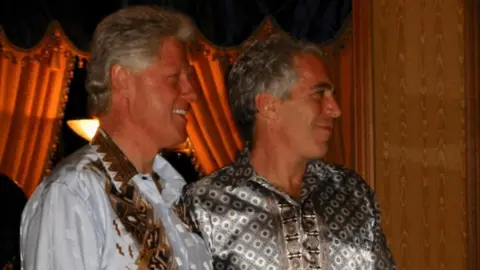
Bill Clinton appears with Epstein and at the late financier’s estate in photographs that were recently released by the US Department of Justice after Congress passed a law requiring the agency to release material related to investigations of Epstein.
One picture shows the former president swimming in a pool, and another shows him lying on his back with his hands behind his head in what appears to be a hot tub.
Clinton was photographed with Epstein several times over the 1990s and early 2000s, before Epstein was arrested for sex-trafficking.
Clinton spokesman Angel Ureña said when the photos were released last month that they were decades old and Clinton stopped associating with Epstein before his crimes came to light.
Congress has the authority to detain someone until they comply with a subpoena, send a contempt certification to the justice department for prosecution or ask a court to force compliance.
“If the court finds that the party is legally obligated to comply, continued non-compliance may result in the party being held in contempt of court,” according to the nonpartisan Congressional Research Service.
“Where the target of the subpoena is an executive branch official, civil enforcement may be the only practical means by which Congress can effectively ensure compliance with its own subpoena.”
Criminal contempt of Congress is a misdemeanour offence punishable by a fine up to $100,000 (£74,500) and imprisonment up to a year.