




 Getty Images
As Ugandans go to the polls next week they are faced with a choice of propelling a leader into his fifth decade in power or backing a candidate seeking to capitalise on the desire for change from some quarters.
President Yoweri Museveni, 81, in office since 1986, is aiming for a seventh successive election victory.
His main challenger, pop-star-turned-politician Bobi Wine, 43, has promised a revolution in governance and sweeping reforms.
Campaigning has been marked by the disruption of opposition activities, including the detention of activists and the breaking-up of rallies by police.
With high rates of youth unemployment in a country where the majority of the population is under 30, the economy has become a key concern in the campaign.
When is Uganda’s general election?
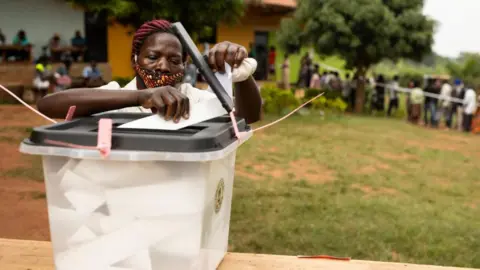
Polling is scheduled for Thursday 15 January. Polls are due to open at 07:00 local time (04:00 GMT) and close at 16:00. Anyone in the queue at that time will be allowed to vote.
What are Ugandans voting for?
The 21.6 million registered voters will be taking part in three elections:
- Presidential – there are eight candidates to choose from
- Parliamentary (1) – 353 constituency MPs will be elected
- Parliamentary (2) – 146 women representatives – one per local district – will be elected
Who could be the next president?


 Getty Images / Reuters
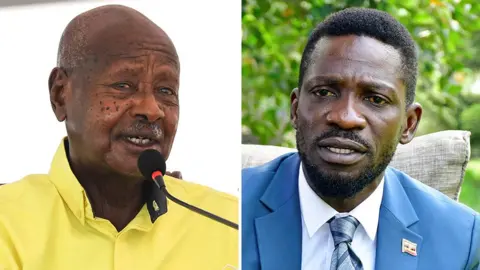
Museveni and Bobi Wine are the two front-runners among the all-male list of eight hopefuls.
This is the second time they are facing off at the ballot box, with the president winning the 2021 poll, marred by allegations of rigging and a crackdown on the opposition, with 58% of the vote compared to Bobi Wine’s 35%.
Yoweri Museveni – National Resistance Movement (NRM)
Museveni first took power by force 40 years ago as the leader of a guerrilla army that pledged to restore democracy after years of civil war and the dictatorship of Idi Amin.
Once feted as being part of a fresh generation of African leaders set to usher in a new democratic era, growing accusations of human rights abuses and harassment of opposition figures have soured that perception.
Critics say he has ruled with an iron hand since he seized control and having gone back on pledges to step down, he is the only president most Ugandans have known.
Currently the third longest-serving leader in Africa, Museveni has benefitted from two constitutional amendments – removing age and term limits – that have allowed him to keep running for office.
He argues that he remains the country’s sole guarantor of stability and progress.
Bobi Wine – National Unity Platform (NUP)
The one-time hit maker Bobi Wine, whose real name is Robert Kyagulanyi, is widely thought to be the strongest of the seven opposition candidates.
Dubbed at one point the “ghetto president”, he is seen as embodying youthful aspirations for change and he enjoys strong support among young, urban, working-class voters.
Bobi Wine established himself as a serious contender five years ago, coming second and helping to restrict Museveni to the lowest share of the vote in any election he has contested. Bobi Wine’s NUP party became the largest opposition force in parliament.
Since that vote, Bobi Wine has continued to face harassment from the security forces.
The other candidates are Frank Bulira, Robert Kasibante, Joseph Mabirizi, Nandala Mafabi, Mugisha Muntu and Mubarak Munyagwa.
Prominent opposition figure Kizza Besigye, who has run against Museveni four times, is not able to take part and remains in jail on treason charges after being arrested in neighbouring Kenya in 2024. He has denied any wrongdoing.
What are the key concerns for voters?
Economic issues, particularly unemployment, are weighing on the minds of many as they get ready to vote.
The average income per person has been slowly but steadily rising since the pandemic but there do not seem to be enough jobs to match the bulging numbers of young people looking for work.
There are also concerns about poor infrastructure and disparities in access to quality education and healthcare.
The country has however managed to avoid the spike in the cost of living that has affected so many other countries in the region and led to pressure on those in power.
Corruption is another major concern.
Uganda comes 140th out of 180 countries on Transparency International’s annual Corruption Perceptions Index, with widespread bribery and nepotism reported in government institutions.
Will the vote be free and fair?
The conduct of elections in Uganda has often been criticised. This time round officials say the vote will be free and fair but UN experts have warned that may not be the case, citing what they describe as a “pervasive climate of fear” in Uganda.
During the campaign period, opposition supporters have faced escalating harassment, including arrest on politically motivated charges, rights groups say.
Bobi Wine’s rallies, unlike those of Museveni, have been disrupted by security forces.
Amnesty International described the use of tear gas, pepper spray, beatings, and other violent acts as “a brutal campaign of repression” ahead of the vote.
The government says the measures are necessary to ensure a peaceful election and prevent anyone from inciting riots on polling day.
When it comes to the election itself, Bobi Wine has urged voters to stay at polling stations and safeguard their ballots to help prevent vote rigging.
But election officials have said people should cast their ballots peacefully and then leave, assuring that the vote counting will be transparent and observed by party agents, the media and election monitors. Critics, however, have questioned the independence of the electoral commission.
Despite government denials, there are also fears, based on previous experience, of an internet shutdown during the election aimed at preventing people from verifying results. The NUP says it has a vote-monitoring app that can overcome this issue by using Bluetooth technology.
When will we know the results?
 Reuters
How does the presidential vote work?
The counting of votes should begin at each polling station as soon as voting closes with the results eventually being transmitted to a central tallying centre.
A candidate must gain more than 50% of the votes cast nationwide to win the presidency in the first round, otherwise there will be a run-off within 30 days between the top two candidates.
Museveni has always gained more than 50% in the initial round of voting.
 Getty Images/BBC