




 Getty Images
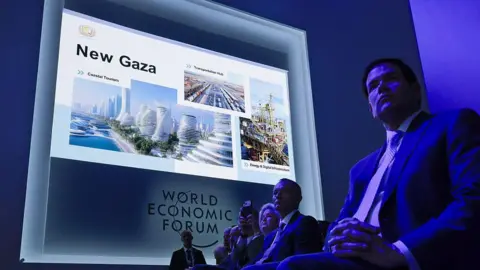
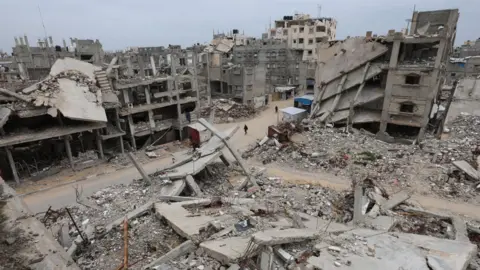
The US has unveiled its plans for a “New Gaza” that would see the devastated Palestinian territory rebuilt from scratch.
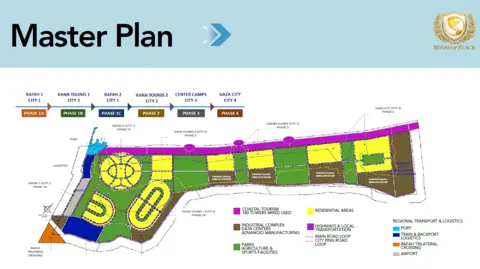
Slides showed dozens of skyscrapers stretching along the Mediterranean coast and housing estates in the Rafah area, while a map outlining the phased development of new residential, agricultural and industrial areas for the 2.1 million population.
They were presented during a signing ceremony at the World Economic Forum in Davos for President Donald Trump’s new Board of Peace, which is tasked with ending the two-year war between Israel and Hamas and overseeing reconstruction.
“We’re going to be very successful in Gaza. It’s going to be a great thing to watch,” Trump declared.
“I’m a real estate person at heart and it’s all about location. And I said: ‘Look at this location on the sea. Look at this beautiful piece of property. What it could be for so many people.'”
Trump’s son-in-law Jared Kushner, who helped broker the ceasefire that took effect in October, said 90,000 tonnes of munitions had been dropped on Gaza and there were 60 million tonnes of rubble to clear.
“In the beginning, we were toying with the idea of saying: ‘Let’s build a free zone, and then we have a Hamas zone.’ And then we said: ‘You know what, let’s just plan for catastrophic success’,” he told the ceremony.
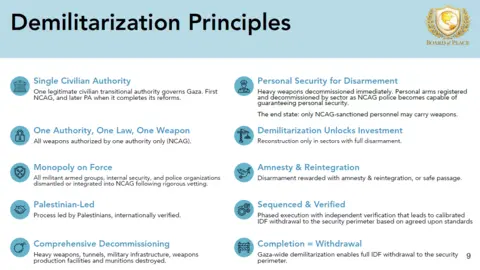
“Hamas signed a deal to demilitarise, that is what we are going to enforce. People ask us what our plan B is. We do not have a plan B.”


 Reuters
A map of the US “Master Plan” showed a zone reserved for “coastal tourism”, where there would be 180 tower-blocks as well a number of zones for “residential areas”, “industrial complex, data centres, advanced manufacturing” and “parks, agriculture and sports facilities”.
A new seaport and airport would be built near the Egyptian border, and there would a “trilateral crossing” where the Egyptian and Israeli borders converge.
Redevelopment would be divided into four phases, starting in Rafah and then gradually moving north towards Gaza City.
The map also featured an empty strip of land running along the Egyptian and Israeli borders. It appeared to mark what Trump’s 20-point peace plan refers to as the “security perimeter” where Israeli forces will remain “until Gaza is properly secure”.
 White House
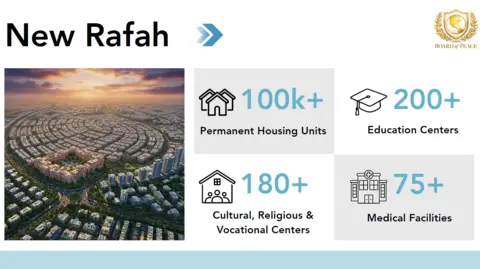
Another slide said “New Rafah” would have more than 100,000 permanent housing units, 200 education centres and 75 medical facilities.
About 280,000 people once lived in Gaza’s southernmost city, but it has been largely levelled by Israeli strikes and controlled demolitions during the war and is currently located inside Israeli-controlled territory.
Kushner said he believed it was “doable” to complete the construction of “New Rafah” in two to three years.
“We’ve already started removing the rubble and doing some of the demolition. And then New Gaza. It could be a hope, it could be a destination, have a lot of industry.”
In the coming weeks, he added, there would be a conference in Washington where contributions from countries would be announced and “amazing investment opportunities” for the private sector outlined.
Last February, Trump sparked outrage around the world when he suggested that Gaza’s Palestinians could be permanently relocated to neighbouring countries, with the US taking over the territory to transform it into “the Riviera of the Middle East”.
 White House
Kushner also declared that the demilitarisation of Gaza was “starting now”, noting that “without security nobody is going to make investments”.
He said the territory’s new technocratic Palestinian government, the National Committee for the Administration of Gaza (NCAG), would be “working with Hamas on demilitarisation to really take the principles that were agreed to in the document to the next phase”.
Hamas has previously refused to give up its weapons without the creation of an independent Palestinian state.
But Trump warned the group: “They have to give up their weapons and if they don’t do that, it’s going to be the end of them.”
 White House
Trump also insisted Hamas hand over the body of the last dead Israeli hostage in Gaza, which Israel said should have happened before phase two of the peace plan began last week.
Under phase one, Hamas and Israel agreed to the ceasefire, an exchange of all living and dead Israeli hostages in Gaza for Palestinians detained in Israeli jails, a partial Israeli withdrawal, and a surge in deliveries of humanitarian aid.
The ceasefire has remained fragile, with at least 477 Palestinians killed in Israeli strikes over the past three months, according to Gaza’s Hamas-run health ministry. The Israeli military says three of its soldiers have been killed in attacks by Palestinian armed groups.
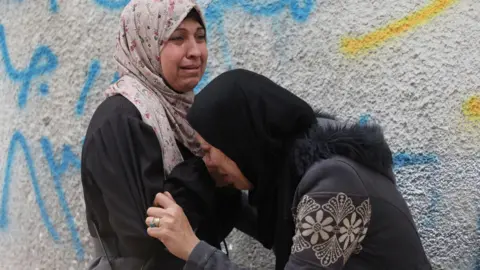
Five people were reportedly killed by Israeli fire across Gaza on Thursday, four of them in an artillery strike in the eastern Zeitoun neighbourhood of Gaza City.
Humanitarian conditions also still dire, with almost 1 million people lacking adequate shelter and 1.6 million facing high levels of acute food insecurity, according to the UN.
 Reuters
Hamas put out a statement on Thursday saying that it remained committed to the October agreement and accusing Israel of seeking to “undermine international efforts aimed at consolidating the ceasefire”.
Speaking at Davos, Israeli President Isaac Herzog praised the “efforts of President Trump and his leadership”. But he warned: “The real test has to be Hamas leaving Gaza”.
President Mahmoud Abbas of the Palestinian Authority (PA), which governs in parts of the occupied West Bank, called for the full implementation of the peace plan, including the withdrawal of Israeli forces, and a central role for the PA in administering Gaza.
The head of the NCAG, Ali Shaath, meanwhile announced that the Rafah border crossing with Egypt would open next week in both directions. It has been mostly closed since May 2024, when the Palestinian side was seized by Israeli forces.
“Opening Rafah signals that Gaza is no longer closed to the future and to the war,” he said.
The war was triggered by the Hamas-led attack on southern Israel on 7 October 2023, in which about 1,200 people were killed and 251 others were taken hostage.
Israel responded to the attack by launching a military campaign in Gaza, during which more than 71,560 people have been killed, according to the territory’s health ministry.