




The discovery of Gravitational Waves (GWs) in 2015 confirmed a prediction made by Einstein’s Theory of General Relativity and led to a revolution in astronomy. These waves are produced when massive, compact objects (such as black holes and neutron stars) merge, creating ripples in spacetime that can be detected millions of light-years away. A decade later, researchers from the University of Amsterdam (UvA) have proposed how GWs could be used to investigate an enduring cosmological mystery – the existence of Dark Matter.
The research comes from UvA’s Institute of Physics(IoP) and the Gravitation & Astroparticle Physics Amsterdam (GRAPPA). Their research, which is detailed in a paper published in the journal Physical Review Letters, introduces an improved way to model how Dark Matter is affected by GWs caused by black hole mergers. By analyzing GWs with next-generation instruments, scientists will be able to discern the presence of this mysterious mass, assuming (of course) that it exists.
The research was led by Rodrigo Vicente, Theophanes K. Karydas, and Gianfranco Bertone from the UvA-IoP and the GRAPPA centre of excellence for Gravitation and Astroparticle Physics Amsterdam. As they describe, their work focused on how black hole binaries or other compact objects (i.e., neutron stars) co-orbit with each other and spiral inward to become much more massive black holes – known as Extreme Mass-Ratio Inspirals (EMRIs).
*Still pic of a video simulation of the final merger of the black hole binary GW150914. Credit: LIGO*
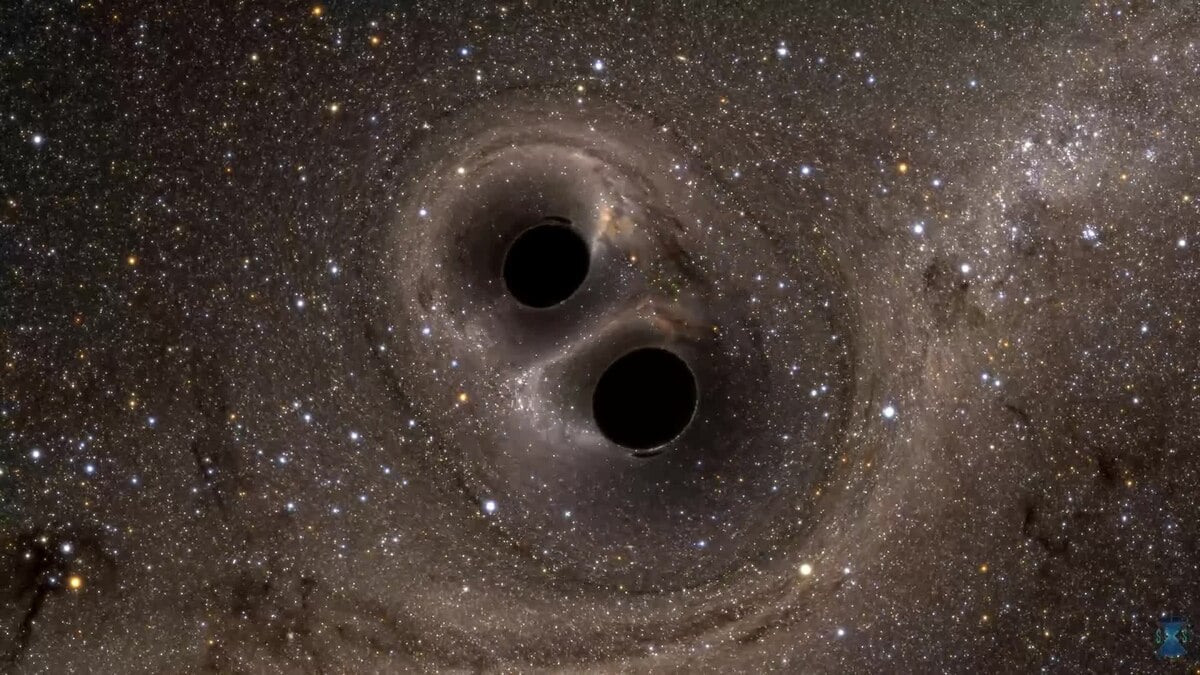
This research is part of a long-term effort to predict what astronomers should expect from GWs and how to extract as much information as possible from them. In the past, studies have typically relied on simplified descriptions of how a black hole’s environment affects EMRIs. In contrast, the new paper encompasses a broad range of environments using General Relativity rather than Newtonian gravity to describe how a black hole’s environment affects an EMRI’s orbit and the resulting GWs. In essence, this new study provides the first fully relativistic framework for predicting GWs caused by black hole mergers.
In particular, the study focuses on dense concentrations of Dark Matter that may form around massive black holes. By combining their relativistic description with state-of-the-art models, the team showed how DM “spikes” or “mounds” would leave a discernible imprint on GW signals. About a decade from now, the European Space Agency (ESA) plans to launch the Laser Interferometer Space Antenna (LISA), the first space-based observatory dedicated to studying GWs. Consisting of three spacecraft using six lasers to measure ripples in spacetime, this observatory is expected to detect over 10,000 GW signals on the course of its mission.
This work not only offers hints about what scientists will find thanks to LISA and other detectors, such as the Laser Interferometer Gravitational Wave Observatory (LIGO), the Virgo Collaboration, and the Kamioka Gravitational-wave Detector (KAGRA). It is also part of a growing field of research that proposes using GWs to map the distribution of DM throughout the Universe, which accounts for 65% of its mass. It is also expected to shed light on the nature of this mass and its composition.
Further Reading: UVA, Physical Review Letters