




(This view of the Valles Marineris canyon comes from Viking Orbiter 1.)
NASA / JPL-Caltech
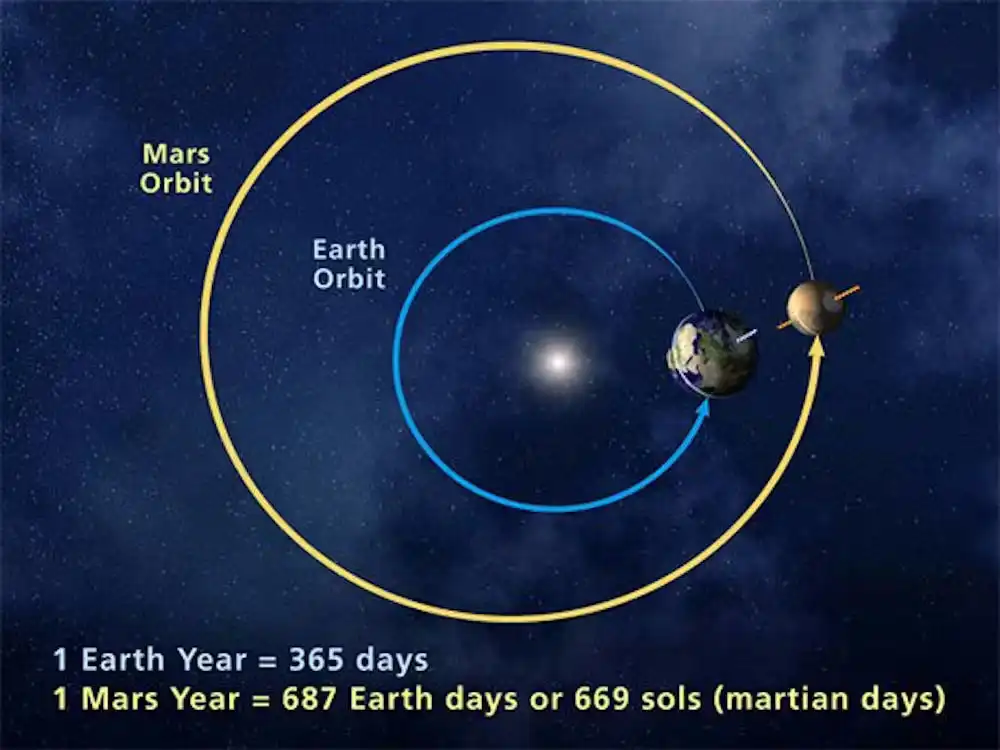
Puny Mars, weighing about 10 times less than Earth, might nevertheless pack a gravitational punch, subtly reshaping Earth’s orbit. The Red Planet might even have triggered ice ages and other large-scale climate shifts, according to a new study.
Earth’s long-term climate is influenced by gravitational interactions with other planets in the solar system, leading to what is known as Milankovitch cycles. These cycles reshape Earth’s orbit over time, changing the amount of solar energy our planet receives. The cycles are closely linked to wet and dry global periods, as well as to the advance and retreat of ice sheets and glaciers.
But the planets’ influence on each other is like a series of pendulums, and as a result, Milankovitch cycles span a wide range of recurring periods. Understanding these periods is even harder because the geological record becomes patchier and less precise as it goes further back in time.
Because all these pendulums are coupled, they create a complex array of cycles, says Stephen Kane (University of California, Riverside), lead author of the study. While some of these cycles stand out, there are a lot of minor cycles layered on top of them, Kane explains. “That’s why in the paper we often refer to bands of cycles rather than a specific cycle.”
One of the most well-known oscillations is powered by Venus and Jupiter, recurring about every 400,000 years. This cycle makes the changing elongation of Earth’s orbit (its eccentricity) even more pronounced, altering the contrast between seasons and inducing glacial cycles that affect erosion rates all over the planet, with variations measurable in records of ancient sediments.
NASA / JPL-Caltech
In recent years, Earth scientists have proposed the existence of a recurring cycle lasting roughly 2.4 million years that might help explain several geological and geochemical mysteries. One study linked this cycle to sediment erosion patterns found in ocean basins, while others suggested that oxygen levels in the oceans may have fluctuated in the same rhythm, with links to episodes of biological diversification such as the Cambrian explosion of marine life 540 million years ago.
These lines of research pointed to Mars as a possible driver. But Kane and his colleagues were skeptical that Mars could exert such a strong influence on terrestrial geological processes. So they conducted a series of computer simulations to test these ideas.
“I thought, come on, Mars doesn’t have enough mass for us to be able to see this in the sedimentary record,” Kane says. “I had always thought of Mars as too small a player within this system of coupled simple harmonic oscillators to really have this effect.”
NASA
The results proved him wrong. While some orbital oscillations are primarily driven by Venus and Jupiter, Mars plays a critical role in others. When Kane removed Mars from the simulations, two cycles — one lasting about 100,000 years and another about 2.4 million years — vanished entirely. Conversely, increasing the mass of Mars shortened the duration of these cycles, suggesting that the Red Planet’s gravitational influence is an important parameter in Earth’s orbital and climate history.
“The 2.4-million-year cycle, in particular, seems to permeate everything,” says biogeochemist Benjamin Mills (Leeds University, UK), who wasn’t involved in this study. “When we’re looking at deep time, we can’t really resolve things on thousand-year scales because we don’t have the sample resolution . . . but we can resolve things on million-year scales, and we see these 2.4-million-year cycles everywhere.” For example, both of the longer-period cycles are associated with Earth’s ice ages.
The simulations also showed that Mars affects Earth’s axial tilt, which came as an extra surprise. Earth’s rotation axis is inclined by about 23.5° to its orbit around the Sun, but this tilt varies slightly over time on a 40,000-year cycle. The researchers found that a more massive Mars would dampen these variations, stabilizing Earth’s tilt.
Mars’s outsized influence on Earth stems from its location rather than its mass. Orbiting farther from the Sun than Earth, Mars occupies a region where the Sun’s gravitational grip is weaker, giving the smaller planet a surprisingly large sphere of influence. At the same time, Mars occupies a delicate dynamical sweet spot where it can influence Earth’s orbit but not much else. In other words, “if we take away Mars, Earth notices but not many other people notice,” Kane says.
“The important thing for me is that Mars matters,” Kane says. The team’s findings appeared in Publications of the Astronomical Society of the Pacific.
The Mars Effect
Taken together, the results suggest that the presence of Mars has played a subtle but consequential role in shaping Earth’s climate, influencing glaciation patterns that, in turn, affect long-term habitability and the evolution of life.
“When we think about evolution and biodiversity we tend to think of environmental change as being some kind of trigger for evolution,” Mills says. There’s a big debate about how much the Cambrian explosion is tied to oxygen availability — whether these pulses of oxygen, coming and going, are what drove all this innovation in the animal world, he explains. “To now link that all the way back to Mars potentially is very, very cool.”
While it might seem that small orbital variations shouldn’t be able to heat or freeze a whole planet, small effects accumulate over long timescales and can trigger subtle geologic changes that end up having larger-scale impacts. For instance, erosion rates control the sequestration of carbon dioxide, which in turn changes ocean chemistry. These follow-on effects might matter more than energy input alone, Kane says.
The authors note that similar gravitational interactions may occur in planetary systems beyond our own. In such systems, relatively small neighboring planets — even those located far from the habitable zone — could nonetheless influence the climate stability and habitability of more favorably placed worlds.
However, detection methods can’t quite pick up these subtle interactions yet, especially for small planets like Earth and Mars. “What this study is saying is: We need to dig deeper; this is a problem we need to solve,” Kane says.