




When SpaceX’s fourth launch of an already busy year for spaceflight left Vandenberg Space Force base on Sunday, January 11th, it was carrying the small satellite Pandora as its primary mission. NASA’s space telescope is looking to characterize the atmospheres of 20 nearby exoplanets.
But also among the manifest of 39 additional CubeSats onboard were two other small astrophysics missions: the Star-Planet Activity Research CubeSat (SPARCS) and the Black Hole Coded Aperture Telescope (BlackCAT). These CubeSats will study low-mass stars and black holes, respectively.
Pandora, SPARCS, and BlackCAT all rode on Twilight, a SpaceX rideshare initiative that partners with ExoLaunch to deploy small, low-cost payloads to low-Earth orbit. SPARCS and BlackCAT have now joined the other rideshares in a steep-inclination, Sun-synchronous orbit, which allows solar-powered missions to stay charged in continuous sunlight. BlackCAT deployed at 2 hours and 20 minutes after launch, and SPARCS left the dispenser 20 seconds later. The two payloads are now in the catalog as NORAD COSPAR IDs 2026-004R/67378 (BlackCAT) and 2026-004V/67382 (SPARCS). (Second stage re-ignition and the following orbital fuel dump was also seen over Finland during a decent auroral display.)
NASA / SpaceX
The Science of SPARCS
Arizona State University
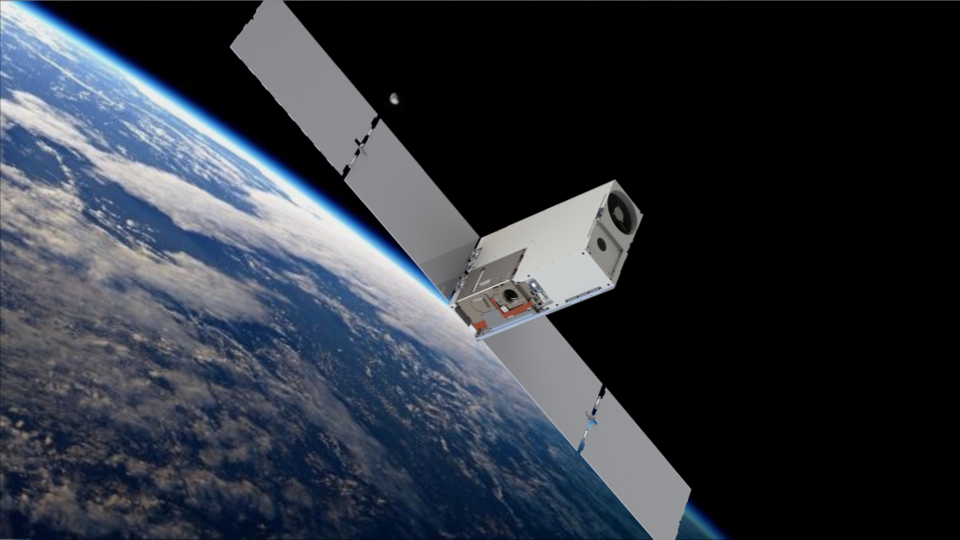
SPARCS, a collaboration between Arizona State University and NASA’s Jet Propulsion Laboratory, will look at ultraviolet emission from low-mass stars. The team is seeking to understand how flares impact the surrounding space-weather environment (and the planets in it).
To gauge the potential for life in these systems, astronomers must better understand the activity of low-mass stars, the most common in our galaxy but also the most volatile. They spew flares into the temperate zones around them, potentially stripping planets of their atmospheres. SPARCS will monitor the ultraviolet-spectrum activity of 20 target stars over a nominal one-year mission.
“For each target star, SPARCS will observe continuously over at least one complete stellar rotation (5 to 45 days),” says Evgenya Shkolnik (Arizona State University). “SPARCS will also advance ultraviolet-detector technology by flying high quantum efficiency, UV-optimized detectors. These ‘delta-doped’ detectors have greater than five times the quantum efficiency of the detectors used by the Galaxy Evolution Explorer (GALEX) mission.” GALEX was the last mission to explore the ultraviolet sky in such depth.
SPARCS will also serve as a pathfinder for a future NASA ultraviolet flagship missions, which is set to launch after the currently under-development Habitable Worlds Observatory, perhaps in the 2040s.
The Science of BlackCAT
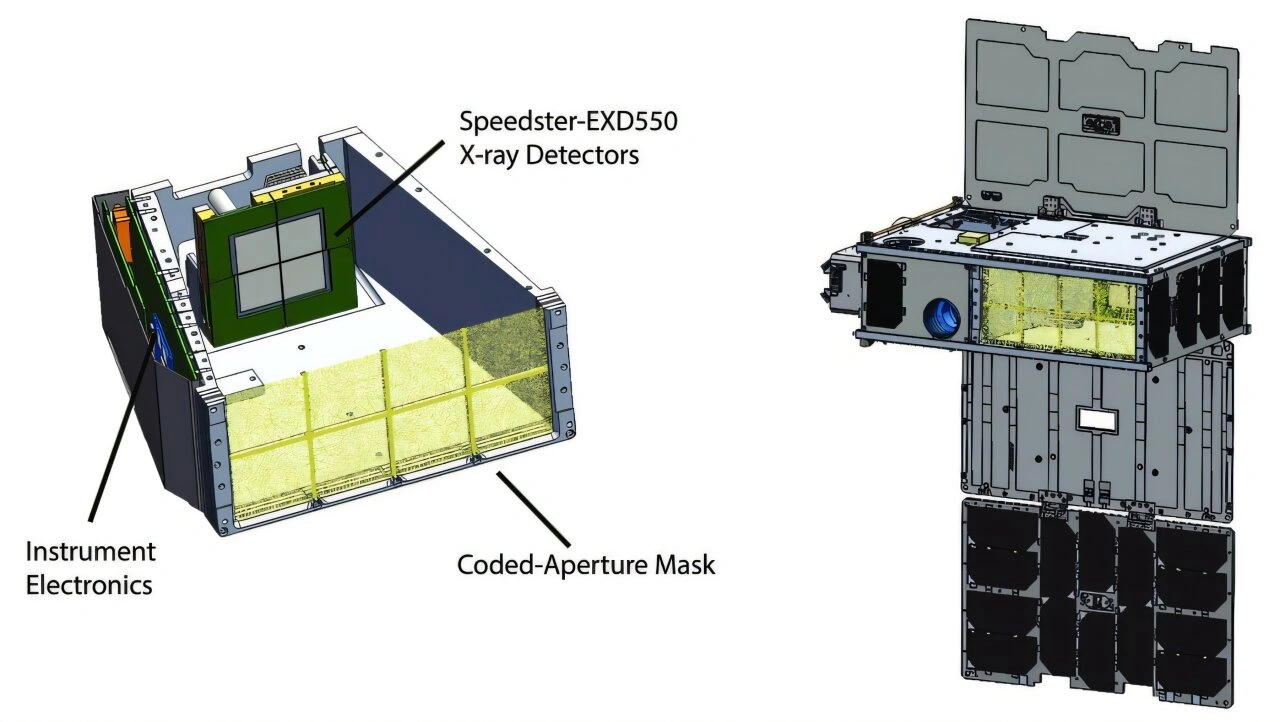
The other CubeSat, BlackCAT, will conduct a wide-field X-ray survey, looking for transient events from the early universe, including gamma-ray bursts and forming black holes. BlackCAT will complement NASA’s fleet of X-ray missions, which currently include Chandra, NuStar, IXPE, XRISM (a collaboration with JAXA), and the NICER instrument aboard the International Space Station. BlackCAT was designed and built by Pennsylvania State University in partnership with Los Alamos National Laboratory.
Penn State University
“We’re trying to find gamma-ray bursts that are particularly shifted down into the X-ray regime,” says Abe Falcone (Penn State University) in a recent press interview. The expanding universe steals energy from photons passing through it, such that the gamma rays that escape from a distant massive exploding star shift down to X-rays by the time we see it. “These particular gamma-ray bursts are ones that come from very far away, from the edges of the universe,” Falcone continues. “Those gamma-ray bursts had to come from stars, and when those stars end their lives in a cataclysmic way, they collapse down to a black hole, and if they’re spinning fast enough, that black hole spews out a jet with lots of radiation, and if that jet is pointed at us, we see it here in our telescope.”
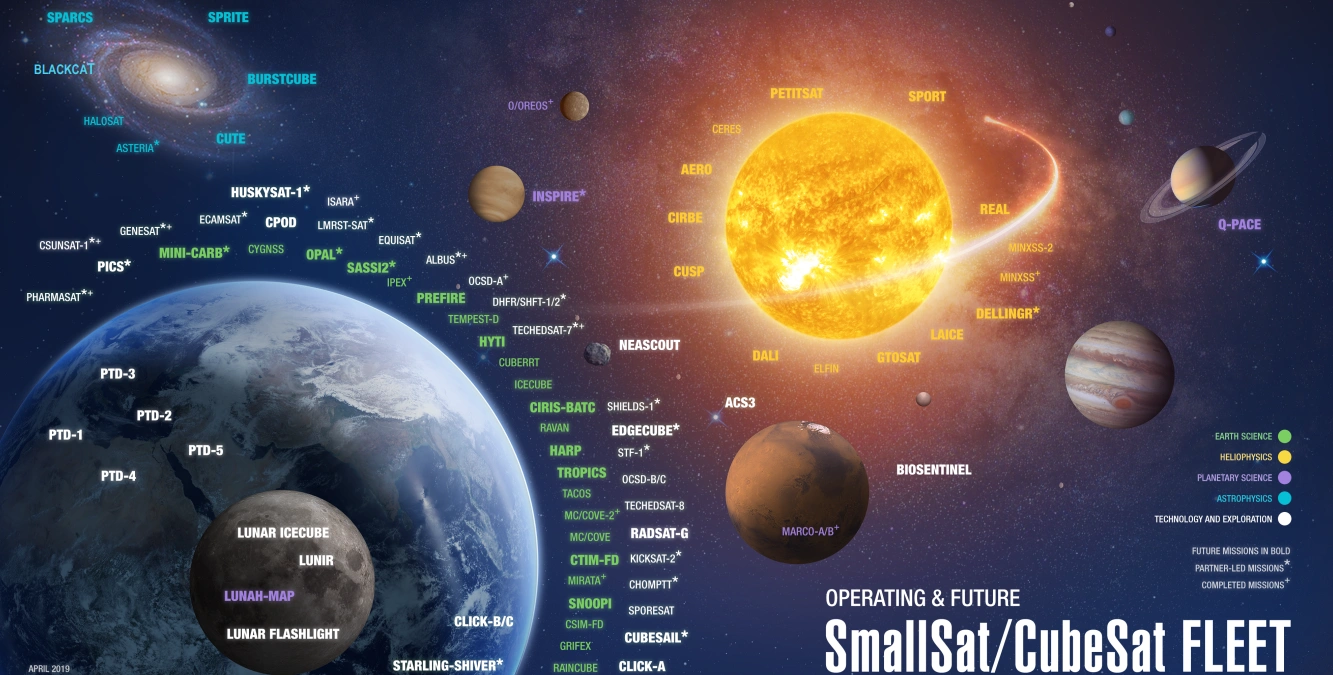
Following CubeSat launches remains one of the true enigmas of modern spaceflight. Many sites simply listed Twilight as containing “Pandora plus rideshares,” almost right up until launch. This is unfortunate, as some of these smallsat missions are just as interesting and crucial as the larger ones. I find that SpaceX’s launch deployment timeline gives me the most accurate view of the overall manifest of what’s actually onboard.
Arizona State University
I’ll have more practice this year, as there’ll be many more launches to come. Congrats to the Pandora, SPARCS, and BlackCAT teams on fielding their missions in a fast-paced time for astronomy and space exploration.