




The Catholic Church and world leaders are criticizing Israeli police after they prevented the Latin Patriarch of Jerusalem, Cardinal Pierbattista Pizzaballa, from entering the Church of the Holy Sepulchre to celebrate a Palm Sunday Mass. Israel said it was for the cardinal’s security amid the ongoing war with Iran.
The Latin Patriarchate of Jerusalem said in a statement that Pizzaballa and Reverend Fr. Francesco Ielpo were prevented from entering the church “as they made their way to celebrate” the Mass.
“As a result, and for the first time in centuries, the Heads of the Church were prevented from celebrating the Palm Sunday Mass at the Church of the Holy Sepulchre,” the statement said. “This incident is a grave precedent and disregards the sensibilities of billions of people around the world, who during this week, look to Jerusalem.”
The Israeli police told the Agence France-Presse that they had received a request from Pizzaballa and “it was clarified that it could not be approved” because of these restrictions, and noted that Jerusalem’s Old City is “a complex area that does not allow access for large emergency and rescue vehicles” in case of a “mass casualty incident.” Police did not specify what the request entailed.
Farid Jubran, the spokesperson for the Latin Patriarchate of Jerusalem, told the Associated Press that the church had requested permission for a few religious leaders to enter the church for a private Mass. Jubran said private masses have been held at the church since the war began.
The Patriarchate’s statement said Pizzaballa and Ielpo were stopped while proceeding privately, not as part of a procession or ceremonial act, and had to turn back. The organization said preventing their entry “constitutes a manifestly unreasonable and grossly disproportionate measure” and called the Israeli police’s decision “hasty and fundamentally flawed” and “tainted by improper considerations.”
Mahmoud Illean / AP
Israeli Prime Minister Benjamin Netanyahu said on X that Pizzaballa was stopped “out of special concern for his safety,” and there “was no malicious intent whatsoever.” Netanyahu said Iran has “repeatedly targeted holy sites” in Jerusalem with ballistic missiles, including one strike that resulted in missile fragments crashing “meters from the Church of the Holy Sepulchre.”
Netanyahu said Israel’s security forces are “putting together a plan to enable church leaders to worship” at the church “in the coming days.” Israeli president Isaac Herzog said on X he felt “deep regret” about the incident, and said that he spoke to Pizzaballa and “clarified Israel’s unwavering commitment to freedom of religion for all faiths and members of the various religions, and to maintaining the status quo at the holy sites in Jerusalem.”
Israeli police said that all holy sites in Jerusalem have been closed since the start of the war in Iran. Israeli officials have banned large gatherings, including at religious sites, and limited public gatherings to around 50 people. A traditional Palm Sunday procession that usually draws tens of thousands from around the world had already been cancelled by the Latin Patriarchate. Ceremonies were held in other churches, with limits on how many could attend.
Palm Sunday begins the Christian Holy Week, which ends with Easter. It symbolizes Christ’s final entry into Jerusalem, days before his crucifixion (which is marked with Good Friday) and resurrection (which is celebrated with Easter). The Church of the Holy Sepulchre marks the site of Jesus’ resurrection and is a major destination for Christians.
World leaders criticize police response
Mike Huckabee, the U.S. ambassador to Israel, called the police’s actions an “unfortunate overreach,” noting that the group was “well below” the 50-person gathering restriction.
“Churches, synagogues, and mosques throughout Jerusalem have met with the restrictions of 50 or less,” Huckabee said on X. “For the Patriarch to be barred from entry to the Church on Palm Sunday for a private ceremony is difficult to understand or justify.”
Huckabee said Israel indicated it would work with Pizzabella “to accommodate a safe means of carrying out Holy Week activities.”
The European Union’s top diplomat, Kaja Kallas, denounced the actions as a “violation of religious freedom.”
“The decision by Israeli police to bar Jerusalem’s Latin Patriarch from entering the Church of the Holy Sepulchre on Palm Sunday constitutes a violation of religious freedom and long-standing protections governing holy sites,” she said in a social media post. “Freedom of worship in Jerusalem must be fully guaranteed, without exception, for all faiths. Jerusalem’s multi-religious character must be protected.”
Italian Prime Minister Giorgia Meloni criticized the police’s actions, calling the incident “an offence not only to the faithful but to any community that respects religious freedom.” Italian foreign minister Antonio Tajani said on social media that he had summoned Israel’s ambassador to discuss the incident, which he called “unacceptable.”
French President Emmanuel Macron also condemned the incident and said worship “for all religions” must be guaranteed in Jerusalem. He added that the police action “adds to a worrying series of violations of the status of holy places in Jerusalem.”
The Jordanian foreign ministry said it “strongly condemned” the interaction, calling it a “flagrant violation of international law and international humanitarian law, as well as the prevailing legal and historical status quo, and an infringement on the unrestricted freedom of access to places of worship.”
Faiz Abu Rmeleh / Getty Images 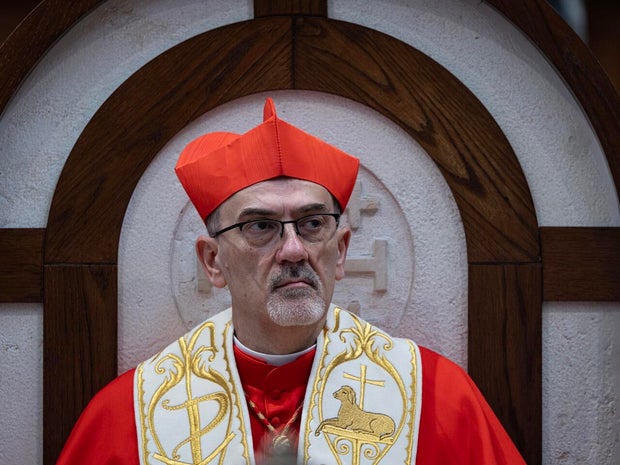
Pope Leo XIV paid tribute to “the Christians of the Middle East, who suffer the consequences of a terrible conflict and in many cases cannot fully live the rites of these holy days” in Rome on Sunday. The Vatican has not specifically commented on the police incident in Jerusalem.
Pizzaballa leads Mass, prayer for peace
Pizzaballa celebrated Mass in St. Savior’s Monastery, a nearby marble church located next to an underground music school that the Israeli military has deemed a safe shelter space, according to the Associated Press.
He later led a prayer for peace at the Dominus Flevit Shrine on the Mount of Olives. Pizzaballa addressed the limitations on celebrating Holy Week in his liturgy, which was shared online, but did not reference the morning’s events specifically.
“In this afternoon of Palm Sunday, we gather without a procession, without palms waving through the streets. This absence is not merely a matter of formalities. It is the war that has interrupted our festive journey, making even the simple joy of following our King difficult,” Pizzaballa said. “Our brothers and sisters of the Holy Land cannot fill the streets this Sunday nor join their voices to the festive procession.”
Pizzaballa said that Jerusalem “remains a sign of both hope and sorrow, of grace and suffering” and offered a message of hope.
“War will not erase the resurrection. Grief will not extinguish hope,” Pizzaballa said.
In Jerusalem’s Old City, Christian worshippers told the AFP they were mourning the traditional processions and activities.
“It’s very said this year. Because we are always used to the procession that starts from the Mount of Olives, but this year because of the precautions of the war it’s forbidden,” 51-year-old Andre, who gave only his first name, told AFP.
“This year, because of the war, we cannot celebrate in the streets like always,” Simon Hosh, 25, told AFP. “So this year we just celebrate in the church. It’s bad.”