




Noor NanjiCulture correspondent
 Thomas Samson via Getty Images
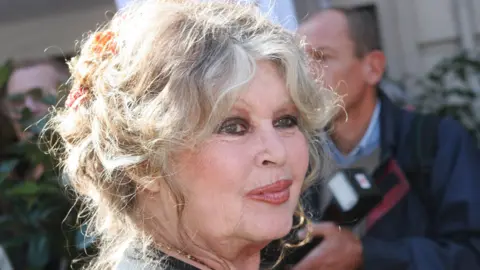
French actress Brigitte Bardot, who revolutionised 1950s French cinema and became a symbol of sexual liberation, has died age 91.
The cinema icon – BB as she was known in her home country – acted in almost 50 films, including And God Created Woman, but retired in 1973 to devote her life to animal welfare.
Paying tribute, President Emmanuel Macron said France is mourning “a legend of the century”, while the Brigitte Bardot Foundation remembered her as a “world-renowned actress”.
Later in life, Bardot’s reputation was damaged after she made homophobic slurs and was fined multiple times for inciting racial hatred.
In a statement, the animal welfare foundation she established said it was announcing her death with “immense sadness”.
The Brigitte Bardot Foundation said she was “a world-renowned actress and singer, who chose to abandon her prestigious career to dedicate her life and energy to animal welfare and her foundation.”
It did not specify where or when Bardot died.
In a tribute on social media, President Macron wrote: “Her films, her voice, her dazzling glory, her initials, her sorrows, her generous passion for animals, her face that became Marianne, Brigitte Bardot embodied a life of freedom.
“French existence, universal brilliance. She touched us. We mourn a legend of the century.”
Another who paid tribute was French far-right politician Marine Le Pen: “France loses an exceptional woman, through her talent, her courage, her frankness, her beauty.”
Bardot’s husband, whom she married in 1992, was Bernard d’Ormale, a former adviser to the late far-right politician Jean-Marie Le Pen – the father of Marine.


 Herbert Dorfman/Corbis via Getty Images
Brigitte Anne-Marie Bardot was born in Paris in 1934 to a wealthy family, who wanted her to become a ballerina.
She was discovered in her teens after posing on the cover of Elle magazine, swiftly becoming a sensation in her home country, and was persuaded to enter the cinema world.
She played iconic roles, the most notable in the 1956 film And God Created Woman, directed by her then-husband Roger Vadim, in which she played a sexually liberated woman.
The film scandalised the American public and was banned in some US states, while the French existentialist philosopher Simone de Beauvoir hailed her as an icon of “absolute freedom”.
Through the late 1950s and 1960s, she became a global phenomenon with roles in The Truth, earning critical acclaim for her dramatic depth; Contempt, a Jean-Luc Godard masterpiece; and Viva Maria!, showcasing her comedic flair alongside Jeanne Moreau.
Beyond her most iconic roles, Bardot showcased her versatility in films like Love on a Pillow, where she portrayed a complex, emotionally-torn character, and Two Weeks in September, a romantic drama that highlighted her ability to convey vulnerability.
In The Bear and the Doll, she brought playful charm to a comedic role, proving her range across genres. These films, though less celebrated, underscored her ability to captivate audiences in diverse narratives.
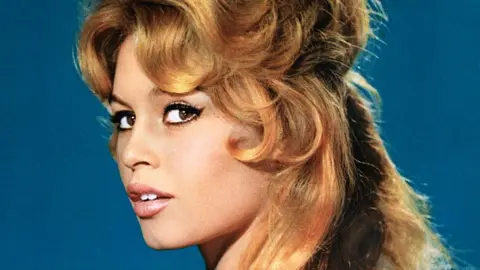
As well as her work in film, Bardot will also be remembered as a fashion icon, with her blonde tousled hair and bold eyeliner setting beauty trends worldwide. After wearing an off-the-shoulder number in Cannes in 1953, similar styles became known as the Bardot neckline.
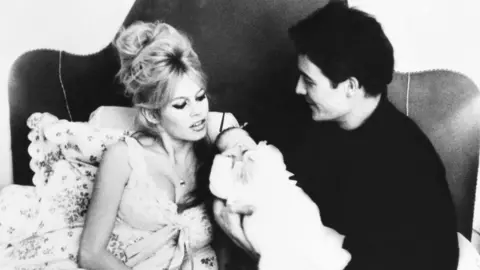
She was married four times and had one son, Nicolas, with French actor and film producer Jacques Charrier, who died in September.
Nicolas later sued his mother for emotional damage after she wrote in an autobiography that she would have preferred to “give birth to a little dog”.
 Keystone-France/Gamma-Keystone via Getty Images
Ruthlessly marketed as a hedonistic sex symbol, Bardot was frustrated in her ambition to become a serious actress.
At the height of her fame, she announced she was retiring at the age of 39 to devote her life to animal welfare.
“I gave my youth and beauty to men, I give my wisdom and experience to animals,” Bardot famously declared.
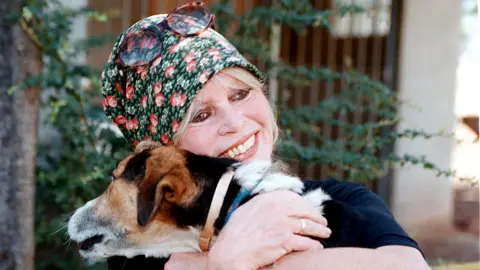
In 1986, she launched the Brigitte Bardot Foundation, which works to protect wild and domestic animals.
She became a vegetarian, and in 2013 even threatened to apply for Russian citizenship in protest against plans to kill two sick elephants in a French zoo.
Reacting to her death, France’s oldest animal protection association – The Société Protectrice des Animaux – paid tribute to an “iconic and passionate figure for the animal cause”.
 Charly Hel/Prestige/Getty Images
But for all her cinema successes and animal welfare work, Bardot leaves behind a controversial legacy, with a string of remarks later in her life about Islam, gay people and the #MeToo movement impacting her reputation.
From the late 1990s, Bardot was fined multiple times for inciting racial hatred after comments she made online and in interviews about Muslims. She was fined €15,000 (£12,000) in 2008 after complaining on her website that Muslims were “destroying our country by imposing their ways”.
Bardot faced fierce criticism for her 2003 book, A Cry in the Silence, where she argued gay people, modern art, politicians and immigrants destroyed French culture.
In 2018, Bardot also dismissed actresses who commented on sexual harassment via the #MeToo movement as “hypocritical, ridiculous, uninteresting”.
“There are many actresses who flirt with producers in order to get a role,” Bardot said in an interview with French magazine, Paris Match.