




Almost 12 years after Malaysia Airlines Flight 370 vanished over the Indian Ocean with 239 people on board, the search for the Boeing 777’s wreckage was scheduled to resume Tuesday in the Indian Ocean — supported by the latest advancements in deep-sea, self-guided drone technology.
MH370 took off from Malaysia’s capital Kuala Lumpur shortly after midnight on March 8, 2014. It should have been a routine, roughly six-hour flight north to Beijing.
About 40 minutes later, the aircraft’s transponder switched off, which made it disappear from civilian air traffic control monitors. Military radar, however, picked up the plane banking sharply west, back over the Malay Peninsula and out over the third largest body of water in the world, the vast Indian Ocean.
The initial search for the aircraft covered more than 46,000 square miles off the coast of western Australia, an area larger than the state of Virginia. But using drift analysis, incorporating data on the history of ocean currents and winds, the people in charge of the search have now narrowed down the area of highest probability for success to around 5,800 square miles.
JOHN SAEKI,NICHOLAS SHEARMAN
British-American deep sea robotics company Ocean Infinity has not revealed the location of the new search, but it hopes to finally solve the tragic mystery by deploying a fleet of the world’s most advanced underwater drones.
The drones, or autonomous underwater vehicles (AUVs), are capable of diving nearly 20,000 feet and running for up to 100 hours before they need to resurface. They’re equipped with side-scan sonar to create detailed 3D images of the seafloor — and anything on it — as they cruise near the bottom, following the contour up and down mountains and into trenches hidden in the abyss.
The AUVs can also use ultrasound imaging to peer beneath seafloor sediment that’s built up over the years, as well as magnetometers that could detect metals in the wreckage of the lost aircraft.
If an object of interest is detected, a remotely operated vehicle (ROV) would then be deployed to take a closer look.
To date, fewer than 30 fragments believed to be from MH370 have washed up on different shores across the Indian Ocean.
Yannick PotouI/AFP/Getty 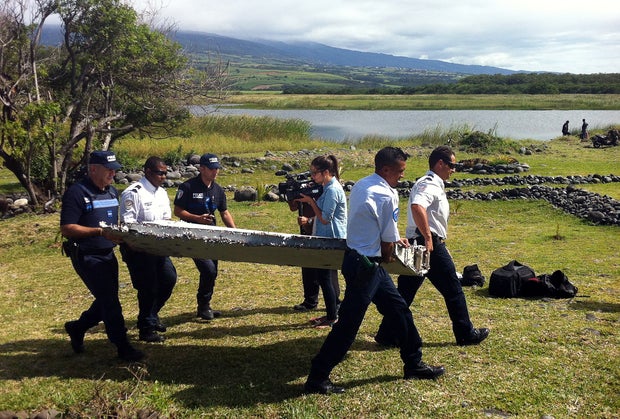
The first was found in 2015, on the French island of La Réunion, more than 400 miles off the eastern coast of Madagascar. A beach cleaner found a flaperon that would have helped the plane roll to the left or right during flight.
Through 2016, more fragments were found washed ashore on Madagascar itself, as well as in Mozambique, South Africa, Tanzania and Mauritius, including a door that covered the front landing gear, a flap from the right wing, and a panel from where a wing joined onto the aircraft’s fuselage — what should have been one of the aircraft’s strongest joints.
So far, no remains of the aircraft’s crew or passengers — who came from 14 countries including China, Australia, France, the United States, Ukraine and Russia — have been found.
Pedro PARDO/AFP/Getty 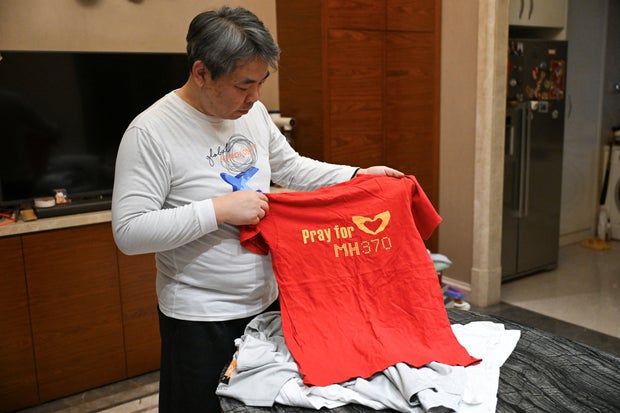
Malaysia’s government agreed to pay Ocean Infinity $70 million, but it has been labelled a “no-find, no fee” contract, meaning the company only gets paid if it finds the missing plane.
Given the huge amount of money invested in the search effort, $70 million wouldn’t actually be a massive payout, but Ocean Infinity would also be able to boast solving one of the world’s biggest aviation mysteries since American aviator Amelia Earhart vanished in 1937 somewhere over the central Pacific Ocean.