




Thousands of Iranians flooded the streets of Tehran and other cities Thursday night, heeding a call by the country’s exiled crown prince to make their voices heard in the most serious challenge to the Islamic Republic’s hardline rulers in many years.
The protests had spread across the country for 12 days, leaving dozens dead and more than 2,000 detained by security forces according to one monitoring group based outside the country, but despite the arrests and a nationwide internet and phone service blackout, the unrest escalated dramatically on Thursday night.
It was impossible to get a clear picture of the extent of the unrest, given the clamp down on the flow of information, but Iran’s ruler appeared in a brief television address on Friday morning, defiantly accusing President Trump of inspiring the protests, showing he remained in charge, and vowing that his regime would “not back down.”
Supreme Leader Ayatollah Ali Khamenei, 86, called for unity and accused “a bunch of vandals” in Tehran, where a state TV building was set alight, of having “destroyed a building that belongs to them to please the U.S. president.”
IRIB/Handout/Anadolu/Getty
As he spoke, an audience in front of him shouted the familiar refrain of “Death to America!”
Given the communications blackout, which continued Friday morning according to the NetBlocks internet monitoring organization, short videos posted online, largely by anti-regime activists, provided the only real window into the chaos across the country.
It appeared to ramp up dramatically from 8 p.m. local time on Thursday, the moment at which exiled Crown Prince Reza Pahlavi had urged Iranians to shout and chant from their windows against the regime.
“Iranians demanded their freedom tonight,” said Pahlavi, the son of the former head of state Shah Mohammad Reza Pahlavi, who fled the country just before the 1979 Islamic revolution that brought the current regime to power.
In statements posted online, he called for European leaders to join Mr. Trump to “hold the regime to account,” using “all technical, financial, and diplomatic resources available to restore communication to the Iranian people so that their voice and their will can be heard and seen. Do not let the voices of my courageous compatriots be silenced.”
Kamran/Middle East Images/AFP/Getty 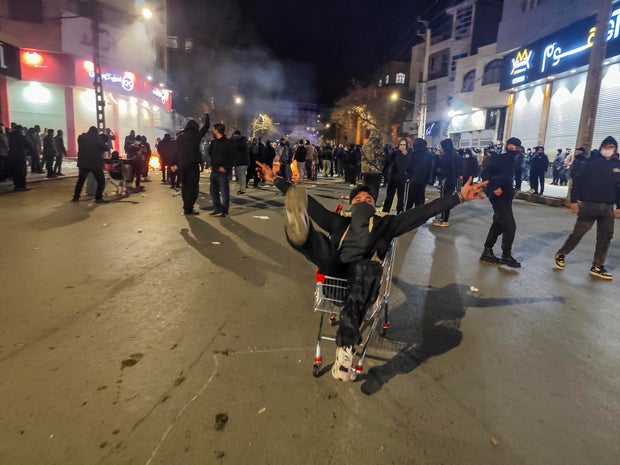
Pahlavi had issued his call several days earlier for mass chanting against the regime at 8 p.m., which is noon on the East Coast of the United States, on both Thursday and Friday, so it’s possible the regime will face another night of massive unrest.
In the videos, which are difficult to independently verify, many people could be heard chanting “Death to the dictator!” and “Death to the Islamic Republic,” while others called for a return of the monarchy, declaring: “Pahlavi will return!”
“All of the huge crowds in my neighborhood are pro-Pahlavi and from several areas my sources report the same — pro-Pahlavi crowds are prevailing, undeniably,” one source in Tehran told CBS News on Thursday night, calling it “monarchists responding to Reza,” before his communications were cut off.
Holly Dagres, a senior fellow at the Washington Institute for Near East Policy, said the crown prince’s rallying call appeared to have “turned the tide of the protests,” telling The Associated Press that, based on social media posts, “it became clear that Iranians had delivered and were taking the call seriously to protest in order to oust the Islamic Republic.”
“This is exactly why the internet was shut down: to prevent the world from seeing the protests. Unfortunately, it also likely provided cover for security forces to kill protesters,” said Dagres.
As of Thursday, the U.S.-based Human Rights Activists News Agency, which relies on a network of contacts inside the country, said at least 42 people had been killed and more than 2,270 others detained, but that was before a clear picture could be gained of the chaos on Thursday night and Friday morning.
Kamran / Middle East Images /AFP via Getty Images 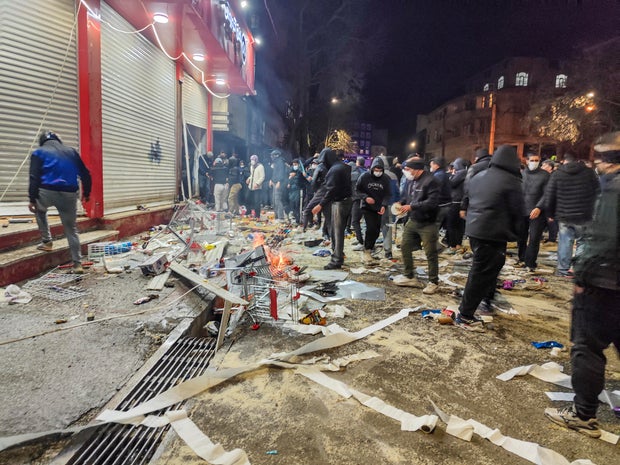
Echoing Khamenei, Iran’s state-controlled media on Friday accused “terrorist agents” of the U.S. and Israel of causing the violence. It acknowledged casualties, but gave no details.
The protests began on December 28 as merchants in Tehran closed their shops and took to the streets to vent anger over Iran’s long-ailing economy, which has been hobbled for years by global isolation and a raft of sanctions imposed by the U.S. and other nations over its nuclear program and backing of armed proxy groups across the region.
Iran’s autocratic regime has quashed several previous waves of unrest, violently, and the source in Tehran told CBS News there was significant fear among many people that the current protests would draw a similar draconian crackdown.
This time, however, the protests are playing out under the threat of a direct U.S. intervention by President Trump.
“I have let them know that if they start killing people, which they tend to do during their riots — they have lots of riots — if they do it, we are going to hit them very hard,” Mr. Trump said Thursday during a radio interview.
Vice President JD Vance told reporters at the White House that the U.S. stood by anyone engaged in peaceful protests in Iran. Asked if the U.S. would, as it did over the summer, join in any new Israeli strikes on Iran, Vance called on Tehran to negotiate with Washington over its nuclear program, but said he would “let the president speak to what we’re going to do in the future.”