




Celebrities came to Park City for the last time this weekend (presuming they don’t return to hit the slopes), including Dave Franco, Seth Rogen, O’Shea Jackson Jr., and Penelope Cruz. Three of the most anticipated movies of Sundance 2026 dropped over the first few days of the fest. They’re all, to varying degrees, worth a look.
Macon Blair became one of the most unexpected winners of the Grand Jury Prize for his 2017 directorial debut “I Don’t Feel at Home in This World Anymore,” but his follow-up, “The Toxic Avenger,” got lost in a distribution nightmare, making his latest pitch-black comedy a bit of a comeback. He’s not in competition this year, but he is back in his wheelhouse with “The Shitheads,” a Coen-esque comedy about colossal fuck-ups who end up stuck with a spoiled rich kid who doesn’t believe in consequences. “The Shitheads” gets a bit too messy in the final act, but it’s still a clever flick with an undercurrent of social commentary about how the bar for just being considered worthwhile in this world can depend on the size of your inheritance.
Davis (Jackson) is introduced as he’s being fired from his latest job overseeing troubled youth for taking them to see a very inappropriate movie. Totally adrift and questioning his faith, he gets a gig working for a low-level transport operation—a quick shot later in the film of the back room reveals boxes of lobsters and two shirtless men doing something with drugs, so it seems like they’ll move anything for the right price. In this case, what they’re being asked to move is a person: Sheridan Kimberley (Mason Thames of the “Black Phone” movies), one of those ultra-rich teenagers whose parents have left him with paid help so much that he’s basically become a sociopath. A viral personality for his Paul Brothers-esque online persona, Kimberley is being sent to a rehab facility—what happens when rich folk commit crimes—for lighting an unhoused man on fire for the clicks.
Davis is joined on this road trip with another recently-fired guy named Mark (Dave Franco), a serious drug user who just wants to get his money, get high, and go home. Franco is excellent as he leans into an archetype that characterized a lot of his brother’s roles years ago as the barely-lovable loser, a guy who’s not quite an idiot as much as he just doesn’t always make the right choices. In some of the film’s funniest beats, Sheridan spots that Mark is the weaker of the two almost immediately and starts fucking with his head. Before you know it, drugs have been ingested and a stripper (Kiernan Shipka) has been dispatched to the motel room they’re sharing for the night. Things get much worse from there.
Blair’s script isn’t just consistently funny; it’s also subtly sharp about what it says about class and the truly vile people who are allowed to do whatever they want within it. Sure, Mark and Davis are what might be called losers, but why? They make mistakes. They might not be that bright. But they don’t light people on fire for attention. They’re trying to find their way instead of being carried. And yet it’s the truly awful guy who has millions of followers. In the end, it’s a film that makes one reconsider its title. Is it the ordinary guys who are playing “Transporter”? Or could it be the millions of people who turn attention-seeking behavior into cultural currency?
Someone who would be interested in all the broad personalities of “The Shitheads” were they real people is the wonderful John Wilson, star of the HBO critical darling “How to with John Wilson.” The quirky documentarian is an underrated humanist, someone who is fascinated by people—what they do, what they feel, and how the two intersect. His latest, “The History of Concrete,” could be dismissed as a 100-minute episode of his show, but don’t let that dissuade you from seeing it. Yes, it has a similar vibe as Wilson follows rabbit holes that somehow connect the Parthenon to Hallmark Movies to DMX, believe it or not. Wilson has boundless interest in his subjects, and he’s made a film that’s ostensibly about concrete but becomes a study of what lasts in society, what has cracks, and what needs repair. It’s fantastic.
Wilson opens his film almost like a vlog, talking about how it’s been difficult to find a follow-up project to his hit show. As he’s exploring options, he attends a workshop during the strike of 2023 on how to write a Hallmark Movie of all things, where he learns about the formulas behind the only cable network that’s actually growing in viewership. His study of the Hallmark machine leads him to a cheesy rom-com that’s also somehow about affordable housing, which, along with problems with his own NY residence regarding a cracked foundation, leads him to consider concrete: its use, prevalence, and even its weaknesses. As you can imagine, selling his team and collaborators on a movie about concrete isn’t easy.
Of course, as with all things John Wilson, it isn’t just about concrete. While you will learn more about the gray stuff than you ever thought you would, it’s basically just a foundation (pun intended) for Wilson to meet people and find out about what moves them and defines them. When a potential financier says they need a musical element to ride the wave of successful streaming docs about musicians, he stumbles into the sphere of a New York artist who heads a local band called Nebulas. At one point, he find himself on the set of a micro-budget short film that seems to be about real estate and murder. He always swings back to concrete, especially how it’s utilized, but it’s a film about the people who work with concrete or even live on it more than the product itself. John Wilson projects are always more than they seem to be. I hope he makes many more of them.
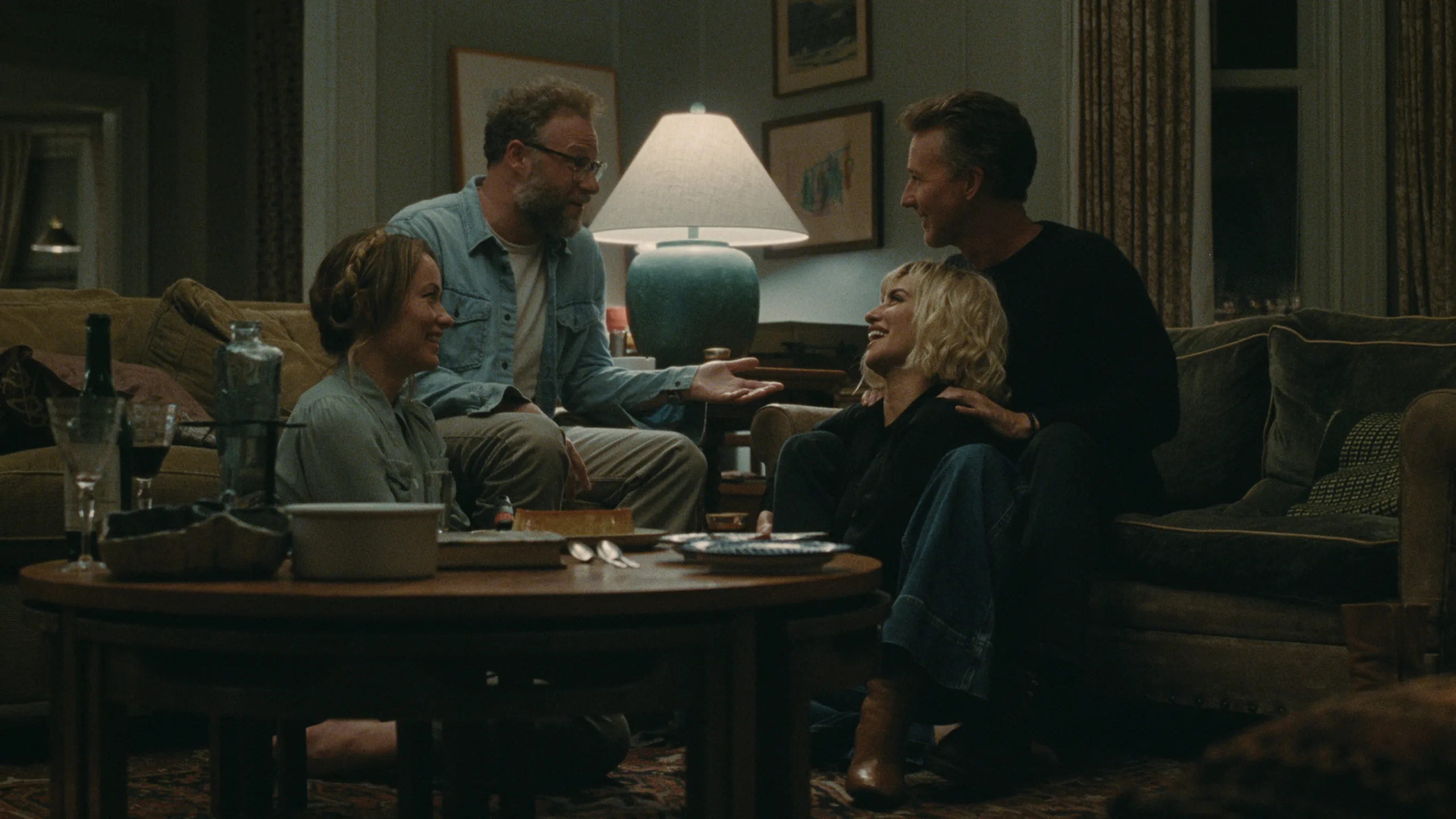
Finally, there’s Olivia Wilde’s “The Invite,” a variation on Who’s Afraid of Virginia Woolf? as a deteriorating couple struggle through a dinner with a pair of guests that they barely know. Wilde, also at Sundance as the star of “I Want Your Sex,” opens her film with a quote from a legendary writer with a shared surname. “One should always be in love,” wrote Oscar Wilde. “That’s the reason one should never marry.” Clearly, it’s going to be a bumpy ride.
The married couple on the ropes here are music teacher Joe (Rogen) and his wife Angela (Wilde). After a long day, he comes home to find Angela in a panic, setting up for a dinner party that she swears she told him about and that he denies knowing about. Which means he didn’t get any wine. She tells him that their upstairs neighbors Pina (Cruz) and Hawk (Edward Norton) will be there in ten minutes. And don’t touch the cheese plate.
From the very beginning of Rashida Jones and Will McCormack’s script, Joe is something of a petulant brat, insisting that the dinner party be canceled and refusing to support Angela’s plans. In a first act that feels too broad and overwritten too often, Wilde makes clear that these people can barely stand each other, going through the motions of a dissolving marriage.
Naturally, dropping gorgeous strangers into a fraught dynamic can only lead to trouble. It doesn’t help that Pina and Hawk are essentially the opposite of their neighbors. Pina is a therapist; Angela seems to struggle to access her own emotions, much less those of others. Hawk is a fireman who is honestly interested in other people; Joe has crippling back pain and borders on misanthropic. One of the things that’s been aggravating Joe is the loud sex that Hawk & Pina have been having that keeps him up at night; it’s not surprising to learn late in the film that Joe & Angela haven’t had sex in a very long time.
These opposing personalities bounce off each other with dialogue that alternates between witty and overwritten. There are just a few too many beats in “The Invite” that sound like writers instead of people, although the film does settle into a better groove as we learn more about these endless founts of witty bon mots.
It helps a great deal to have a quartet that’s this talented. Rogen takes the character that’s the most frustrating on the page—as funny as he can be in the context of the film, Joe is truly a tough guy to be around—and does the heavy acting work of finding the broken humanity underneath his assholery. As he almost always does, Norton makes smart, unexpected choices, especially late in one of the film’s best dramatic beats. Cruz is never bad and often great. And, of course, Wilde deserves credit for creating the right atmosphere as a director for her cast to find their characters.
My issues with “The Invite” are almost entirely on a screenwriting level. Something like this needs to hum with believability, and this often plays more like an acting exercise than a character study. That’s fine, of course, and “The Invite” is certainly worth seeing for its cast and funny moments, but when you endeavor to make a relationship dramedy like the Edward Albee and Woody Allen ones that shaped the form, one hopes for something that isn’t ultimately so shallow.