




YouTube creators can earn real income through multiple revenue streams once they meet specific eligibility thresholds. The platform offers everything from traditional ad revenue to fan funding, channel memberships, and brand partnerships. But here’s what most creators get wrong: they focus exclusively on ads while ignoring methods that often generate higher returns per engaged viewer.
I’ve been teaching digital marketing at Rutgers Business School and UCLA Extension for years, and I’ve watched the creator economy transform from a side hustle into a legitimate career path. In my book Digital Threads, I break down how video marketing fits into a broader digital strategy. And through my work as a Fractional CMO, I’ve helped businesses and creators alike understand what actually moves the needle on YouTube revenue.
The reality? Making real money on YouTube isn’t about get-rich-quick schemes. You need to understand how the YouTube Partner Program works, what each revenue stream actually pays, and which monetization methods align with your content style. This guide breaks down exactly how to qualify for each revenue stream, what you can realistically earn, and the specific steps to set up each monetization method.
Key Takeaways
✅ YouTube’s lower entry tier lets you start earning at just 500 subscribers through fan funding features like Super Chat and memberships
✅ Long-form video ad revenue splits 55% to creators and 45% to YouTube, while Shorts operate on a 45/55 split from a pooled revenue model
✅ Geographic location and content niche dramatically impact earnings, with US viewers generating significantly higher CPMs than other regions
✅ Diversifying across multiple revenue streams provides income stability when algorithm changes or seasonal ad spending fluctuations occur
✅ Channel memberships often generate more predictable recurring revenue than ad earnings, especially for channels with engaged audiences
What Is the YouTube Partner Program?
The YouTube Partner Program is YouTube’s official monetization system that gives creators access to nearly every revenue stream on the platform. Think of it as your monetization license. Without it, you cannot earn money directly through YouTube’s systems.
According to YouTube’s official Partner Program documentation, the program is the official way creators can earn money directly from their videos. When you join, YouTube allows ads, memberships, and other revenue features on your channel so you can get paid for the content you already create.
The program now operates on a two-tier structure based on your channel metrics. The lower tier grants access to fan funding features, while the higher tier unlocks full ad revenue potential. Most creators focus on the ad revenue tier, but the fan funding tier often generates more consistent income for channels with highly engaged audiences.
YouTube Partner Program Requirements: The Two Tiers
| Tier | Subscribers | Watch Hours/Views | Features Unlocked |
|---|---|---|---|
| Expanded YPP | 500 | 3,000 watch hours (12 months) OR 3M Shorts views (90 days) + 3 public uploads in 90 days | Super Chat, Super Thanks, Super Stickers, Channel Memberships, YouTube Shopping |
| Full YPP | 1,000 | 4,000 watch hours (12 months) OR 10M Shorts views (90 days) | All above + Ad Revenue Sharing |
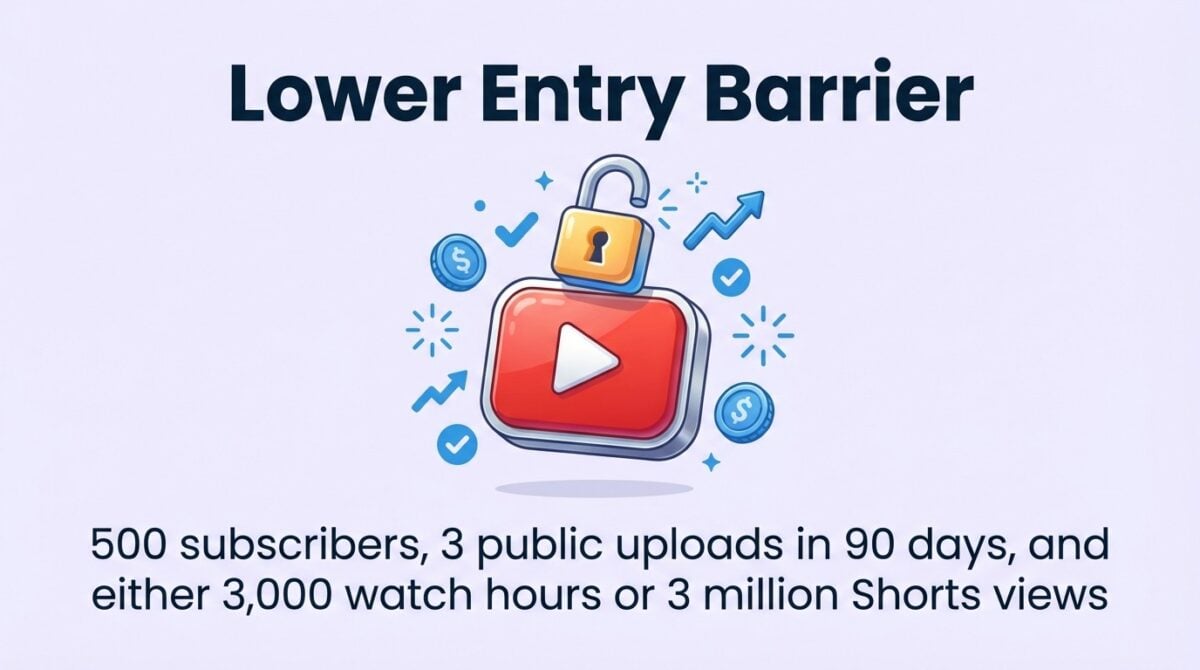
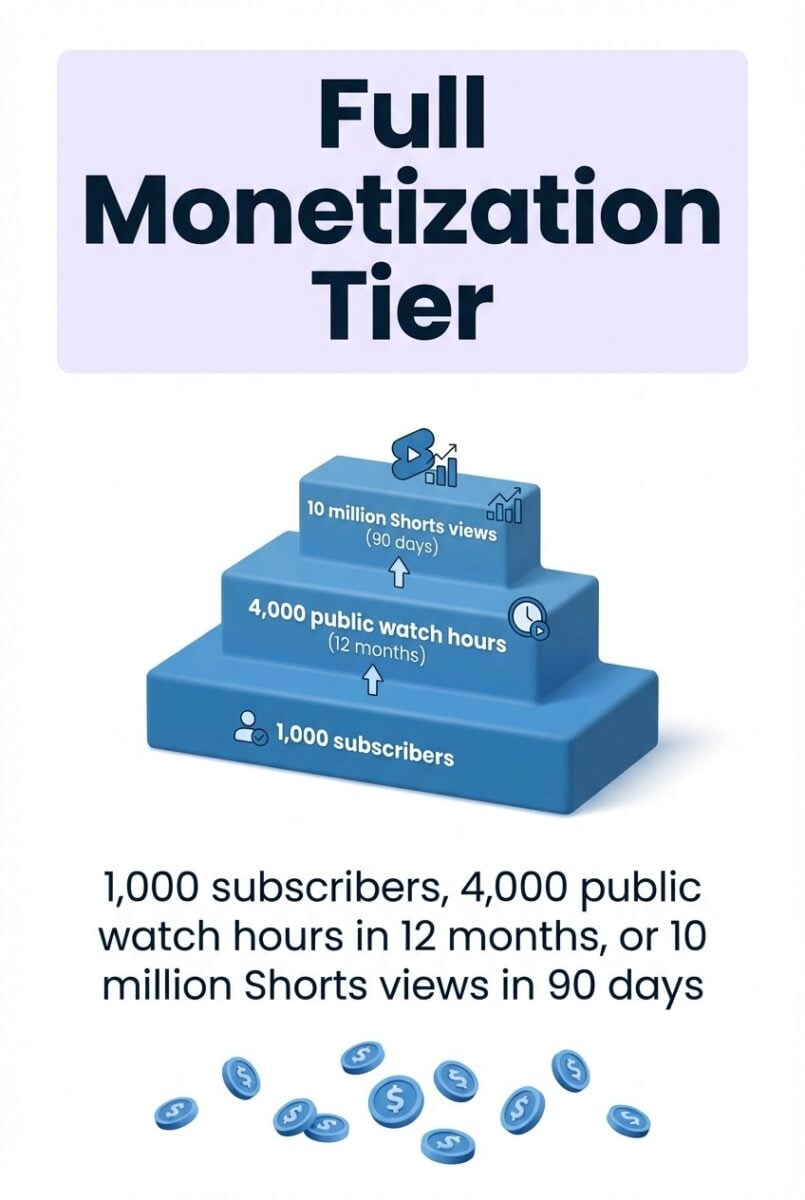
According to TubeBuddy’s monetization guide, YouTube monetization requirements include subscriber milestones, watch hours, and Shorts views, along with eligibility rules like location, originality, and AdSense setup.
For new channels, I recommend targeting the 500-subscriber threshold first. Once your channel crosses 500 subscribers, YouTube unlocks extra features like channel memberships, Super Chats, and shopping tools. However, unlocking YouTube ads (the most powerful monetization tool) still requires the higher milestone.
Beyond subscriber counts, you’ll need:
- An active Google AdSense account linked to your channel
- Compliance with YouTube’s monetization policies and community guidelines
- Residence in a country where the YouTube Partner Program operates
- Two-step verification enabled on your Google account
- No active Community Guidelines strikes
As of 2025, the YouTube Partner Program is available in over 120 countries. Check the official YouTube country eligibility list before applying.
The application process typically takes about 30 days. The platform uses a mix of automated systems plus human reviewers to ensure your channel meets all criteria.
Want to track your progress toward these thresholds? Check out my YouTube Money Calculator to estimate your potential earnings based on your niche and target audience.
How Much Do YouTubers Make? Understanding CPM and RPM
Before jumping into specific monetization methods, you need to understand the two metrics that determine your ad revenue: CPM and RPM.
CPM (Cost Per Mille) refers to the cost advertisers pay for 1,000 ad views on a video. RPM (Revenue Per Mille) is the actual revenue a creator earns per 1,000 views, after YouTube’s 45% cut.
Here’s the thing most creators miss: CPM varies wildly based on your niche, viewer location, and video length. A 10-minute finance video watched in the United States earns 10-20 times more than a 3-minute gaming video watched in developing countries.
Is Your LinkedIn Not Delivering Results?
Just released: my new book to help professionals, entrepreneurs, and business owners maximize LinkedIn for real growth.
With years of LinkedIn expertise, Maximizing LinkedIn for Business Growth offers actionable steps to build your brand, expand your network, and drive results.
Start leveraging LinkedIn like never before—grab your copy now! Click the cover or button below to buy on Amazon.

CPM Rates by Country (2025 Data)
| Country | Median CPM |
|---|---|
| United States | $11.95 |
| Australia | $8.93 |
| Norway | $8.19 |
| Switzerland | $7.00+ |
| United Kingdom | $7.00+ |
| Global Median | $2.91 |
According to Digital Information World’s analysis of CPM data, median CPM figures from 50 countries put the global midpoint at $2.91 per thousand ad views, with the United States coming in at $11.95, the highest in the dataset.
As reported by Stan Store’s creator earnings analysis, creators in finance or tech can easily see RPMs of $10 to $20, while general entertainment averages around $2 to $4. With an RPM of $2 to $10, 10 million views can bring in anywhere from $20,000 to $100,000.
For a deeper dive into YouTube earnings potential, check out my guides on how much YouTubers make and how much YouTube pays per view.
1. How Do You Earn Money Through YouTube Ad Revenue?
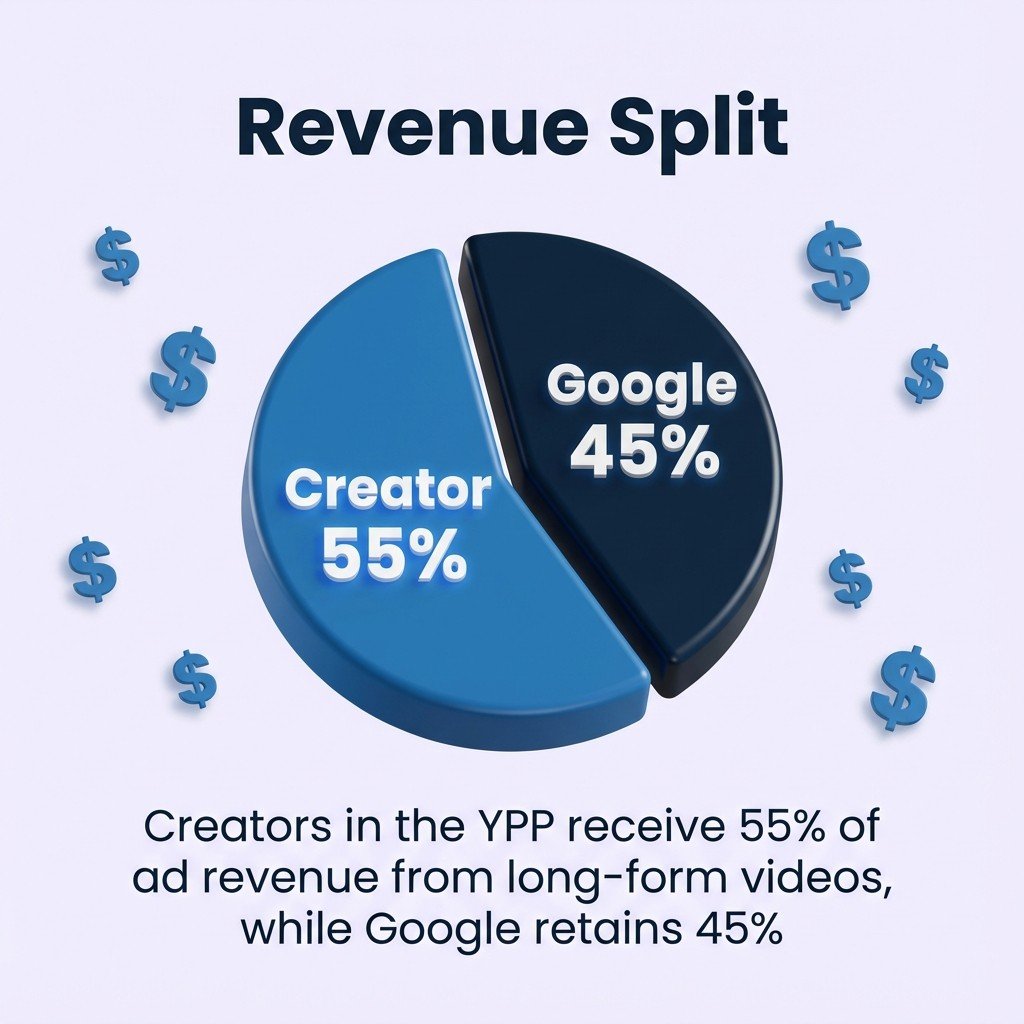
Ad revenue forms the foundation of most YouTube earnings once you reach the 1,000 subscriber threshold. According to TubeBuddy’s CPM and RPM guide, for any views generated, YouTube gives creators the majority share: 55%, and takes the remaining 45%.
How YouTube Ad Revenue Actually Works
Advertisers bid to show ads on your videos through Google’s auction system. Higher-value niches like finance, business, and insurance attract bigger advertising budgets. YouTube places ads before, during, and after your videos based on length and the ad settings you choose.
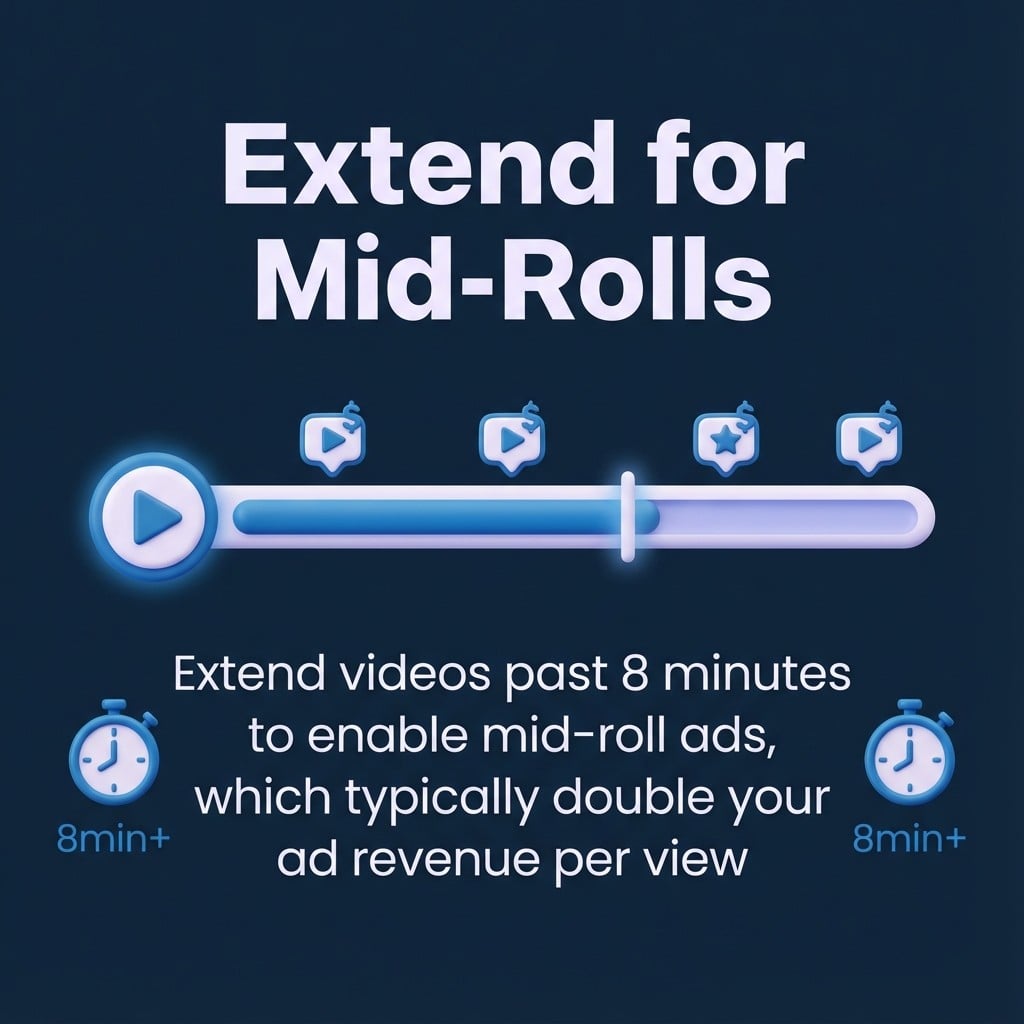
Longer videos also allow you to insert more breaks for mid-roll ads, increasing your potential to earn more revenue. Videos over 8 minutes qualify for mid-roll ads, which typically double your ad revenue per view.
| Video Length | Ad Types Available | Revenue Potential |
|---|---|---|
| Under 8 minutes | Pre-roll, post-roll | Baseline |
| 8+ minutes | Pre-roll, mid-roll, post-roll | 2x baseline |
| 20+ minutes | Multiple mid-rolls | 3x+ baseline |
YouTube creators can expect to make around $5 to $7 per 1,000 ad views. For every million views your videos receive, potential earnings would likely range somewhere between $1,200 to $6,000, considering all factors.
Maximizing Your Ad Revenue
Create content in high-CPM niches if revenue is your primary goal. According to Social Rails’ YouTube earnings calculator data, finance, insurance, B2B software, and investing content has 3 to 10x higher CPM than gaming or entertainment.
Focus on viewers from high-value countries. Views from the United States, Canada, Australia, the UK, and Western Europe often have higher CPMs than views from regions with lower advertiser demand.
Want to optimize your video content for better reach? My guide on YouTube SEO covers the strategies that help videos rank higher and attract more monetizable views.
2. How Much Can You Make from YouTube Shorts?
YouTube Shorts monetization works differently than traditional video ad revenue. According to YouTube’s official Shorts monetization policies, each month, revenue from ads appearing between videos in the Shorts Feed is pooled together and used to reward Shorts creators and cover the costs of music licensing. From the overall amount allocated to creators (also known as the Creator Pool), they keep 45% of the revenue, regardless of whether they use music in their Shorts.
The Shorts Revenue Model Explained
If a monetizing creator uploads a Short without any music, all of the revenue associated with it goes into the Creator Pool. If the Short features 1 music track, half of the revenue associated with its engaged views would be allocated to the Creator Pool. If the Short features 2 music tracks, then one third of the revenue associated with its engaged views would be allocated to the Creator Pool.
| Music Tracks Used | Revenue to Creator Pool | Revenue to Music Licensing |
|---|---|---|
| 0 (No music) | 100% | 0% |
| 1 track | 50% | 50% |
| 2 tracks | 33% | 67% |
According to Zebracat’s YouTube Shorts statistics report, the average RPM (Revenue per Mille) for Shorts is $0.75 to $2.50, depending on the niche and region. Compared to long-form videos, Shorts RPM is 60 to 80% lower due to shorter watch time and limited ad placements.
vidIQ’s Shorts monetization guide reports that earnings vary, but many creators make between $0.03 and $0.10 per 1,000 views. For example, a Short with 1 million views might earn between $30 and $100.
Strategic Shorts Implementation
Shorts offer a faster path to the initial 500-subscriber threshold. The 3 million Shorts views requirement seems massive, but popular Shorts accumulate views exponentially faster than long-form content. A single viral Short can generate millions of views overnight.
Use Shorts to grow your channel and funnel viewers to long-form content where you make real money.
According to Shopify’s Shorts monetization analysis, over 80% of those who joined through the Shorts criteria are now taking advantage of other monetization features like long-form ads and memberships.
Learn how to create effective short-form content with my guides on how to make YouTube Shorts and YouTube Shorts monetization.
3. How Do Channel Memberships Generate Recurring Revenue?
Channel memberships convert your most engaged viewers into paying subscribers. This feature becomes available at the 500-subscriber threshold, making it accessible long before you can monetize through ads.
The key advantage? Predictable recurring revenue. Unlike ad revenue that fluctuates with views, membership income remains stable month over month. A channel with 100 paying members at $5 monthly generates $500 guaranteed income regardless of video performance.
Setting Up Membership Tiers
YouTube allows up to five membership tiers at different price points. Most successful channels start with one or two tiers priced between $2.99 and $9.99 monthly.
According to Earnpace’s channel memberships guide, YouTube takes 30% of your membership earnings. So a $4.99 membership pays you roughly $3.50 per member per month.
You keep 70% of that income. Even 100 loyal members at $4.99 can bring in $350/month after YouTube’s cut.
| Membership Tier | Price | Your Revenue (70%) | With 100 Members |
|---|---|---|---|
| Basic | $2.99 | $2.09 | $209/month |
| Standard | $4.99 | $3.49 | $349/month |
| Premium | $9.99 | $6.99 | $699/month |
Popular Membership Perks
Create meaningful perks that don’t require excessive ongoing work:
- Custom emoji and badges (one-time setup, lasting value)
- Members-only community posts
- Early video access
- Behind-the-scenes content
- Priority comment responses
- Monthly exclusive live streams
Start with 1 to 2% of your subscriber base converting to members as a realistic initial goal. Channels with highly engaged communities sometimes hit 3 to 5% conversion rates.
For strategies on building an engaged audience, check out my guide on how to get subscribers on YouTube.
4. What Are Super Chat, Super Stickers, and Super Thanks?
These three fan funding features let viewers pay to highlight their messages during live streams and video comments. All three become available at the 500-subscriber threshold.
Super Chat and Super Stickers (Live Streams)
Super Chat works during live streams. Viewers purchase highlighted messages that stay pinned in the chat for a set duration based on payment amount. Amounts range from $1 to $500.
According to YouTube’s official Super Chat documentation, creators receive 70% of Supers revenue that is confirmed by Google. The 70% is calculated after local sales tax and App Store fees on iOS are deducted.
The more they pay, the longer their message stays pinned and the more visible it becomes. Messages can stay pinned for up to 5 hours.
Super Thanks (Regular Videos and Shorts)
Super Thanks allows viewers to purchase highlighted comments on regular uploaded videos. The feature adds a “Thanks” button below your videos where viewers can buy a one-time highlighted comment. Amounts range from $2 to $50.
With just 500 subs, you can collect Super Thanks revenue on your YouTube Shorts. These are “video tips” ranging from $2 to $50 that your fans can send to support individual videos.
Live streaming consistently builds a community that uses Super Chat regularly. Interactive content drives higher Super Chat volumes. Q&A streams, live reactions, and real-time tutorials encourage viewer participation more than passive content.
5. How Can You Sell Products Through YouTube Shopping?
YouTube Shopping integrates e-commerce directly into your videos and live streams. Tag products in your content, and viewers can browse and purchase without leaving YouTube.
The shopping feature requires at least 1,000 subscribers and acceptance into the YouTube Partner Program. Connect your Shopify store or other supported e-commerce platform through YouTube Studio to activate product tagging.
Merchandise Sales
Print-on-demand services like Teespring integrate directly with YouTube. Design t-shirts, hoodies, mugs, and other products featuring your channel branding. YouTube displays a merchandise shelf below your videos automatically once connected.
There’s no item limit in 2025: Unlike the old cap of 12 products, you can now sell as many as your partner allows. Perfect for creators who want to turn their channel into a storefront.
Affiliate Marketing Integration
Affiliate marketing pays commissions when viewers purchase products through your unique affiliate links. Tech review channels, tutorial creators, and product recommendation channels generate substantial affiliate income alongside ad revenue.
Create dedicated product review or recommendation videos that naturally incorporate affiliate links. Tutorial videos showing how to use specific tools or products convert better than generic “top 10” lists.
For more on creating effective product content, see my guide on product videos.
6. How Do You Secure Brand Partnerships and Sponsored Content?
Brand partnerships and sponsored content often generate more revenue per video than ad revenue, especially for channels with highly engaged niche audiences. Companies pay creators flat fees regardless of view count to feature their products or services.
Here’s what works: direct value creation for brands. A channel with 10,000 engaged subscribers in a specific niche often secures bigger sponsorship deals than a channel with 100,000 general entertainment subscribers. Brands pay for access to their target customers, not raw view counts.
Landing Your First Sponsorships
Build a media kit showcasing your channel statistics, audience demographics, and engagement rates. Include:
- Subscriber count and average views per video
- Audience age ranges and geographic distribution
- Typical engagement percentages
- Examples of previous brand collaborations
According to vidIQ’s analysis, 26% of marketers said they plan to invest in short-form content more than they did in 2024. Brands are excited to partner with short-form creators, who bring 2.5 times more engagement than long-form videos.
Sponsorship Pricing Guidelines
| Channel Size | Typical Sponsorship Range |
|---|---|
| 1K to 10K subscribers | $50 to $300 per video |
| 10K to 100K subscribers | $500 to $2,000 per video |
| 100K+ subscribers | $2,000+ per video |
According to MilX’s live streaming monetization guide, small streamers (1K to 10K subs) can land $50 to $300 deals, while mid-sized creators (10K to 100K subs) often earn $500 to $2,000+ per stream.
Require creative control over the integration. The best sponsorships let you present the product in your authentic voice. Viewers detect and reject forced sponsorships immediately, hurting both brand results and your channel reputation.
Disclose all sponsorships clearly. YouTube requires creators to mark sponsored content using the built-in disclosure feature. For more on disclosure requirements, see my guide on FTC influencer guidelines.
7. Can You License Your Content to Media Outlets?
Licensing content to media outlets provides unexpected revenue for creators whose videos go viral or capture newsworthy moments. News organizations, entertainment shows, and digital media companies pay for rights to use viral clips.
Viral videos, unique footage, or timely content attracts media licensing opportunities. A video capturing an unusual event, heartwarming moment, or breaking news can generate thousands in licensing fees from multiple outlets.
Content Licensing Process
Register with licensing platforms like Jukin Media, ViralHog, or Newsflare. These services monitor for viral content, then handle licensing negotiations on your behalf in exchange for a commission percentage.
Maintain clear ownership of your content. Never use copyrighted music, footage, or other materials you don’t own. Media companies only license content with clean rights.
How Should You Build Your Monetization Strategy by Channel Size?
The most successful YouTube creators diversify across multiple revenue streams rather than relying solely on ad revenue. This approach provides income stability when algorithm changes affect views or when advertiser budgets fluctuate seasonally.
Revenue Stream Priority by Channel Size
| Channel Size | Primary Revenue Sources | Focus Strategy |
|---|---|---|
| 0 to 500 subscribers | Affiliate marketing, small sponsorships | Growth and audience building |
| 500 to 1,000 subscribers | Memberships, Super Thanks, sponsorships | Fan funding activation |
| 1,000 to 10,000 subscribers | Ad revenue, memberships, sponsorships | Diversified monetization |
| 10,000+ subscribers | All streams, premium sponsorships | Revenue optimization |
According to Social Rails’ earnings data, with 1,000 subscribers (minimum for monetization), most YouTubers earn $10 to $100/month from ads alone, depending on views. Add sponsorships and other income streams to potentially earn $100 to $500/month.
Channels with 100K+ subscribers and consistent uploads can earn $2,000 to $10,000+/month. Many full-time YouTubers earn $50,000 to $500,000+ annually through ads, sponsorships, and products.
For strategies on growing your channel at each stage, check out my guides on how to become a YouTuber and how to get more views on YouTube videos.
What Success Factors Matter Most for YouTube Monetization?
Consistency in upload schedule matters more than perfection in individual videos. Channels that publish reliably every week grow faster and monetize better than channels posting sporadically, even if the sporadic videos have higher production value.
Content Quality Standards
Original content with clear value passes Partner Program review and attracts paying sponsors. Focus on solving specific problems, teaching valuable skills, or entertaining in unique ways.
Audio quality matters more than video quality for most content types. Viewers tolerate mediocre lighting or basic editing, but poor audio causes immediate abandonment.
Thumbnail and title optimization dramatically affects view counts, which directly impacts all monetization methods. For thumbnail best practices, see my guide on YouTube thumbnails.
Watch Time and Engagement Metrics
Watch time percentage indicates content quality to YouTube’s algorithm. Videos that retain 50% or more of viewers through the entire duration get promoted more aggressively than videos with 30% retention.
Watch time is the hidden currency of YouTube. The longer viewers stay on your video, the more ad inventory YouTube can sell, and the more you earn.
For comprehensive video content ideas, explore my YouTube video ideas guide.
What Compliance and Policy Requirements Must You Follow?
YouTube’s monetization policies determine whether you can earn money through the platform. Violations lead to demonetization, channel strikes, or permanent removal from the Partner Program.
Copyright and Reused Content
Original content is mandatory for sustained monetization. Channels that primarily upload compilations, reactions with minimal commentary, or reposted content from other creators face demonetization.
Only “original” Shorts count. Views from reused TikTok videos, copied clips, or content with watermarks won’t be counted.
Music licensing causes most copyright issues. Use YouTube’s Audio Library for free music, purchase licensing from services like Epidemic Sound, or create original audio.
Community Guidelines and Strikes
YouTube pays close attention to policy violations, and even a single strike can slow down or block your application.
Common violations include misleading thumbnails, spam, impersonation, and harassment. Self-censoring certain words or topics in the first 30 seconds helps maintain monetization status, as YouTube’s automated system heavily weights video openings.
Frequently Asked Questions
You need 500 subscribers to access fan funding features like Super Chat, Super Thanks, and channel memberships through YouTube’s expanded Partner Program. For ad revenue sharing, you need 1,000 subscribers plus either 4,000 watch hours in 12 months or 10 million Shorts views in 90 days.
YouTube pays creators approximately $1 to $5 per 1,000 views after YouTube’s 45% cut, though this varies significantly by niche and viewer location. Finance and tech channels can earn $10 to $20 per 1,000 views, while entertainment content averages $2 to $4. US viewers generate the highest CPMs at around $12 median.
Yes, YouTube Shorts can earn money through the Partner Program’s revenue sharing model. Creators keep 45% of their allocated share from the Shorts ad revenue pool. Earnings typically range from $0.03 to $0.10 per 1,000 views, significantly lower than long-form content but with higher viral potential.
YouTube aims to review Partner Program applications within 30 days, though delays can occur during high-volume periods. The review process uses both automated systems and human reviewers to ensure channels meet all policies and guidelines. Rejected applicants can reapply after 30 days (first rejection) or 90 days (subsequent rejections).
YouTube takes 45% of ad revenue from long-form videos (creators keep 55%) and 55% from Shorts revenue (creators keep 45%). For Super Chat, Super Thanks, and Super Stickers, YouTube takes 30% (creators keep 70%). Channel memberships also follow the 70/30 split in favor of creators.

Start Your YouTube Monetization Journey Today
YouTube monetization offers creators multiple paths to revenue at different channel sizes. You don’t need millions of subscribers to earn meaningful income when you understand and implement the right strategies for your current stage.
The key is starting now with the monetization methods available to you today. Creators under 500 subscribers can build affiliate partnerships and pitch small brands for sponsorships. Once you hit 500 subscribers, activate fan funding features immediately. At 1,000 subscribers, enable ad revenue while maintaining your other revenue streams.
Your first action should be checking your current metrics against the Partner Program thresholds. If you’re close to 500 or 1,000 subscribers, focus your immediate efforts on growing your channel to cross those monetization gates. If you’re just starting, commit to a consistent upload schedule and start building relationships with potential sponsors in your niche.
For entrepreneurs and small business owners looking to take their YouTube strategy to the next level, consider joining my Digital First Group Coaching Community where we dive deep into video marketing and creator economy strategies. And if you want a comprehensive guide covering YouTube marketing alongside SEO, email, and AI marketing, download the free preview of my book Digital Threads.
YouTube monetization isn’t about overnight success. What works is sustainable content creation paired with strategic monetization that grows alongside your audience.
Actionable advice for your digital / content / influencer / social media marketing.
Join 13,000+ smart professionals who subscribe to my regular updates.