




The coin, found in Norfolk and thought to be from the ninth century C.E., is baffling numismatics experts.
Andrew Williams/Norfolk County CouncilThe pendant bears some resemblance to coins minted in the 860s and 870s.
Metal detectorists often stumble across treasures in England. But a metal detectorist in Dunton, Norfolk, recently came across an especially unusual discovery: a ninth-century coin pendant depicting John the Baptist.
The artifact is unusual in a number of ways. For starters, religious figures are rarely seen portrayed on such objects from this period in English history. For another, the type of coin was typically made by Scandinavians, who weren’t yet Christian at the time. So, where did it come from? This is the question that experts are still trying to answer.
The John The Baptist Coin Pendant Found In Dunton
According to the BBC, the coin pendant was found by a metal detectorist in Dunton, a small village in Norfolk. It is a gold imitation solidus coin with a hole pierced through the top so that it could be worn as a pendant.
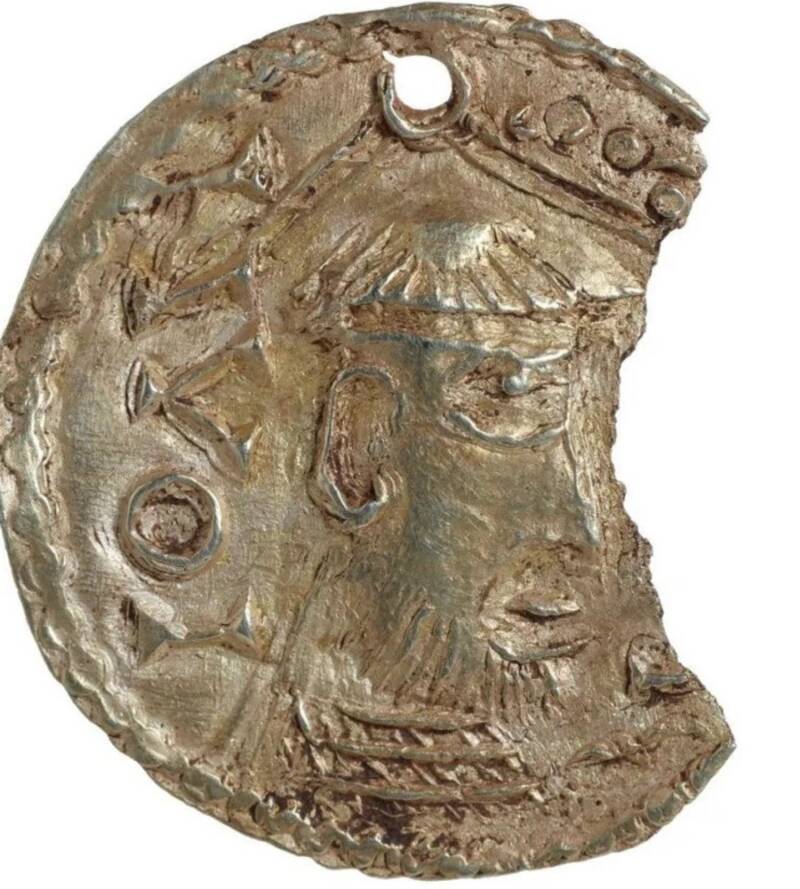
Andrew Williams/Norfolk County CouncilOne side of the coin pendant depicts a bearded man seemingly meant to be John the Baptist.
Though the relic is broken, it’s possible to make out most of the Latin words inscribed upon it. “IOAN” is written on one side alongside a depiction of a bearded man. The opposite side includes a cross surrounded by the words “BABTIS… T EVVAN.” Together, this translates to “John, Baptist and Evangelist.”
Numismatist Simon Coupland told the BBC that the coin likely dates to the 860s or 870s. Its lettering matches other coins from that era — the Carolingian period, between 751 and 887 C.E. — and imitation coins like this one were often valued enough to be used as jewelry, which explains the piercing.
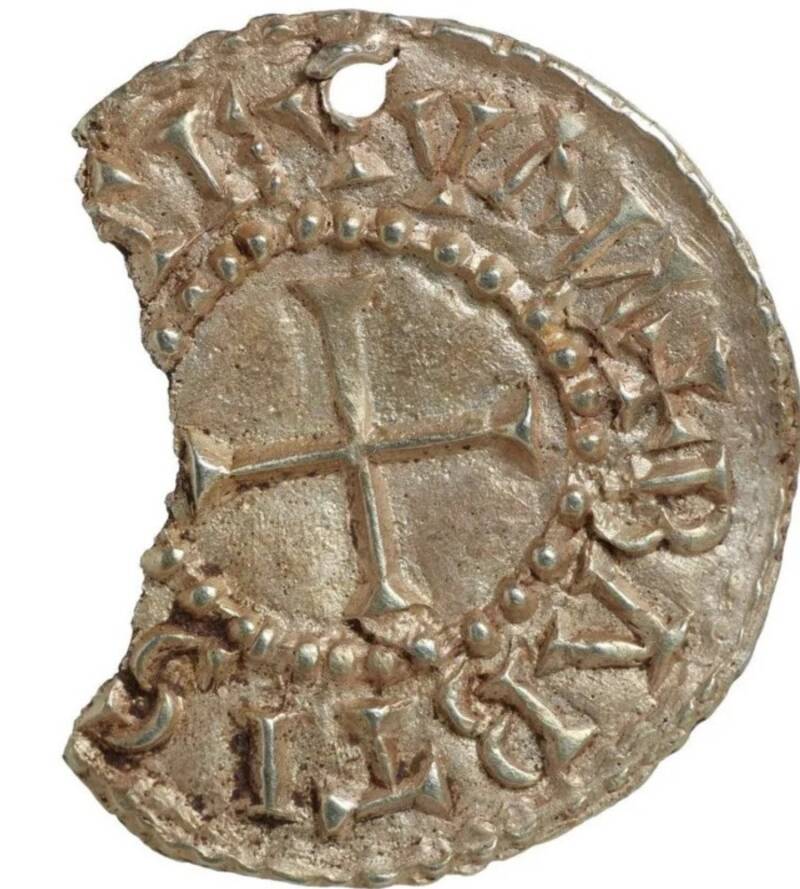
Andrew Williams/Norfolk County CouncilThe other side of the coin pendant depicts a cross and a Latin inscription.
However, in other ways, the coin is an extremely unusual find.
Questions About The ‘Bizarre’ Coin Pendant
In Christianity, John the Baptist is an important figure. A prophet and a precursor to Jesus Christ, John the Baptist baptized Jesus just before he began his public ministry.
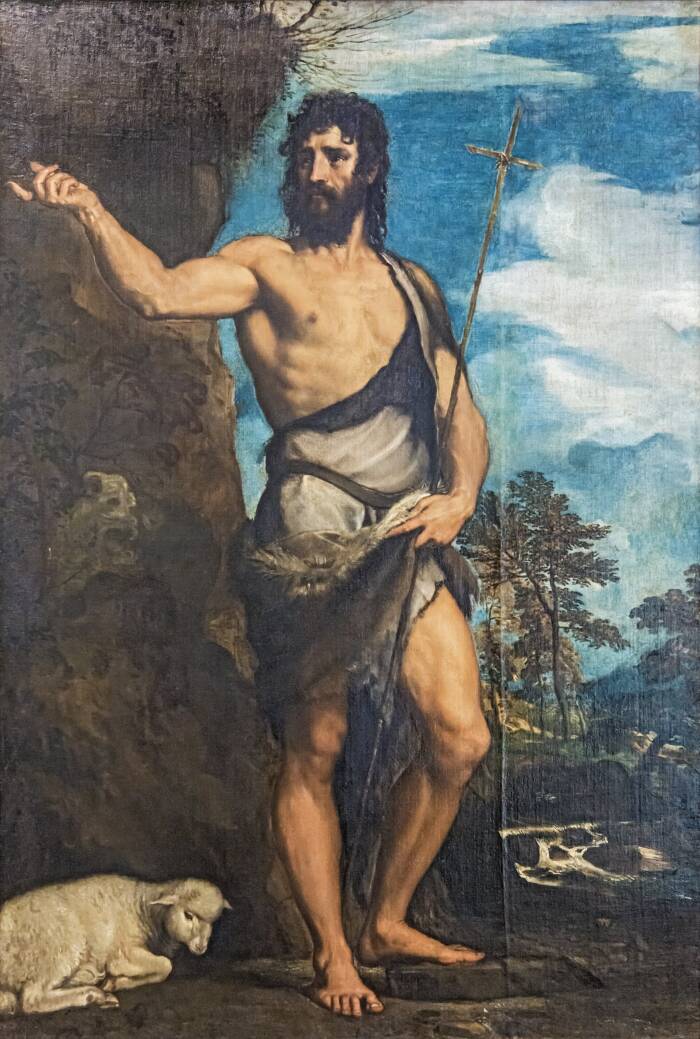
Gallerie dell’AccademiaA 16th-century depiction of John the Baptist.
But as Coupland told the BBC, the figure of John the Baptist is a highly unusual one for a coin from the Carolingian period. In Western Europe at the time, coins usually depicted kings — not religious figures. And Coupland has never seen a similar depiction of John the Baptist on a Carolingian-era coin.
“[A] figure of John the Baptist on a coin is so unusual and remarkable — I don’t know of another John the Baptist from the Carolingian period; it’s bizarre — it’s not like anything else I know,” Coupland stated.
The coin is unusual for another reason as well. These imitation solidus coins were typically made by Scandinavians. But in 870, much of northern Europe was still under the control of the Vikings. The Norsemen had not yet converted to Christianity, so Coupland told the BBC that he’s baffled that they would have made a coin depicting John the Baptist.
“So now you see why it is such a mysterious find,” Coupland said. “[I]t’s like a child with a hexagonal shaped object trying to fit it into squares when it doesn’t fit at all.”
Experts are currently analyzing the coin pendant to determine if it is a treasure, a proceeding that studies the artifact’s age and the composition of its precious metals. If it is indeed deemed a treasure, the nearby Norwich Castle Museum hopes to acquire it.
In the meantime, many questions remain about the unusual coin. It’s unknown why it depicts John the Baptist or who created it. But it stands as just the latest remarkable find made by a metal detectorist in England.
Over the last several years, metal detectorists in the country have come across a number of other exciting treasures, including a Roman brooch, a hoard of Roman coins, a Bronze Age rapier, and a rare 14th-century “leopard” coin that later sold for more than $200,000.
These objects, always fascinating and frequently mysterious, make up a patchwork of stories about England’s history. The John the Baptist coin pendant belongs to this intriguing heritage, though many questions about its provenance, its maker, and its purpose still remain.
After reading about the unusual John the Baptist coin pendant discovered in England, go inside the question of what Jesus Christ looked like. Or, discover the story of Golgotha, the Biblical site where Jesus was crucified.