




This article examines the 2026 SEC regulatory shift, its impact on institutional crypto frameworks, and how $2 million capital requirements are redefining market credibility and security.
Digital assets have shifted from the “Wild West” era of 2018 to a highly structured, institutional battlefield. In a major move, the United States Securities and Exchange Commission (SEC) recently sent a comprehensive crypto regulation proposal to the White House, signaling a definitive end to the period of enforcement by litigation. This proposal does not just tweak existing rules; it fundamentally rewrites how crypto firms operate, focusing on massive capital barriers and rigorous auditing. While some critics lament this as a reversal of the SEC’s previous “tough on crypto” stance, the market sees it as the birth of a professional class of digital finance.
This article extensively explores the new SEC regulatory framework, examining the 100-page disclosure requirements, the role of the “Big Four” auditors in crypto security, and how the transfer of power to $2 million players is reshaping global digital asset credibility.
Moving beyond 2018: The death of zero-credibility projects
In 2018, the crypto market was largely a collection of whitepapers and promises. Credibility was near zero as retail investors fell victim to projects that vanished overnight. Today, the 2026 SEC enforcement reversal suggests that the era of “guessing the rules” is over.
The new framework establishes a rigorous vetting process that mirrors traditional banking. To even apply for a license, firms must show a level of transparency that was unthinkable five years ago. This shift is not just about catching bad actors; it is about building a system where only the most resilient and well-capitalized firms can survive. This transition has sparked fresh debates among regulators who worry that the SEC might be giving too much ground to an industry it once fought.
The $2 million gateway and the transfer of power
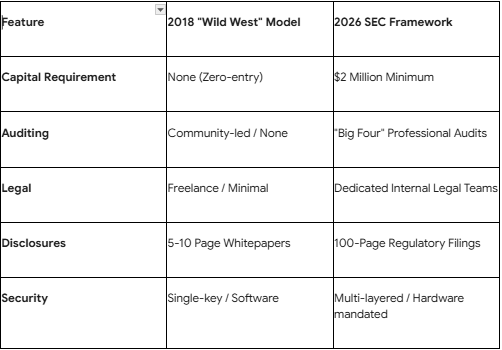
One of the most controversial points in the White House proposal is the capital requirement. The SEC is moving to transfer market power exclusively to players with at least $2 million in liquid capital.
- Barriers to entry: This rule ensures that only entities with significant “skin in the game” can manage user funds.
- Consolidation: By setting the bar high, the SEC is effectively forcing a merger between boutique crypto firms and established financial institutions.
- Investor protection: Proponents argue that these $2 million players are less likely to collapse under market volatility than the under-capitalized startups of the past.
While some argue this limits the “decentralized” nature of crypto, others see it as a necessary step for mass adoption. It ensures that those handling billions in assets have the financial cushion to withstand black swan events.
Security layers and the four big auditors
In the current climate, a simple smart contract audit is no longer enough. The new SEC framework demands multiple security layers that satisfy the standards of the world’s top accounting firms.
The “Big Four” auditors — Deloitte, PwC, EY, and KPMG — have become the new gatekeepers of crypto credibility. Under the 2026 rules, a firm’s security protocols must be vetted by these giants to ensure they can handle cyberwarfare threats and shadow economy risks. This involves:
- Cold storage mandates: Strict rules on how much crypto must be kept offline.
- Multi-signature protocols: Ensuring no single individual has total control over funds.
- Real-time monitoring: Constant blockchain intelligence tracking to spot illicit flows.
The 100-page disclosure: A new era of transparency
Gone are the days of five-page summaries. The SEC now requires a 100-page disclosure document for any project seeking a public listing or retail offering. This document must be drafted by a real legal team and cover everything from tokenomics to the digital footprint of the founders.
This massive filing includes:
- Detailed risk assessments: Identifying potential “giveaway traps” or phishing vulnerabilities.
- Founder backgrounds: Vetting leaders for any past involvement in cryptocurrency wallet scams.
- Financial audits: Providing a clear, audited trail of how the $2 million in capital is being managed.
How states and shadow economies complicate the debate
The push for regulation is driven by more than just investor protection. As state actors like North Korea use crypto to fund weapons programs, the SEC’s framework serves as a tool for national security.
Blockchain intelligence has shown that illicit funds move through low-compliance chains and friendly exchanges to bypass sanctions. By forcing firms into a 100-page disclosure model and Big Four audits, the US government hopes to close the “exit points” used by criminal finance. This adds a geopolitical layer to the “SEC vs. Crypto” narrative, making the debate about much more than just “securities vs. commodities.”
Separating the survivors from the rest
The market is currently witnessing a Great Thinning. The survivors are those who can navigate the complexities of the new rules, while those who never could were often those relying on the lack of oversight to hide weaknesses.
The future of digital asset sovereignty
The shift toward institutional-grade regulation marks a turning point. We are no longer debating whether crypto will exist, but who will be allowed to run it. As the $2 million players take the lead, will the original spirit of decentralization survive, or will crypto become a high-tech extension of the existing banking system?
One thing is certain: the projects that withstand the SEC’s 100-page scrutiny and the Big Four’s audits will possess a level of credibility that was unimaginable during the 2018 bubble. This is the birth of a new financial infrastructure, one built on the hard-won lessons of a decade of scams and successes.

The new crypto order: How the 2026 SEC framework separates survivors from the skeptics was originally published in The Capital on Medium, where people are continuing the conversation by highlighting and responding to this story.