




Instagram crossed 3 billion users in 2025, and the platform looks very different from the photo-sharing app it started as. It’s now one of Meta’s most valuable advertising engines and a video-first network where Reels and carousels do the heavy lifting. The numbers below are the ones I actually use in my keynotes and the classes I teach at Rutgers Business School, each refreshed against a primary source and paired with what it means for your marketing.
Key Takeaways
✅ Instagram’s scale is now in rare company. It sits among the small handful of apps that have ever crossed three billion users, which makes it impossible to ignore for almost any audience.
✅ It’s become Meta’s most valuable ad engine in the US. Instagram now drives more of Meta’s US advertising revenue than Facebook does, a complete reversal from a decade ago.
✅ Engagement is low but has stopped falling. After years of decline, average engagement stabilized in 2026, and the format you choose and your account size matter more than raw follower totals.
✅ Video and DMs are driving the platform. Instagram’s own leadership says growth comes from Reels, recommendations, and private messaging, so your strategy should follow the same priorities.
✅ It’s still the home of influencer marketing. Instagram remains the platform marketers reach for first when they run creator campaigns, even as TikTok grows.
✅ The numbers only help if they match your business. The stat that matters is the one that lines up with your audience, your model, and the formats you can actually produce.
How Big Is Instagram in 2026?
Instagram reached 3 billion monthly active users in September 2025, becoming the third Meta app to cross that mark in a single year, alongside Facebook and WhatsApp. That scale puts a meaningful slice of the connected world within reach of any brand on the platform. But scale alone isn’t the story. How that audience behaves, how much time they give the app, and how Instagram itself is steering them matters far more for your results.
1. Instagram has 3 billion monthly active users
Mark Zuckerberg and Instagram head Adam Mosseri announced the 3 billion milestone in September 2025, putting Instagram alongside Facebook and WhatsApp in the three-billion-user club, making it the third Meta app to cross the mark in a single year. To put the climb in perspective, the app crossed 2 billion in October 2022, the last time Meta publicly disclosed Instagram’s user numbers, which means it added another billion in under three years. That’s not a platform in decline, whatever you’ve heard about Gen Z drifting to TikTok.
What’s driving that growth? Mosseri was direct about it. As he put it, “almost all of our growth has been driven by DMs, Reels, and recommendations,” and the company is reorienting the app around those three things. I’ll be honest, this validated a prediction I made years ago: I argued that social media users would pull “the personal” back into their feeds and shift toward more private, communication-first spaces. The rise of DMs as a growth driver is that shift playing out.
What this means for you: Instagram is a default channel, not an optional one. With an audience this size, the question isn’t whether your customers are there, it’s whether you’re reaching them on the formats Instagram is pushing hardest, which are Reels, recommendations, and DMs.
2. Instagram ads reach 1.99 billion people, nearly a quarter of the planet
As of April 2026, DataReportal reports that Instagram’s advertising tools reach 1.99 billion users worldwide, putting the platform’s targetable audience close to a quarter of everyone on Earth and still growing year over year. One caveat worth keeping straight: ad reach is not the same as monthly active users. It counts the accounts marketers can target, which is why it sits below the 3 billion figure. Plenty of posts confuse the two.
What this means for you: the targetable audience is enormous and still expanding. The practical benefits of advertising on Instagram come down to that reach combined with visual targeting and shopping integration.
3. India is the largest Instagram market, not the US
A lot of marketers assume the US leads, but it doesn’t. Statista’s ranking, based on We Are Social, DataReportal, and Meltwater data, puts India well out front, followed by the US and Brazil. Most of Instagram’s recent growth is coming from South and Southeast Asia, not Western markets that are nearing saturation.
| Country | Instagram users (Oct 2025) |
|---|---|
| India | 480.55 million |
| United States | 181.75 million |
| Brazil | 147 million |
Source: Statista, citing We Are Social, DataReportal, and Meltwater, October 2025.
What this means for you: if you sell internationally, your largest pools of potential reach may sit well outside North America. Even US-focused brands should know the global center of gravity has moved.
4. Users spend an average of 1 hour 13 minutes a day in the app
DataReportal’s Digital 2026 report, using Similarweb’s Android data, puts the average Instagram user at 1 hour and 13 minutes per day in the app. That sits behind TikTok at 1 hour 37 minutes and YouTube, but it still adds up to more than eight hours a week of attention that brands can earn or lose.
What this means for you: this is sustained time, not a passing glance. An audience that gives the app an hour-plus a day will notice whether you show up consistently, so a steady presence in feed and Stories compounds in a way sporadic posting never does.
5. 65.4% of users open Instagram every single day
Reach is one thing, habit is another. The same DataReportal analysis found that 65.4% of Instagram’s Android users open the app every day, third among the major apps behind WhatsApp and Facebook. Daily-active behavior is what turns a big audience into a dependable one.
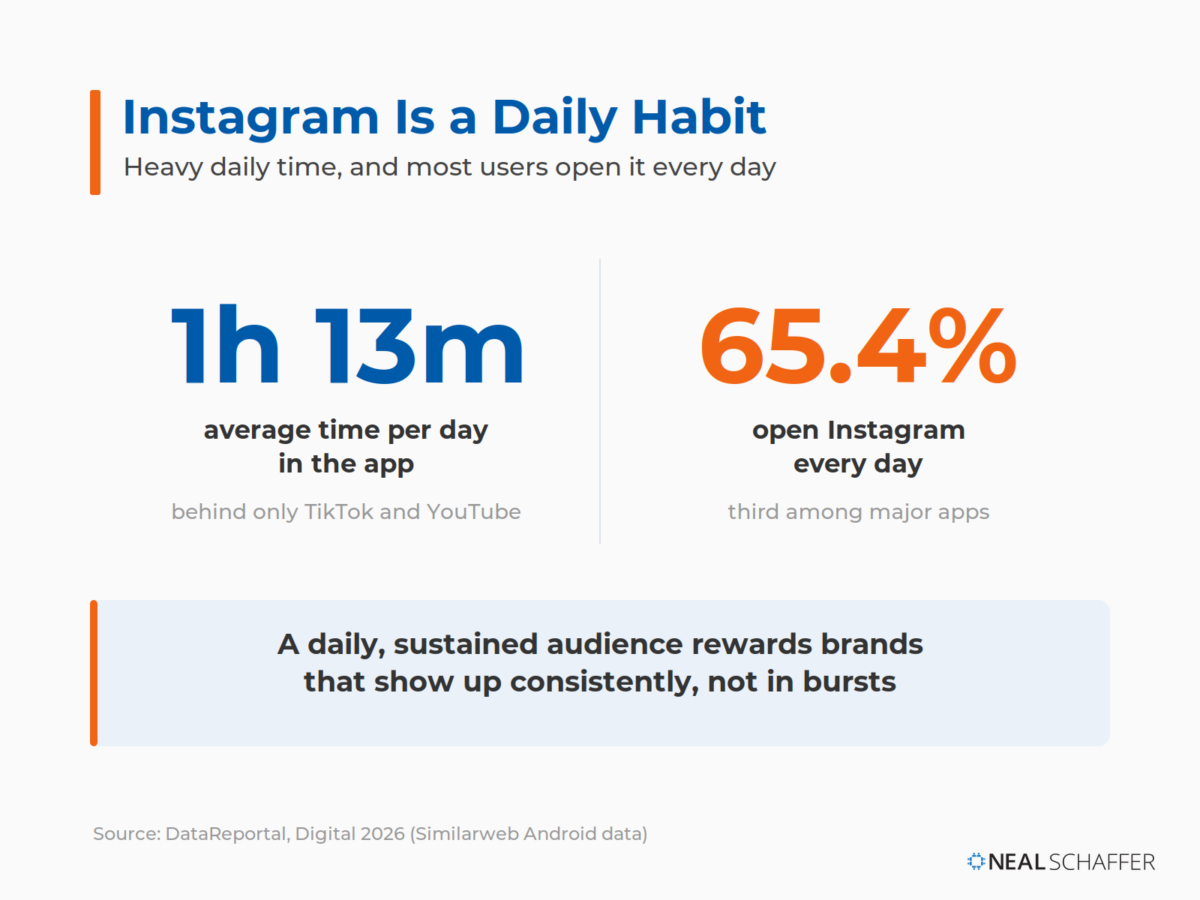
What this means for you: most of your audience checks in daily, which rewards a consistent cadence over occasional bursts. You are publishing into a daily habit, and habits favor the brands that are reliably there.
Is Your LinkedIn Working?
Just released: my new book to help professionals, entrepreneurs, and business owners maximize LinkedIn for real growth.
With years of LinkedIn expertise, Maximizing LinkedIn for Business Growth offers actionable steps to build your brand, expand your network, and drive results.
Start leveraging LinkedIn like never before—grab your copy now! Click the cover or button below to buy on Amazon.

Who Actually Uses Instagram?
Instagram’s audience skews young and splits fairly evenly by gender worldwide, though that balance flips in some countries. The largest single group is 25 to 34 year olds, which means the platform has matured past its teenage-only reputation into a core channel for working-age adults with real spending power, even as it holds on to its teen base. Knowing the specific makeup of your audience is what separates targeted content from guesswork.
6. The biggest age group is 25 to 34 year olds
DataReportal’s analysis of Meta’s audience data shows the 25 to 34 cohort makes up about 33% of Instagram’s global ad audience, the single largest group, with men aged 25 to 34 the biggest slice of all. The platform still skews young overall, but it’s no longer just a millennial and Gen Z space. Older brackets keep growing every year.
What this means for you: if your customers are working-age adults, Instagram fits. The “it’s only for teenagers” objection stopped being true a long time ago.
7. The global gender split is close, but it flips by country
Worldwide, Instagram’s audience runs 52.7% male and 47.3% female, per DataReportal’s read of Meta’s data. But that average hides big regional swings. Hootsuite reports that the US audience leans female, closer to 55% women, while India skews heavily male.
What this means for you: don’t apply a global gender assumption to a local campaign. Pull your own audience demographics before you build creative, because the platform-wide average may be the opposite of your actual market.
8. About 6 in 10 U.S. teens use Instagram
The “teens all left for TikTok” story is overstated. Pew Research Center’s 2025 survey of U.S. teens ages 13 to 17 found that about six in ten use Instagram, behind YouTube but level with TikTok and ahead of Snapchat. Instagram has held its teen base even as it grew into a working-age channel.
What this means for you: if your audience skews teen or young adult, Instagram still belongs in the plan next to TikTok rather than being replaced by it. The two platforms share most of the same young users.
How Do People Engage on Instagram?
Engagement rates on Instagram are low in absolute terms and slid for years, but 2026 brought a plateau. The bigger lesson is that format choice and engagement rate now drive outcomes more than raw follower count. Carousels and Reels carry the platform while static images keep fading, and where people spend their time has shifted decisively toward video.
9. Average engagement has stabilized at just under 0.5%
After a roughly 20% slide from 2022 onward, Instagram’s overall engagement rate steadied in 2026 rather than continuing to fall, according to Socialinsider’s benchmarks. The platform’s push toward Reels and carousels is what’s holding the average up while static images keep dragging it down.
What this means for you: a “good” engagement rate is lower than most people think. If you’re above 1%, you’re doing better than the typical account. Don’t measure yourself against inflated benchmarks from five years ago.
10. Carousels out-engage Reels, and images trail both
Format is the lever. In Socialinsider’s Q1 2026 benchmarks, carousels held the highest engagement rate of any post type, with Reels close behind and single images well back. People swipe through every slide of a carousel, and that extra time is exactly what the algorithm rewards.
| Content format | Avg. engagement rate (Q1 2026) |
|---|---|
| Carousels | 0.52% |
| Reels | 0.50% |
| Single images | 0.35% |
Source: Socialinsider, Q1 2026.
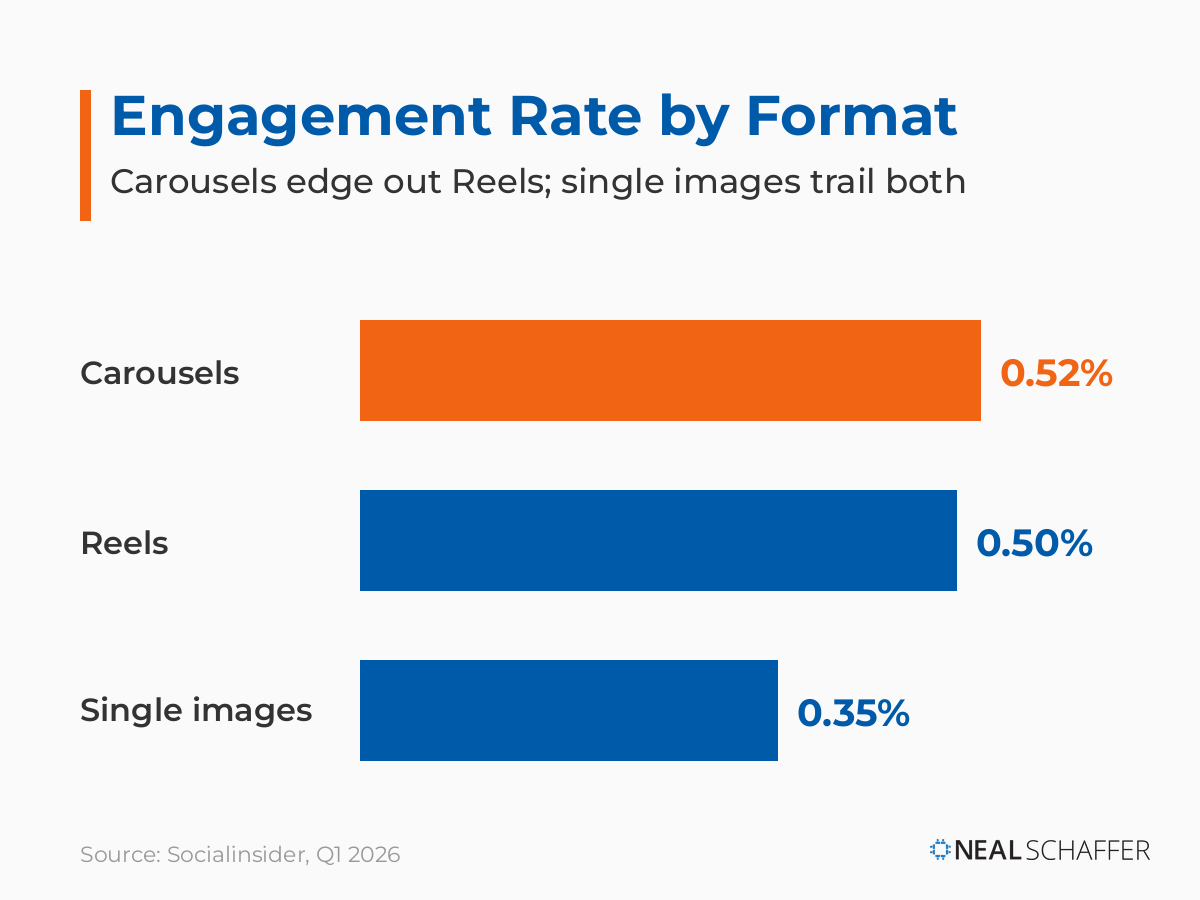
What this means for you: if you’re still posting mostly single images, you’re choosing the lowest-performing format. A strong Instagram carousel often beats a polished single photo, and pairing carousels for depth with Instagram Reels for reach is the combination that works in 2026.
11. Users spend close to two-thirds of their time watching video
Instagram is a video platform now, whatever its photo-sharing origins suggest. eMarketer’s Jasmine Enberg noted that users spend “close to two-thirds of their Instagram time watching videos.” That’s the practical reason Mosseri’s team is reorienting the app around Reels.
What this means for you: video isn’t a content category on Instagram anymore. It’s the main event. If video makes up a small share of your output, your time allocation is out of step with how people actually use the app.
12. Posting cadence is an amplifier, not a primary engagement driver
Buffer’s 2026 State of Social Media Engagement report, built on 52 million posts across 10 platforms, found that timing and frequency “can boost engagement, but not drive it.” They’re a layer you optimize once you know what content is landing, not the place to start. The far bigger lever, in Buffer’s data, was replying to the people who engage with you, which outperformed posting tactics across every platform they studied.
What this means for you: cadence still matters, since accounts that go dark lose ground to their own baseline. But pick a rhythm you can hold for a year (two-to-five posts a week beats a daily sprint that burns out in three weeks), let a social media scheduling tool protect that rhythm, and spend the energy you save on actually replying to comments. Timing is the bonus layer on top, and the best time to post on Instagram for your specific audience is worth optimizing once the rest is in place.
13. Brands post an average of 5 times per week
Socialinsider’s 2026 benchmarks, built on tens of millions of posts, found that brands publish an average of 5 posts per week on Instagram. That is the competitive baseline you are measuring against, not a number to beat for its own sake.
What this means for you: five posts a week is the going rate, but the cadence research earlier in this list is the better guide. Match a rhythm you can hold all year, then spend the energy you save replying to the people who engage. Five posts you can sustain beat seven that fizzle out by spring.
14. Smaller accounts win on engagement, with nano accounts highest
Engagement slides as audiences grow. eMarketer, drawing on HypeAuditor’s 2026 State of Influencer Marketing report, pegs the smallest creators highest: the 1,000 to 10,000 follower tier averages 1.78%, roughly triple the 0.54% seen in the 10,000 to 50,000 range and more than five times the 0.33% at accounts past a million. Reach runs the other way. A million-plus account still pulls a median near 6,678 likes on a post, against about 91 for a smaller micro creator.
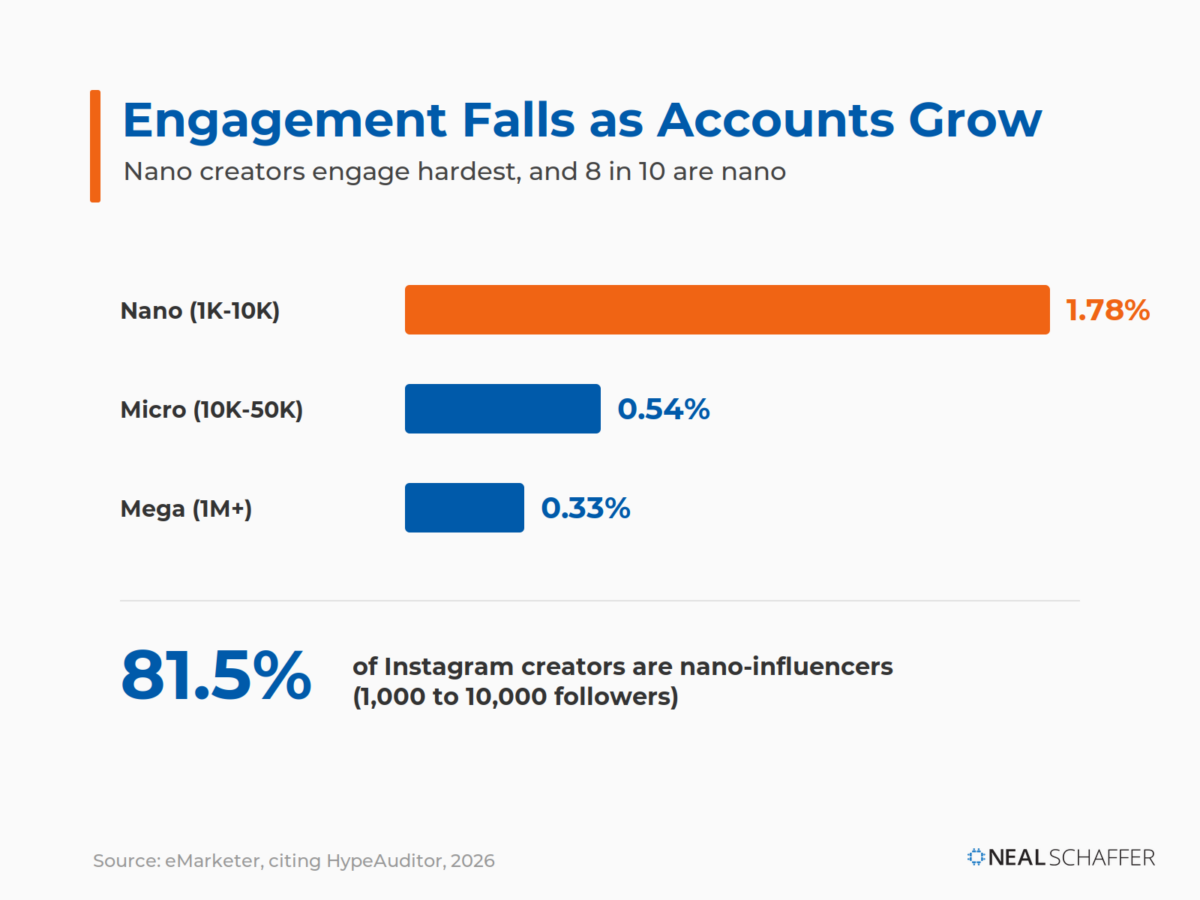
What this means for you: a smaller, engaged following can beat a large, passive one on rate, which is why brands keep partnering with nano and micro creators. When you size up a creator, weigh real engagement against follower count and screen for inflated or fake followers that make a big account look stronger than it performs.
How Do People Buy Through Instagram?
Instagram has quietly become one of Meta’s most important commercial assets, and for many businesses it’s now a primary sales channel rather than a branding nicety. The platform earns more per US user than Facebook does, drives a growing share of social shopping, and turns short-form video into direct purchases. The discovery-to-checkout loop increasingly happens without anyone leaving the app.
15. Instagram now drives over half of Meta’s US ad revenue
This is the number that reframes everything. eMarketer reported that Instagram generated $32.03 billion in US ad revenue in 2025, which is 50.3% of Meta’s total US ad revenue, the first time it crossed half. A decade ago that share was 7.7%. It also earns more per user than its sibling app, about $223 per US user versus Facebook’s $191. Instagram went from a side product to Meta’s most valuable US advertising engine.
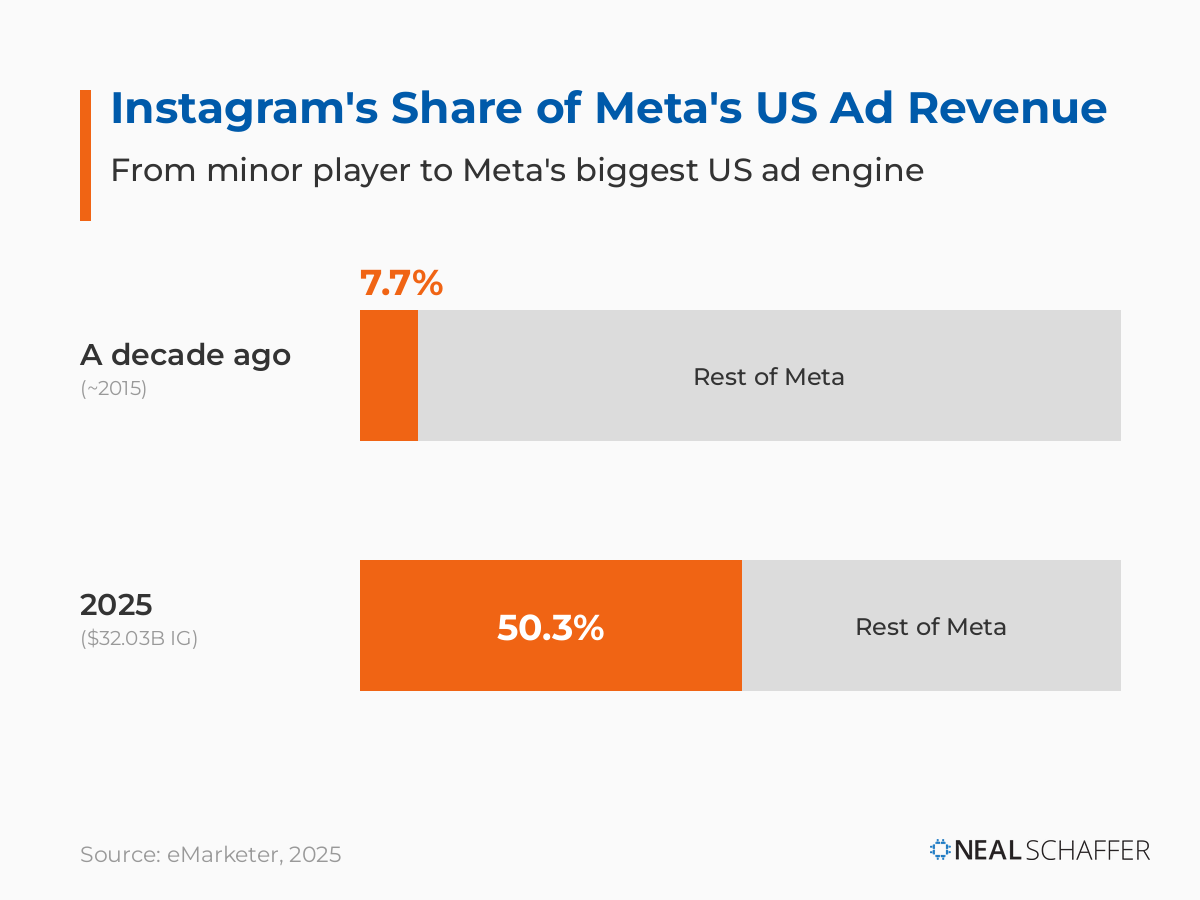
What this means for you: Meta is investing where the money is, and that’s Instagram. Expect the ad tools, formats, and shopping features here to keep improving faster than on Facebook. If you A/B test Instagram against your other channels and the numbers hold up, the data says you’re in good company.
16. More than a quarter of users come to Instagram to decide what to buy next
Buying on Instagram often starts as browsing. In Sprout Social’s 2026 Social Media Content Strategy Report, more than 25% of users in every age group said the platform is where they look for what to buy next, often nudged by a Reel or a creator post before they have actively set out to shop.
What this means for you: treat Instagram as a discovery engine, not a catalog. Native, scroll-stopping content like Reels, carousels, and creator posts puts your products in that discovery moment, well before someone searches your category directly.
17. An estimated 47% of US social buyers will purchase through Instagram in 2026
Hootsuite’s analysis projects that about 47% of US social buyers will make a purchase through Instagram in 2026. People discover products while browsing the feed, Reels, Stories, and Explore, often before they’ve consciously decided to shop. Discovery happens fast, and your Instagram caption carries a lot of the selling weight in those scroll-by moments.
What this means for you: treat Instagram as a real storefront rather than a billboard. The path from “saw it” to “bought it” is shorter than it’s ever been
18. 79% of weekly Reels users have bought after seeing a product in a Reel
Reels don’t just earn reach, they drive purchases. Sprout Social reports that 79% of weekly Reels users have bought a product or service after seeing it in a Reel. Short-form video has turned into one of the highest-intent formats on the platform.
What this means for you: if you have commerce goals, Reels are non-negotiable. A product shown naturally in a Reel converts in a way a static catalog post rarely does.
19. 62.8% of users turn to Instagram to follow or research brands
Instagram is where people actively look brands up. DataReportal’s Digital 2026 report, citing GWI survey data, found that 62.8% of Instagram’s users go there to keep tabs on and dig into brands and products, a bigger share than on any other network and ahead of TikTok (56.2%) and Facebook (53%).
What this means for you: your audience is actively researching brands on Instagram, not passively scrolling past them. A complete, current profile and a clear trail of content become part of your sales process, because people are sizing you up here before they decide to buy.
Is Instagram Still the Influencer Marketing Platform?
Yes, but it’s no longer uncontested. Instagram remains the most-used platform for influencer marketing today, with mature creator tools, commerce integration, and broad demographics behind it. But the freshest 2026 data shows marketers increasingly betting on TikTok for new investment, even as Instagram retains the installed-base advantage. The spending behind the channel keeps climbing across the board.
20. Instagram leads today, but TikTok is winning 2026 investment plans
Statista reports that Instagram remains the most popular influencer marketing platform in the US among current programs. But the freshest 2026 data tells a different story: the Influencer Marketing Hub 2026 Benchmark Report shows TikTok is now the most-selected platform for new influencer investment, included in 31% of marketers’ 2026 plans, more than double Instagram’s share. The pattern looks like Instagram has become the scaling layer where proven creative gets operationalized, while TikTok has become the experimentation engine where new campaigns launch first.
What this means for you: if you already run a creator program, Instagram is where your installed-base playbooks live and where most of your audience follows creators. If you’re planning fresh creator investment for 2026, pressure-test whether TikTok belongs in the mix before defaulting to Instagram. Finding the right partners takes the same skill as finding the right customers, and Instagram user search tools speed up both jobs.
21. Around 70% of marketers plan to increase their Instagram investment
Brands aren’t pulling back. Sprout Social found that roughly 70% of marketers plan to increase their Instagram investment, which means competition for attention will keep rising. The marketers winning here are getting more deliberate, not louder.
What this means for you: doing the basics won’t be enough as more budget floods in. A documented Instagram marketing strategy is what turns audience size into actual results when everyone around you is spending more.
22. Most Instagram creators are nano accounts
The creator economy on Instagram runs on small accounts. eMarketer, citing HypeAuditor’s 2026 State of Influencer Marketing report, puts the platform’s roster overwhelmingly in the nano tier: accounts in the 1,000 to 10,000 follower range represent 81.5% of all Instagram creators. Another 14.4% fall into the micro band, and a sliver, 0.1%, clear a million followers. The partnership market is built on the long tail, not the celebrities.
What this means for you: the creators most likely to fit your budget, and to deliver the higher engagement rates from earlier in this list, are the small ones, and there is no shortage of them. A program built around several nano and micro creators is usually more efficient than chasing one big name.
What’s Driving Instagram’s Growth in 2026?
The short answer is Reels. Meta has rebuilt Instagram around short-form video over the past five years, and the data now bears it out: Reels drive about half of all time spent on the platform, anchor Meta’s fastest-growing revenue line, and pull more conversation than any other format. Understanding where Reels sit in the data is now table-stakes for any serious Instagram strategy.
23. Reels now drive nearly half of all time spent on Instagram
CNBC reported in January 2026, citing Sensor Tower data, that Reels accounted for 46% of time spent on the Instagram app in the US in 2025, up from 37% in 2024. That’s a 9-point jump in twelve months, and it explains why Meta has restructured the app’s feed placement, Explore tab, and recommendation algorithm around surfacing Reels. The format has gone from a TikTok-copy experiment in 2020 to Instagram’s center of gravity in five years.
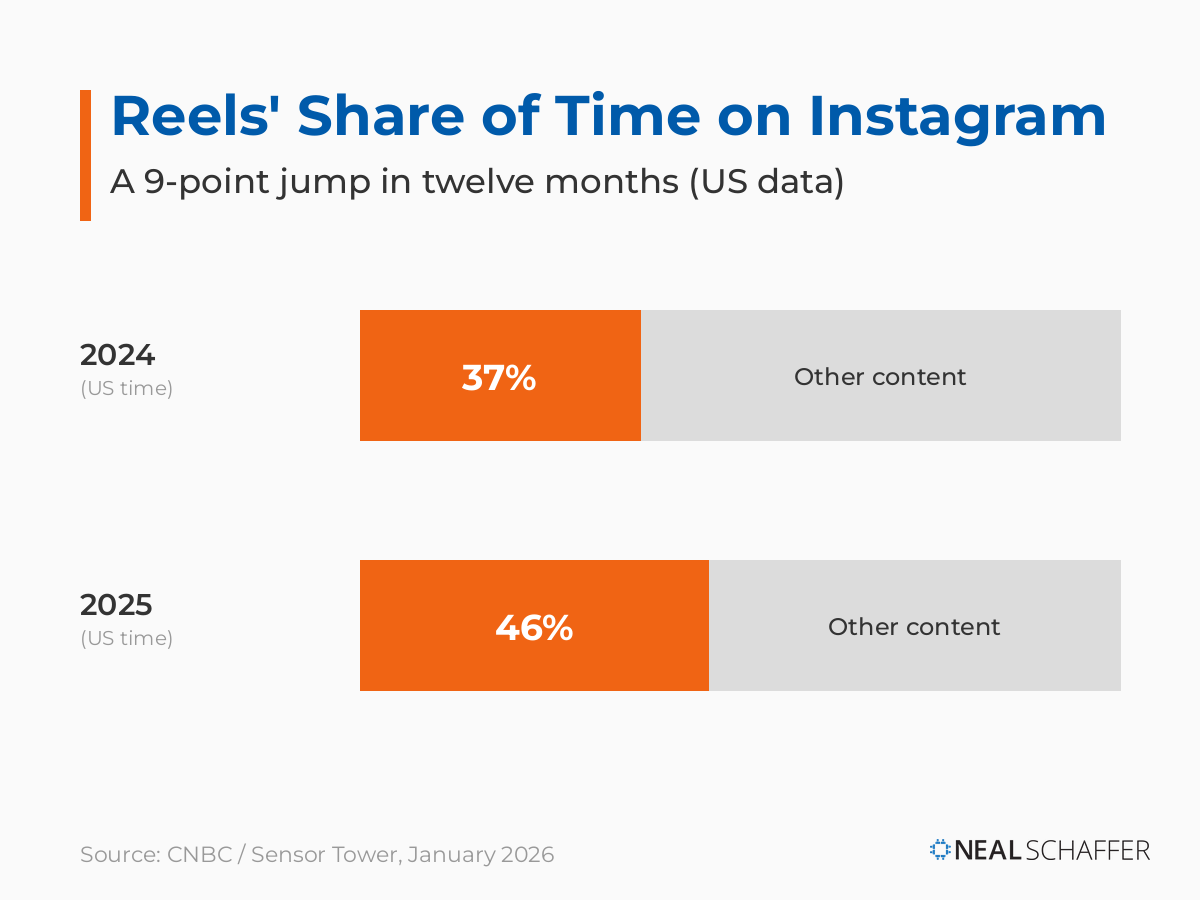
What this means for you: if your Instagram strategy doesn’t have a primary Reels lane, you’re optimizing for half the platform. The other half is everything else combined. Knowing how to use Instagram Reels for marketing isn’t a bonus skill anymore, it’s the baseline.
24. Reels hit a $50 billion annual revenue run rate
On Meta’s Q3 earnings call in October 2025, Mark Zuckerberg said that Reels had reached an annual revenue run rate of over $50 billion across Facebook and Instagram, per the earnings call transcript. That puts Reels in the same revenue conversation as YouTube’s entire advertising business, and it explains why Meta has reorganized its ad sales and creative tooling around the format.
What this means for you: ad inventory is following the eyeballs. If you’re buying Instagram advertising, expect more of your budget to land in Reels placements whether you actively choose them or not. Building creative that works in vertical 9:16 short-form is now the baseline for any Instagram ad strategy, not a separate workflow.
25. Reels generate the most comments of any Instagram format
Reels are Instagram’s conversation engine. Socialinsider’s 2026 benchmarks, built on an analysis of 35 million posts, found that Reels generate more comments than carousels or single images at every account size, and the gap widens as you grow. Accounts with 100,000 to 1 million followers average 60 comments on a Reel, compared with 40 on a carousel and 38 on a single image. The format’s fast pace, sound, and trend-driven hooks are what pull viewers into the comments instead of just past the post. It’s the flip side of the format picture from earlier: carousels win on overall engagement rate and saves, while Reels win on conversation.
What this means for you: if your goal is sparking discussion and community, not just racking up impressions, Reels are the format that gets people talking. Pair them with carousels, which earn the saves and the highest engagement rate, and you cover both jobs at once. A feed that’s all single images leaves the conversation, and the comment count, on the table.
Frequently Asked Questions
Instagram reached 3 billion monthly active users in September 2025, announced directly by Meta’s leadership. That makes Instagram the third Meta app to cross 3 billion users in 2025, joining Facebook and WhatsApp. Note that advertising reach, nearly 2 billion, is a separate and lower figure because it counts only the accounts marketers can target.
The platform average sits just under 0.5%, so anything above 1% is strong and anything above 3% is excellent. Smaller accounts see much higher rates than large ones, with the smallest (nano) accounts the top tier, and carousels and Reels outperform single images. Compare yourself to current benchmarks for your account size, not to the inflated numbers from several years ago.
Carousels and Reels lead, with carousels edging out Reels on engagement and Reels winning on reach and discovery. Single images consistently perform worst. The strongest approach pairs Reels to reach new audiences with carousels to engage the followers you already have.
Yes. Instagram now drives more than half of Meta’s US ad revenue, earns more per US user than Facebook, and converts short-form video into direct purchases. More than 6 in 10 users rely on it to keep up with and check out brands, the highest share of any network. For most consumer brands and many service businesses, it functions as a genuine sales channel rather than just brand awareness.
Yes, but the dynamic is shifting. Instagram remains the most-used platform for existing creator programs, with around 70% of marketers planning to increase their Instagram investment. But for fresh 2026 investment, marketers are increasingly choosing TikTok first, with 31% naming it as their top platform for new influencer dollars. The smart play is treating Instagram as your scaling layer and pressure-testing TikTok for new experimentation.
Reels are now the dominant content format on Instagram. They account for about half of all time spent on the platform, generate more comments than any other format, and reach audiences beyond your existing followers through Meta’s recommendations. If your Instagram strategy doesn’t have a primary Reels lane, you’re optimizing for half the platform.
Turn These Instagram Statistics Into a Strategy
Numbers like 3 billion users and half of Meta’s US ad revenue make Instagram impossible to ignore, but reading the data is the easy part. The work is choosing where your effort actually moves the needle for your audience, your business model, and the formats you can credibly produce. Pick the two or three stats above that match your situation, and build your plan around those rather than trying to chase all of them at once.
A consistent posting cadence sits behind almost every account that wins in these numbers. If you want to make that cadence sustainable, the tools and workflow for scheduling Instagram posts handle the heavy lifting. To see how Instagram fits alongside every other channel, the broader social media marketing statistics are worth bookmarking next. And for a full playbook that ties Instagram into the rest of your digital marketing, grab a free preview of Digital Threads. If you’d rather have an outside expert help your team build a coordinated strategy across channels, my Fractional CMO services might be a fit.
Actionable advice for your digital / content / influencer / social media marketing.
Join 13,000+ smart professionals who subscribe to my regular updates.