




How do you study a place that lets nothing escape? The event horizon of a black hole is the ultimate locked door, the boundary where gravity grows so intense that you would need to travel faster than light to break free, and since nothing can, everything that drifts across is gone for good, light and matter and information alike. It should be unobservable by its very nature. And yet a team of scientists has just found a way to eavesdrop on it, by listening to the loudest sound two black holes have ever made.
That sound was a gravitational wave, a ripple in the fabric of spacetime set off when two black holes spiralled together and merged. Astronomers cannot hear these ripples in the ordinary sense, but they can detect them, and the signal known as GW250114, picked up last year by the twin LIGO observatories in the United States, was the loudest yet recorded, roughly three times stronger than the very first gravitational wave caught a decade ago.
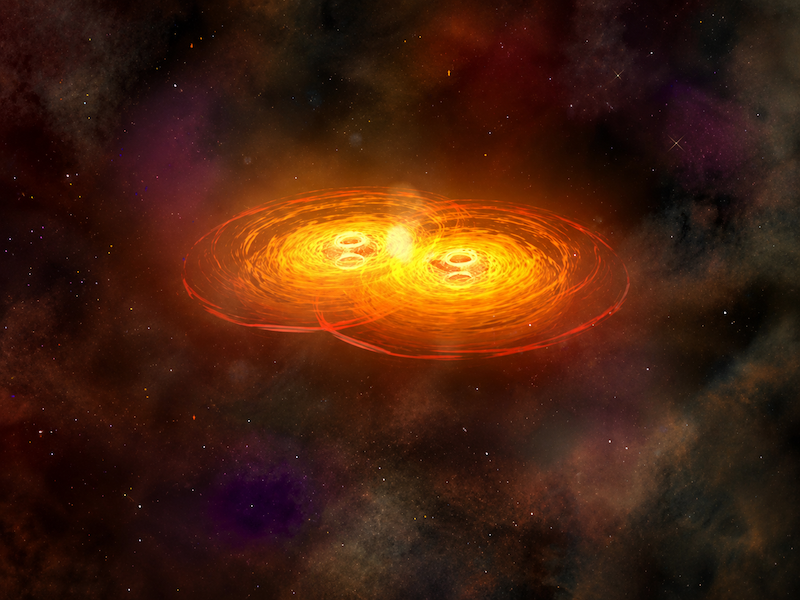
This illustration shows a stage in the merger of two galaxies that forms a single galaxy with two centrally located supermassive black holes surrounded by disks of hot gas. The black holes orbit each other for hundreds of millions of years before they merge to form a single supermassive black hole that sends out intense gravitational waves (Credit :
Buried inside that powerful signal was something faint that nobody had managed to read before. Led by Dr Ling Sun and PhD student Neil Lu at the Australian National University, with colleagues across Canada, the United States and Spain, the team teased out a subtle component they call direct waves, carrying information from the region right beside the event horizon, in the final instant before the merging black holes sealed themselves away for ever.
From it they read two of the new black hole’s most basic properties: how fast it spins, and the strength of gravity at its surface. Reporting their results in the journal Nature, they describe it as the first real glimpse of the horizon at the very moment of collision, just before light and sound were swallowed forever. The measurements are a first step, they say, towards testing whether Einstein’s century old theory still holds in the most punishing gravity the universe can muster, the very conditions under which it is most likely to crack and reveal something new.
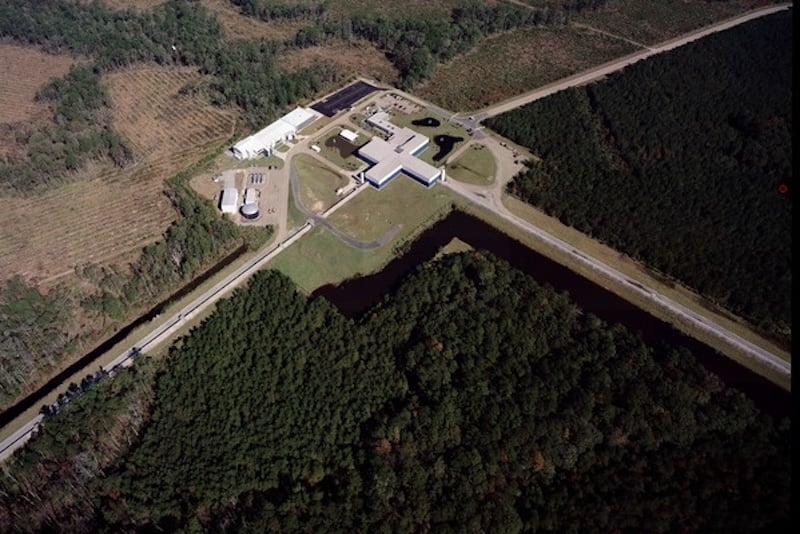 LIGO Louisiana Observatory (Credit : Caltech/MIT/LIGO Lab)
That matters because the event horizon is where physics turns strange. It is the one place where Einstein’s general relativity, which governs the very large, runs headlong into quantum theory, which governs the very small, and where the two have never been reconciled. The new method also opens a window onto frame dragging, the eerie effect by which a spinning black hole hauls the fabric of spacetime around with it, leaving nothing nearby able to stay still.
For decades the event horizon has been the part of a black hole we could describe but never truly probe, a frontier marked here be dragons on our map of the universe. Now, by listening closely to the last dying cries of two colliding giants, astronomers have found a way to creep right up to the edge. The era of testing our deepest theories against the darkest objects in the universe has only just begun.
Source : Scientists find a way to study the event horizon where light and sound are swallowed for eternity