




Archaeologists excavating the Don Yai Thong site believe that the rings once belonged to members of the Vaishya social class, the commoners of the Indian caste system who generally worked as merchants, farmers, and traders.
The Fine Arts Department via APArchaeologists in Thailand discovered this 2,000-year-old gold ring adorned with a Brahmi inscription.
Archaeologists at the Don Yai Thong archaeological site in western Thailand just discovered a pair of rare gold rings that date back a whopping 2,000 years. While one ring is plain gold without any pattern, the other bears an inscription in an ancient Indian writing system that references the zodiac.
Now, these discoveries and the others made at this same site are inspiring new questions and ideas about life in Thailand during the late Iron Age.
The Ancient Gold Rings Found Among Human Remains At Don Yai Thong
The Fine Arts Department of Thailand announced the discovery of the rings, found among a number of scattered human bones, in late June.
Excavations at the archaeological site, located about 80 miles southwest of Bangkok in the Phetchaburi province, had been ongoing since February. It was then that locals accidentally discovered the site after coming across pieces of ancient bronze drums in nearby rice fields.
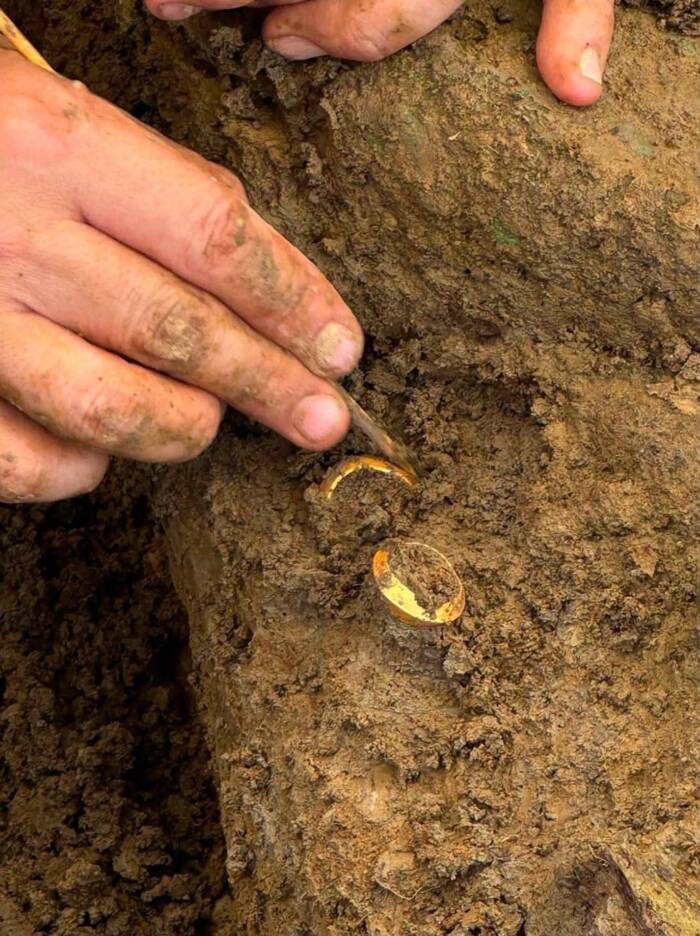
The Fine Arts Department via APResearchers have been excavating the site since February, and have also found nine human skeletons thus far.
Since then, archaeologists have discovered a trove of artifacts, including gold ornaments, pottery, and glass beads, which they date to the Iron Age, around 2,500 to 1,500 years ago.
The team has also already uncovered eight human skeletons, and each seems to have been buried in a deliberately ritualistic way, facing northeast with a bronze object placed above their heads. Fine Arts Department Director-General Phnombootra Chandrajoti told the Bangkok Post that this burial positioning is rarely found at archaeological sites in Thailand.
Now, this new find adds to an already fruitful excavation at Don Yai Thong.
The team has found a ninth human skeleton, this one likely belonging to a child under the age of 12. The child’s skeleton was also buried in accordance with the same ritual used for the previous eight skeletons. In addition to the human remains, the team discovered a possible bronze gong, more glass beads and pottery, and a well-preserved jaw of a cow or buffalo.
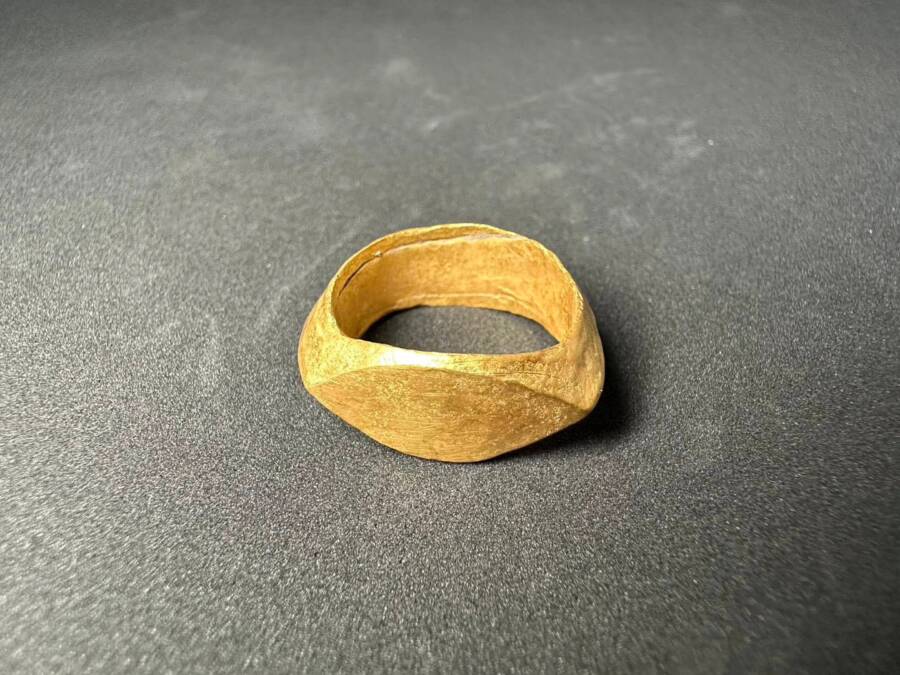
The Fine Arts Department via APThe research team believes that the rings’ owners belonged to the Vaishya social class.
It was alongside all of these finds that the archaeologists unearthed the two gold rings, both of them in an excellent state of preservation.
One of the rings is unadorned, without any writings or patterns. The other is engraved with Brahmi, an ancient Indian script that scholars believe was derived from Aramaic, and was the foundation for many modern languages in southeast Asia, including Thai.
After initial analysis of the script, researchers determined that it says “pusarakhitasa” in Brahmi, which means “the one protected by Pushya.” According to the Fine Arts Department, Pushya is one of the most auspicious zodiac signs in Indian astronomy.
What This Rare Discovery Reveals About Life In Iron Age Thailand
Researchers believe that these Iron Age burial grounds were reserved for community members of high social standing. For instance, the first skeleton found at the site was buried with rings, bangles, earrings, and gold pendants — luxurious grave goods, all of them.
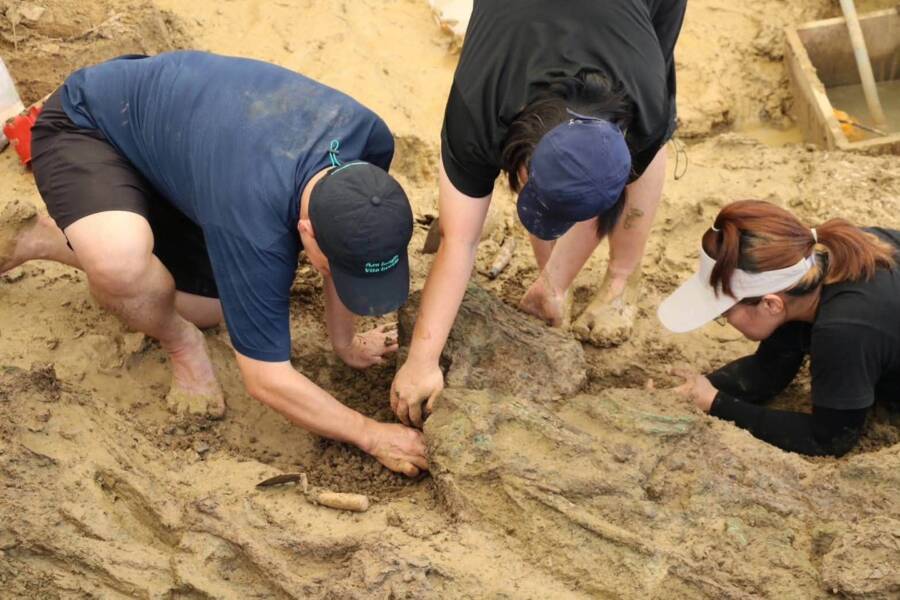
The Fine Arts Department via APThe artifacts and human remains uncovered at Don Yai Thong date back to the late Iron Age.
Such valuable grave goods also indicate that this entire society was likely prosperous, and that they valued elaborate funerary practices, including offerings to the dead.
The non-human remains found at the site may indicate a practice of sacrificial animal offerings or ritual animal burials, but researchers said that more study is needed to confirm such a hypothesis.
But what is clear now, after only an initial analysis, is that the rings were owned by members of the Vaishya social class, which ranked third out of the four classes in the traditional Indian caste system. The Vaishyas were generally merchants, artisans, farmers, and traders.
This opens up questions about how social class affected burial rituals in this ancient society, given that researchers found burials of elites right alongside those of community members with lower status.
The Fine Arts Department said they plan to continue uncovering more remains and artifacts in July, but that work is currently suspended because of flooding risks due to the area’s rainy season.
The team also plans to conduct 3D scans of the burial grounds, as well as send charcoal samples to the U.S. for scientific dating analysis.
Before initiating conservation processes, the department will display the artifacts to the public for several days, which will perhaps lead to a permanent exhibition for these stunning finds.
After reading about the rare pair of 2,000-year-old gold rings found in Thailand, see the 29,000-year-old remains of a child that were unearthed elsewhere in Thailand. Then, learn about the 2,200-year-old zodiac paintings found in an Egyptian cave.