




MUBI Fest returned to Chicago for the third time this year with its most varied and robust line-up yet, further cementing it as an art powerhouse that thieves in creating films in conversation with cinema canon. That Chicago remains the only place in the United States to host this event is a testament to the Windy City as a premier destination not just for cinema but for the arts at large.
Like past year’s MUBI Fests, this year’s iteration anchored its programming around a theme, and I couldn’t help but be moved by the choice: Better Together. A MUBI release was often paired with a non-MUBI film that acted as a cinematic sibling. Some pairings came from the filmmakers themselves, such as “My Father’s Shadow” being programmed alongside “Monster,” as director Akinola Davis Jr. has cited Hirokazu Kore-eda as his favorite director. Others were rooted in thematic questions; “Why do the people we love the most drive us insane?” reads the descriptor for the 25th anniversary screening of Wes Anderson’s “The Royal Tenenbaums,” which was linked with a sneak peek screening of Karim Aïnouz’s “Rosebush Pruning.”
Per the programmers’ intentions, the connected films could both “reflect and refract,” “echo or complicate” each other, but the belief was that, at the end of the day, the films were better when viewed together. I have no problem seeing films as being in dialogue, but to say that two films could be greater than the sum of their parts was a bold statement; I was excited to put that theory to the test.
One facet worth mentioning is that there was a longer build-up to this year’s film programming with several other activations and events happening throughout the week. My favorite was a “Happy Dipping Sauce Hour.” Hosted at The Brewed coffee shop, people could go for free finger foods, signature dipping sauces, and specially themed drinks that highlighted the weekend line-up. Food and movie collaborations can often feel tacky, but there was a deep synergy in the offerings here. On a scorching Chicago day, for example, it was refreshing to sip on a drink inspired by “The Substance,” which had matcha, lime, mint, and sparkling water; it looked very much like the sickly green activator in Coralie Fargeat’s body horror film of the same name.
The event was also a clever nod to one of the most anticipated film premieres of the festival: Jane Schoenbrun’s “Teenage Sex and Death at Camp Miasma,” which might be the first film with the honor of using dipping sauces as an aphrodisiac (or at least, KFC’s honey mustard and buffalo). Music Box Theater audiences are always generous in their engagement, but there was something special about not being able to hear the present dialogue because people were laughing at a joke from three beats prior. If “I Saw the TV Glow” was about how queer people find solace, home, and safety in media, “Teenage Sex and Death at Camp Miasma” is the next step in that idea, asking how to interrogate that media post-rebirth (or more personally in Schoenbrun’s case, post-transition). It’s a haunting, beautiful, and hilarious film that felt special to experience with a group of moviegoers who were on board with Schoenbrun’s spasmodic wavelength.
The night continued with “Sleepaway Camp,” which feels both too on the nose (in the best way) and makes perfect sense to pair with Schoenbrun’s film. MUBI Fest made a space for engaging with it in its own right, thanks to drag performer Peaches Christ, her co-host of the Midnight Mass podcast, Michael Varrati, and star of the film Felissa Rose, doing a Q&A before the film that explored the film in the context of the queer slasher canon. It’s one of the many examples of the festival not being afraid to program projects that might be challenging by providing a scaffolding with which to hold those conversations.
In addition to a live performance from the Current Joys and Delroy Edwards, day two of MUBI Fest featured two interactive experiences that elevated already stellar films. At the Salt Shed, attendees got to experience a scratch ‘n sniff edition of “The Substance,” accompanied by a punch card to scratch and smell when the corresponding number appeared on screen. The screening was a great way to keep audiences engaged, and only solidified how watching movies in a theater is a sacred act of community; I’ll never forget the moment we saw Dennis Quaid’s character chewing on shrimp up close, and I witnessed everyone methodically raise their cards to smell the scent.
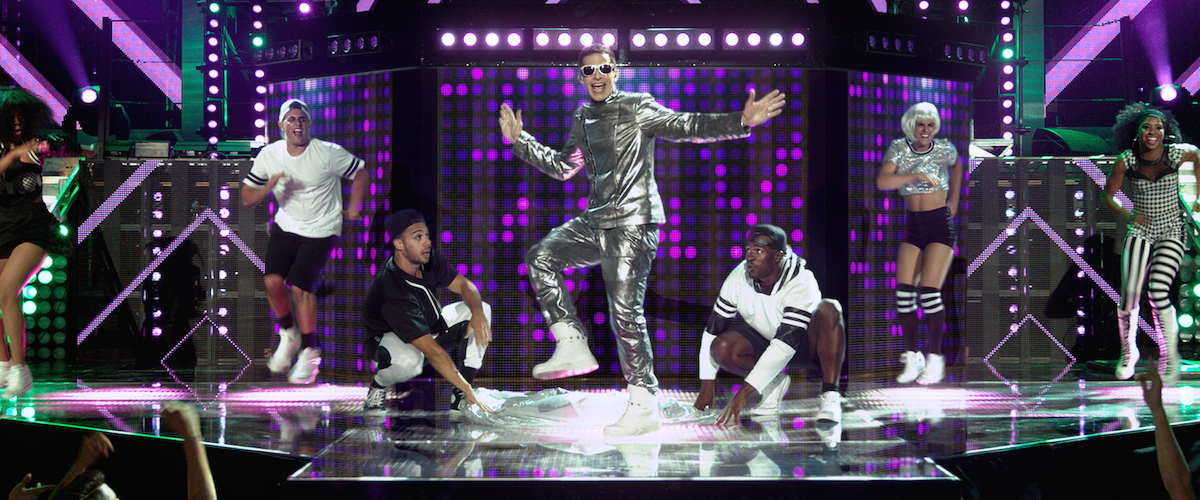
I had somehow gone my whole life having never seen “Popstar: Never Stop Popping,” and I’ll forever cherish that my first experience of this masterpiece was in the context of a sing-along event. Attendees were gifted flags and light-up sticks and encouraged to sing all of Lonely Island’s outlandish lyrics with musical abandon. Witnessing the crowd, with their imperfect pitch and infectious enthusiasm ringing through the theater, I’m fully convinced I’ll never see a better concert.
I am grateful to MUBI Fest for giving me a new way to document time because I now will exclusively think about my life as “before I saw Rob Mazurek and The Mastermind quartet perform live” and “after I saw Rob Mazurek and The Mastermind quartet perform live” (should any reader come up with a snappier abbreviation, sound off below. I had seen and loved “The Mastermind” prior but seeing it with Mazurek and his coterie (Victoria Vieira-Branco on vibraphone, Joey Sullivan on drums, and John Moran on Bass and Mazurek on the trumpet) made it feel like I was almost watching a different movie.
Kelly Reichardt’s slow-burn heist film is already understated, with Mazurek’s score giving the film a jolt of energy just when you think the temperature has been turned too low, but hearing it live only made the silences deeper and the cacophony more vociferous. This was paired with a screening of Steven Soderbergh’s “Ocean’s Eleven,” and if “The Mastermind” was ever going to feel like an “Oceans” film, it would be thanks to Mazurek and his team performing the score live. Truly, the glee I felt witnessing the score in the theater rivaled only that of when a heist gets successfully pulled off.

For Mazurek, playing in the Music Box Theater felt like his own homecoming. “I moved to Chicago in 1983, and, soon after, ‘84-85, found the Music Box,” he told RogerEbert.com, “The Music Box opened my world up to foreign film, the great American canon of film.” The sound was tightly integrated into the experience, and for Mazurek, performing meant there were opportunities for him to add flourishes in real time. “The overall shape and timings for the thing were spot on. We used a little more improvisation in this performance, but in subtle ways. For the second solo trumpet section, when Josh O’Connor’s Mooney gets on the bus, I had John hit a few tones on the bass just for a slight variation. And of course, for the end credits we hit it a little harder and floated a melody that was composed for the film but was not used.”
As energizing as Mazurek’s score is, per Reichardt’s films, there are long stretches where the film is also silent. For Mazurek and his team, not just watching the film but actively participating in it unlocked a new appreciation for a film he told me he’s seen “at least one hundred times.” “The silence in this film was as important and strong as the soundtrack itself. Nothing was trying to make you feel a certain way. It just was … the quartet and I were mesmerized by her painterly shots, sublime pacing, and ability to slow down and take in the beauty of Chris Blauvelt’s amazing cinematography. I can tell you one thing: we weren’t smoking between scenes!,” he shared.
I was already a fan of Alex Russell’s “Lurker” and crowned it the #1 film of the year on my personal top ten and was delighted to hear that a special 35mm screening at the Gene Siskel Film Center acted as the closing film for the festival. In the year since its release, its musings on the relationship between love and obsession, the ways people will hollow themselves out for a taste of the spotlight, and its interrogation of the toxic power dynamics within male friendship circles seem only more pertinent in our parasocial age.
Speaking with me before the film’s Q&A, Russell waxed poetic about “Popstar: Never Stop Popping,” which “Lurker” was paired with. There are some surface-level connections in that both films are about the entourages that surround pop stars, but Russell found a deeper, more tender thread of DNA. “A lot of Lonely Island comedy is about two deadpan guys singing to each other about these excuses they have to not hang out with each other. Their work revolves around guys who don’t know how to talk to each other; that very much speaks to ‘Lurker.’”
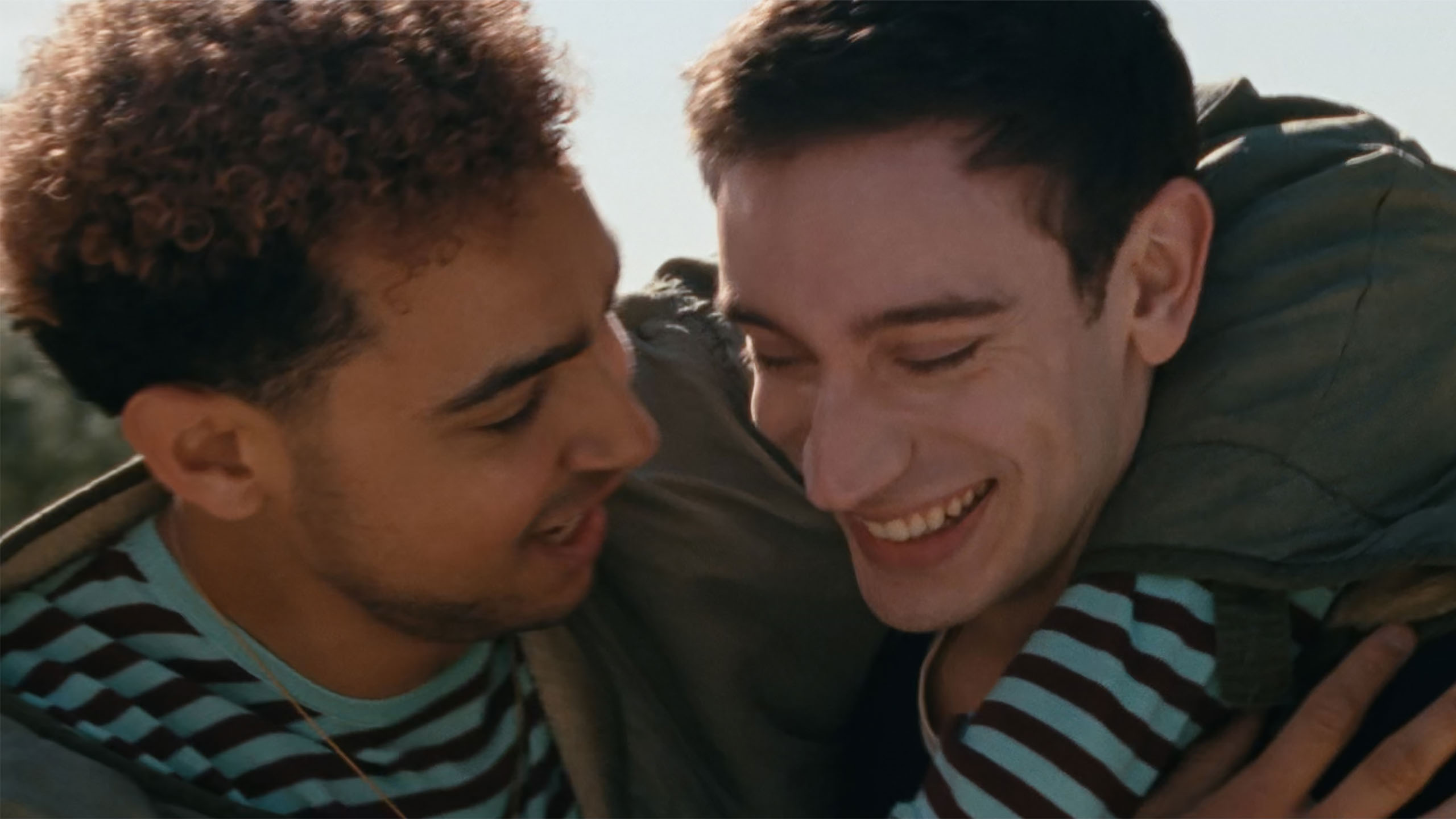
As much as “Lurker” may be a cautionary tale about fandom, in the year since its release, Russell touchingly reflects on the beauty of pursuing passion and being unapologetic about what you enjoy. “I think it actually is really cool to be a fan and to openly love things and express your appreciation for things because as much as it’s shown in movies that people don’t appreciate that, it is appreciated,” he shared. He also offers an interesting thought that as much as our parasocial age is primed to want to know the ins and outs of the people we’re obsessed with, there’s still beauty in mystique. “As you get older, you realize everyone is a person, and there’s something nice about the mystique that you can have between yourself and somebody you’re a fan of. Your view of them is not going to get better than it is as a teen with a poster on your wall. It’s kind of the same as having a crush. That in itself is something to cherish, and even sort of the yearning for familiarity with someone that you project so much can only ruin things.”
The Q&A post-screening was also among the best I’ve seen, thanks to Russell’s humor and willingness to be present with those who had come out for the screening. When given the cue to wrap, Russell advocated for more time, saying, “The film is streaming on two separate platforms. I feel like if you guys came out for this, then you want to talk, and I want to talk because I came to Chicago for this.” I’d like to think we all left the screening with a deeper awareness of how to be better fans of the people around us.
As I anticipate what a future version of MUBI Fest could be, I’m grateful for another lesson the festival imparted: that viewings don’t exist in a vacuum, and that writing about them should acknowledge, in some form, the context with which you watched it. So often when reviewing, I strive for objectivity but attending MUBI Fest made me consider that maybe there’s space in criticism to acknowledge the many factors that go into viewing and watching a film. What makes each viewing of a film so special is that it is either implicitly or explicitly engaging with not just what’s going on in my own life, but the things I may have seen before. There’s a power in acknowledging that, and now I attend each viewing with a certain excited curiosity: how might what I see not just be evaluated on its own merits, but be speaking to what I saw the night before? I leave MUBI Fest not just more cultured but also more attuned to the wondrous commonalities that may exist across cinema as a whole.