




Once considered the world’s worst aviation disaster, Turkish Airlines Flight 981 crashed outside of Paris on March 3, 1974, killing all 346 people on board.
Wikimedia CommonsThe plane that later crashed as Turkish Airlines Flight 981.
Passengers on Turkish Airlines Flight 981 had little reason to worry when they boarded their plane on March 3, 1974. The McDonnell Douglas DC-10 had just a short hop, from Paris to London. But the plane would never make it to its destination at London Heathrow Airport. Instead, it became the deadliest accident in aviation history for years to come.
The plane was holding 346 souls — businessmen, families, rugby players, and even newlyweds — when disaster struck just nine minutes after takeoff.
It happened fast. Just sixty seconds before Turkish Airlines Flight 981 crashed into the Ermenonville Forest outside of Paris, its rear cargo door blew off. The plane plummeted from the sky at almost 500 miles per hour, and exploded into hundreds of pieces as it smashed into the ground. All 335 passengers and 11 crew members were killed.
At the time, the crash of Turkish Airlines Flight 981 was the worst aviation disaster in history. It was made all the more tragic by the subsequent investigation, which proved that the tragedy could have been averted.
Turkish Air Lines Flight 881
Turkish Airlines Flight 981 departed Yeşilköy Airport in Istanbul, Turkey on March 3, 1974, at 07:57 a.m. local time. Bound for London Heathrow Airport with one intermediate stop, it landed in Paris’ Orly Airport at 11:02 a.m. with 167 passengers on board. Fifty people disembarked the plane and, normally, the plane would continue to London almost empty. But as The Times reports, a British European Airway strike meant that dozens of passengers had been stranded at Orly, and chose to board Turkish Airlines Flight 981.
They were in steady hands: the plane’s captain, 44-year-old Nejat Berköz, had 7,000 flying hours, his first officer, 38-year-old Oral Ulusman, had 5,600 flying hours, and the flight engineer, 37-year-old Erhan Özer, had 2,120 flying hours. What’s more, the passengers would be flying in a McDonnell Douglas DC-10 aircraft, a new plane that had been flying for just two years.
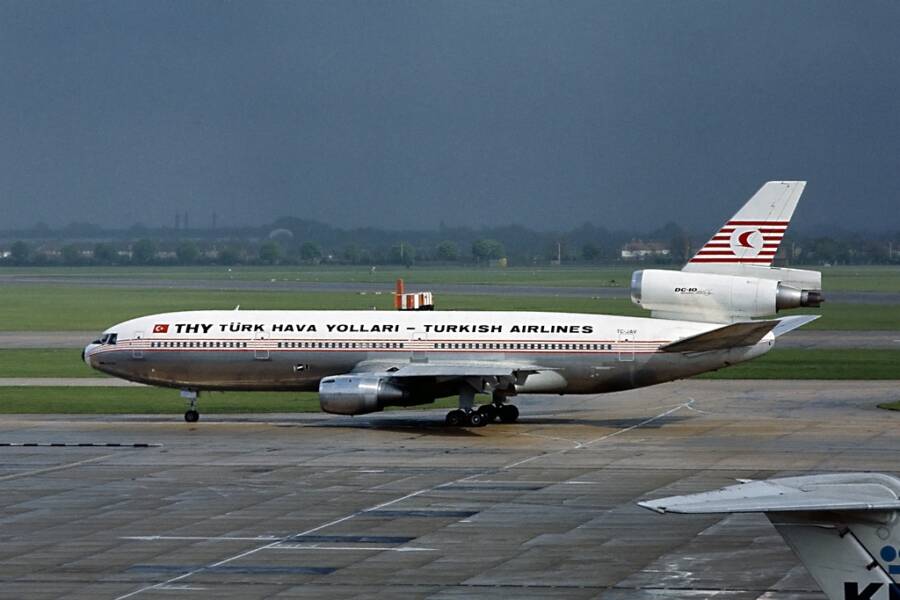
Steve Fitzgerald/Wikimedia CommonsThe aircraft used in Turkish Airlines Flight 981, seen here in May 1973.
Though the plane was delayed by about 30 minutes to account for the rebooking of passengers, there was no indication that anything would go wrong. Turkish Airlines Flight 981 took off from Paris Orly Airport at 12:32 pm. It ascended to 23,000 feet, and began its westward turn toward London.
Minutes later, disaster struck.
The Ermenonville Air Disaster
After taking off, Turkish Airlines Flight 931 initially flew as normal. Weather conditions were pristine, and the flight from Paris to London was only supposed to take less than an hour. Its passengers — which included dozens of Japanese bank management trainees, 17 English rugby players, six English fashion models, and passengers from the United States, Turkey, and several other countries — had no sign that anything would go wrong.
But just nine minutes after takeoff, Turkish Airlines Flight 931’s rear left cargo door blew off, causing a catastrophic change in air pressure between the cargo hold and the pressurized passenger cabin above it. The subsequent explosion was so loud that it was heard by witnesses on the ground, who also looked up and noticed that the plane was flying at an odd angle.
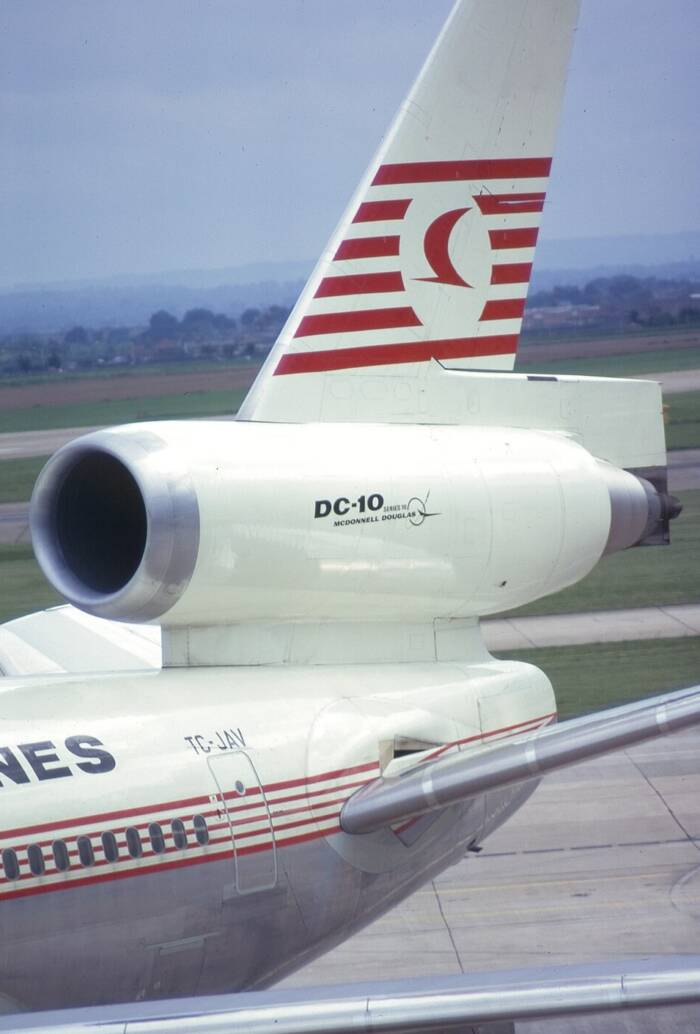
Wikimedia CommonsThe rear cargo door which doomed the plane can be seen to the left.
As The New York Times later reported, the explosion caused a “violent rush of air” which sucked six passengers, still in their seats, out of the plane. It also crushed the plane’s hydraulic steering apparatus, making it impossible for the flight crew to respond. According to the FAA, audio in the cockpit captured chaos, including Ulusman crying: “the fuselage has burst!”
Just a minute later, the plane crashed into Paris’ Ermenonville Forest.
What Happened To Turkish Airlines Flight 981?
Turkish Airlines Flight 981 crashed into the Ermenonville Forest 23 miles northeast of Paris at 12:40 p.m. It had entered a steep dive of 20 degrees and smashed into the forest floor at 490 miles per hour. It practically disintegrated upon contact, exploding into more than 18,000 pieces.
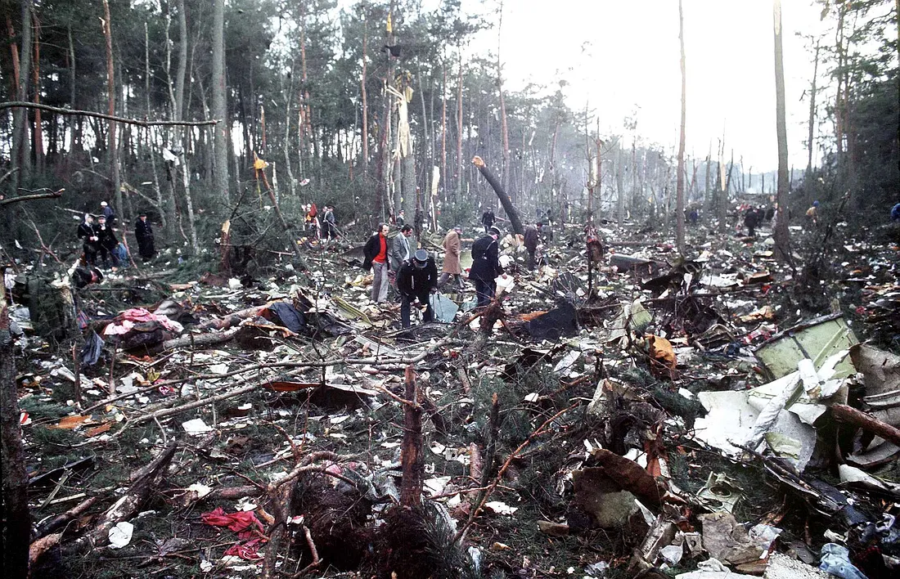
Bureau of Aircraft Accidents ArchivesThe main crash site of Turkish Airlines Flight 981.
Rescue workers raced to the scene, but there was no one to save. Turkish Airlines Flight 981 was nothing but tiny fragments of aluminum engines, luggage — and people. All 346 people onboard were killed and, at the time, it was the worst aviation disaster in human history.
So what exactly had gone wrong?
At first, some believed that Turkish Airlines Flight 981 had been brought down by a bomb. But an investigation found that the cause of the crash was human error. The pilot and his crew were faultless — but the plane wasn’t.
Wikimedia CommonsA grainy image of the plane crash debris.
Investigators determined that the plane’s fatal flaw lay in its cargo door. Put simply, the door could close even when it was not in the right position. And McDonnell Douglas, the airplane’s manufacturer, was well-aware.
As The New York Times reports, the rear cargo door of another DC-10 had blown off during a low-level pressure vessel test on May 29, 1970. Two years later, the rear cargo door of another DC-10 blew off during a flight over Windsor, Ontario, though the pilot was able to safely land the plane.
The Federal Aviation Administration and McDonnell Douglas entered into a “gentlemen’s agreement,” agreeing that the FAA would not ground the planes, and that McDonnell Douglas would work on fixing the cargo doors. To make matters worse, paperwork had been filed claiming that these modifications had been performed on Turkish Airlines Flight 981 — but they hadn’t.
The Sad Legacy Of Turkish Airlines Flight 981
In the aftermath of Turkish Airlines Flight 981, the flawed cargo door on the DC-10s was fixed. McDonnell-Douglas and Turkish Airlines were sued, and ultimately settled out of court, paying the victims’ families millions of dollars.
However, this was little comfort to those who lost loved ones in the crash.
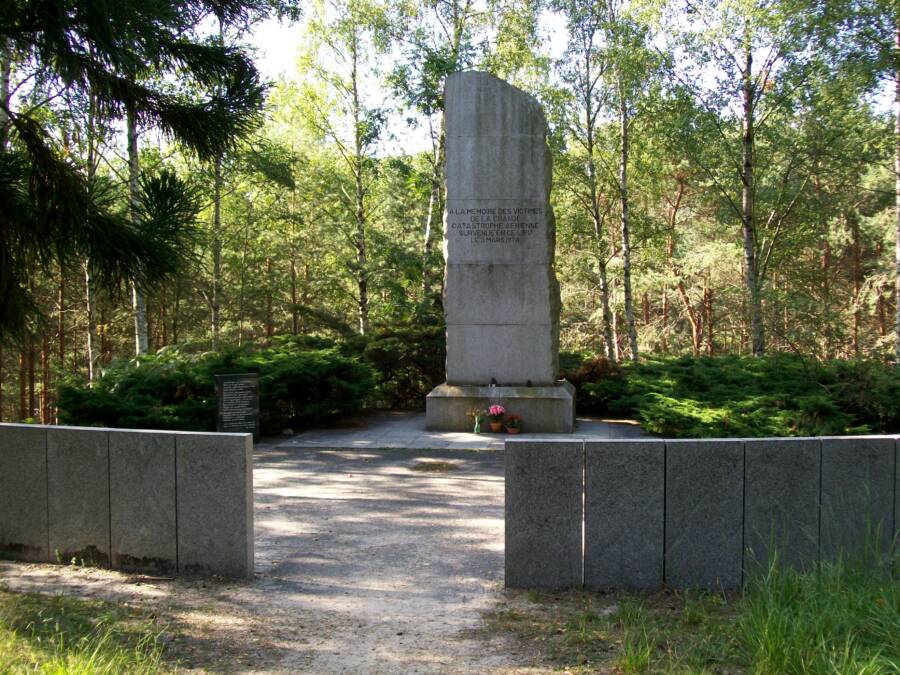
Wikimedia CommonsA monument to the victims in Ermenonville Forest.
As The New York Times notes, the crash killed more than a dozen entire families, widowed 80 women, and made 29 men into widowers. Fifty-two children lost both parents, and more than 200 children lost one parent. Countless people also lost friends, loved ones, and teammates.
A memorial in Ermenonville Forest attests to this loss.
After learning about Turkish Airlines flight 981, one of the worst aviation disasters in history, read about the American Airlines Flight 191, the deadliest non-terrorist-related plane crash in U.S. history. Then, go inside the mystery of what really happened to Malaysia Airlines Flight 370.