




Towards the end of Rian Johnson’s “Wake Up Dead Man,” Josh O’Connor’s Judd Duplenticy says of his suffering congregation, “And some got their miracle. Not being cured or fixed, but finding the sustaining power to wake up every day and do what we’re here to do.” This celebration of finding strength through community to make steady steps toward healing and betterment is a key part of what gives director Adam Meeks’ “Union County” its inspiring staying power.
Meeks’ film lends tranquility to a story of recovery, a quality usually not afforded to films of a similar ilk. Will Poulter stars as Cody Parsons, someone who was recently incarcerated and, as part of his recovery, was assigned to a county-mandated drug court program in rural Ohio. Having wrestled with opioid addiction, the film bears witness to Cody’s struggle to get back on his feet, learning to live one day at a time, even while the fear of relapse and the presence of past demons actively war against him. His foster brother, Jack (Noah Centineo), is in the same program, whose own struggles with relapse mirror Cody’s own.
A unique fixture of “Union County” is the way it was so deeply created in collaboration with the community it depicts (the best comparison I can think of recently is Greg Kwedar’s “Sing Sing”). Meeks and his team made the film in partnership with participants in an adult recovery court program in Bellefontaine in 2025. The film features real court hearings and recovery meetings, with participants being given the option to opt out on any given day if they weren’t comfortable being filmed.
Meeks intended to be “observational” rather than “impositional,” and you feel that in his and cinematographer Stefan Weinberger’s approach to filming the participants here. There are frequent close-ups, but the camera delights in holding on to the visages of these people and asking us to hold on to their humanity.
Poulter and Centineo shared the screen in “Warfare,” an intense experience that solidified their camaraderie on- and off-screen and also had thematic synergy with their roles in Meeks’ film. In an interview with assistant editor Clint Worthington, “Warfare” co-director Ray Mendoza shared that “What separates good production units or military units is, when mistakes happen, it all goes back to preparation and training. How fast can you get back on track?” This mirrors, in many ways, the slow, steady, and non-linear path towards healing that these recovery programs celebrate. The mistakes and slip-ups matter less than being willing to get back on the wagon, reset, and try again.
Ahead of the film’s release, RogerEbert.com spoke with Poulter and Centineo about viewing the courtroom as a sanctuary and a chopping block, changing the Hollywood grammar when it comes to depicting stories about recovery and addiction, and the ways their roles as Cody and Jack are in conversation with past roles in “Our Hero, Balthazar,” and “Dopesick.”
This conversation has been edited and condensed for clarity.
Both of your characters smoke quite a bit. No drag looks the same, and I’m fascinated by how your approach to smoking scenes has evolved throughout your career. How does working with a tactile prop like that, with its own rhythms, help you access your characters better?
Will Poulter: It’s interesting because my dad’s a medic, and one of his first questions to me after watching the film was “How many cigarettes did you smoke?” I was like, “Really? That’s your question?” (Laughs) It’s interesting because, with an action like smoking, my perspective is that it has to feel earned in some way, justified by a genuine element of the character, or be part of the culture they belong to; I wouldn’t want a character to do it arbitrarily.
I think of Noah and my experience on “Warfare,” and speaking to a lot of people with lived experience of serving in the military and a lot of the gentlemen that we were responsible for representing, smoking was something that was done as much to pass the time as anything else. I would assume it offered some form of stress relief, too, but often, as documented in the film, there were many idle moments when guys were just drinking tea and smoking cigarettes. Smoking was a way of feeling more proximate to the lived experience we all were simulating.
The cigarettes function in quite a different capacity in “Union County.” Smoking after meetings or after court hearings or after various elements of the recovery program was common, but there’s an almost deeper reverence for it. Obviously the folks in recovery are abstaining from substances, and so there are things that one can engage in without derailing the recovery process.
Noah Centineo: It’s about choosing which vice you’re comfortable with, if you will. Caffeine and nicotine … Those are the two common ones. If you can’t have other things, you’ll take those two. There’s something about having a prop like a cigarette that you’re able to see different people’s personalities come out. Everyone smokes differently, and you can see that in the campfire scene in particular.
Charles Melton mentioned that for “Her Private Hell,” Nicolas Winding Refn had him smoke more than 50 cigarettes in a single scene. I suppose that’s the record to beat.
WP: We may have him beat for the aforementioned campfire scene … we had to smoke a lot that day.
When your director, Adam, stepped into the courtroom and witnessed participants go in for their check-in, it felt like a sanctuary. It was “a community of people seeking support, a handful of court employees there to help as best they could, and a pervasive feeling of empathy and the embracing of individual humanity.” I’m curious how that view, if it was communicated to you both during filming, informed the way you would operate and move in that space.
WP: Adam has an amazing way with words, and not only do I really connect with that idea, I think that’s consistent with what I observed as well. Adam often refers to this quote about sobriety from Johann Hari, who said: “The opposite of addiction is not sobriety, the opposite is connection.” What the courtroom kind of exemplifies is that idea that this is a place where folks find a sense of community, a sense of connection, and the support that folks feel in recovery is characterized by being around like-minded people who are also trying to get back on their feet and make better choices for themselves and those around them.
There is a sense of camaraderie, I think, that develops between both service providers and the participants of the program in that courtroom. I think one thing that is so beautiful about the program is that, unlike some of the more punitive and criminally weighted responses to folks who have substance abuse disorder, this is characterized by really humanizing people, taking the time to listen to people’s experiences, and finding out in a more holistic way what kind of possible support someone might need. That’s just a really beautiful response to a subject matter that is so heavily stigmatized.
People’s struggles are often responded to in a reductive way because our impressions of addiction are incredibly reductive and oversimplified. Noah got a chance to go out and spend some time and sit in on some court hearings about a year before the shooting, and it was invaluable to understanding why that is such a sanctuary, basically, how that is such a sacred space.
NC: It is very much a sanctuary for many, and it can also be a kind of chopping block.
You embody that sensibility in Jack so well, particularly in how you capture that character’s shiftiness and unease when being called up.
NC: Yeah, if you get questioned by the judge, bro, you’d be jittery. You get called up, kind of like confession, and you’re before this deity who is that all-powerful judge. If you’ve done well, atoned, done the right things, you get blessed, whether that is through receiving food stamps, bus passes, or credits. If you haven’t done well, you get punished. That’s not to say it is cruel or unusual by any means, but maybe it is further evidence that the courtroom could be a sanctuary.
Hollywood tends to over-sensationalize addiction, but there’s something about this that is so lo-fi, tender, and understated. What was rewarding about working on a story like this that operates at such a different register?
WP: It’s almost like two different sides of the same coin. One thing that I love about this film, and the reason that I really was drawn to it, was that it really challenged the stigma that is so asphyxiating when it comes to folks with substance use disorder. Within our industry, there is a responsibility to consider how we continually represent certain people and groups. Some of the stigma that exists around the subject of addiction has been proliferated by stereotypes on screen and the emphasis on negative stories when it comes to addiction. I love that “Union County” is, in many ways, a celebration of the progress and success that this program is achieving and of the participants who are committed to recovery.
This adult recovery program has a success rate of over 50%. There are 4,000 problem-solving courts across America. Many of them are focused on supporting folks with substance use disorder, but not all have this success rate.
I think the film, hopefully as much as anything else, will draw people’s attention to what the program in “Union County” is doing differently. Hopefully people will think differently when they do come into contact with someone who is experiencing addiction because I think that should encourage more grace and more empathy.
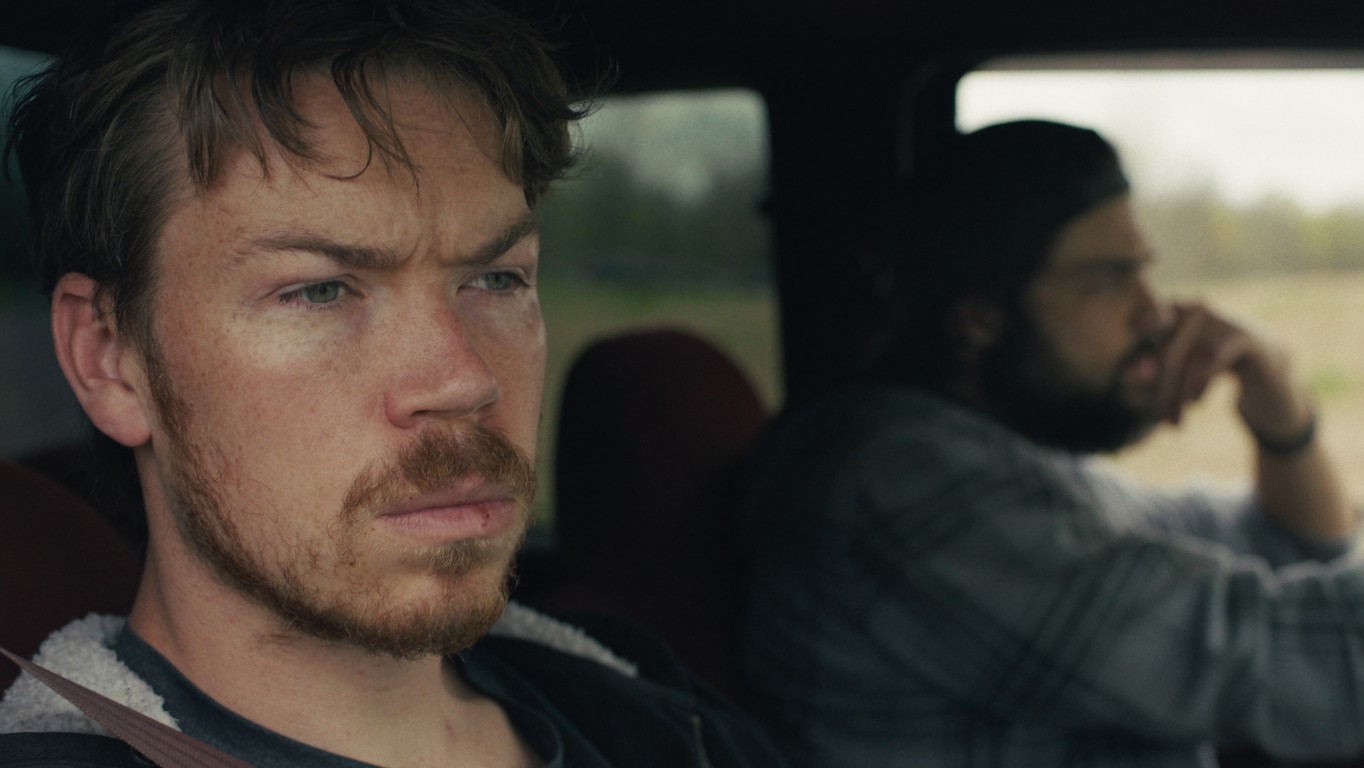
You’re working to change the grammar of Hollywood films for these types of stories, which can prioritize sensationalism over reality. The film feels in conversation with both of your past works. Noah, I think about your role as Anthony in “Our Hero, Balthazar,” and how that character, in seeing someone like Balthazar struggle, exploits instead of offering aid. Will, your work in “Dopesick” had your character on the opposite side of the opioid crisis from Cody. Can you speak more to the gift of being able to embody roles that feel as though they’re echoes of each other in some fashion?
NC: I think that one of the central themes in “Union County” is trust. That’s a general theme in some way with “Our Hero, Balthazar.” Anthony doesn’t have Balthazar’s trust, but if you’re going to be someone’s life coach, if you’re going to try to help someone, you would hope that there’s a little piece of trust there. I think the only trust is between Anthony and Balthasar’s mother, but Anthony abuses it to make money. Whereas, as you said, in “Union County,” this trust is very different. It is the trust between Annette Deao and the participants in the program that, I think, ultimately drives the program’s over-50 % success rate.
At the very end of the scene, when Cody is in the car and he’s tempted to use, he gets that idea: “Maybe I should call Annette.” Even if his body might find more solace in the drugs, it’s the trust that actually moves his hand to the phone. That is something that is earned throughout the film that’s not there, and I think that is the reason why Annette has had success and why these programs, as Will mentioned, there are 4,000 of them around America. It’s through this rigorous accountability, from the system holding its participants to the participants holding themselves, that trust can blossom for everyone’s benefit.
WP: I’m glad Noah brought up trust because I couldn’t agree more. Yeah, “Dopesick” was such an interesting education for me in terms of the opioid epidemic, and also I think some of the challenges that are unique to opioid addiction in respect of recovery. I think our show was weighted more toward the injustices of that epidemic, the widespread devastation it inflicted on so many people, and how, in many ways, that damage was irreparable. The lingering questions that “Dopesick” touched upon in the final episode are: “What workable treatments are there? What sort of actionable responses are there to this epidemic in the interest of recovery?”
Adam Meeks’ short film “Union County” and this full-length feature are the story that answered that question. Here was this program that was very successful, was helping folks get back on his feet and was also mindful of the fact that at its core, remained mindful of the fact that no one wakes up and decides to become addicted to heroin, that there are long and complex journeys often characterized by a situation where someone may have been reliant on medication and they were prescribed oxycodone by a doctor. We heard that repeatedly in our time sitting in drug court and within the community. So I think “Dopesick” just helped me gain a sort of understanding of that kind of reality, and then I was able to approach “Union County” with a pre-baked awareness of that complexity, and ultimately end it with a semblance of hope.
“Union County” is in theaters now via Oscilloscope Laboratories.