




Fred Rogers’s song “What do you do with the Mad that you Feel” comes to mind when watching director Alexander Ullom’s existential road-trip nightmare, “It Ends.” In his song, Rogers articulates a need for vessels to place our rage, angst, and grief, and sings how easy it is to feel powerless in the face of all that afflicts us. That same thorny longing, terrifying questioning, and ultimately deep-seated hope that depression won’t rule the day courses through Ullom’s film, which takes the straitjackets of horror and hangout movies and blends them into a unique meditation on growing up and finding your way.
Ullom’s film follows four recent college grads, James (Phinehas Yoon), Tyler (Mitchell Cole), Fisher (Noah Toth), and Day (Akira Jackson), who embark on a late-night drive before they go their separate ways. They realize that they’ve turned onto a never-ending road, and any time they try to pause to catch their breath, they have only ninety seconds of respite before hordes of screaming people swarm and attack them. As the odometer climbs and days begin to blend, each member of the crew has to wrestle with what this purgatory means for the futures they once thought they had.
Though the foursome are plagued by eternal monotony, the road to “It Ends” finding a movie home was far from straightforward. After a premiere at SXSW, a subsequent tour on the festival circuit that included the 2025 Chicago Critics Film Festival, a stint on the Letterboxd Video Store, and creative persistence from Ullom himself (“insanity,” he corrects me in our interview) involving influencers at a “Jurassic World: Rebirth” event, “It Ends” finally roars into theaters now.
RogerEbert.com spoke with Ullom once in person during the film’s Chicago premiere and once over Zoom after Ullom wrapped principal photography on his follow-up, “4×4: The Event”; this piece combines those interviews into one fluid conversation. Ullom spoke about the importance of silly questions when navigating our present hellscape, humanity’s tendency to create liturgies to process suffering, and how his decisions to balance the film’s horror and hangout elements manifest in the characters’ arcs.
This conversation has been edited and condensed for clarity.
I found the sequence where James is pleading out to some unknown force for the car to start to be relatable for those who come from religious backgrounds, in particular, the ways people of faith or dechurched people can be so quick to revert to crying out to God in a moment of crisis. Did drawing from your own faith background prove prudent when articulating some of these characters’ spiritual angsts?
Alexander Ullom: The film is definitely religious trauma coded, but I have nothing against religion. Anything that would give people a sense of comfort as they’re dying is probably a good thing, and we have an increasingly short supply of those balms. That scene where Fisher is lamenting that his mother might think he’s going to hell because he told her he was not religious has personal resonance.
In the two-and-a-half-hour version of this movie, there was a whole swath of scenes where the group was trying to remember stories from the Bible. They were talking about Lot’s wife and how she turned to a pillar of salt because she turned around to look at the destruction of Sodom when God told her not to, and trying to understand why she’d do that. Like, dude, if God–like literally, God– fucking showed up and was like, “Do not turn around or else …” I would be like, “Yeah, absolutely. Assignment understood.”
One thing that your film really dives into is the fear of eternity. I feel like as human beings we’re not built to fully reckon with the concept of “forever.” What’s your relationship to eternity?
I think for people my age, our relationship with infiniteness and liminality–call it “Backrooms,” if you will–all stems less from a religious place and more from the fact that we don’t really have a destination to “arrive at” anymore. There’s a movement away from any sort of interconnected moral system in our generation that there might have been in the past. The tent poles of structure that used to hold up society, whether it was having a family or buying a house, or literally religion–which used to be one of the moral center points of what held all the kids together–all of those structures have kind of dissolved, and in their place is kind of nothing, like a transitional state.
If liminal spaces are transitionary states, it just feels like we’re in a long one right now. Our relationship with nature is off right now, and because, in general, I think people are becoming less religious or spiritual, we’re losing a connection to something bigger than ourselves.
I was struck by a relatable, futile tendency to graft ritual onto otherworldly situations to shrink them down to size and make them relatable. It’s why I resonated so much with the on-screen rituals we see the characters undergo once they accept their fate. What was the origin of coming up with these rituals?
The guide rails were that each practice or “time” was crafted to process a specific emotion. The screaming is the physical sensation of getting the fear out; the memes are brain gooping, to give your mind space to unwind. I’m probably not smart enough to articulate this, but with the dancing, one of the things I was trying to communicate was how, within the confines of capitalism, every emotion and physical need is exploited, individual time that needs to exist inside of a larger structure. So dancing was a way to break free from some of that.
Are there practices you find yourself implementing now that act as your form of release? What do you do with your anger, despondency, and despair?
It has changed over time. When I was young, meditating was ridiculous to me, but now I figured out how to climb our fire escape to get to the roof of my apartment. So now I’ll go up there and just sit in the sun for a while. Reading has reentered my life, which is crazy. I’m trying to commit to doing things that actually are good for your well-being. Eating all the food groups …
Where do Clif Bars–which get a nice payoff at the end of the film–fall into that diet?
I don’t think I can eat those anymore. I told Phineas I’d eat bar for bar what he ate during production, and I ended up eating a lot of them. This stuff to actually improve your life is just what everyone already knows; you just have to commit to doing it, which sucks. With meditation, my attitude was, “ I don’t want to waste 15 minutes sitting in silence when I could be, I don’t know, doing anything else.” But then after 15 minutes, I’m like, “All right, I feel a little better. I can enjoy TikTok a little better now.” (Laughs)
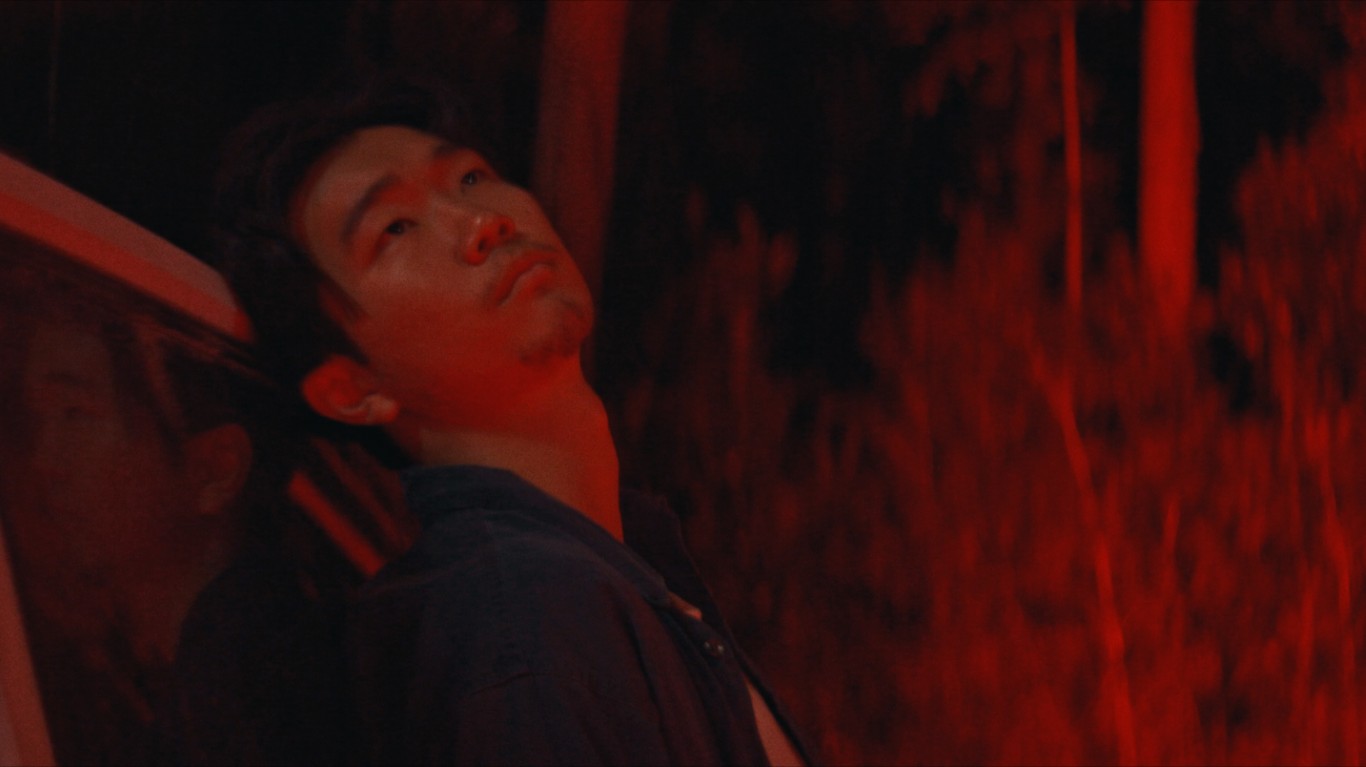
How do you think growing up terminally online has shaped your (or Gen Z’s) approach to processing trauma?
Personally, I was fifteen when I saw the Russian Brick Video. I saw a cartel execution online when I was twelve years old. Every single time you watch anything on a phone–even in movies– there’s a simulation of emotion, and so if I was going to feel the real thing, I had already been desensitized to the actual sensation of that feeling. I think we’re all walking around with a functioning numbness, spawned in part due to a collective dissociation.
I’m curious if someone in medieval times who saw their family’s heads chopped off in real time would process it better than how we’re processing similar images now because their emotions are rooted in witnessing something real. Every time we see awful footage online and go on with our lives, we are–as Fisher says–experiencing weaker shades of emotions.
I remember my first heartbreak, and it was world-ending, and then I got used to it. It feels like we only have a certain reservoir for a specific emotion, and over time, it gets ground down and down. You run out of it, and the more you’re online watching stuff, the more I think you use up that reservoir.
Even with watching a horror movie, about an hour in, I just get desensitized to the actual sound of the theater. There’s only a certain number of times a speaker gets really loud before I’m completely used to it.
It’s terrifying how easily we get used to things. In addition to the aforementioned Russian Brick Video and Bible story retelling scene, I also know there were lots of conversations and scenes that you ultimately didn’t include in this edited cut, like another one including the song “Viva La Vida.” Tell me more about the process of choosing the cultural references in this film, knowing that by the time of release, the film may feel dated by what its characters talk about?
I just wanted to root the dialogue in the stuff that’s stuck around with my actual friends in real life. It’s weird because by the time this movie comes out, people are going to think that we’re copying the “100 men versus gorillas” meme based on the question that the characters bicker about at the start of the film. This interview proves we are ahead of the game right now. I think what will keep it universal and fresh is that the references aren’t necessarily rooted in a specific trend. Like modern art, people use memes to process what they’re going through, and that’s what will be familiar, less so the content of the meme itself.
You’ve shared before that when you were in a dark place, the silly debate you had with a friend about whether a gorilla or bear would win in a fight galvanized something in you that helped make life worth living. Tell me more about the role of silly questions in friendships.
There’s no such thing as objective truth anymore. So now these questions are a truth in a way. The actual limit of the human experience is questions with no answers. The confines of existence are questions without an answer, but also know that since there’s no truth, everyone’s subjective opinion is the most important thing now. So the person arguing for the gorilla …. That debate is essentially a spiritual battle, because that’s all that’s left (Laughs). I feel like scholars and scientists have kind of already figured out everything there needs to be, and now it’s for us to debate the silly questions of life. Maybe that’s the unifying moral structure our generation can push together in the absence of religion. In many ways, arguing over a stupid hypothetical is actually the most important thing in the entire world.
A lot of the characters’ grief stems from a legitimate nihilism that anyone would feel living in the world we’re in now. I found their grief to be an almost righteous form of discontent.
If there’s all this horror, if all this shit is going on around us all the time, then the only real thing we can do to make our fellow conscious experience a little bit better is hang out and connect with someone through conversation. Talking with people, hearing different perspectives- to me, these feel like the ways to combat that desensitized meaninglessness. They don’t necessarily need to be these “bear versus gorilla” questions either. If everything’s horrifying, terrifying, and meaningless, then the only reaction is to hear everyone talking about it.
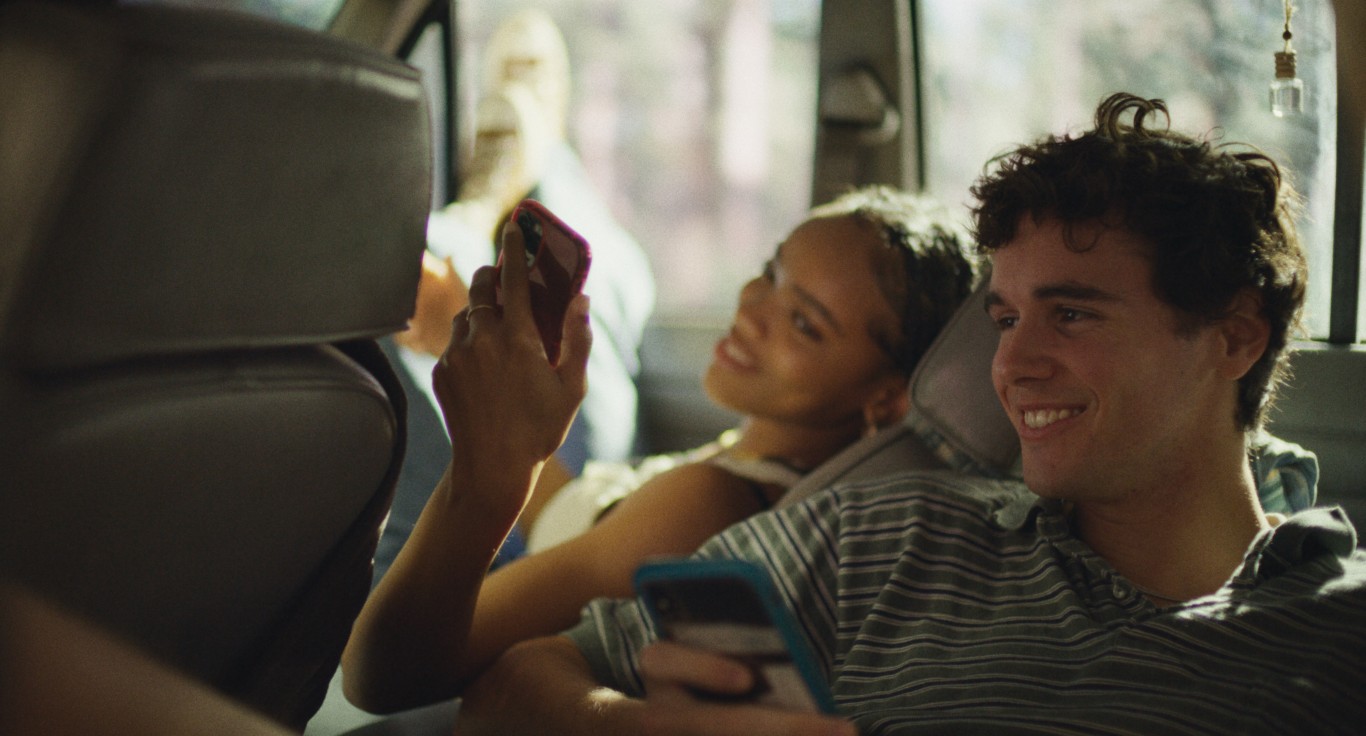
You talked about how one read of “It Ends” that you like is that there’s a war over the film’s tone with the characters themselves, right down to the changes in aspect ratio. The film widens during the hangout moments, whereas in its “horror” phase the frame is tighter. Talk to me a little bit about that wrestling you were undergoing as a director with this film, and then transplanting that struggle onto the characters?
I think that if they didn’t make that turn, the group would have gone and had a “Dazed and Confused” kind of night. The film would have been a dope little hangout movie, and they probably would have kept butting heads because James is a bit of an asshole. But the film turns onto the road, and now it’s in horror movie mode.
Horror and genre are built on overcoming conflict as quickly as possible. A belief runs through those projects, rooted in the hero’s journey: I’m going to conquer this object, this conflict, and then I will return having changed. That is not how adulthood works at all, or real life. There’s just this scrap in the mud where you pull meaning from wherever, and that’s the thing that James couldn’t fully understand.
So while James is on one end, bringing in that framework and horror, you have Fisher and Day on the other, who, after the time jump, are just trying to hang out. There’s a healing in vibing, and that helps save us from the period of transition we’re in. James is literally saying: “I want the new thing? What is the new thing?” That’s very typical of a genre audience member. For James, he can’t accept that relationships and the people you love are what give life meaning. He doesn’t want to hang out. That was me when I was younger; I couldn’t be present. I couldn’t live in a world where I couldn’t get an answer for that, partly because of my religious upbringing too.
Fisher and Day have to literally turn off the story vehicle. James can’t accept that, so he takes the same vehicle, the one driving the plot, and takes off on his own. They’re battling, and the movie can’t conclude till the plot concludes and, by extension, he takes the movie from them.
Going just off the logline of your next film, “4×4: The Event,” it feels like if “It Ends” is going to be about that transition to adulthood, your follow-up is about how to survive the reality of adulthood.
Yeah, if “It Ends is like “Hey, don’t kill yourself. Love the people around you,” “4×4: The Event” is very much “Okay, now that you didn’t kill yourself, we need to unite.” It’s an intense escalation. If “It Ends” was about the transition from 18 to the ages 23-25, then the next project is about me going from 25 to 30 and watching the people I love’s lives be deeply and negatively affected by the state of the world.
Visually, the film was inspired by my time living in that windowless walk-in closet while I was making “It Ends.” You don’t get this from the logline, but yeah, all the contestants are living in small, dark, windowless concrete rooms with tunnels between them. There’s a drop chute where their orders come in. It’s a setup that truly inverts the natural world. There’s not a single thing in that room that’s organic. They’re pretty much told, “Hey, here’s your computer … here’s your tool to conquer the world. Good fucking luck.” That’s modern life in a nutshell.
“It Ends” is in select theaters via NEON.