




You’ve built an audience that trusts what you recommend. So when someone asks which camera you shoot with or which book reshaped how you think about marketing, you send them a link, and that link earns Amazon a sale and you nothing. An Amazon influencer store fixes that. It turns the recommendations you already make into a single shoppable page that pays you back.
I teach personal branding and influencer marketing at UCLA Extension, I wrote a book about the space called The Age of Influence, and I advise companies as a fractional CMO. I also run one of these stores myself. I’m an approved Amazon influencer, and my storefront lives at amazon.com/shop/nealschaffer. So the steps below come from setting one up and curating it, not from reading someone else’s summary.
I’ll be honest with you up front: this is not a get-rich scheme. Commissions are modest and the window to earn them is short. But for creators who genuinely recommend products, a storefront is a low-effort asset that earns quietly in the background while you do the work you were already doing.
Key Takeaways
✅ An Amazon influencer store is a free, curated shopping page with a vanity URL like amazon.com/shop/yourhandle, where you collect products you recommend and earn a commission when followers buy.
✅ Amazon doesn’t publish a follower minimum. It weighs engagement and content quality, so creators with a few thousand active followers get approved alongside much larger accounts.
✅ Commission rates run from 1% to 10% depending on category, and Amazon’s tracking window is only 24 hours, so the money comes from volume and trust, not from any single big sale.
✅ The storefronts that convert are tightly curated by topic, mix your own products with picks you genuinely stand behind, and carry a short, honest note on each item.
✅ Disclosure isn’t optional. The FTC requires a clear statement that you earn from qualifying purchases, and Amazon requires it too.
What Is an Amazon Influencer Store?
An Amazon influencer store is your own page on Amazon where you collect and recommend products to your followers. Amazon gives approved creators a vanity URL, customizable lists, and a commission on what people buy. It’s an extension of the Amazon Associates affiliate program, built specifically for social media creators with an audience.
According to Amazon’s own description of the program, you get a customizable presence on Amazon that you curate with the products you feature in your videos and posts. You also get a special vanity URL in the format amazon.com/shop/yourhandle that you can share verbally with your audience. When customers visit your page and shop, you’re compensated much as you would be through Associates.
The store sits inside a much bigger shift in how people buy. Goldman Sachs estimates the creator economy could reach roughly $480 billion by 2027, and the paid-partnership slice of it is growing just as fast. Influencer Marketing Hub pegged the influencer marketing industry at $32.55 billion in 2025, up from $24 billion the year before, and Statista estimates the global influencer market has more than tripled since 2020. A lot of that growth runs straight through the kind of product recommendations a storefront makes shoppable. If you want the wider numbers on how this channel has grown, I keep a running set of influencer marketing statistics updated on my site.
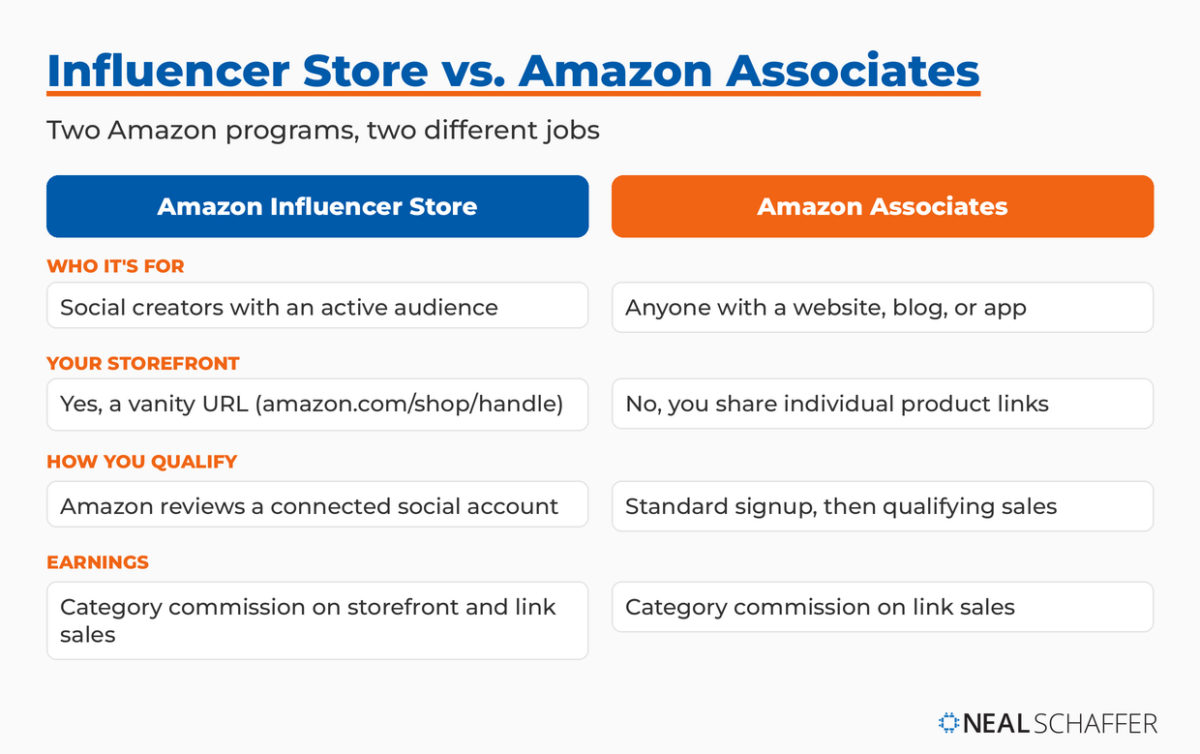
It helps to know how the influencer store differs from plain Amazon Associates, because creators often confuse the two.
| Feature | Amazon Influencer Store | Amazon Associates |
|---|---|---|
| Who it’s for | Social creators with an active audience | Anyone with a website, blog, or app |
| Your own storefront | Yes, with a vanity URL (amazon.com/shop/handle) | No, you share individual product links |
| How you qualify | Amazon reviews a connected social account | Standard signup, then qualifying sales |
| Best for | Recommending across your social channels | In-content links inside articles and pages |
| Earnings | Category commission on storefront and link sales | Category commission on link sales |
If you’re weighing whether this fits your wider creator plans, it’s worth understanding how influencers make money across all their channels, because a storefront is one income stream among several, not a standalone business.
How Do You Qualify for an Amazon Influencer Store?
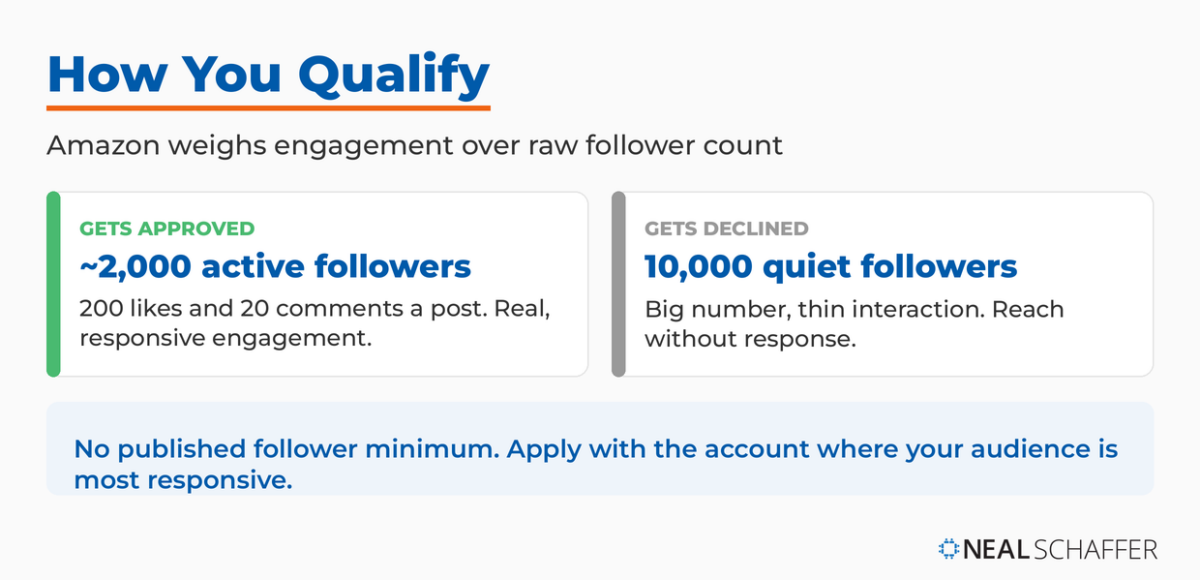
You qualify by connecting a social account and letting Amazon evaluate it. Unlike basic Associates, the influencer program reviews your audience and content before approving you. Amazon looks at the platform where you’re strongest, whether that’s YouTube, Instagram, TikTok, or Facebook, and judges whether you actually influence buying decisions.
The part that trips people up is the follower question, because Amazon does not publish a minimum. In my experience and across the creators I work with, it weighs engagement rate and content quality more heavily than raw follower count. Accounts in the low thousands get approved when their audience is active, and large accounts get declined when their engagement is thin. Apply with the account where your audience is most responsive, not the one with the biggest number.
The mechanics of applying are straightforward. If you want the click-by-click version, I lay it out in my post on becoming an Amazon influencer. The short story: you sign in with your Amazon account, connect a social profile, and wait for the review. For the wider context first, my post on the Amazon Influencer Program explains how it sits inside Amazon’s broader affiliate setup.
If you’re earlier in the journey and still building the audience that makes approval likely, focus there first. The same habits that grow an engaged following are the ones I cover in becoming a content creator, and they matter far more than gaming any approval threshold.
How Much Can You Earn From an Amazon Influencer Store?
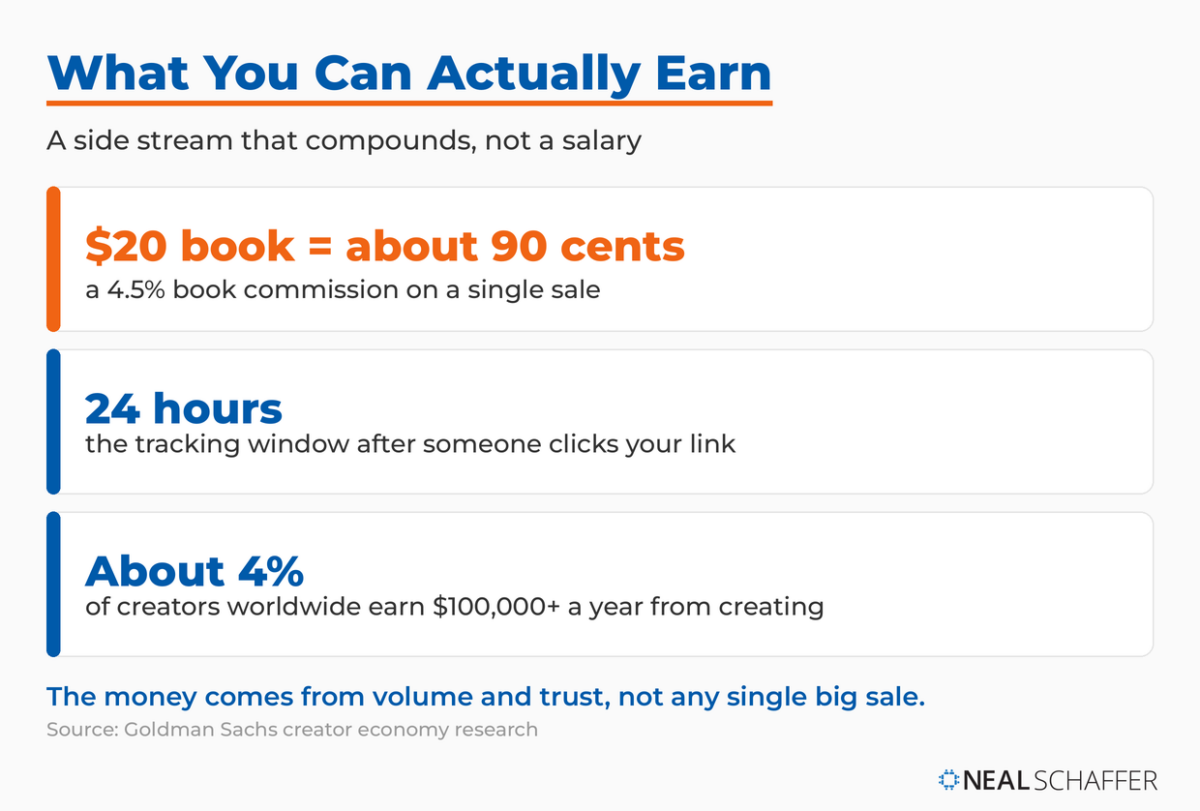
Earnings depend on three things: your commission rate, how much your audience buys, and how quickly they buy. Amazon pays a percentage that varies by product category, and the tracking window is short. Once someone clicks your link, you earn on qualifying purchases made within 24 hours, which means trust and timing matter more than any single recommendation.
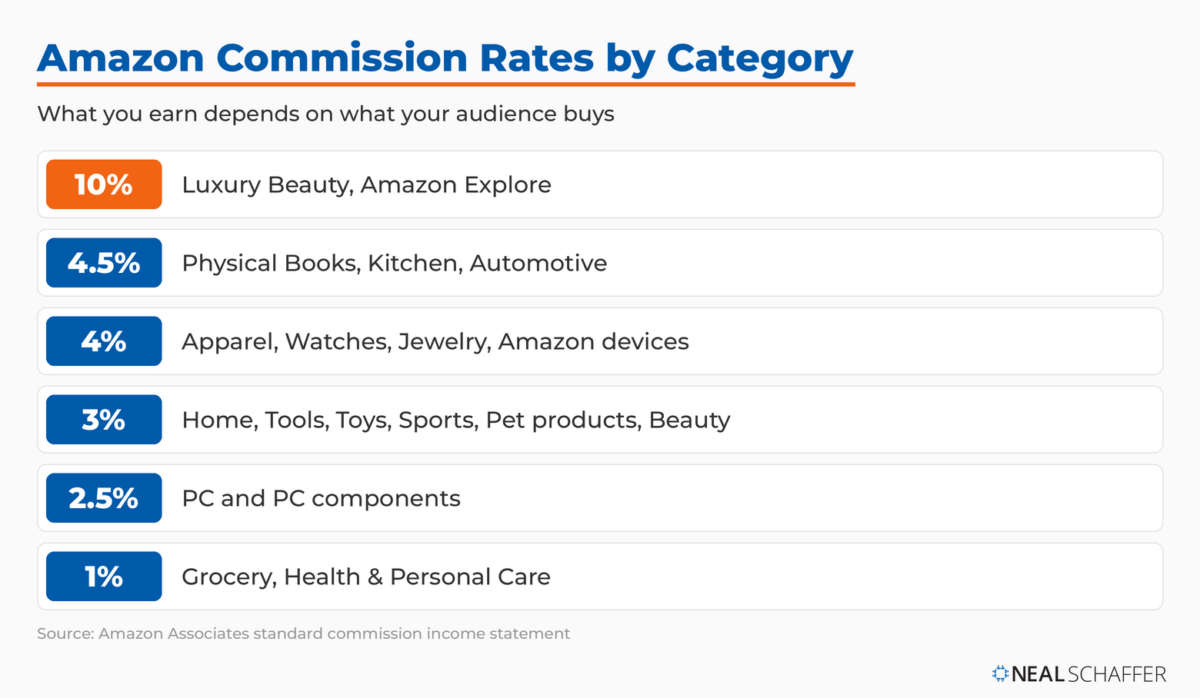
The rates themselves are set by category. Per Amazon’s standard commission income statement, they range from 1% to 10%. Here are the categories most relevant to the kind of store a marketer, author, or lifestyle creator tends to build.
| Product category | Standard commission rate |
|---|---|
| Luxury Beauty, Amazon Explore | 10% |
| Physical Books, Kitchen, Automotive | 4.5% |
| Apparel, Watches, Jewelry, Amazon devices | 4% |
| Home, Tools, Toys, Sports, Pet products, Beauty | 3% |
| PC and PC components | 2.5% |
| Grocery, Health & Personal Care | 1% |
So temper your expectations. If you sell a $20 book, your 4.5% cut is about 90 cents. Goldman Sachs found that only about 4% of creators worldwide earn more than $100,000 a year from creating, and storefronts are rarely the reason someone crosses that line. Think of this as a stream that compounds, not a salary. For a realistic picture of where storefront income fits, my post on how influencers make money lays out the other levers.
How to Set Up and Build Your Amazon Influencer Store
Once Amazon approves you, building the store is fast. You name your storefront, claim your vanity URL, and start adding products into Idea Lists, which are themed collections you create around a topic. You can also publish shoppable photos and videos, and your content can appear on the relevant Amazon product pages where it earns onsite commissions.
A couple of details I learned by doing it, that the help docs gloss over. When you build an Idea List, the first product you add becomes the cover image for that list, so lead with something that visually represents the whole collection. And Amazon offers to write a product description for you with an AI button, labeled so you know it’s machine-generated and worth checking. I skip it and write my own every time, because the note is the part your audience actually reads.
My own storefront is organized into themed Idea Lists rather than one giant pile of products. I keep separate book lists for digital marketing, social media, influencer marketing, and LinkedIn, plus a content creator list of the gear I actually use to record and publish. That structure isn’t an accident, and it’s the difference between a store people scroll past and one they buy from.
If your goal is also to publish shoppable videos on product pages, the skills overlap heavily with what UGC creators do for brands, and that experience translates directly into stronger onsite content.
How to Build a Storefront That Actually Converts
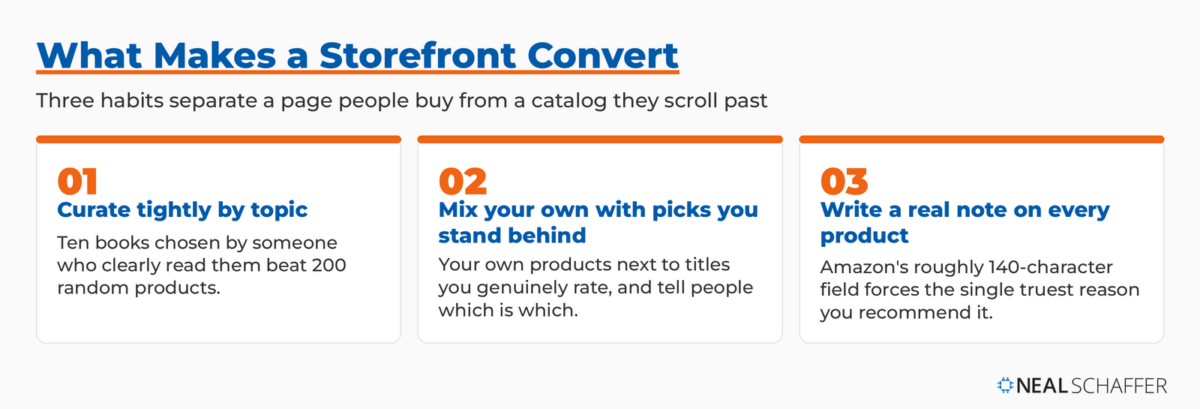
A storefront converts when it feels like a trusted recommendation, not a catalog. The mechanics are easy. The judgment is what’s hard, and it’s where most creators leave money on the table. Three habits separate a page people buy from: tight curation, honest mixing, and a real note on every product.
One Strategy to Connect All Your Marketing
My latest book helps small businesses, entrepreneurs, and marketers bring search, email, and social together into one digital marketing strategy that actually compounds.
Drawing on my work as a Fractional CMO, Digital Threads turns complicated tactics into a clear, practical plan you can follow, whatever your budget or team size.
Grab your copy on Amazon and start weaving your own digital threads. Click the cover or the button below to get started.

Curate tightly by topic. Nobody trusts a list of 200 random products. They trust ten books chosen by someone who clearly read them. I keep each Idea List focused on a single theme, because a focused collection signals expertise and a dumping ground signals an affiliate cash grab. The same instinct that improves an ecommerce conversion rate applies here: fewer, better-framed choices outperform more options.
Mix your own products with picks you genuinely stand behind. My lists include my own books next to titles from authors I respect. I wrote the foreword to one of the influencer marketing books I feature, and I co-hosted a podcast with the author of another, so I’m not pretending these are arms-length picks. I tell people that, because the honesty is the point.
Write a real note on every product. Amazon gives you a short field, roughly 140 characters, for “what you like about this product.” That limit is a gift. It forces you to say the single truest thing about why you recommend it. A specific, honest line (“the chapter on positioning alone is worth it”) converts far better than a generic blurb, and it’s the reason I never use the auto-generated text.
Promotion is where the storefront earns. The page won’t find an audience on its own, so you point your audience to it: link it in your social bios, mention the vanity URL in videos, and reference specific products when they come up naturally in your content. The goal is to make buying the easy next step after the recommendation.
The behavior is already there to meet. Pew Research found that 79% of Americans shop online and that 74% say reading reviews from people who’ve bought an item matters before they purchase. Your honest take is exactly that kind of signal. McKinsey has tracked how social commerce keeps climbing as people research and buy across both social feeds and stores, which is the exact path a storefront link shortens.
Recommendations also move product more than most creators assume. eMarketer reports that 58% of U.S. adults have bought something because of an influencer endorsement. That’s the whole thesis of a storefront: you’ve already earned the trust, so give people a frictionless way to act on it. Tie each promotion to a genuine moment, like a product you mention in a tutorial, rather than blasting the link cold.
How to Stay Compliant With Disclosures and Reviews
Disclosure is mandatory, and it protects your credibility as much as it satisfies the rules. Any time you earn a commission, you have a material connection to disclose. The fix is simple and you only have to do it clearly: tell people you earn from qualifying purchases, place it where they’ll see it, and keep your reviews honest.
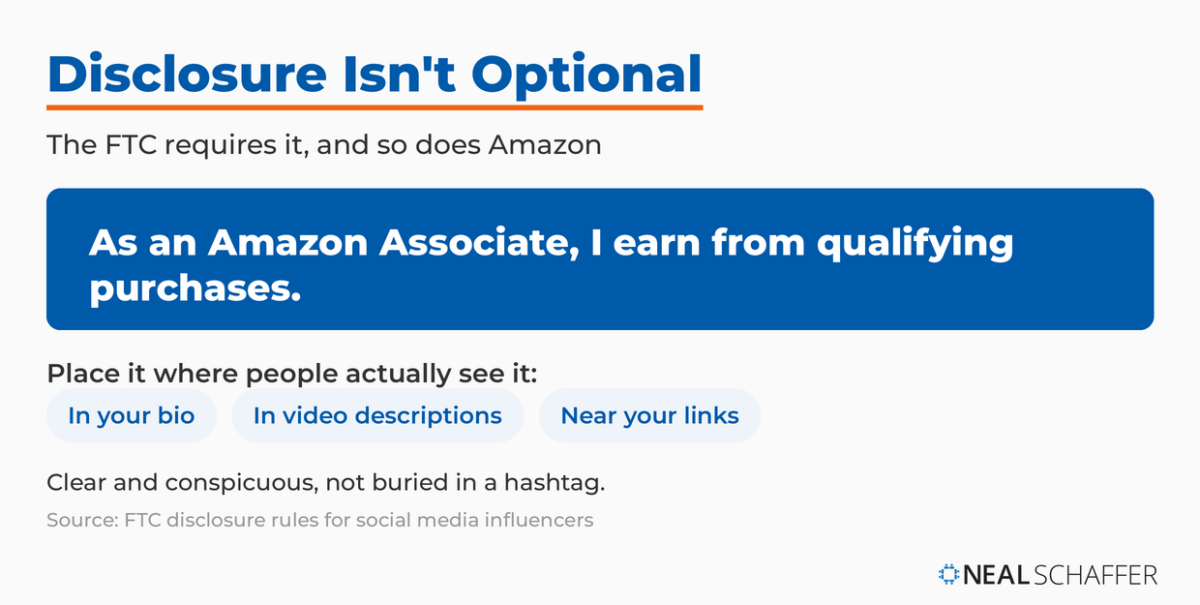
The standard comes from the FTC’s disclosure rules for social media influencers, which require any financial relationship with a brand to be disclosed clearly and conspicuously. Amazon requires it too, and gives you the standard line: “As an Amazon Associate, I earn from qualifying purchases.” Put it in your bio, your video descriptions, and near your links, not buried in a hashtag.
Honesty extends to the recommendations themselves. Amazon doesn’t expect only glowing reviews, and a willingness to name a product’s weak spots builds the kind of trust that makes the positive picks land. The data backs the strategy too. Industry research from Sprout Social shows most brands are expanding their influencer programs, and the creators who win that spend are the ones audiences believe.
Frequently Asked Questions
No. The Amazon Influencer Program is free to join and free to run. You’re not paying Amazon and Amazon isn’t paying you a salary. You earn a category commission only when your followers buy through your storefront or links, so the only investment is the time you spend curating it well.
There’s no published number. Amazon evaluates engagement and content quality on the social account you connect, so an active audience in the low thousands can beat a larger but quieter one. Apply with the platform where your followers respond most, and grow genuine engagement before you worry about a threshold.
Associates is for anyone placing product links on a website or app. The influencer store is built for social creators and gives you a curated page with a vanity URL plus the ability to post shoppable video. Many creators run both, since the influencer program is an extension of Associates rather than a replacement.
It varies widely with your category mix and audience size. Commissions run from 1% to 10%, and global research suggests only a small share of creators earn six figures from creating overall. Treat a storefront as a compounding side stream tied to recommendations you’d make anyway, not a primary income.
Only things you’d recommend to a friend. Build tightly themed Idea Lists around your areas of expertise, mix your own products with picks you genuinely rate, and add an honest note to each one. A focused, credible store converts far better than a sprawling list of unrelated products.
Put These Steps to Work
An Amazon influencer store rewards the creators who treat it like an extension of their judgment rather than a quick affiliate play. Get approved by leading with your most engaged platform, build tightly themed lists, write an honest note on every product, disclose plainly, and point your audience to the page when a recommendation comes up naturally.
Start small. Set up one Idea List around the topic you know best, add the handful of products you’d recommend without hesitation, and share the link the next time someone asks. Then build from there. If you want the click-by-click version of the application itself, my post on becoming an Amazon influencer takes it step by step.
And if a storefront is one piece of a bigger digital strategy you’re trying to pull together, that’s the exact problem my book Digital Threads was written to solve. You can read a free preview to see whether it fits what you’re building.
Actionable advice for your digital / content / influencer / social media marketing.
Join 13,000+ smart professionals who subscribe to my regular updates.