




London — British Prime Minister Andy Burnham has called the ban on alcohol in the stands at high-level men’s soccer matches in the U.K. “discrimination,” teasing fellow fans with a possible reversal of a more than 40-year-old ban.
“I don’t think it’s fair for football fans to be singled out,” Burnham told reporters in New York on Wednesday, where he is attending the United Nations General Assembly.
He hinted at a trial to reintroduce alcohol consumption in stadium seating.
The U.K. government, under then-Prime Minister Margaret Thatcher, banned alcohol in the bleachers at men’s soccer games in England and Wales in 1985.
Home Secretary Leon Brittan said at the time that booze was a “major contributory factor in violent and disorderly behavior” in soccer stadiums.
Since then, fans attending men’s soccer games in the top five divisions have not been allowed to drink alcohol in view of the pitch. People can still buy and drink alcohol in the concourse before games and during halftime, but they cannot carry it back to their seats.
No other sports are subject to such a ban in the U.K.
At some older, less well-equipped soccer grounds, lines for pints of beer can get so long during halftime that fans will leave their seats before the referee blows the whistle.
In a statement, the Football Supporters’ Association said Thursday that it has “always argued that it’s unfair to criminalize football fans for having a pint while watching the match,” and it argued that many clubs are in favor of a reintroduction of alcohol, adding: “We welcome the prime minister’s comments and totally agree that the legislation is outdated.”
After a successful pilot run in the Women’s Super League, the highest level of English women’s soccer, fans of the women’s game have been allowed to drink in the stands since the beginning of the current season.
Burnham, who’s a season ticket holder at Premier League club Everton, criticized the restriction shortly before becoming prime minister.
Asked Wednesday if he still held the same view, he said: “I think that legislation dates to an era where football was very different … And I do believe there is a case to remove that discrimination. There are different ways it could be done. It could happen on a trial basis.”
“I’m not going to back away from what’s been a long-held view of mine,” he said. “I don’t see how it can be fair that some supporters of one sport can be treated differently.”
Richard Pohle-WPA Pool/Getty 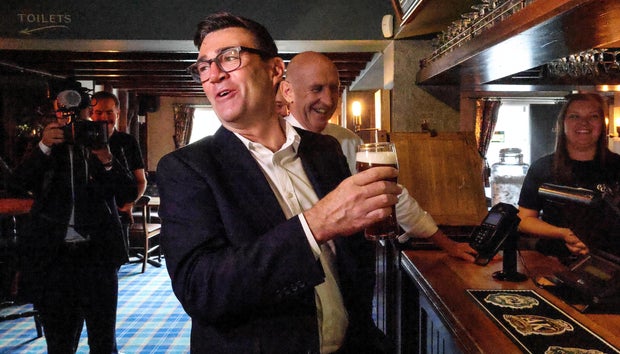
The ban was imposed with reason, however.
Soccer hooliganism in 1970s and 1980s England — sometimes referred to as the “English Disease” — involved fans in rival gangs linked to soccer clubs fighting each other and vandalizing areas in and around stadiums.
Several high-profile deaths linked to hooliganism, including that of a 14-year-old boy who died when fans were pushed into a wall by police after violence between Birmingham City and Leeds United fans, led to the alcohol ban.
Police have long supported the legislation.
“Other sports simply don’t see the violence and criminal behavior from their supporters that football does, albeit a minority, with alcohol often playing a significant part in violent and disorderly behavior,” a spokesperson for the U.K.’s Football Policing Unit said, according to CBS News’ U.K. partner network the BBC.
“It would be irresponsible to fuel this by allowing greater alcohol consumption during games,” they said, adding that it would be “incredibly rash to make fundamental changes without a full examination of the evidence and meaningful consultation with police practitioners who have the expertise in this area.”
A fan-led review of U.K. laws around soccer in 2021 called for the legislation to be reviewed, however.
In Scotland, which also has a history of soccer-related violence, alcohol has been banned from soccer stadiums since 1981, but recent trials have seen it reintroduced, and fans can now buy booze at games at Hampden Park, the country’s national soccer stadium.