




It is rare to see a perfect film, let alone two back-to-back, but that is precisely what happened to me on the same day recently at the Toronto International Film Festival (TIFF). Both films were documentaries, which in this day and age can be as dramatic as any narrative feature. And these films—Barry Avrich’s “Darlene Love: I Know Where I’ve Been” and William & David Greaves’ “Once Upon a Time in Harlem”—were uplifting in the way they brought to life key figures and moments in history that can show us a path forward. Let’s begin with the original Queen of Christmas…
Finally, Darlene Love is no longer twenty feet from stardom. She is now front and center on stage and in her own life. Like Morgan Neville’s “Twenty Feet From Stardom,” which earned the Best Documentary Oscar in 2013, Canadian director Barry Avrich puts a fully dimensional face on an artist whose voice holds an indelible place in our memories, even when it was left uncredited. I was once again reminded that a lot of the voices and harmonies I liked most in classic songs were because of the value added by backup singers. And in this instance an inordinate percent of those were sung by Darlene Love.
The documentary takes us through the history of Darlene Love under the tutelage of record producer Phil Spector. We learn that he deliberately kept her in the background because he didn’t want her singing talent to outshine his ability to produce the music. As far as he was concerned, the singers were fungible commodities. You could substitute one for the other and it wouldn’t matter. Spector’s premise was that it was his own brilliance in the layering of the wall of sound that created the hits. But then we hear such icons as Cher, Bruce Springsteen and Dionne Warwick, among others, singing Love’s praises and declaring her voice outstanding. And no one proclaims it better than Paul Shaffer, the Canadian musician and former Bandleader for the David Letterman show.
The scenes of Shaffer directing Darlene Love in her comeback tour are worth the price of admission. But what makes the film a must-see is its footage of Darlene herself, who at age 85, is as towering a life force as ever. In the film there are brief scenes of her going through her daily exercise paces on the treadmill and in the weight rooms. We know how the voice can change and weaken with age, so when I heard her on film singing so robustly, I just assumed the sound had been fortified. But then Ms Love came out live on stage! She wore a mini-skirt and platform heels to show off the fruits of all those workouts at the gym. And when she opened her mouth, her vocals came out rich and strong, age-be-damned. We understood her mantra of knowing where she’s going because she knows where she’s been. And we are all glad that she is back.
Whereas “Darlene Love: I Know Where I’ve Been” peers through the eyes of a legend who is thankfully still with us, “Once Upon a Time in Harlem” brought me an experience that is as close to time travel as cinema can get. Just as Alan Elliott brought us breathtaking concert footage of Aretha Franklin in 2018’s “Amazing Grace,” originally shot by Sydney Pollack in 1972, David Greaves’s film ingeniously assembles 16mm reels that his father William (the visionary auteur whose credits include 1968’s “Symbiopsychotaxiplasm: Take One”) had shot in the same year. What they capture is astonishing: a high-spirited gathering of various iconic figures from the Harlem Renaissance invited by Greaves to the home of Duke Ellington. Among them are poets Arna Bontemps and Richard Bruce Nugent, painter Aaron Douglas, composer Eubie Blake, photographer James Van Der Zee, and Ida Mae Cullen, widow of the late poet Countee Cullen.
In Robert Daniels’ review written after the film’s Sundance premiere, he poetically noted how “we witness these legends grappling with what their legacy will be, especially with a younger militant generation who they feel are forgetting them. That angst, tension, and candidness grant these towering figures a grounded vulnerability. And as they begin to leave this room, walking toward antiquity, we want to remain and revisit their presence—living with them in an intellectual fairytale whose occurrence remains incredible and whose existence feels like a miracle.”
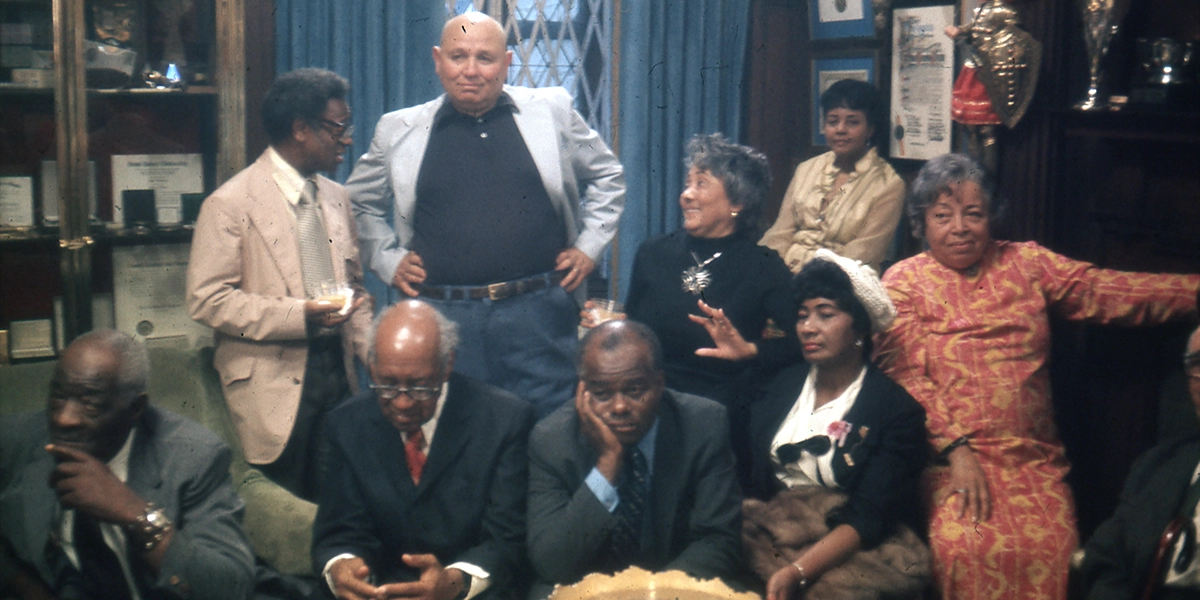
Daniels is right, you don’t just watch this film, it gives you the ethereal feeling of sitting in history. The film lovingly cuts between split screens of Romare Bearden and James Van Der Zee as they debate the importance of the Renaissance and then shows their actual paintings and photographs. Ida Mae Cullen insistently interrupts to make sure that her husband and his spot in highlighting the importance of Black and African history is not forgotten.
HERITAGE: BY COUNTEE CULLEN
What is Africa to me:
Copper sun or scarlet sea,
Jungle star or jungle track,
Strong bronzed men, or regal black
Women from whose loins I sprang
When the birds of Eden sang?
One three centuries removed
From the scenes his fathers loved,
Spicy grove, cinnamon tree,
What is Africa to me?
I have only read Zora Neale Hurston’s books, but to hear these luminaries discuss how none of this would have been possible without her intervention is illuminating. And what a treat it is to see the wizened actor Leigh Whipper become animated as he recites from memory his lines from stage and poems. In the film he is older than most of the others at the gathering and he seems almost asleep. But when prodded to recite his lines he does so instantly and perfectly. It’s the sort of treasure that you want to share with as many people as possible.
I had the pleasure of interviewing William Greaves’ granddaughter, Liani Greaves, at Sandra Schulberg’s “Rescue Fest” in Los Angeles in December 2024. Schulberg is the founder of IndieCollect whose exalted mission is to locate and restore lost indie films from approximately 1950-2000. At Rescue Fest she presented a restored copy of William Greaves’ film “Nationtime,” the only film made about the 1972 National Black Political Convention held in Gary, Indiana. There, as in “Once Upon A Time in Harlem,” you get to see the immediacy and vibrancy of Greaves’ cinema verite style. Also participating at Rescue Fest was Mario Van Peebles who presented his father Melvin Van Peebles film “The Story of a Three-Day Pass.” And on Opening Night, Jane Fonda and Lily Tomlin presented John Bailey’s “The Search for Signs of Intelligent Life in the Universe.”
It is so important to acknowledge these cinematic treasures. They not only educate and entertain us but seemingly open a portal into humanity itself.