




Most social media contest advice you will find today was written before the rules changed.
The classic format is everywhere: pick a prize, ask people to like the post, share it, and tag three friends. It is easy to run and it produces a spike.
It is also, as written, against Meta’s current promotions policy. The Pages, Groups and Events policy states that your promotion “must not require or incentivize participants to share, repost, tag others” or otherwise publicize it. That is not a gray area anymore. It used to be.
I have been teaching social media marketing to executives at Rutgers Business School for years, and contests come up in nearly every cohort. The question is always some version of “what should we give away?” That is the wrong first question. The prize is the easy part. The hard part is picking an entry mechanic that brings you people who might actually buy something, and that will not get your post buried or your page restricted.
So this is both halves. The formats worth running in 2026, sorted by what you want out of them. And the platform rules that decide which ones you can legally and safely use. I am Neal Schaffer, a Fractional CMO and the author of six books on digital and social media marketing, and I would rather you run one contest that works than five that inflate a number nobody looks at.
Key Takeaways
✅ Meta’s current policy prohibits requiring or incentivizing shares, reposts, and tags as entry. The “like, share, tag three friends” format is no longer compliant in its mandatory form.
✅ Pick your format from your goal, not from a list. Email capture, user-generated content, and engagement are three different jobs with three different mechanics.
✅ Every major platform requires you to publish official rules and to state that the platform is not sponsoring or administering your contest.
✅ The FTC treats a contest entry as a material connection. If entrants post about your product to enter, the disclosure has to make the contest obvious.
✅ Prize relevance is the single biggest lever on entry quality. A generic gadget brings you people who want gadgets.
✅ Follower count is the weakest measure of a contest. Email captures, 60-day engagement rate, and traceable sales are the numbers that tell you whether it worked.
A social media contest is a promotion where entrants compete on merit, with a winner chosen by judging or by vote. A giveaway or sweepstakes picks the winner at random. The distinction matters legally: skill-based contests and chance-based sweepstakes sit under different rules in different states, and the entry mechanics that are safe on each platform differ too.
In everyday marketing conversation the three words get used interchangeably, and that is usually fine. When you write your official rules, it stops being fine. A sweepstakes that requires a purchase to enter becomes an illegal lottery in the United States. A contest judged on merit can charge, in some jurisdictions, but most platforms forbid it anyway.
Meta adds its own layer on top of the law. Its Pages policy treats games where something of monetary value is required to play, and where something of monetary value forms part of the prize, as gambling, which needs prior written permission. Charge for entry on a cash prize and a state regulator is only your second problem. The first one is losing the Page.
The practical version: if a random draw decides it, call it a giveaway or sweepstakes and guarantee a free entry route. If a judge or a public vote decides it, call it a contest and publish your judging criteria before anyone enters.
That vocabulary matters more this year than it used to, because the platforms have gotten specific about which mechanics they will tolerate.
What Changed in the Platform Rules, and Why Your Old Contest Format Is Now Risky
Meta now prohibits building entry around shares and tags. Its monetization promotion guidelines name share-to-your-Timeline and tag-your-friends entry as examples of what is not permitted, and the general Pages policy goes further by barring incentives for those actions too. You can invite them. You cannot require them.
The algorithm got there before the policy did
There is a second, older layer that people forget. In December 2017 Meta announced it would begin demoting engagement bait in the News Feed, describing it as spammy posts that goad people into interacting with likes, shares, comments, and other actions.
A machine learning model detects them and those posts get shown less. Meta later extended the same demotion to comments, and then to engagement bait in video audio. A tag-to-enter contest was already fighting the algorithm years before the policy wording caught up.
Meta is not alone in this, which is the part that should change how you plan. TikTok’s giveaway policy, updated 31 July 2026, states that “no extra actions can be required by the customer beyond entering the giveaway.” Two of the largest platforms arrived at the same restriction independently. The stacked-entry contest is not a Facebook problem. It is becoming the industry default.
What I was doing, and why it stopped working
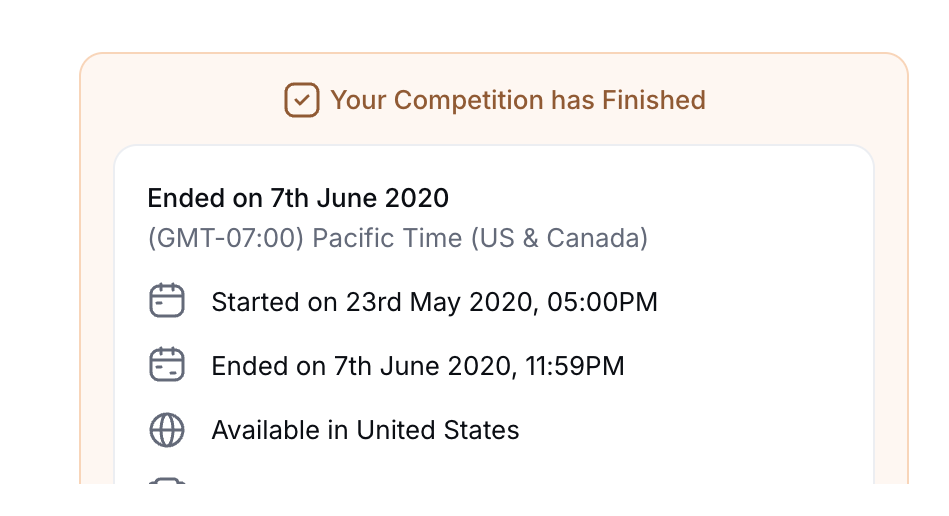
I have to put my own hand up here. When The Age of Influence came out in 2020 I ran a book giveaway through Gleam and built it on exactly this mechanic, awarding bonus entries for following me across platforms at once. The giveaway itself, YouTube, the rest of my accounts.
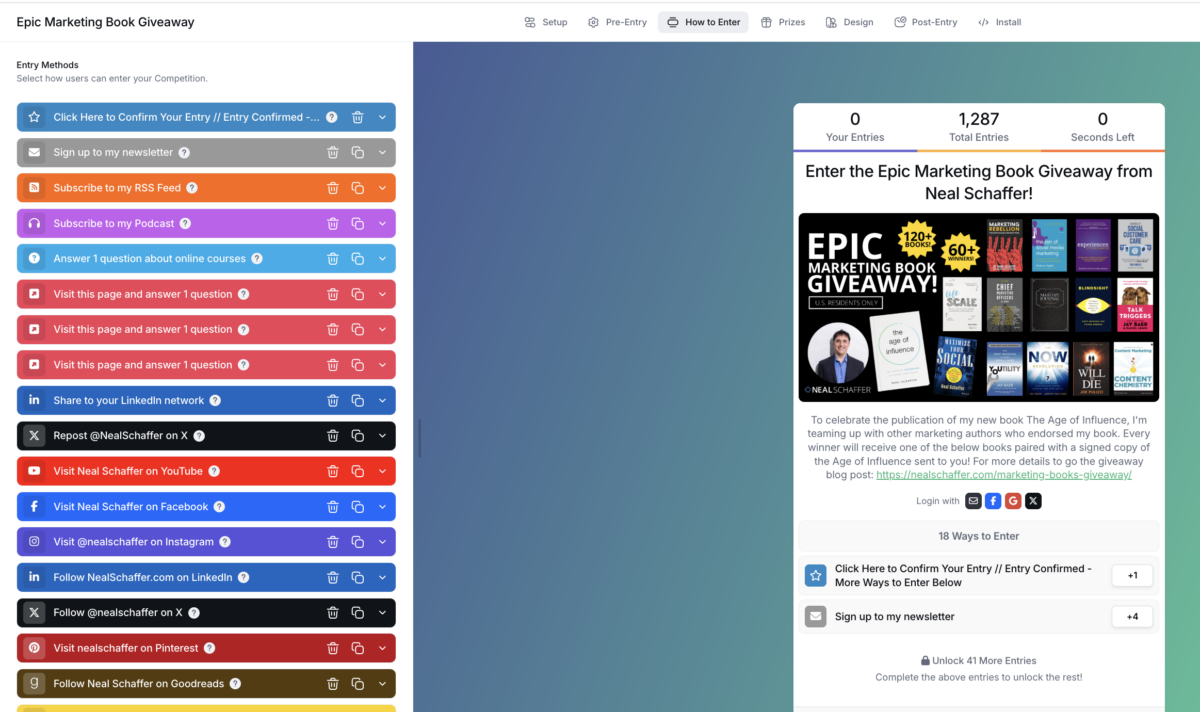
I built eighteen ways to enter into that one campaign, with another forty-one entries waiting behind them. Reposts on X, follows on LinkedIn and Goodreads, visits to every profile I had.
It worked, and the data still shows why it was tempting. Entrants averaged between four and five separate actions each, which turned into roughly eleven entries per person. That multiplier is the entire appeal of stacked entry, and it is the exact mechanic these policies have been closing. The share and tag portion is plainly out under Meta’s current wording.
One decision inside that setup I would still defend. The action I weighted highest was not a social one. Confirming an entry was worth a single point. Signing up for my newsletter was worth four. Even in a contest built on stacking, the email address was the thing I actually wanted, and I priced it accordingly.
Something else in that list only stands out in hindsight. The Facebook and Instagram actions are visits. The follows and the reposts all sit on X, LinkedIn, and Goodreads. I did not think about it at the time, and I am not going to claim I planned it, but the pattern is hard to miss now.
The LinkedIn Playbook for Real Business Growth
My latest book helps professionals, entrepreneurs, and business owners turn LinkedIn from a static profile into a real source of clients and growth.
Maximizing LinkedIn for Business Growth gives you clear, practical steps to build a profile that gets noticed and a network that actually sends business your way.
Grab your copy on Amazon and put it to work this week. Click the cover or the button below to get started.

One piece of it survives, and it is the piece I would keep anyway. Subscribing to my podcast was one of the eighteen. No platform can actually confirm a podcast subscription, so that action amounted to sending someone to the show and trusting them.
Which is exactly why it raises no policy question at all. Nobody games a metric nobody measures. If you want extra mileage from a giveaway without compliance risk, point entrants somewhere unverifiable and treat the visit itself as the return.
The physical-goods rule almost everyone misreads
One correction worth making, because most contest roundups get it backwards. Meta’s monetization guidelines say you cannot give away physical goods in connection with a promotion, and that line gets quoted everywhere as a general Facebook contest rule. Read the scope: it governs promotions on Facebook monetization products, meaning Subscriptions, Stars, and Content Monetization.
The general Pages policy contains no such restriction at all. If you are running an ordinary Page giveaway, ship the physical prize. That rule was never about you.
And your audience noticed. In Sprout Social’s Q1 2026 Pulse Survey of 2,250 social media users across the US, UK and Australia, using engagement-bait tactics ranked second on the list of things people want brands to stop doing in 2026, named by 23% of respondents. Only unlabeled AI content scored worse.
None of this makes contests a bad idea. It makes one specific contest format a bad idea, and that format happens to be the one everybody copied.
The workaround is not clever. It is to ask for one meaningful action instead of five easy ones, which is also what produces better entrants.
The contest formats that build an email list route entry through a form you control rather than through a platform action. A follow can be undone with one tap. An email address survives an unfollow, an algorithm change, and a platform you eventually abandon. If you run one contest this year, make it one of these.
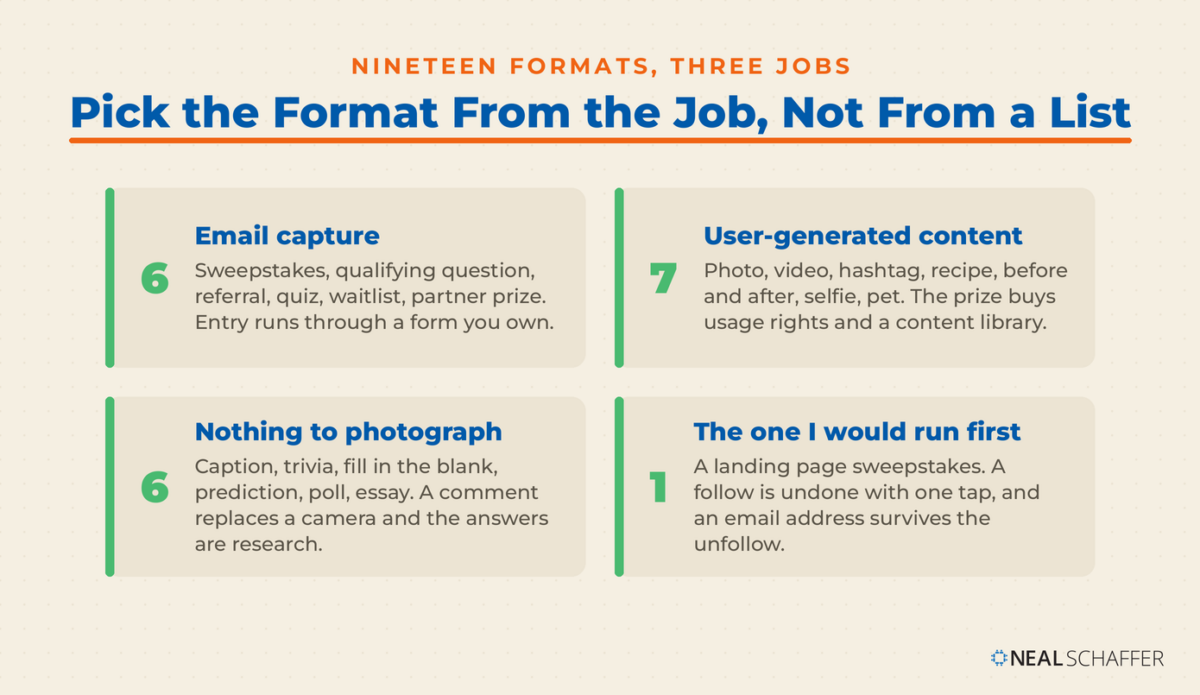
Six formats that put an email address on your list
1. Sweepstakes with landing page entry. Entrants submit their email on your site for a random draw. The simplest format that produces an asset you keep. Pair it with your existing approach to building an email list so the entrants land in a real nurture sequence rather than a spreadsheet.
One rule to build in from the start. Meta requires that when you collect information from people who interact with your Page, you give notice first, obtain explicit consent to use their data, and state plainly that you are collecting it rather than Meta. Put that line on the entry form, not buried in the rules.
2. Qualifying-question contest. Ask for a specific answer that only an interested person can give. “Tell us the biggest mistake you made with your last product launch” filters hard. “Tag two friends” filters for nothing. I used this in my own book giveaway, where one entry method asked entrants a question about online courses, and the answers were market research I would otherwise have paid for.
3. Refer-a-friend contest. Entrants get extra chances when someone they refer enters through their link. Note that this runs through your own entry form, not through platform tagging, which is what keeps it on the right side of Meta’s policy.
4. Quiz or assessment contest. Entrants complete a short diagnostic, get a result, and are entered. You learn something about every entrant, which makes the follow-up email far easier to write.
5. Waitlist or early-access draw. Everyone who joins the launch list before a date is entered. This one doubles as launch demand and costs you nothing extra.
6. Partner or co-prize giveaway. Bring in a second brand, author, or creator and give away both prizes together. Each side brings its own audience, the prize gets more attractive without either party doubling its budget, and the partnership itself tends to outlast the campaign.
Why a partner prize outperformed everything else I ran
My giveaways have all been built around book launches, and the best one I ran was for The Age of Influence. Rather than giving away only my own book, I brought in books from the marketing authors who had endorsed mine. The pool came to more than 120 books across more than 60 winners, and every winner received one of those titles paired with a signed copy of mine.
More people entered, which was the point. But the part I did not anticipate was what it did for the relationships. It gave me a reason to put every endorsing author’s work in front of a new audience, and those relationships have outlived the launch by years.
So did the entrants. That giveaway ran in the spring of 2020 and drew 115 participants. Checking today, six years on, 76 people carrying its tag are still active subscribers. The overlap between my giveaway platform and my email tool is not exact, so treat that as an estimate rather than a clean retention rate. It is still around two thirds of the people who took part, still here, six years later.
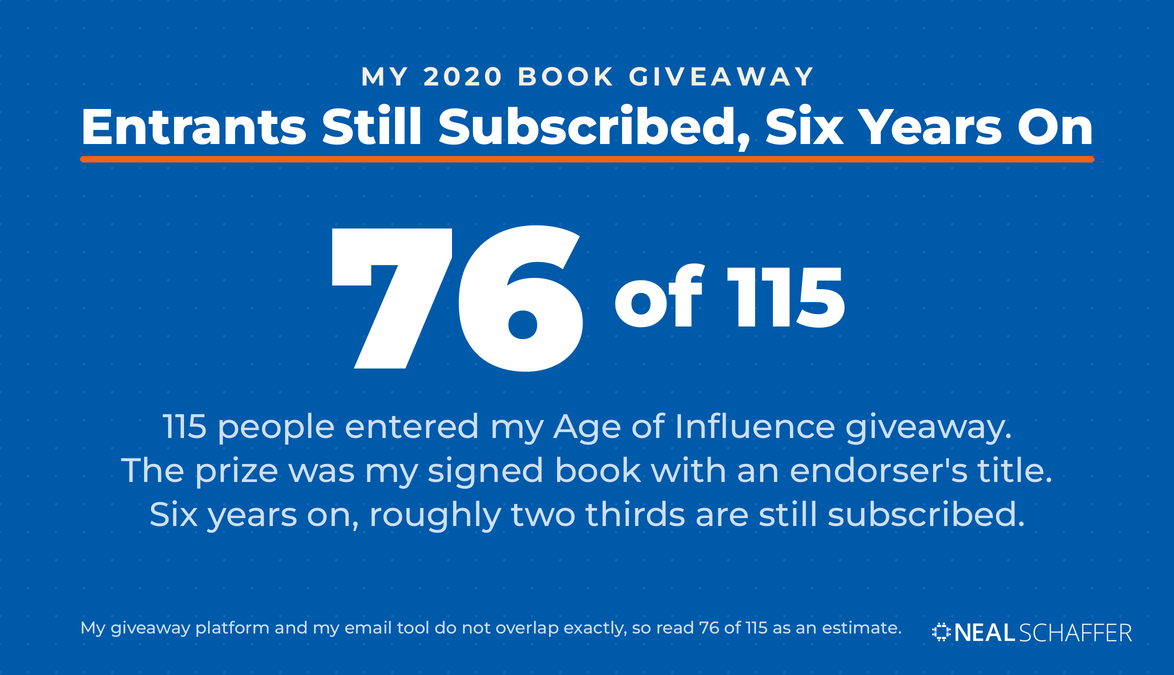
Retention like that is not an accident of format. It comes from what was in the box.
Which Prize Actually Filters for Real Interest?
The prize decides who enters, and therefore who is still with you a year later. A prize with broad appeal brings volume and very little else. A prize only your ideal customer would want does the filtering before anyone fills in a form, which is work you never have to undo afterwards.
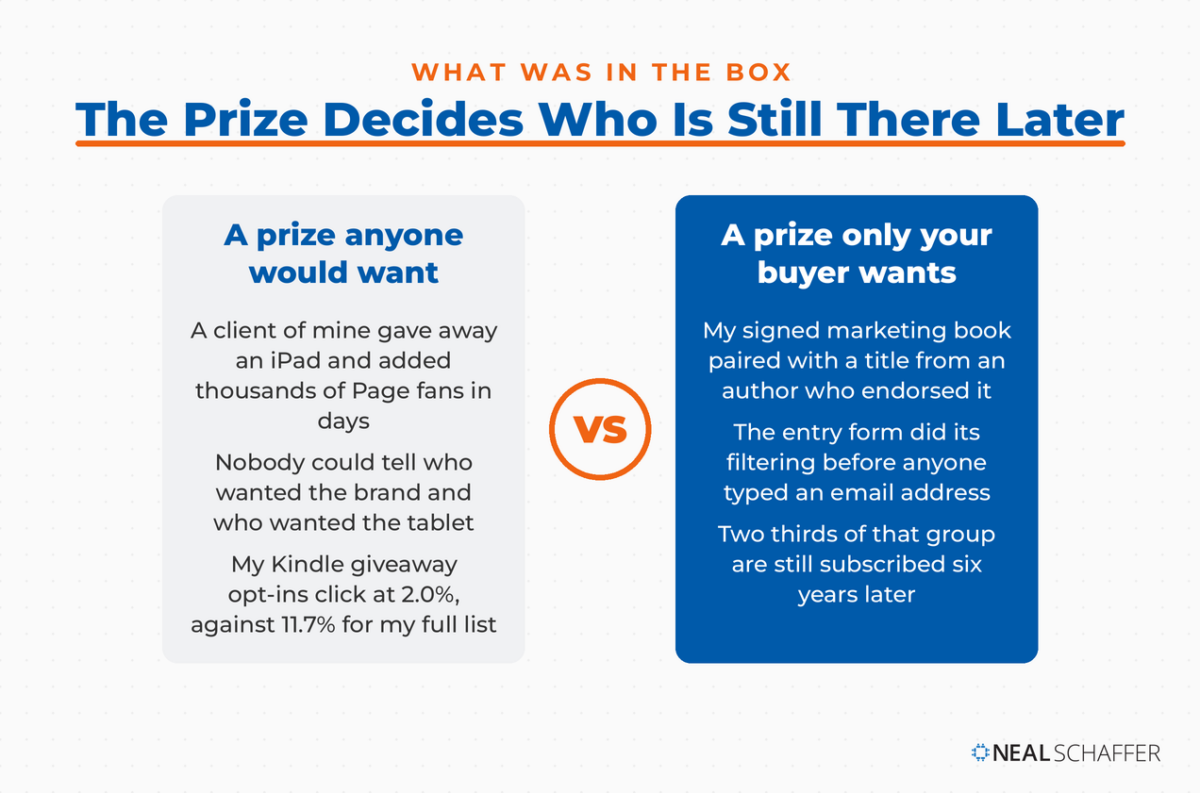
I watched this play out years ago, back in the early days of Facebook Pages. A client of mine ran one of those trending giveaways that were everywhere at the time, offering an iPad, and it worked exactly as advertised. Thousands of new fans on the Page in a matter of days.
Then they came to me with the real question. What do we do with all of these people now?
Nobody could answer the only thing that mattered, which was whether those fans had joined because they wanted to hear from the brand or because they wanted a free iPad. And once a giveaway is over, there is no way to go back and find out. You architect that answer in before you launch, through the prize and the entry mechanic, or you never get it.
Lilach Bullock, a Forbes Top 20 Social Media Power Influencer, named the same problem when writing about contests that grow an audience rather than a follower count: “You’re filtering for people who like winning things.”
All of which makes the next admission an awkward one, because I do it anyway.
Should You Join a Group Giveaway Instead of Running Your Own?
A group giveaway is one somebody else organizes, where several brands contribute prizes or promotion and each collects the entrants who opted in to them. You get a share of a much larger prize pool without carrying the organizing, the rules, or the promotion budget on your own.
Having said all of that, I join giveaways built on exactly that kind of prize. The difference is that I know what I am buying.
What a pooled giveaway actually buys you
You do not have to run one yourself. In most industries somebody already runs a pooled giveaway you can buy into: a software bundle, an ecommerce co-promotion, a sponsor prize pool at a conference. One organizer promotes, one big prize does the pulling, and every participating brand collects the opt-ins of entrants who chose them.
In publishing that role is played by companies like Written Word Media. One grand prize, an Amazon Kindle plus ebooks from the participating authors, and an entry form where joining the host’s list is worth three entries and joining all twenty-five featured authors at once is worth twenty-five.
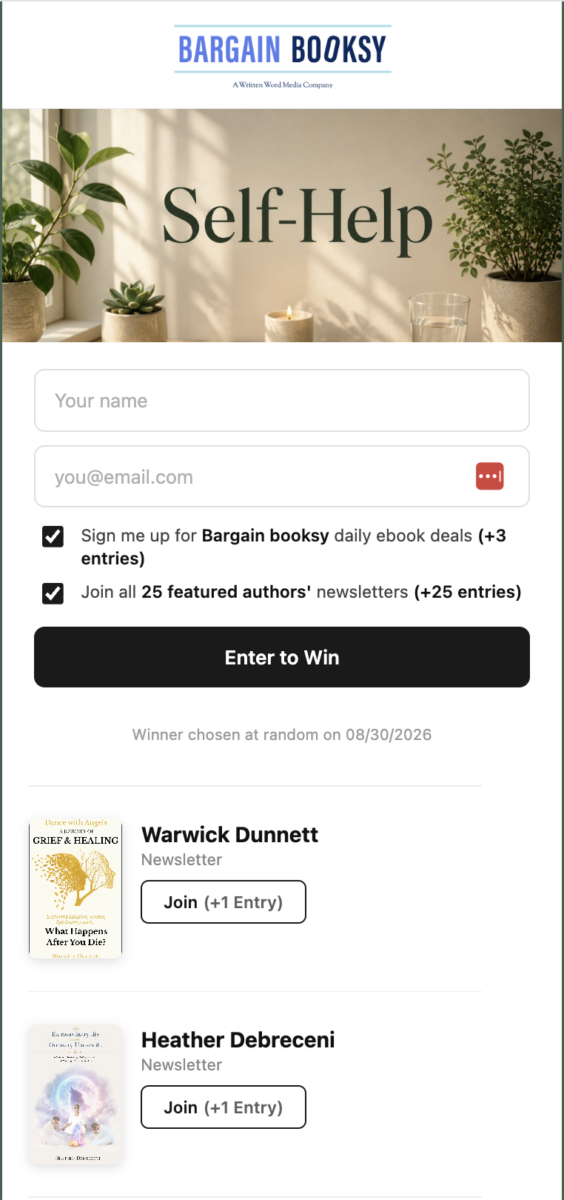
Every one of those entries is an email address changing hands. That is the economy of a group giveaway whatever the industry, and it is the same instinct behind weighting my own newsletter signup at four.
Those opt-ins arrive on my list. The quality is not the best I get from anywhere, and I would not pretend otherwise. Some of those people came for the Kindle.
What the list quality really looks like
I checked the numbers before writing this rather than guessing at them. Over the last ninety days, 46.6% of the subscribers I picked up through those giveaways opened at least one email, against 72.9% of my list as a whole. Roughly two-thirds the engagement. A real discount, and not a disaster.
Clicks are where it gets uncomfortable. Two percent of that cohort clicked something in the same window, against 11.7% of my full list. My list clicks at close to six times the rate. Attention survives the transition from a giveaway. Intent mostly does not.
Part of that group joined within the last two weeks and is still working through the welcome sequence, so read both figures as directional. The shape of the gap is the point: you are buying reach into a reading audience at a known discount, and the discount is steepest on the actions that matter most.
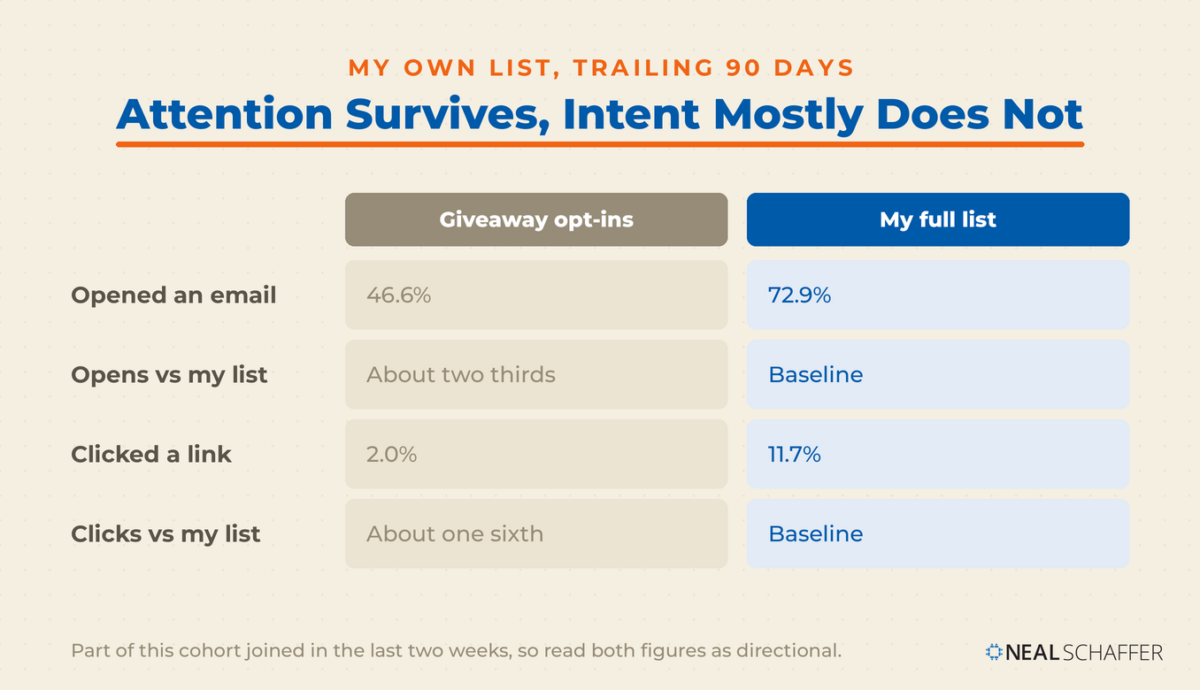
Set that beside the book giveaway from earlier and the lesson stops being about giveaways at all. The prize there was a signed copy of a marketing book alongside another marketing book, and two thirds of those entrants are still with me six years later. The prize here is a Kindle, and the cohort clicks at a sixth of my list rate. Same tactic, same author, opposite prize, and the prize is what decided who stayed.
But a Kindle is a gadget only readers want, which does more filtering than an iPad ever did for my client. And I have a five-email sequence waiting, which opens by pointing out that only one person wins so nobody should walk away empty-handed, then hands over something free.
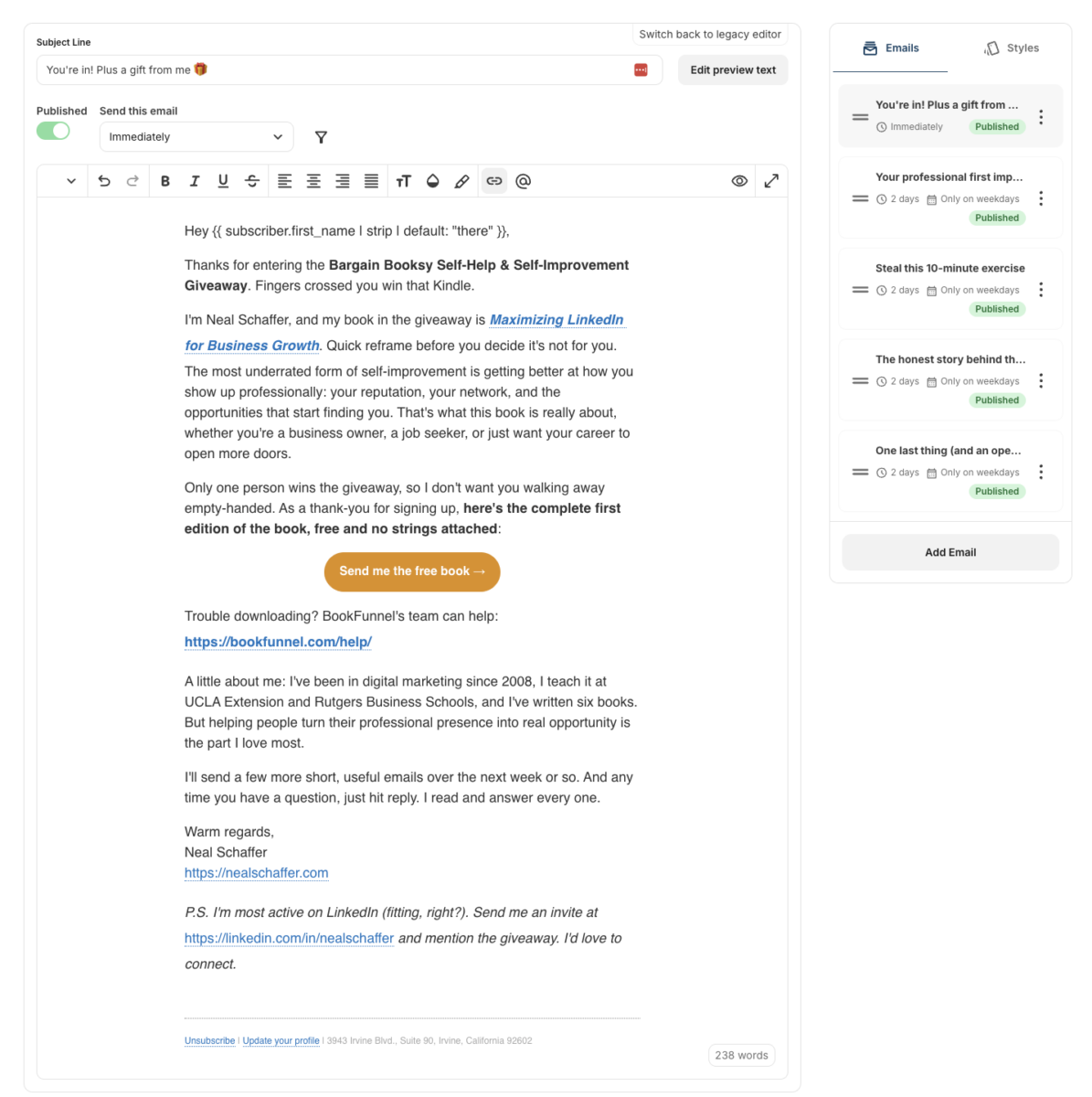
Two things in that first email transfer to any industry. One is translation. In a pooled giveaway the audience arrives on the host’s topic, not yours, and you have about four seconds to connect the two before they decide you are irrelevant. Skip it and the unsubscribes arrive the same day.
The other is the ask. That email requests a LinkedIn connection with nothing awarded for it. You cannot pay people in entries to follow you anymore, but nothing stops you asking once they are on your list and you have already given them something. It converts better there anyway.
That sequence is what makes a mid-quality list worth having. Without it I would be my own client, sitting on thousands of names with no idea what to do next.
Platform-run giveaway programs
One more principle, learned the expensive way. Some platforms run their own giveaway programs where the payoff is a native signal rather than the prize, and it pays to know which signal you are buying.
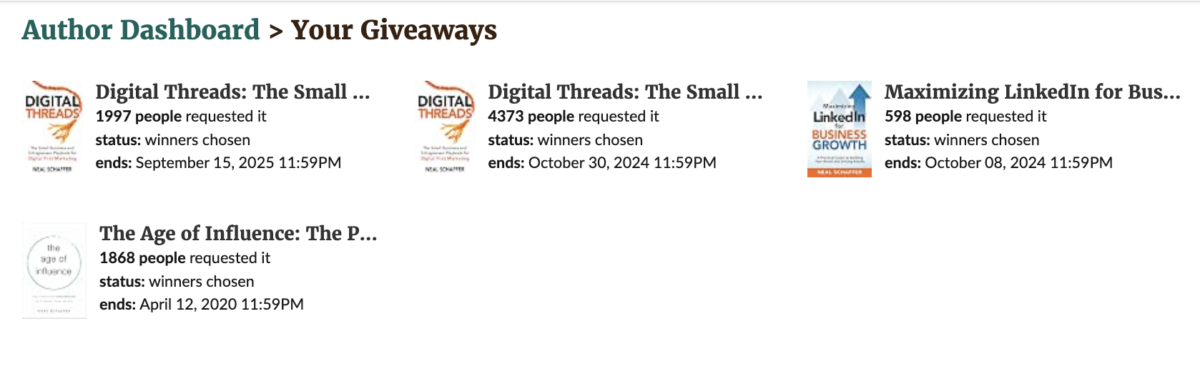
I have run four Goodreads giveaways drawing 8,836 entries between them. They reliably produce shelf adds and the discovery that follows. They do not produce reviews, which is what I actually wanted. Work out what a platform program is really selling before you pay for it.
Pooled or solo, if the list is the goal that is the whole game. But some brands need content more than they need contacts.
Which Contest Formats Produce User-Generated Content?
Contests that ask entrants to create something hand you a library of user-generated content you can use for months. The prize buys usage rights and a wave of authentic material at once, which is often worth more than the follower bump. Ask for a photo, a video, or a demonstration, and make the usage terms explicit in your rules.
7. Photo submission contest. Still the highest-participation creative format, because almost everyone has a usable photo already on their phone.
8. Video submission contest. Fewer entries, better assets. A video entrant has invested real effort, which usually shows in the quality.
9. Hashtag challenge. Entrants post using your branded hashtag. On TikTok this is the native format, and a challenge tied to a specific sound travels further than one tied to a slogan.
10. Recipe or how-to contest. Food brands are the obvious fit, but a “recipe” can be any repeatable sequence of steps using your product.
11. Before-and-after contest. Strong for fitness, home improvement, beauty, and any category with a visible outcome. It also produces your best proof assets.
12. Selfie or unboxing contest. Low creative barrier, high volume, and useful for showing a product in real hands.
13. Pet contest. People love their pets, and pet entries pull in participation from followers who would never post themselves. Do not overthink whether it fits your brand.
Every one of these creates an FTC obligation, which I cover further down, because an entrant posting about your product is legally an endorsement.
Not every business has anything to photograph, though, and those brands get told to run photo contests anyway.
What Contest Ideas Work If Your Brand Isn’t Visual?
Text-based contest formats work for professional services, B2B, software, and any brand with nothing photogenic to show. They ask for a comment rather than a camera, which lowers the barrier and tends to produce longer responses. Those responses are also research: you learn how your audience describes their own problems, in their own words.
14. Caption contest. Post an image, ask for the best caption. Fast to enter, genuinely fun, and it works in any category.
15. Trivia or guess-the-answer. Ask something a quick search cannot resolve. An industry-specific question filters your audience automatically.
16. Fill-in-the-blank. “The one tool I could not run my business without is ______.” Easy to answer, and the answers are a free market research panel.
17. Prediction contest. Tie entries to an outcome nobody knows yet: an industry announcement, a sports result, a launch date. Anticipation keeps the thread alive for days.
18. Poll or vote-to-win. Entrants vote on a real decision you are making, such as a new flavor or feature. Be careful here, since soliciting reactions as votes is exactly the behavior Meta’s demotion targets. Keep the vote genuine and the entry separate.
19. Essay or story contest. The highest-effort format and the lowest-volume one. When you need depth rather than reach, this is the one. The entries frequently become case studies.
These nineteen are the formats worth your time. Where they run is a separate question, and the answer has shifted since the last time most of these lists were updated.
Which Contest Ideas Fit Each Platform in 2026?
Format fit is platform-specific, and copying one contest across five channels is the most common way marketers waste a prize budget. TikTok rewards sound-driven participation. Pinterest does not want you routing entries through its own save and click buttons. X still runs on speed. Match the format to the channel’s native behavior, then adapt the creative.
| Platform | Formats that fit | What to avoid |
|---|---|---|
| Landing page sweepstakes, caption, comment-to-enter | Required shares or tags; personal profile promotions | |
| Photo, before-and-after, Stories poll entry, Reels submission | Required tagging; hidden disclosures in a hashtag block | |
| TikTok | Sound-based challenge, duet, stitch (organic); LIVE join-to-win or comment-to-win (Shop) | Stacked entry steps; gamified spin-the-wheel; cash or gift card prizes |
| Original-pin creation, board-building | Repin-to-win mechanics; paid entry | |
| YouTube | Comment-to-enter, video submission | Subscriptions as tracked entries |
| X | Timed reply contests, prediction, trivia | Multiple-account entry encouragement |
The TikTok row is the one most contest lists still get wrong. Duet and stitch are entry mechanics unique to that platform, and neither existed in any meaningful form when the standard twenty-ideas list was written.
Watch the split on TikTok, though. Run a purely organic brand contest and those creative mechanics are yours to use. The moment the giveaway touches TikTok Shop, whether through a product listing, a LIVE, or a short video tied to commerce, the giveaway policy takes over and you are limited to the official LIVE Giveaway feature, or to join-to-win and comment-to-win where that feature is unavailable.
On Instagram, the mechanics for running a giveaway on Instagram differ enough from Facebook that treating the two as one platform will cost you entries. A Stories-native entry route often outperforms a feed post. Facebook has its own quirks, which my roundup of Facebook contest ideas works through in more detail.
On X, the follow-to-win and reply-to-win formats that dominate Twitter giveaways still function, largely because the platform never adopted Meta’s restrictions.
Fitting the format to the platform keeps your entries up. Reading the platform’s actual rules keeps your account safe.
What Do the Platform Rules Actually Require?
Every major platform requires three things: publish official rules, take responsibility for lawful operation, and make entrants release the platform from liability while acknowledging it is not sponsoring or administering the promotion. Beyond that floor, each adds its own restrictions, several of them counterintuitive. Read the policy before you design the mechanic.
Eligibility, and where to draw the line
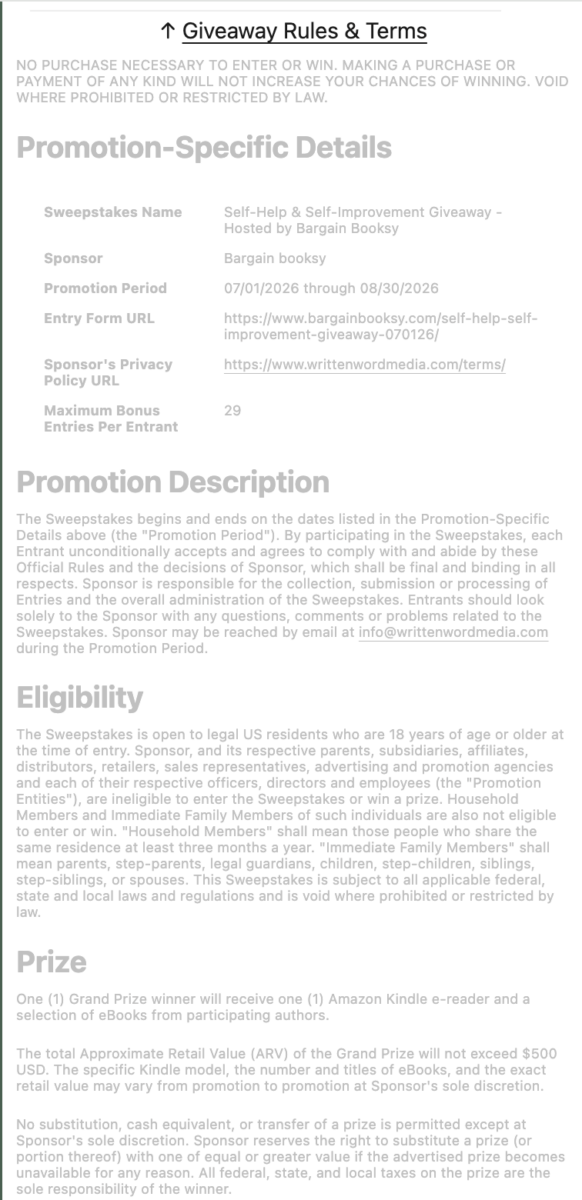
Then there is the layer that has nothing to do with platforms. The FTC treats a contest entry as something of value, which makes an entrant’s post an endorsement requiring disclosure. Its guidance in the Endorsement Guides FAQ is that “#XYZ_Contest” or “#XYZ_Sweepstakes” in the hashtag is sufficient, while “#sweeps” probably is not, because most people will not know what it means. Tell entrants exactly where to put it, ideally at the start of the caption.
That shared floor is also where eligibility belongs, and it is the piece most small businesses skip. Meta’s policy names age and residency restrictions as part of the offer terms you are required to disclose. In practice that means writing the boundary into your rules before launch: who can enter by age, which countries or states you will accept, that employees and their families cannot win, and that the promotion is void where prohibited.
I ran my own book giveaway open to United States residents only, and put that on the graphic itself rather than burying it in the rules. Set the boundary narrower than feels generous. Every additional country you open to adds a privacy regime, a translation question, and a shipping cost you may not have priced. This matters more now that you know a physical prize is allowed, because a prize that ships is a prize that has to clear customs.
I am not a lawyer and this is not legal advice. Registration and bonding requirements for prize promotions exist, they vary by jurisdiction, and they tend to switch on above a certain prize value. If your prize is worth real money, that is the point to spend an hour with someone qualified rather than an afternoon with a search engine.
Rules dictate what you can ask for. Tools decide how painful it is to administer.
You need three things: something to design the creative, something to collect and validate entries, and something to pick a winner defensibly. Small contests can run on a form and a spreadsheet. Once you are past a few hundred entries, or once a prize is valuable enough that someone might dispute the draw, purpose-built tooling pays for itself.
For the creative, I use and recommend Adobe Express, and I should disclose that I serve as an official Adobe Express Ambassador.
The practical reason I reach for it on contest work is template resizing. One contest graphic has to become a feed post, a Story, a Reel cover, and a Pin. Rebuilding that by hand four times is where most people quietly give up and post one badly cropped image everywhere. Canva does this too, and does it well. Adobe Express is where I start.
For entry collection, any form tool connected to your email platform will do the job, and Gleam is the one I have used across every book launch. What matters is that entries land in your list tagged as contest entrants, so you can measure that segment separately later.
For winner selection, keep a record. A random draw you cannot document is a dispute waiting to happen. For Facebook comment draws specifically, a Facebook giveaway picker handles the randomization and gives you something to point at when someone questions the result.
Tooling makes a contest runnable. The next decision is one almost everybody copies from somebody else without checking whether it fits.
Most advice says five to seven days, and for an organic contest promoted to an audience you already have, that is sound. I disagree once paid media enters the picture. If you are running ads against the contest, a week is gone before the campaign has even settled.
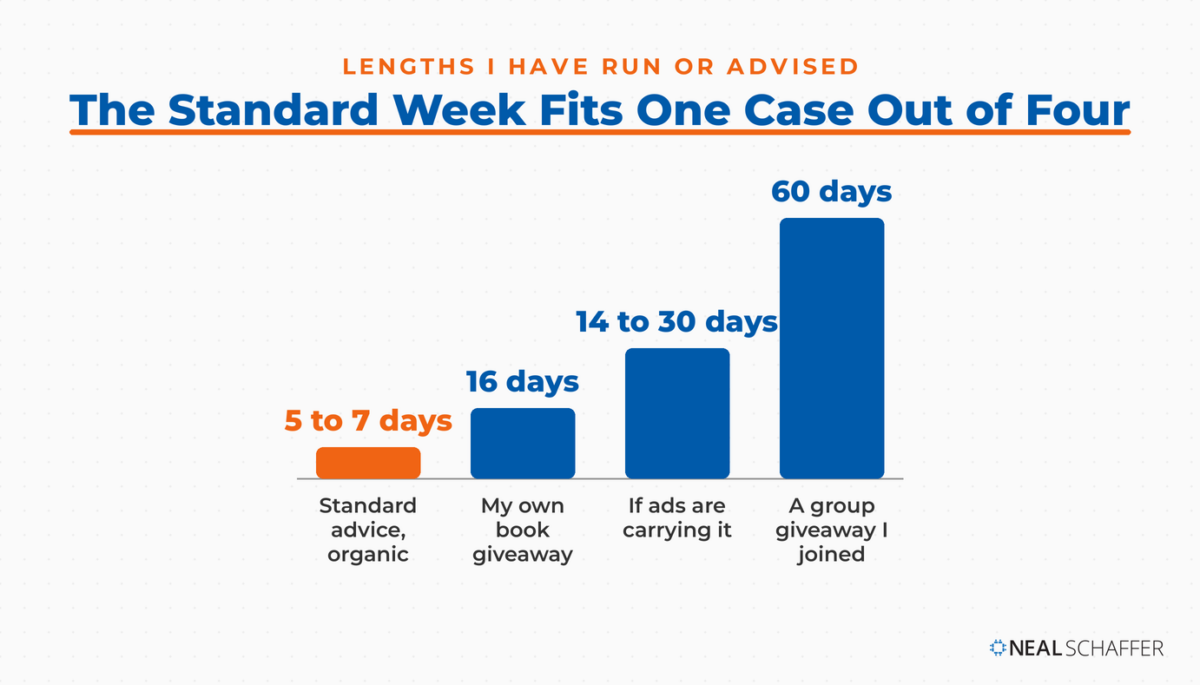
Facebook ads need to exit the learning phase before the delivery you are paying for stabilizes, and in my experience that takes a week or two on its own. End the contest on day seven and you have spent the entire budget while the campaign was still finding its footing. If ads are carrying the promotion, think about running as long as thirty days. Fourteen is not too long either.
My own book giveaway ran just over two weeks, and that felt right rather than long. The group giveaways I enter run far longer, two months in the case of the last one, because the organizer is promoting continuously to a list built for exactly that. Two weeks gave the promotion time to reach people who had never heard of the book, which is the whole reason to run one at a launch.
The real argument for a short window has nothing to do with urgency, which is where most advice puts it. It is that a short contest does not require you to keep reminding people. The longer it runs, the more obligated you feel to promote it day after day, and that is where audience fatigue sets in.
So the honest answer is that there is no correct length. There is only the length that fits your audience and the way you plan to promote. If contests are going to be a real part of your social media marketing rather than a one-off, run a short one and a long one and compare what each produced.
Whatever window you pick, decide before launch how you will judge the result.
Judge a contest on what it left behind 60 days later, not on the entry spike. Four numbers matter: qualified entries captured, engagement rate of new followers compared to your account average, email open rate for the contest segment against your general list, and revenue traceable to entrants. Follower count is the weakest signal on that list.
| What to track | When to check it | What the number tells you |
|---|---|---|
| Qualified entries | At close | Entries carrying a real email or a genuine answer, not the raw count |
| Engagement rate of new followers | 30 and 60 days | Measured against your account average; a collapse means the prize was wrong |
| Open and click rate of the contest segment | 30 days | Track both. Opens hold up far better than clicks, and clicks are the honest signal |
| Sales or bookings traced to entrants | 90 days | The only number that settles whether to run another |
| Follower count | Not as a success measure | Almost nothing on its own |
What a well-run contest actually produces
The business case for contests lives in those numbers, and it is worth separating the six things a well-run contest actually produces:
- Community. Entrants bring their own networks into the conversation, which is reach you did not buy.
- Followers with a reason. A follow earned by genuine interest behaves differently from a follow earned by a tag.
- Awareness. Contests spread through people who already like you, which is the most credible distribution there is.
- Email subscribers. The only outcome you fully own.
- Sales. Winners have tried your product for free, which is a strong position to sell from, particularly when the prize is your own product rather than a gadget.
- Engagement. Relevant new entrants keep interacting after the prize is gone. Irrelevant ones do not.
Track that second-to-last one properly by comparing the contest segment against your baseline. If you are not already measuring the baseline, how to calculate engagement rate covers the arithmetic, and without it you have nothing to compare against.
One honest caveat. A contest concentrates and rewards an audience you already have. It does not manufacture one. If your account is quiet, a giveaway will expose that rather than fix it, and the fix is consistent social media engagement posts over months rather than a prize budget over a week.
Which raises a question worth sitting with after four thousand words about picking winners.
When Is a Giveaway Actually a Lead Magnet?
A giveaway becomes a lead magnet the moment every entrant receives the thing rather than one of them winning it. There is no draw and no winner, which means there is nobody entering purely to win. The prize-hunter problem this whole post works around simply stops existing.
The best campaign of this kind I have been part of was for a client in the health information industry, and it was built around exactly that inversion. What we gave away was a personalized score assessing aspects of someone’s health, returned with guidance on living healthier. Everyone who completed it received one.
The ask was the clever part. It wanted an email address and health details, and the more someone was willing to share, the more accurate and useful their result became. The entry form did the qualifying by itself. Nobody fills out a detailed health questionnaire to win a gadget, because there is no gadget.
We ran it in the earlier days of social media, posting curated content organically on Facebook and Twitter while running paid campaigns on both in parallel. The Twitter ads converted at a lower cost, which was not what any of us expected going in.
I would not read that as advice to buy X ads today, because both platforms are unrecognizable now. Read it as a reason to run the cheaper-looking channel and the obvious channel side by side and let the cost per qualified entry decide, rather than assuming you already know.
The test is simple. If your prize could be delivered to every single entrant without bankrupting you, it probably should be. A score, an assessment, a template pack, an audit against your own criteria. Those cost you once to build and then filter for genuine interest on every entry after that, which is more than most prizes ever manage.
Frequently Asked Questions
They give people a concrete reason to interact with a brand they would otherwise scroll past, and they spread through the entrant’s own network, which is more credible than an ad. The strongest promotional benefit is the email list you build, because that asset survives after the campaign ends.
Not on Facebook or Instagram. Meta bars personal Timelines and friend connections from administering a promotion, and names share-to-enter and tag-to-enter as not permitted. You can invite those actions, but you cannot make winning contingent on them or award extra entries for them.
Five to seven days is the standard advice and it works for an organic contest run to your existing audience. If you are putting ad spend behind it, go longer, because a week is not enough time for the campaign to settle before you have already declared a winner.
Your own product, service, or time. A generic gift card or gadget attracts people who want gift cards and gadgets. A prize that only your ideal customer would want does your filtering for you before anyone even enters.
They grow the number, but the followers acquired through a one-tap entry disengage quickly. Contests grow a durable audience only when entry requires genuine interest, such as answering a real question or handing over an email address.
Start With One Contest, Not Five
Pick the goal before you pick the prize. If you want an email list, run a landing page sweepstakes built around a qualifying question that only an interested person can answer. If you want content, run a photo or video submission contest with the usage terms written plainly into your official rules.
Then read the actual policy for the platform you are running on, publish your official rules, and say plainly that the platform is not involved.
Set the window to match your promotion plan rather than a rule of thumb, tag your entrants separately in your email tool, and check the engagement rate of that segment at 30 and 60 days. If it holds near your account average, run another one. If it collapses, your prize was wrong.
The latest social media marketing statistics are worth reviewing before you commit a budget, since contest performance tracks closely with organic reach on each platform.
If you want the contest to sit inside something larger rather than run as a one-off, my breakdown of how to build a social media strategy covers where promotions fit in the calendar. And if you would like help building that plan across search, email, and social together, download a free preview of Digital Threads or get in touch about Fractional CMO services.
Actionable advice for your digital / content / influencer / social media marketing.
Join 13,000+ smart professionals who subscribe to my regular updates.