




You went looking for more likes on your Facebook business page, and somewhere along the way the button you were chasing quietly disappeared.
I have been blogging about Facebook for more than a decade, and almost nothing I would have told you in 2012 still holds today. A like was worth real money back then, and I will show you exactly why. Meta has spent the years since taking that machinery apart, and the button itself was the last piece to go. I teach social media marketing to executives at Rutgers Business School, and I run my own Facebook page as a test bed rather than a trophy.
So let’s start where you actually are. What the metric is now, what a realistic result looks like at the size you are today, and the specific things that move it.
Key Takeaways
✅ Meta retired the Page likes metric. Pages migrated to the new Pages experience, and the follower count is what the platform, the API, and every reporting tool now use.
✅ A follow is worth a fraction of what a like was worth in 2010. I walk through what changed below, including the moment Meta stopped selling Page Likes as an ad objective.
✅ The first 100 followers come from people who already know you. Invites, your email list, your website, and your own profile do more at that stage than any content strategy, and none of it happens quickly.
✅ Two reasons to keep growing anyway: social proof and ad targeting. A healthy follower count reassures a buyer, and the audience becomes a seed for lookalike targeting when you advertise.
✅ Buying followers breaks Meta’s rules and US law. I go through the Community Standard and the FTC case below, and neither one leaves much room for argument.
✅ Followers only pay off when they leave Facebook. I judge the channel on email signups and site visits, because those survive an algorithm change and a follower count does not.
What Happened to Facebook Page Likes?
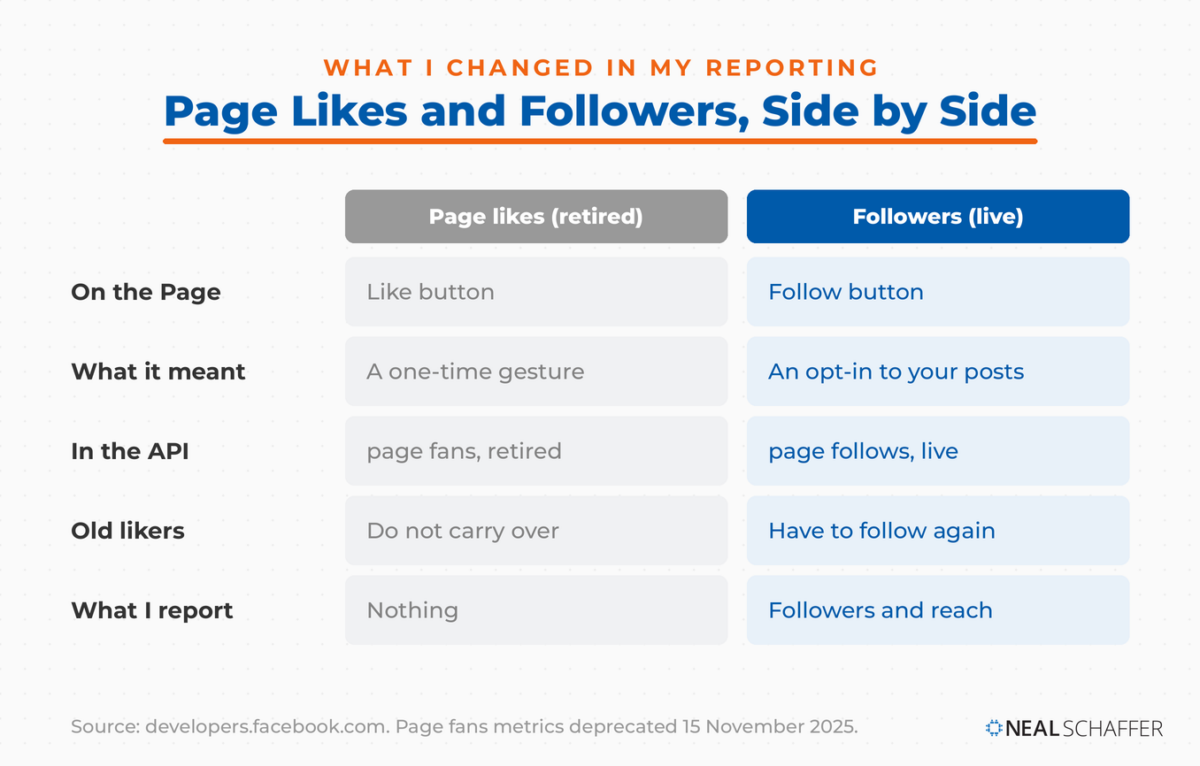
Facebook Page likes are gone as a working metric. Meta migrated every Page to the new Pages experience, retired the classic Page Insights tab, and then deprecated the page fans metrics on November 15, 2025. Followers replaced them. If your Page shows a Follow button, there is no Like button behind it.
Meta’s own help documentation on Page likes transitioning to followers spells out what changes. The Like button disappears from Pages. Pages display only a follower count. People can still like your posts without following the Page at all. Meta notes the rollout is gradual, so some Pages will see it later than others.
One line in that documentation deserves your attention more than the rest. Anyone who currently likes your Page but never followed it does not convert automatically. They have to choose to follow you again. If your Page carried a large like count built years ago, some of that number is about to walk out the door.
The change was not cosmetic. A like was a one-time gesture that a person could keep while quietly unfollowing your posts, so a page could carry a large like count and reach almost nobody. A follower is someone who has actually opted into seeing your updates, which is the number a marketer wants anyway.
What this means practically: stop reporting Page likes to your boss or your client, because the number is frozen at best and unavailable at worst. Open Meta Business Suite, go to Insights, and use followers and reach. Any dashboard still showing a fans column is reading a field that no longer updates.
That is the metric sorted. The harder question is what the surviving number is actually worth.
Do Facebook Likes Still Matter for a Business Page?
Followers matter as an audience you can reach for free, and they matter far less as a scoreboard. Socialinsider analyzed 70 million posts and found that Facebook engagement sits around 0.13% of a page’s followers per post, flat through the middle of 2026. On a thousand followers, that is roughly one interaction per post.
Run the arithmetic on your own page before you set a goal. Multiply your follower count by 0.0013 and you have the typical interaction count for one post. Five thousand followers works out to six or seven reactions. Most of the disappointment I hear from small business owners is not a content problem at all. They are comparing a real page against a number nobody actually hits.
### What a follow used to be worth
Far more than it is now, and that history explains why the advice you have read feels off. I joined Facebook in 2009, when a Page could still reach most of its audience organically without paying a cent. Better still, when someone engaged with a Page, that activity showed up in their friends’ feeds.
That second part was the whole game. Every new like was a doorway into a friends-of-friends audience you had no other way to buy. Likes compounded. A page with ten thousand of them was genuinely worth ten times a page with one thousand, because the reach scaled with the number.
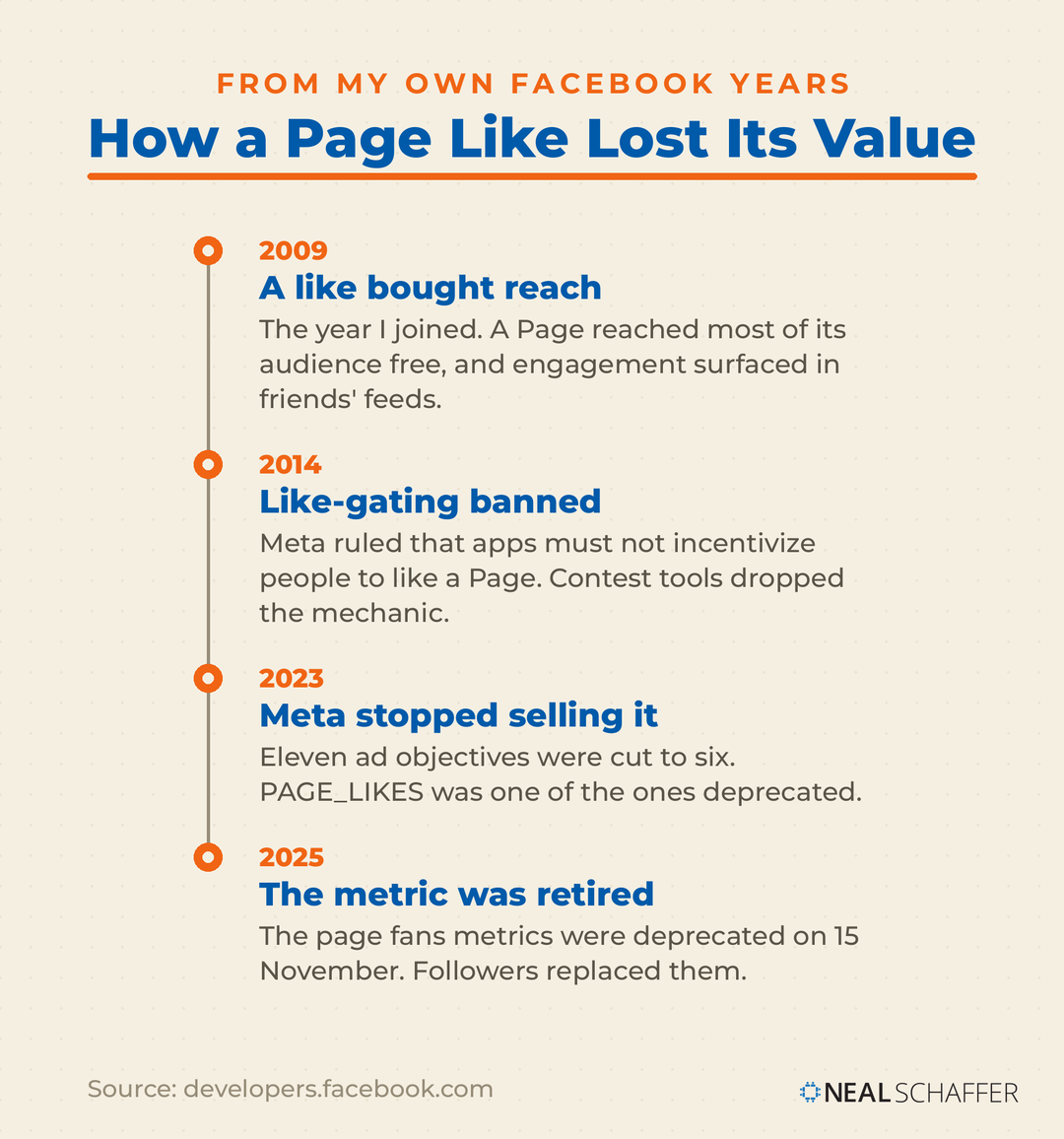
None of that machinery survives. Organic reach for Pages was throttled years ago, and the friend-of-a-friend exposure went with it. Meta made its own view plain when it cut eleven ad objectives down to six. Page Likes was one of the objectives it deprecated. The company stopped selling the thing it once trained everyone to chase.
My own Page makes the same case, less flatteringly. Across the 28 days to August 15, 2026, on a base of roughly 35,000 followers, I finished 16 followers down. Twenty-eight people unfollowed. Visits to the Page over the same stretch were up more than 80%.

Sit with that pair for a second. More people arrived, and the audience number still went backwards. If follower count were still the thing that produced reach, those two lines could not move in opposite directions.
### So why keep growing the number at all?
Two reasons, and neither is reach. The first is social proof. A prospect who lands on your Page from a Google search reads the follower count the way they read your review count. It tells them whether you are a going concern. A page with a handful of followers and a last post from two years ago quietly tells a buyer you might not be around much longer.
One Strategy to Connect All Your Marketing
My latest book helps small businesses, entrepreneurs, and marketers bring search, email, and social together into one digital marketing strategy that actually compounds.
Drawing on my work as a Fractional CMO, Digital Threads turns complicated tactics into a clear, practical plan you can follow, whatever your budget or team size.
Grab your copy on Amazon and start weaving your own digital threads. Click the cover or the button below to get started.

The second reason is where the money actually is. Meta’s lookalike audience documentation lists Page fans as one of the seed audiences you can build from, alongside customer lists and campaign conversions. Feed it your followers and Meta goes and finds more people who resemble them.
That is the actual payoff, and it only arrives if you advertise. In client work the follower base is rarely the target; it is the training data for the targeting. A page nobody follows gives the ad system nothing to learn from.
### None of this happens fast
Growing a Facebook audience takes the same patient work every other platform demands, and I would rather say that plainly than sell you a shortcut. Jon-Stephen Stansel, author of *The 10 Principles of Effective Social Media Marketing*, told me on my podcast what to ask an agency that promises overnight growth. “Well, where are those followers coming from?” He makes the same point about size. A million followers would do almost nothing for a local chain of copy shops, because those people will never walk in.
The audience itself is still worth reaching. Pew Research found that 71% of US adults use Facebook, peaking at 80% among 30 to 49 year olds, which is exactly the working-age bracket most businesses sell to. Sprout Social’s 2026 data adds that 39% of consumers use Facebook to find new products and 45% go there for support.
So the audience is there and the per-post ceiling is low. Where you are starting from decides which of those two facts you feel first.
How Do You Get Your First 100 Facebook Followers?
Your first 100 followers come from people who already know you, not from strangers finding your content. Buffer’s analysis of 52 million posts found that pages under 1,000 followers see a median reach of 21 people per post. At that size the algorithm is not going to introduce you to anyone. You have to do the introducing.
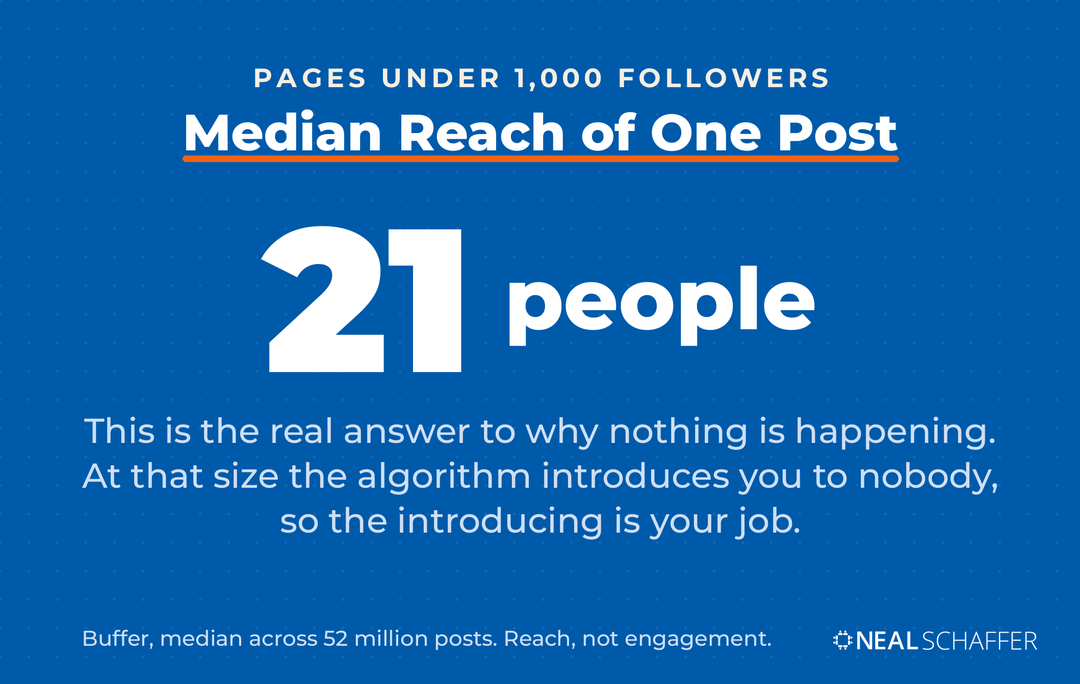
That number is the real answer to “why is nothing happening.” Nothing is happening because 21 people saw it. Getting past that point is the entire job at this stage, and it is mostly manual work.
### Finish the page before you invite anyone
Work through these in order, because each one is a reason someone might decline the invite you are about to send:
- Set the Page username to your brand name, so the URL is memorable and shareable.
- Add the profile photo (your logo) and a cover image that shows what you actually do.
- Fill the About section with the words a customer would search, not your mission statement.
- Add the action button that matches your business: Book Now, Shop Now, Sign Up, or Contact Us.
- Pin one post that explains who you are and what someone gets by following.
Do not skip the About section. Filling it properly is also the cheapest Facebook SEO work available, because it is what Facebook’s own search matches against.
### Invite the people who already know you
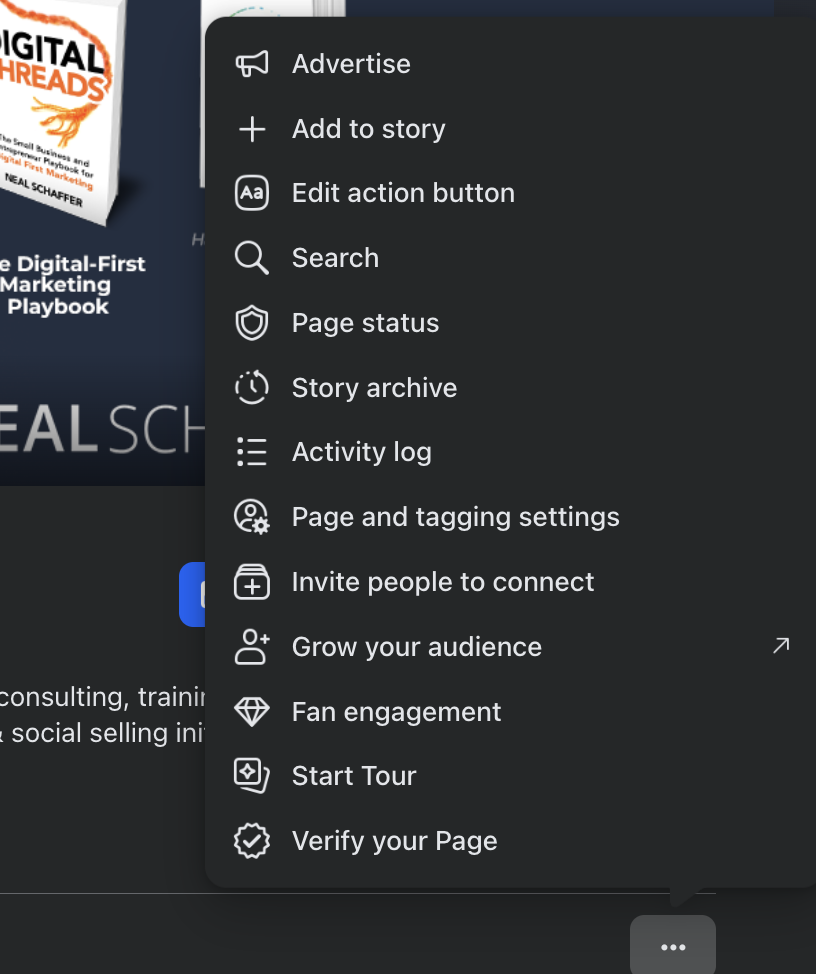
Facebook buries this one, and the menu label does not say what it does. From your Page, open the three-dot menu below the cover photo and choose Invite people to connect. Facebook then switches you over to your personal profile, where the actual invite list opens. Select your friends there and send in bulk. It feels awkward. Send them anyway, once, and do not repeat it every month.
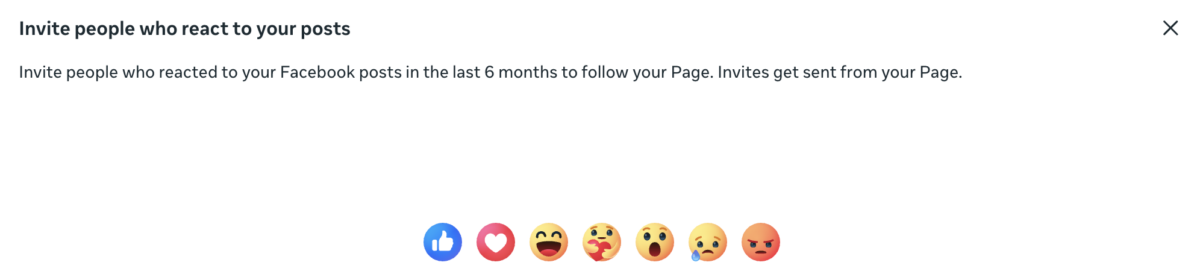
There is a second option in that same menu worth knowing about. Grow your audience hands you off to Meta Business Suite and offers to invite everyone who reacted to your posts in the last six months. These are better prospects than your friends list, because they already engaged with something you published rather than knowing you personally.
Set your expectations before you open it. When I ran it on my own Page, it showed me nobody at all, even though my ads had been collecting reactions across that same window. My read is that it counts organic post reactions only, so a page running mostly paid may find the list empty. Worth ninety seconds to check either way.
Then work the assets you own. Add the Page URL to your email signature. Put it in the footer of your newsletter. If you have a physical location, a small sign at the register does more than most people expect. I have seen this used well by car repair shops and barbers for years, usually alongside a request for a Google Business Profile review. It works because the customer is standing in front of you and already happy.
### Borrow an audience instead of building one
Engaging from your Page inside other communities puts your name in front of people who have never heard of you. Comment as your Page on complementary businesses, answer real questions in Facebook groups for business, and consider running a group of your own once you have something to say weekly.
Past a few hundred followers, the platform starts doing some of the work. Before you get there, though, one tactic gets suggested more than any other, and almost everyone sets it up wrong.
Can You Still Run a Facebook Contest to Get Likes?
Not the version you are picturing. The “like our Page to enter” giveaway has been against the rules for more than a decade, and the button it depended on is now gone as well. Contests themselves remain fine, and Meta says so in the same policy notice. Only the entry mechanic has to change.
Meta’s platform policy update in August 2014 was blunt: “You must not incentivize people to use social plugins or to like a Page.” The same notice ruled out gating rewards or content behind a like.
Read the next line in that notice, though, because it is the one that saves the tactic. Meta said it remains acceptable to incentivize people to enter a promotion. Contests are fine. The entry mechanic is the part that has to change.
Contest tools sorted this out years ago. Gleam retired its Like A Page entry method in November 2014 and replaced it with Visit A Page, and documents the reasoning along with the actions it does still support. Entrants earn their entry for visiting your Page. The follow button sits right there, optional, awarding nothing. Some of them press it because they liked what they found, which is the only sort of follower worth having.
### How to set up a compliant Facebook contest
The reason each step is here is that it keeps the entry tied to something you are allowed to reward:
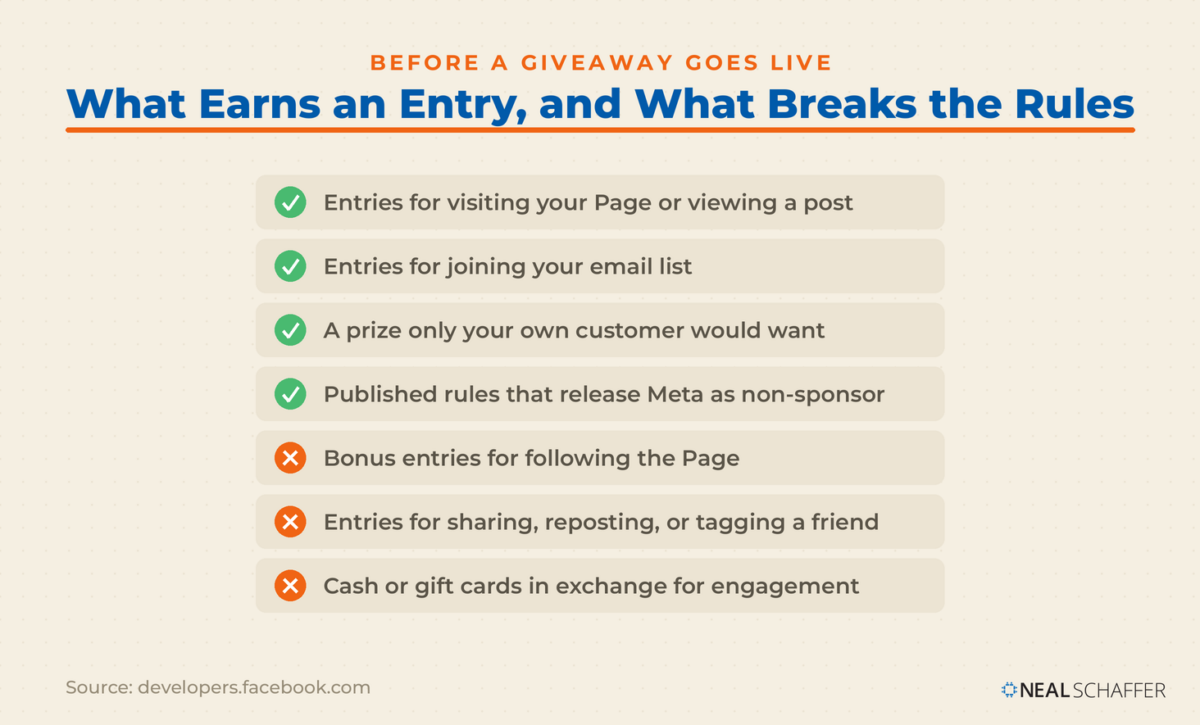
- Pick a prize only your own customer would want. Your product, a session with you, or something from your category. A generic prize buys you entrants who wanted the prize.
- Award entries for permitted actions: visiting your Page, viewing a specific post, joining your email list.
- Leave the follow optional and give it nothing. No bonus entries, no extra chances.
- Do not reward shares or tags either. Meta’s Pages, Groups and Events Policies say a promotion must not require or incentivize entrants to share, repost, tag others, or otherwise publicize it. The word “incentivize” rules out the bonus-entry version, not only the mandatory one.
- Publish official rules. The same policy requires entrants to release Meta and to acknowledge that the promotion is not sponsored, endorsed, or administered by Meta. Everything else legal is yours, including any registration your jurisdiction wants.
- Ask for the email address as a required field, because that is the asset the contest is actually for.
My contest ideas and a random winner picker for the draw are both on the blog.
That is who you ask. What you post is the next question.
How Do You Get More Likes on Your Facebook Posts?
Post likes come from two things you control: the format you publish in and whether you show up in the comments. Buffer’s benchmark of 52 million posts puts photos 34.7% above text, and its study of over a million Facebook posts links replying to comments with 9.5% more reactions.
Both of those are free. Neither requires a strategy document.
### Lead with images, and make them yours
Photos beat text in the Buffer benchmark cited above because they stop the scroll. A second study disagrees, and I get into that below. What neither disputes is the next part. Original shots of your work, your team, or your product beat stock every time, and they cost you nothing but a phone.
For posts that need a designed graphic rather than a photograph, I use Adobe Express. The Facebook post templates are free, and the one-click Resize tool turns a finished graphic into a Facebook Story or a banner without rebuilding it. I serve as an official Adobe Express Ambassador, so take the recommendation with that in mind, but the free tier genuinely covers what a small business page needs. Canva is the other obvious option if you are already in it.
If you are stuck on what to publish, my Facebook post ideas and engagement post formats are both worth raiding.
### Answer every comment while the post is young
Replying is the tactic people skip because it does not feel like marketing. The Buffer study noted above says it moves reactions, and the mechanism makes sense. A reply restarts the conversation, keeps the post active, and tells the algorithm real people are talking.
Block two ten-minute windows a day rather than trying to catch everything live. Ask a follow-up question instead of typing “thanks.” And get in early, because how the Facebook algorithm weighs early engagement decides how far the post travels.
The stakes are higher than reactions. Sprout Social found 73% of social users will buy from a competitor if a brand does not respond.
### Do not ask for the like
Asking people to like, share, or tag is engagement bait, and Meta demotes it. Its content distribution guidelines define engagement bait as posts that explicitly request votes, shares, comments, tags, or reactions for their own sake. The stated reason is that people dislike being asked.
Ask a question you actually want answered instead. Meta is drawing a line between earning engagement and demanding it, and that line is easy enough to stay on the right side of.
### Publish when your people are awake
Timing will not save weak content, but it decides whether good content gets a first hour. Check your own audience’s active hours in Meta Business Suite before trusting any published benchmark, since the best time to post on Facebook varies more by audience than by industry.
| What to do | Effort | What the data shows |
|---|---|---|
| Post a photo instead of text | Minutes | 34.7% more engagement than text posts |
| Reply to every comment | 20 min/day | 9.5% more reactions |
| Post when your audience is online | One-time setup | Decides first-hour distribution |
| Ask for likes and shares | None | Demoted as engagement bait |
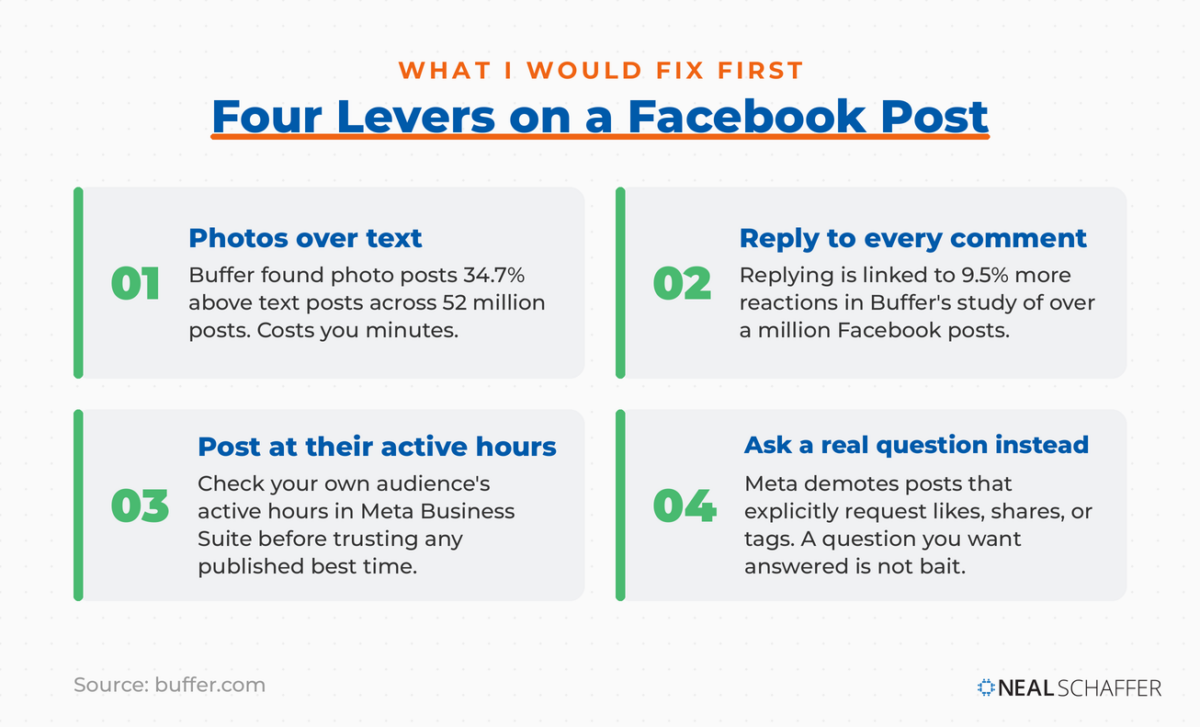
Those four levers apply whatever you are posting. Which raises the question of what you should be posting in the first place.
Which Content Formats Actually Work on Facebook?
No single format wins on Facebook, and the two largest studies of the platform disagree about which one comes closest. That is the finding, not a dodge. Facebook was never a visual-first platform the way Instagram is, so the format that carries an Instagram account will not automatically carry your Page.
People open Instagram to look at things. They open Facebook to catch up on people, argue in the comments, and read. Any advice that assumes otherwise is borrowing a playbook from a different app.
Look at what happens when two serious datasets ask the same question. Buffer’s benchmark, cited earlier, put photo posts 34.7% above text posts. Socialinsider studied 25 million posts from more than 130,000 Facebook pages and broke the results out by format, and found plain text status updates leading images on engagement rate.
| Format | Views per post, pages with 1K to 5K followers | Where it led |
|---|---|---|
| Album | 85 | Most views and most shares, at every page size |
| Status (plain text) | 60 | Highest engagement rate and the most comments |
| Image | 60 | Nothing in particular, steady everywhere |
| Link | 20 | Last on every measure in the study |
| Reel | 10 | Top engagement rate in the most recent quarter |
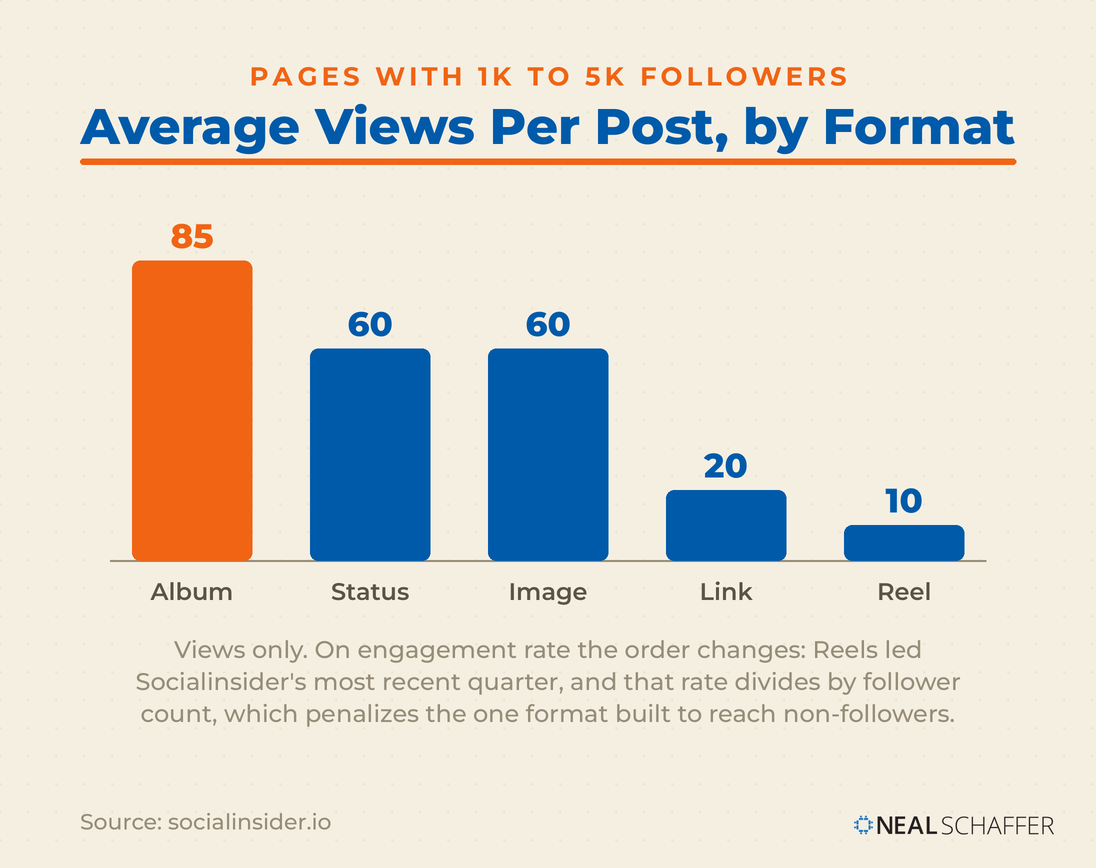
Read the spread rather than the winner. Albums took views, plain text updates took conversation, and Reels finished last on views in the annual numbers while topping engagement rate in Socialinsider’s most recent quarterly update. Their engagement rate also divides by follower count, which penalizes the one format built to reach people who do not follow you.
My own dashboard says something blunter. Over those same 28 days, 99.2% of the views on my Page came from people who do not follow it. My followers accounted for 0.8%.
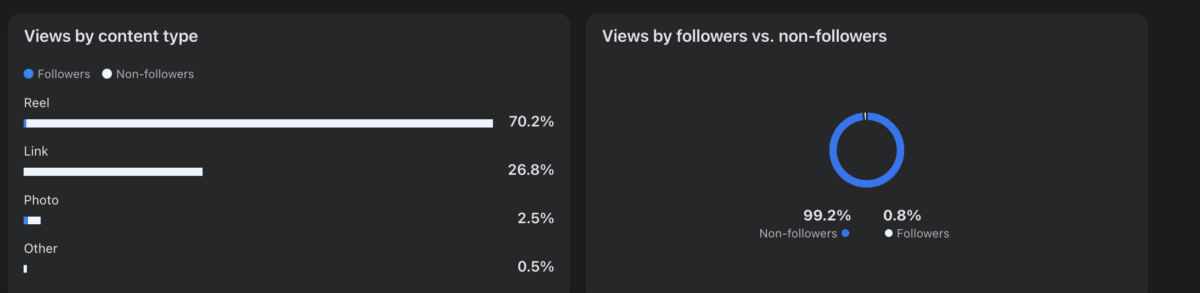
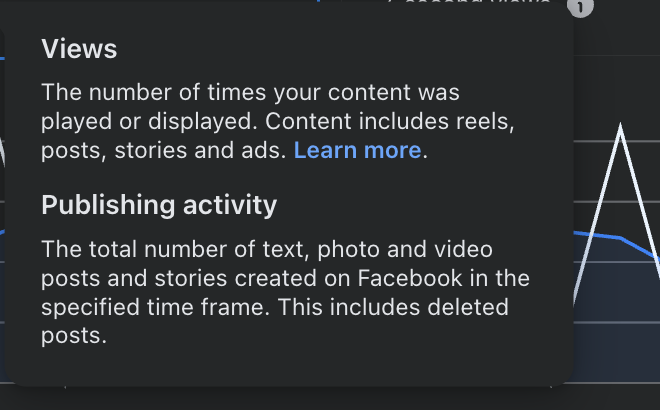
I should be straight about what sits inside that number. Meta counts reels, posts, stories and ads in its views metric. I was running Reels ads for a lead magnet across that window, so a share of those views was bought rather than earned. That does not rescue the follower count. It sharpens the point. I paid to reach an audience, and the audience I had already spent years building delivered less than one view in a hundred.
### Run the 30-day format test on your own page
Two large studies pointing different directions is the strongest argument I can give you for testing rather than copying. There is no format answer waiting to be discovered. There is only your audience’s answer, and you get it the same way I do.
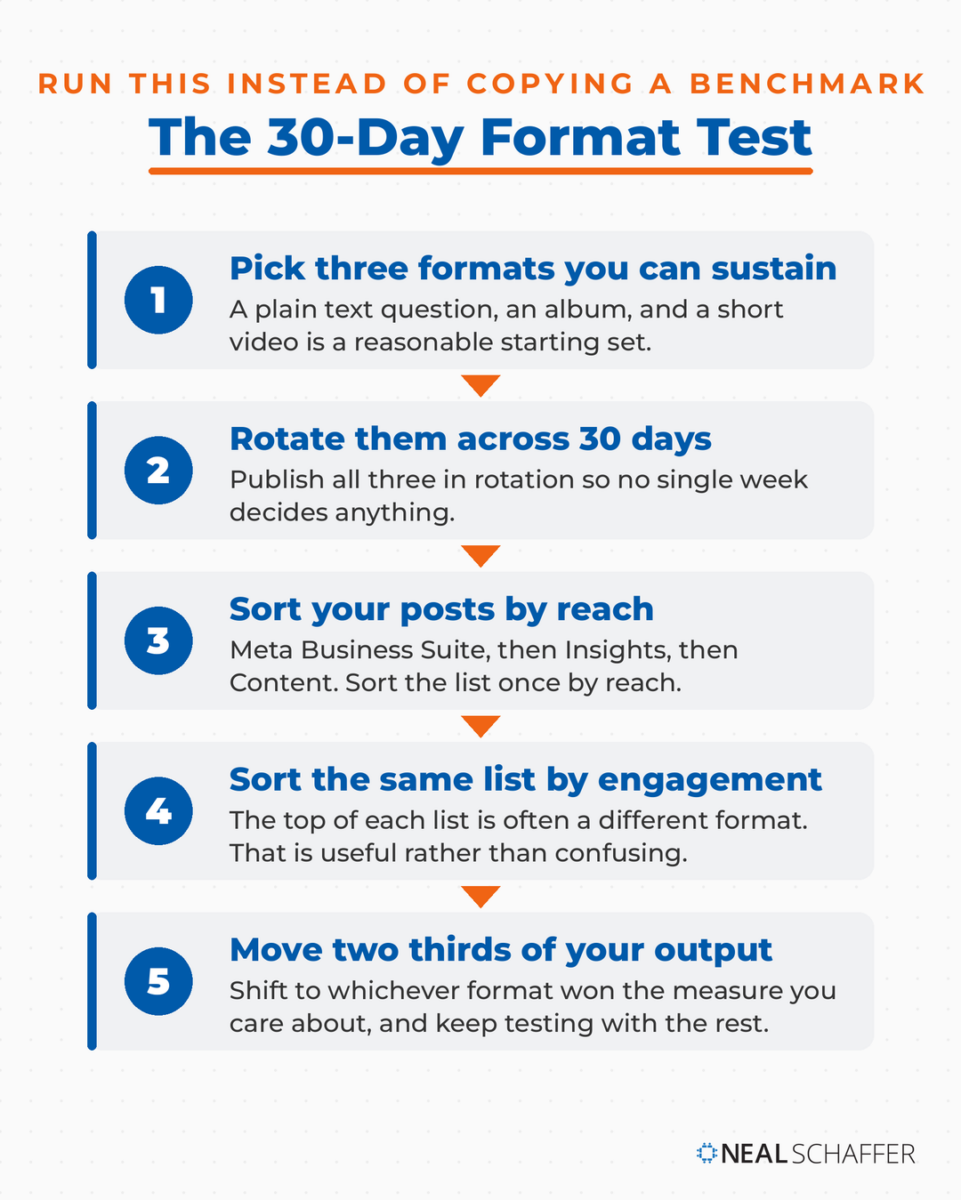
- Pick three formats you can sustain. A plain text question, an album, and a short video is a reasonable starting set.
- Publish all three across the next 30 days, in rotation, so no single week decides anything.
- Open Meta Business Suite, go to Insights, then Content, and sort your posts by reach. Then sort again by engagement.
- Note which format sits at the top of each list. They will often be different formats, and that is useful rather than confusing.
- Shift roughly two thirds of your output to whichever format won the measure you care about, and keep testing with the rest.
Thirty days of that beats every benchmark in this post, because it answers the question for your page instead of for the average of 130,000 other ones.
Two things the research is clear enough about to act on today. Stop posting bare links; they finished last on everything Socialinsider measured. And if you are already producing Reels for Instagram, cross-post them, because Meta owns both and the video is already made. That second one is a production argument rather than a reach argument, and it is worth labelling as one.
Formats decide what happens to the people who already see you. The bigger constraint is how many people that is, and the answer to that sits off Facebook entirely.
How Do You Turn Your Website and Email List Into Facebook Followers?
Your website and your email list are the highest-converting follower sources you have, because those people already chose you once. Meta’s Page plugin embeds your Page directly on your site, with a follow action and a timeline tab, in a few lines of markup. It works on any public Page that is not age or country restricted.
I would start with three placements.
On your site. Drop the Page plugin in a sidebar or a footer where it does not fight your main call to action. A small popup works too. MiloTree is the tool I would reach for there, because it puts a follow prompt on the screen for Facebook or any other platform without needing a developer.
In your email. Add the Page URL to your signature and to the footer of every email newsletter you send. This costs one afternoon and then runs forever.
Plenty of signature tools will build you a block with clickable social icons and track the clicks. You can also skip the subscription. I found a signature design I liked, asked AI to build me something similar, and I still use it today. The trade is that you lose the click analytics those providers give you, so you will not know how many follows the signature earned.
In content you already made. Every podcast episode, video, or long post you publish can point to the Page. I turn podcast episodes into blog posts here regularly, and repurposing content that way means the Facebook mention rides along at no extra cost.
Now for the shortcut everyone gets offered, and why it ends badly.
Should You Buy Facebook Likes or Followers?
No. Buying followers violates Meta’s rules and has been treated as unlawful deception in the United States. Meta’s Community Standards on spam prohibit attempting to or successfully selling, buying, or exchanging engagement, naming likes, shares, views, follows, and clicks. The same policy notes that Meta may place restrictions on the accounts involved.
The legal side is settled too. In 2019 the FTC brought its first-ever complaint over sold indicators of social media influence against Devumi. The company had filled more than 58,000 orders for fake Twitter followers. The Bureau of Consumer Protection director said plainly that “buying and selling fake followers is illegal.”
That same Community Standard is worth reading before you plan a giveaway. It treats offering a chance to win cash or cash equivalents in exchange for engagement as spam. So prefer a product prize over a gift card.
Set the rules aside and the math still fails. Bought followers do not open your posts, so your engagement rate drops the moment they land. A lower rate means less organic reach for the people who followed you on purpose. You pay money to reach fewer customers.
If you want to accelerate without breaking anything, buy attention instead of applause. Boosting a post that already performed organically puts budget behind something you know works. A real Facebook ads strategy targets people by who they are, not by how many of them you can rent.
All of which leaves you with a list of tactics and a finite week. So here is how I would sequence them.
Which Tactics Should You Actually Run First?
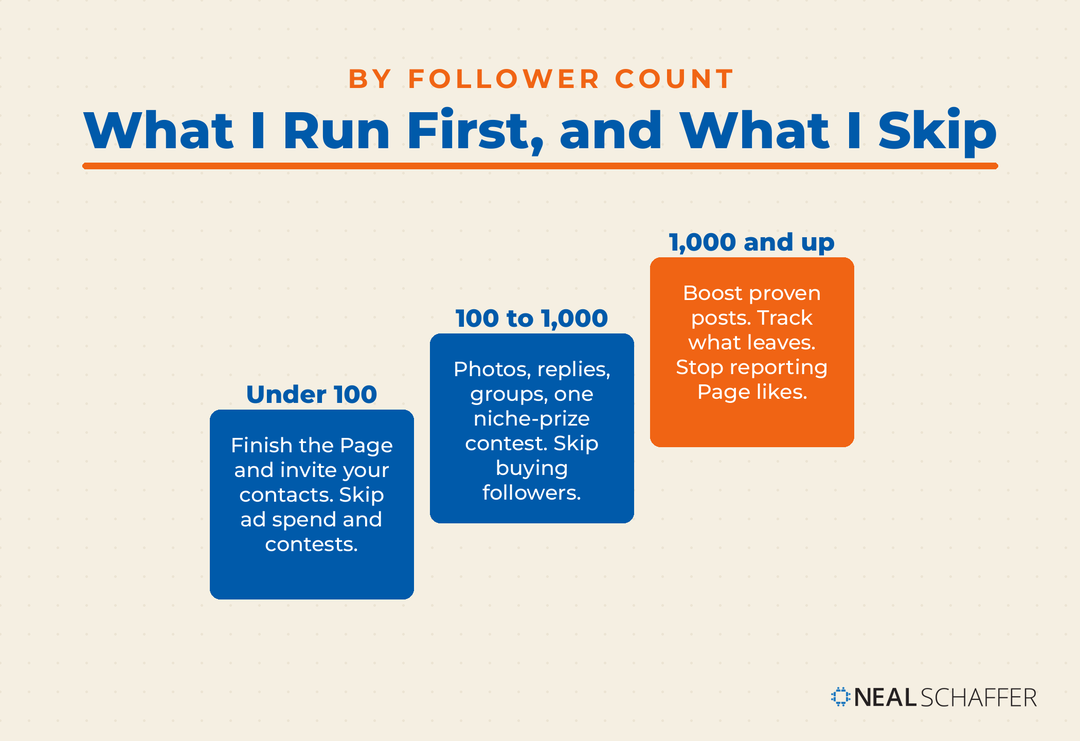
Run the owned-audience tactics first, the content tactics second, and paid last. The reason for that order is speed of feedback. Invites and email placements convert people who already trust you, so you learn within days whether anyone wants your page. That beats spending three months producing content for an audience of 21.
| Stage | Do this | Skip this |
|---|---|---|
| Under 100 followers | Finish the Page, invite contacts, add the URL to email and site | Posting daily, ad spend, contests |
| 100 to 1,000 | Photos, replies, groups, one contest with a niche prize | Buying followers, chasing viral formats |
| 1,000 and up | Boost proven posts, track in Facebook analytics tools | Reporting Page likes to anyone |
Who this is not for. If you sell exclusively to people under 25, this whole page is a distraction; Pew’s age data puts your audience elsewhere. If you have no website and no email list, I would fix that first. An audience you cannot contact off-platform is one the platform can take back with a single ranking change. And if you are a local service business with a full book, I would put the same hour into reviews instead.
The point of any of this is what happens after the follow. My broader thinking on Facebook marketing and on Facebook for small business both come back to the same test: did that person end up on a list you own?
Frequently Asked Questions
Not on the new Pages experience. Per the developer notice linked earlier, Meta moved Pages to a Follow button and retired the page fans metrics from its Page Insights API. Some legacy Pages still display a like count, but it is not a number you can act on.
There is no threshold that matters on its own. A local business with 400 engaged local followers will outperform one with 40,000 scattered globally. Per the Socialinsider benchmark cited earlier, average per-post engagement is low enough that raw size predicts very little.
Longer than most tip lists suggest. Buffer’s tier data puts typical monthly follower growth well under 1% for small pages. From a standing start, with consistent posting and active invites, plan on many months rather than weeks.
Not directly. A Facebook page can rank in Google for your brand name, and it sends referral traffic, which is worth having. The follower count itself carries no ranking weight. Treat it as a distribution channel, not an SEO tactic.
No, at least not as its own campaign objective. Meta deprecated Page Likes when it cut eleven objectives down to six, as the developer notice linked earlier records, and new campaigns cannot be built on it. A page-likes option still sits inside the Engagement objective in Ads Manager, but I would argue the budget is better spent almost anywhere else. Optimizing for the cheapest possible follow selects for the people least likely to buy from you.
Start Growing an Audience You Actually Own
Pick the stage you are in from the table above and do the three things listed for it this week. Finish the Page, send the invites, and add the URL to your email signature. That is an afternoon of work and it will teach you more than another month of posting into an empty room.
Then change what you measure. Followers are a means; the number that tells you whether Facebook is working is how many of those people ended up on your email list or on your site.
If you want the numbers behind all of this, the current Facebook statistics are worth bookmarking before you set any goals for the quarter.
And if you would rather wire Facebook into the rest of your marketing than run it as a standalone channel, download a free preview of Digital Threads. You can also see what we work on inside my Digital First Mastermind, or get in touch about Fractional CMO services.
Actionable advice for your digital / content / influencer / social media marketing.
Join 13,000+ smart professionals who subscribe to my regular updates.