




Most of the stars in the Milky Way are what we might call normal stars. They’re main sequence stars like our Sun, meaning they’re doing what most people probably think stars do: shining as they fuse hydrogen atoms into helium atoms on a vast scale.
But all stars run out of hydrogen fuel eventually, and some stars end up in odd states as they evolve off of the main sequence. White dwarfs represent one of these odd evolutionary statea. Our Sun will become one of these when it runs out of fuel in several billion years. These stars are super-compact and dense; they’re about as large as Earth but have about as much mass as the Sun. They shine only with remnant energy.
White dwarfs are strange, but not rare. About 97% of the Milky Way’s stars will become white dwarfs eventually, and they’re not difficult to detect.
Another strange end-state is the neutron star. They form when massive stars explode as core-collapse supernovae. Since massive stars are rare, so are neutron stars. They’re also extremely dense objects, but even more dense than white dwarfs. They can have 2 solar masses and be only 12 km in diameter. It’s often said that a teaspoon of neutron star would ‘weigh’ one billion tonnes.
Not only are neutron stars rare, but they’re difficult to detect; they’re small, dark, and cold. But some neutron stars do announce their presence as pulsars. Pulsars are rapidly rotating neutron stars that shine beams of light from their poles. If one of those beams is aimed at us, astronomers can see it blinking. They’re cosmic lighthouses.
Millisecond pulsars (MSPs) are a specific type of pulsar with rotation periods of 10 milliseconds or less that only form when they have a binary companion. It happens when the companion swells up due to its own evolution. Mass spills over from the companion and spirals onto the millisecond pulsar, giving it angular momentum, or rotational energy that makes it spin rapidly. Finding these binary stars is of great interest to astronomers, and a team of researchers from Italy and Germany have found one with a very young white dwarf partner.
Their research is published in a paper titled “The youngest white dwarf companion to a millisecond pulsar: Insights from NGC 362D.” It’s published in Astronomy and Astrophysics, and the first author is Greta Ettorre, a PhD student in the Department of Physics and Astronomy at the Alma Mater Studiorum University of Bologna, Italy.
Globular clusters are excellent hunting grounds for millisecond pulsars, because the stellar density is so high that neutron stars are more likely to have companions. NGC362D is a millisecond pulsar with a rotation period of only 5.83 milliseconds, meaning it rotates more than 10,000 times per minute. It was first discovered in December, 2022, in the globular cluster NGC 362, about 29,300 light years away.
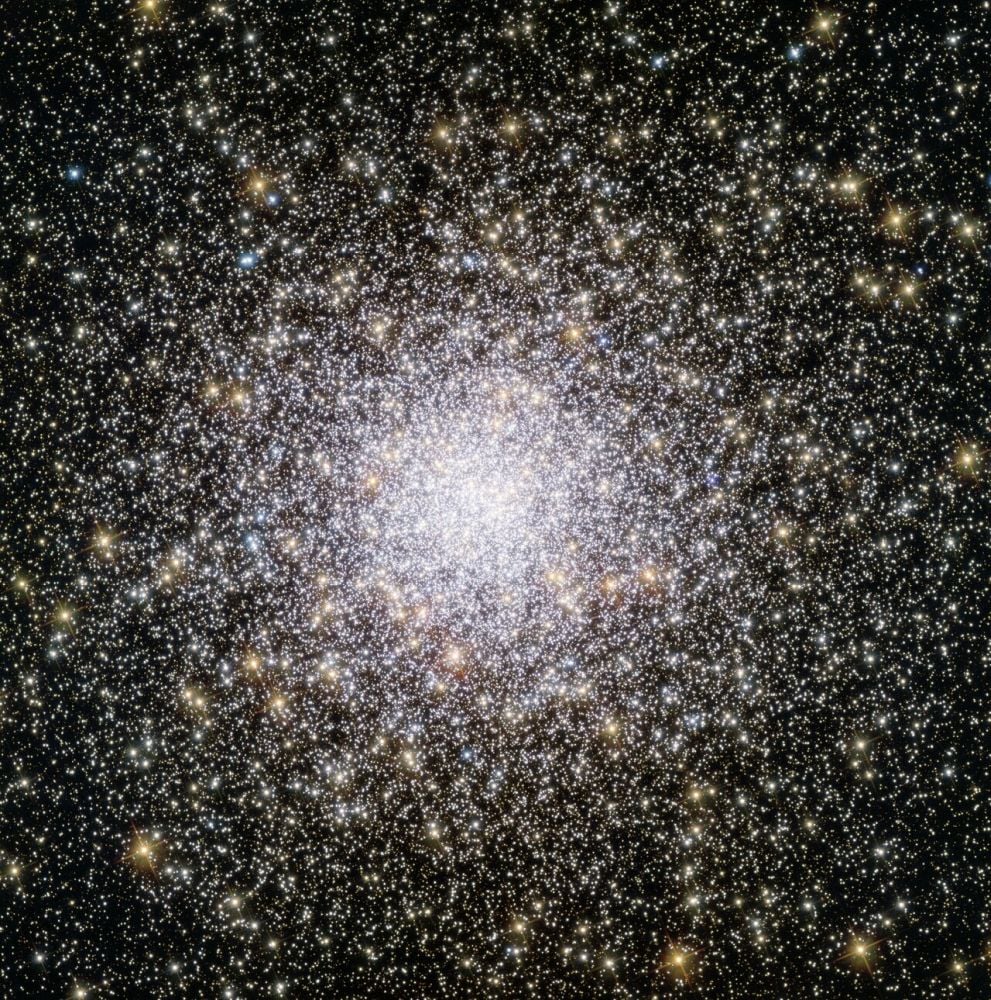
*Somewhere in this globular cluster (NGC 362), a millisecond pulsar and its binary companion, a white dwarf, are in a rare stage of evolution. The pulsar, which is a dense, rapidly spinning neutron star, has been drawing material away from its less dense white dwarf companion, hastening its evolution into a white dwarf. Image Credit: By ESA/Hubble, CC BY 4.0, https://commons.wikimedia.org/w/index.php?
“Millisecond pulsars (MSPs) form in binary systems containing a slowly rotating neutron star (NS) that is eventually spun up to millisecond periods by heavy-mass and angular-momentum transfer from an evolving companion,” the authors explain. “The recycling scenario for MSP formation predicts that the mass transfer between the non-degenerate companion and the NS typically starts when the donor is either a main sequence or a subgiant or red-giant branch star.”
The pulsar’s companion, called COM-NGC 362D, is the youngest MSP companion ever found. It’s a proto-white dwarf, which indicates that it’s only just entering the earliest stages of becoming a white dwarf. “Our analysis robustly shows that this object is a very low-mass (∼0.18 M⊙) He white dwarf (WD) still in the pre-cooling phase,” the authors write.
NGC 362D and its companion are important because the astronomers caught them in a rare stage of their relationship. “Interestingly, a detailed comparison with updated binary evolution models indicates that this object completed the mass-transfer phase only recently (∼0.6 Gyr ago), thus strongly suggesting that COM-NGC 362D is the youngest WD companion to a MSP identified to date,” the authors explain. This is especially interesting because as the pulsar draws material from its companion, it drastically shapes the companion’s evolution, forcing it to become a white dwarf far sooner than it would on its own. This is called the recycling process.
Astronomers found COM-NGC 362D by cross-referencing radio data from the pulsar itself with ten years of Hubble observations in ultraviolet and near-infrared. By comparing that data with stellar evolution models, they determined its age and other properties. But there was something else: the same models showed less UV radiation than expected for a white dwarf like this. Something was blocking or attenuating some of its UV.
“Remarkably, in this respect, the photometric properties of NGC 362D show, for the first time in this class of objects, significant wavelength-dependent variations that are consistent with the presence of residual circumstellar material,” the authors write. This material was likely expelled during the mass-transfer phase, emphasizing how young the white dwarf is.
“What makes this system particularly interesting is the possibility of observing it at a very early stage of its evolution,” lead author Ettorre said. “Moreover, the attenuation of the signal that we observed in the ultraviolet could indicate the presence of material still surrounding the white dwarf.”
They acknowledge that it’s unclear if the material could’ve survived for this long, but it’s still their preferred explanation.
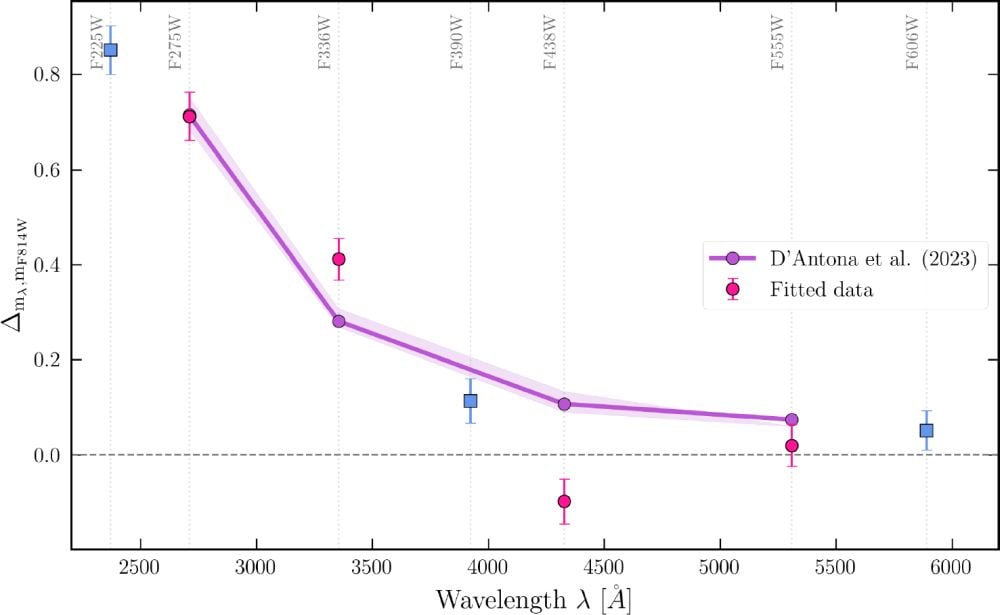 The purple line in this figure shows the reference model for a young He white dwarf in its cooling phase. The pink points are fitted data from COM-NGC 362D. (The blue points represent data that couldn’t be fitted for technical reasons.) “The observed trend, with larger deviations at shorter wavelengths, is consistent with a self-extinction effect likely produced by circumstellar material surrounding the proto-WD companion,” the authors write. Image Credit: Ettorre et al. A&A, 713, L14 (2026)
“Our proposed scenario envisages that COM-NGC 362D is an extremely young WD that only recently ended the mass-transfer phase and is surrounded by a residual cloud of material producing self-extinction,” the authors write.
This means that they system is a unique opportunity to study the aftermath of the recycling process that generates an MSP. If COM-NGC 362D has only recently had its outer layers stripped away, then the dense core left behind is only in the early stages of transitioning to a white dwarf. So finding this young core could make it easier to identify others.
“NGC 362D currently offers us a unique opportunity to study what happens in the immediate aftermath of the millisecond pulsar recycling process,” said study co-author Emanuele Dalessandro, a researcher at INAF. “In this context, the possible presence of material around the white dwarf is particularly interesting. In fact, it could produce signatures at radio wavelengths in addition to the optical, similar to those observed in systems with non-degenerate companions, and could therefore help us correctly interpret the properties of other young systems.”
Though their proposed scenario is that COM-NGC 362D is a very young white dwarf at the end of the recycling process, they do acknowledge another possibility. “Alternatively, the material may have been expelled during a previous hydrogen-shell flash,” they write.
In any case, pulsars are fascinating objects, and their rapid and regular pulses of electromagnetic energy make them natural clocks. This makes them useful in studying other aspects of the Universe. Understanding how they form will only be helpful.
“Millisecond pulsars rotate with extraordinary regularity and can be used as true natural clocks. Measuring the arrival times of their pulses with extreme precision allows us, among other things, to study gravity under extreme conditions and to carry out increasingly precise tests of general relativity. Understanding their surroundings and reconstructing their evolutionary history is therefore essential to fully exploit what these remarkable cosmic laboratories can tell us.” Ettorre concludes.