




Godwin AsedibaBBC News Komla Dumor Award winner, Eastern Province, Sierra Leone
 Andre Lombard / BBC
There is a sense of disbelief in this Sierra Leonean village as people weep in front of the bodies of two teenage boys wrapped in white cloth.
The day before, 16-year-old Mohamed Bangura and 17-year-old Yayah Jenneh left their homes in Nyimbadu, in the country’s Eastern Province, hoping to earn a little extra money for their families.
They had gone in search of gold but never returned. The makeshift pit they were digging in collapsed on them.
This was the third fatal mine accident, leaving a total of at least five children dead, in the last four years in this region.
Mohamed and Yayah were part of a phenomenon that has seen a growing number of children missing school in parts of Sierra Leone to mine the precious metal in potentially lethal pits, according to headteachers and community activists.
The Eastern Province has historically been known for diamond mining. But in recent years informal – or artisanal – gold mining has expanded as the diamond reserves have been depleted.


 David Wilkins / BBC
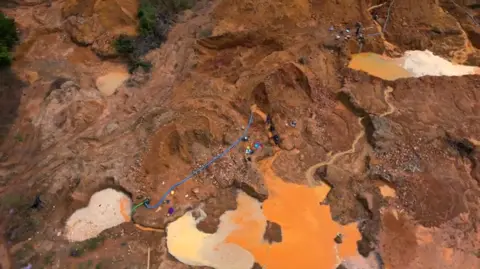
Mining sites pop up wherever local people find deposits in this land laden with riches – on farmland, in former graveyards and along riverbeds.
There are few formal mining companies operating here, but in the areas which are not considered profitable, the landscape is dotted with these unregulated pits that can be as deep as 4m (13 feet).
Similar – and equally dangerous – mines can be found in many African countries and there are often reports of deadly collapses.
Most families in Nyimbadu rely on small-scale farming and petty trading for a living. Alternative employment is scarce so the opportunity to earn some extra cash is very attractive.
But the community in the village gathered at the local funeral home know the work also comes at a price, with the loss of two young lives full of promise.
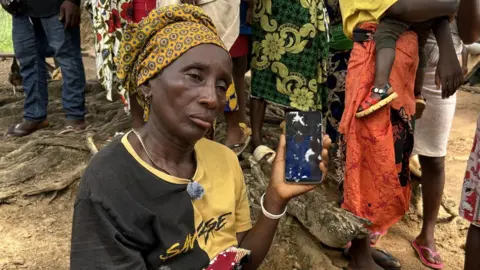
Yayah’s mother, Namina Jenneh, is a widow and had been relying on her young son to help provide for her other five children.
As someone who worked in the pits herself, she acknowledges that she introduced Yayah to mining but says: “He didn’t tell me he was going to that site – if I had known I would have stopped him.”
When she heard about the collapse, she says she begged someone to “call the excavator driver.
“When he arrived, he cleared the debris that had buried the children.”
But it was too late to save them.
 Namina Jenneh
Ms Jenneh speaks with deep pain. On a mobile phone with a cracked screen, she scrolls through pictures of her son, a boy with bright eyes who supported her.
Sahr Ansumana, a local child protection activist, takes me to the collapsed pit.
“If you ask some parents, they’ll tell you there’s no other alternative. They are poor, they are widows, they are single parents,” he says.
“They have to take care of the kids. They themselves encourage the kids to go and mine. We are struggling and need help. It’s worrying and getting out of hand.”
But the warning goes unheeded – the loss of Yayah and Mohamed has not emptied the pits.
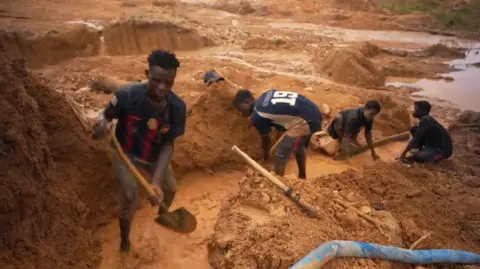
The day after their funerals, miners including children are back at work, their hands sifting sand by the river or inspecting the earth manually excavated in search of the glimmer of gold.
 David Wilkins / BBC
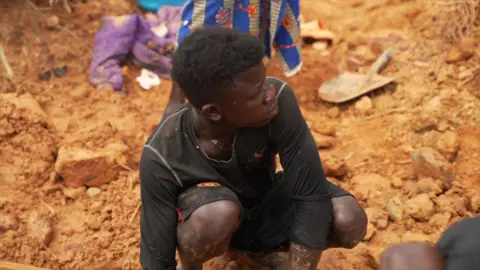
At one site I meet 17-year-old Komba Sesay who wants to be a lawyer, but he spends daylight hours here to support his mother.
“There is no money,” he says. “That is what we are trying to find. I am working so I can register and sit my [high school] exams. I want to return to school. I’m not happy here.”
Komba’s earnings are meagre. In most weeks he earns about $3.50 (£2.65) – less than half the country’s minimum wage. But he perseveres in the hope of striking it rich. On some, very rare, good days he has found enough ore to earn him $35.
Of course, he knows the work is risky. Komba has friends who have been injured in pit collapses. But he feels that mining is the only way he can earn some money.
 David Wilkins / BBC
And it is not only pupils who are leaving schools.
Roosevelt Bundo, the headteacher of Gbogboafeh Aladura Junior Secondary School in Nyimbadu says “teachers also leave classes to go to the mining sites, they mine together with the students”.
Their government pay cannot compete with what they may be able to earn from gold mining.
There are also wider signs of change around the mining hubs. What were once small camps have swelled into towns in the last two years.
The government says it is addressing the issue.
Information Minister Chernor Bah tells the BBC that the government remains committed to education but adds that the state recognises the many challenges people face.
“We spend about 8.9% of our GDP, the highest of any other country in this sub-region, on education,” he says, adding that funds go to teachers, school-feeding programmes and subsidies intended to keep children in the classroom.
But on the ground, reality bites. Immediate survival often wins over policy.
Charities and local activists try to remove children from the pits and place them back into school, but without reliable alternatives for income, the pits are too attractive.
Back in Nyimbado, the families of the two dead boys appear exhausted and hollowed out.
The loss is not just of two young lives. It is the steady erosion of possibility for a generation.
“We need help,” the activist Mr Ansumana says. “Not prayers. Not promises. Help.”
 Getty Images/BBC