




Jonathan HeadSouth East Asia correspondent
 Getty Images
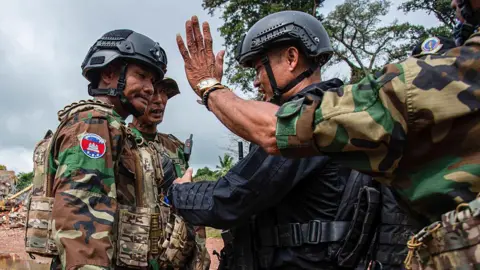
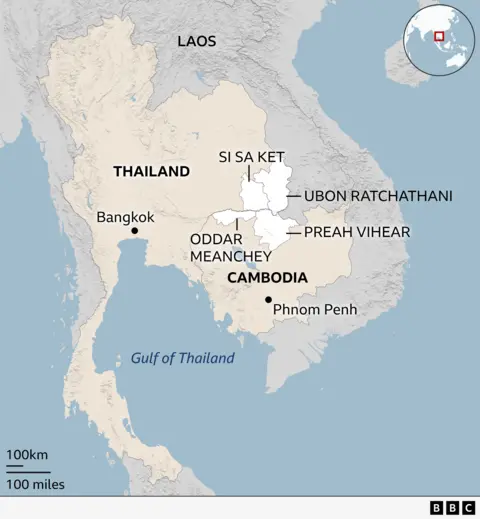
Once again the boom of artillery, rockets and air strikes sounds along the Thai-Cambodian border.
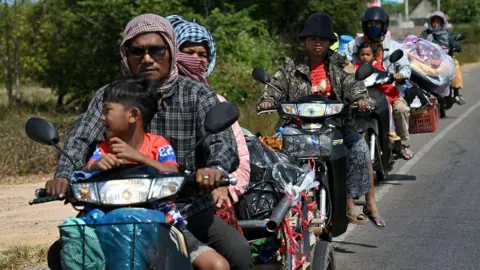
Villages in a corridor stretching for hundreds of kilometres have been evacuated for a second time in five months. Families and their pets sit on mats in temporary shelters, wondering when they can go home, and when they might be forced to flee yet again.
Why has this happened so soon after the ceasefire brokered by US President Donald Trump in July?
It was ignited by a seemingly minor incident on Sunday, when a Thai engineering team working on an access road in the disputed area of the border was, according to the Thai army, fired on by Cambodian troops. Two Thai soldiers were injured, neither seriously.
In the past this might have been settled by some fleet-footed diplomacy. But there has been little of that this year. Instead a yawning gulf of mistrust lies between these two neighbours, one even Trump’s deal-making prowess has failed to bridge.


 Getty Images
Despite his claim to have struck a historic peace deal, the ceasefire he forced on the two countries in July was always tenuous.
Thailand in particular was very uneasy about internationalising the border conflict, and only agreed to the ceasefire because Trump held a tariff gun to its head; at the time both Thailand and Cambodia were just days away from a deadline to negotiate significantly lower tariff rates on their vital exports to the US.
Cambodia, by contrast, is only too happy to welcome outside intervention. As the smaller country it feels at a disadvantage in bilateral negotiations with Thailand.
But on the border its troops have continued to engage in confrontations with the Thai army, and, in a move guaranteed to anger the Thai public, to lay new land-mines which have so far caused seven Thai soldiers to lose limbs. Thailand has presented compelling evidence of this, accused Cambodia of bad faith, and refused to release 18 of its soldiers captured in July.
Since July, any restraint there was on the Thai armed forces has gone. The current prime minister Anutin Charvirakul heads a minority coalition, and is beset with other challenges. He has given the military carte blanche to manage the border conflict as it sees fit.
The army has said its goal is to inflict sufficient damage on its Cambodian counterpart to ensure it can never again threaten border communities. It also wants to take control of several hill-top positions which would give its soldiers greater advantage in any future battles with Cambodian forces.
Both sides have been manoeuvring around these positions all year, trying to reinforce roads access and fortifications around them.
The Thais believed they were on track to push the Cambodians back when they were forced to stop in July. The military says it wants to finish the job now.
It also sees its role of defending Thailand’s territorial claims as a sacred one, even though this conflict is about tiny slivers of mostly unpopulated land.
 Getty Images
The motivations at work in the Cambodian leadership are much harder to divine.
Former Prime Minister Hun Sen is still the puppet-master pulling the strings of his son, current PM Hun Manet. Publicly he has appealed for restraint by his troops, portraying Cambodia as being bullied by a more powerful neighbour and in need of international support.
Yet his interventions in this simmering border dispute have been decisive this year, in particular his decision to leak a confidential phone conversation with the then-Thai PM Paetongtarn Shinawatra, whose father Thaksin was a long-standing friend and business partner of Hun Sen’s.
Her leaked comments, praising him and condemning her own army commanders for being too gung-ho, were catastrophic for her and her father. Her government collapsed, he has gone to jail, and many Thais, even those bitterly opposed to the Shinawatra family, have been angered by the perception that Cambodia has been meddling in Thai politics.
Thai public opinion is now much more in favour of their army’s hard-line approach to Cambodia.
Can President Trump bang heads together again as he did in July? Perhaps.
But if all he achieves is another ceasefire it will only be a matter of time before fighting breaks out again. And Thailand has said repeatedly that it is not yet ready for diplomacy. Cambodia, it says, must show sincerity before it is ready to try for a ceasefire again.
What that means exactly is not clear, but at the very least it would require a decisive and verified end to the use of land-mines on the border.