





Anthony ZurcherSenior North America reporter


 BBC
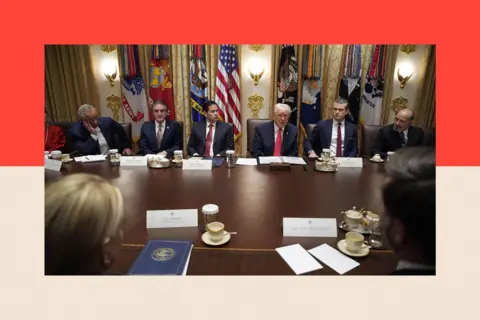
BBCAt a meeting of his cabinet at the White House two weeks ago, US President Donald Trump looked around the long room filled with his top advisers, administration officials and aides, and made a prediction.
The next Republican presidential candidate, he said, is “probably sitting at this table”.
“It could be a couple of people sitting at this table,” he added, hinting at possible electoral clashes to come.
Despite a constitutional amendment limiting him to two four-year terms, his supporters chanted “four more years” at a rally last Tuesday night in Pennsylvania. Trump said at the time that the final three years of his second term amount to an “eternity”.
But in the cabinet room last week, when talking about prospects for the 2028 Republican president nomination, he was clear: “It’s not going to be me.”
The next presidential election may seem a long way off, but Trump’s own speculation – and certain frictions within Trump’s coalition – suggest that the jockeying to succeed and define the Make America Great Again (Maga) movement after Trump is well under way.
 EPA/Shutterstock
In last month’s local elections, the Republican Party lost support among the minority and working-class voters who helped Trump win back the White House in 2024.
Members of his team have feuded over policy. And some, most notably Congresswoman Marjorie Taylor Greene, have cut loose from his orbit, accusing the president of losing touch with the Americans who gave him power.
There has been speculation about fractures within the Maga base in certain quarters of the international press, as well as at home. On Monday, a headline in The Washington Post asked: “Maga leaders warn Trump the base is checking out. Will he listen?”
The warning signs are there. While Trump has long been known for being in tune with his base, the months ahead will pose a series of challenges to the president and his movement. Nothing less than his political legacy is at stake.
From Vance to Rubio: A team of rivals?
It was all smiles and talk of historic presidential achievements inside the friendly confines of Trump’s newly redecorated, gold-bedecked cabinet room two weeks ago.
But the presidential aspirants Trump may have had in mind as he looked around the table hint at just how hard it could be to keep his Maga movement from stretching apart at the seams.
Vice-President JD Vance sat directly across from the president. As his running mate, he is widely considered to be Trump’s most likely heir apparent – the favourite of Trump’s sons and libertarian Silicon Valley tech billionaires.
 Getty Images
Secretary of State Marco Rubio was on the president’s immediate right. The former Florida senator, who competed with Trump for the Republican nomination in 2016, had spent the past 10 years undergoing a Maga transformation.
He has jettisoned his past support for liberalising immigration policy and his hard line on Russia in lieu of Trump’s America First foreign policy. But if there is anyone close to an old-guard Republican with influence in Trump’s party, Rubio tops the list.
Then there is Secretary Robert F Kennedy Jr, whose vaccine scepticism and “Make America Healthy Again” agenda have sent earthquakes through the US health bureaucracy; he sat two down from Rubio. The Democrat-turned-independent-turned-Republican is a living embodiment of the strange ideological bedfellows Trump made on his way to re-election last year.
And finally, Kristi Noem, the homeland security secretary, was tucked off to the corner of the table. While the former South Dakota governor is not considered a major presidential contender, her advocacy for aggressive immigration enforcement – including a recent call for a full travel ban on “every damn country that’s been flooding our nation with killers, leeches and entitlement junkies” – has made her a prominent face of administration’s policies.
 Reuters
Each might believe they could, if they chose to run, become Trump’s political heir and take control of the political movement that has reshaped American politics over the last decade.
But to paraphrase Benjamin Franklin’s comments at the birth of American democracy, whoever wins the Republican nomination will have been given a winning coalition – if they can keep it.
The Republican empire transformed
Of course none of this is guaranteed – nor is it certain that the next generation of Maga leaders will be someone from the president’s inner circle. Trump stormed the White House as a political outsider. The next Republican leader may follow a similar path.
“It’s going to be up to the next Republican president who follows Trump to set him or herself apart,” says former Republican Congressman Rodney Davis of Illinois, who now works for the US Chamber of Commerce.
“But at the same time make sure that you don’t go too far away, because clearly it’s Donald Trump [who] got elected president twice.”
When the November 2028 presidential election rolls around, American voters may not even want someone like Trump. Some public opinion polls suggest that the president may not be as popular as he once was.
A survey by YouGov earlier this month indicated the president had a net approval rating of -14, compared with +6 when he took office again in January. Then there are concerns about the economy and his relentless efforts to push the boundaries of presidential power.
 Getty Images
Leadership of Trump’s movement still represents the keys to the Republican empire, however, even if that empire has drastically changed in recent years.
“I think the Republican coalition has become fundamentally different over the last few decades,” said Davis, who served in Congress from 2013 to 2023. “The Republican coalition that existed when Ronald Reagan was elected is not the Republican coalition anymore.”
Back in the 1980s, the Reagan coalition was a fusion of free-market economics, cultural conservatism, anti-communism and international foreign affairs, says Laura K Field, author of Furious Minds: The Making of the Maga New Right.
Trump’s party, she continues, was perhaps best described by long-time Trump adviser and current state department official Michael Anton in a 2016 essay advocating for Trump’s election. In contrast with the Reagan era, its core principles include “secure borders, economic nationalism and America-first foreign policy”.
‘Normie Republicans’ versus ‘the edgelords’
Earlier this month, the conservative Manhattan Institute released a comprehensive survey of Republican voters, shedding more light on the composition of Trump’s coalition.
It suggested that 65% of the current Republican Party are what it calls “core Republicans” – those who have supported party presidential nominees since at least 2016. (If they were alive in the 1980s, they may well have voted for Reagan.)
On the other hand, 29% are what the Institute called “new entrant Republicans”. It is among those new Republicans that the challenge to the durability of Trump’s coalition presents itself.
Only just over half said they would “definitely” support a Republican in next year’s mid-term congressional elections.
According to the survey, the new entrants are younger, more diverse and more likely to hold views that break with traditional conservative orthodoxy. They hold comparatively more left-leaning views of economic policy, they tend to be more liberal on immigration and social issues, and they may also be more pro-China or critical of Israel, for example.
 AFP via Getty Images
Jesse Arm, vice-president of external affairs at the Manhattan Institute, told the BBC in an email: “A lot of the conversation about the future of the right is being driven by the loudest and strangest voices online, rather than by the voters who actually make up the bulk of the Republican coalition.”
Perhaps not surprisingly, the so-called new entrant Republican voters are significantly less supportive of some of Trump’s would-be heirs. While 70% of core Republicans have positive views of Rubio and 80% for Vance, just over half of new entrants feel that way about either.
Other findings could be more concerning for Republicans.
More than half of new entrants believe the use of political violence in American politics “is sometimes justified” – compared to just 20% among core Republicans.
It also suggests they may be more likely to be tolerant of racist or anti-Semitic speech and more prone to conspiratorial thinking – on topics like the moon landings, 9/11 and vaccines.
Trump was able to attract these voters into his coalition. The question is whether he and his political heirs can keep them there – or if they even want to.
“The real takeaway is not that these voters will ‘define’ the post-Trump GOP, but that future Republican leaders will have to draw clear lines about who sets the agenda,” argues Mr Arm.
“The heart of the party remains normie Republicans, not the edgelords that both the media and the dissident right are strangely invested in elevating.”
Clashes in the conservative ranks
The divides revealed in the Manhattan Institute poll helps explain some of the most notable frictions within the Trump coalition over the past few months.
The Trump-Greene feud that culminated in the latter’s resignation from Congress began with her backing of a full release of the government files connected to the Jeffrey Epstein underage sex-trafficking case – long a source of conservative conspiracy theories.
It broadened, however, into a critique of Trump’s Middle East policy and accusations of his failure to address cost-of-living and healthcare concerns for low-income American voters.
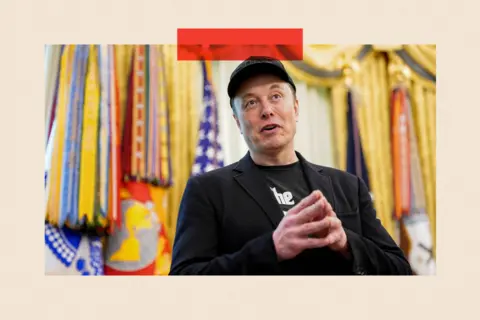
An earlier high-profile Maga split erupted over Trump’s economic policy, with billionaire Elon Musk, a strong supporter and member of Trump’s inner circle at the start of the year, going on to condemn certain tariffs and government spending policies.
 Reuters
The president has, for the moment, largely tried to stay out of another bitter clash within conservative ranks over whether Nick Fuentes, a far-right political commentator and Holocaust denier, is welcome within the conservative movement.
It’s a dispute that has roiled the influential Heritage Foundation and pitted some powerful right-wing commentators against each other.
According to Ms Field, those who follow Trump may find it a difficult conflict to avoid. “Nick Fuentes has a huge following,” she says. “Part of how the conservative movement got the energy and power that they’ve got is by peddling to this part of the Republican Party.”
In the halls of the Republican-controlled Congress, some signs of friction with the president’s agenda are showing. Despite White House lobbying, it couldn’t stop the House from passing a measure mandating release of the Epstein files.
The president has also been unable to convince Senate Republicans to abandon the filibuster, a parliamentary procedure Democrats in the minority have been able to block some of Trump’s agenda.
 AFP via Getty Images
Meanwhile, Trump’s party has been stumbling at the polls, with the Democrats winning governorships in Virginia and New Jersey last month by comfortable margins.
In dozens of contested special elections for state and local seats over the past year, Democrats have on average improved their margins by around 13% over similar races held in last November’s national elections.
The future of Trumpism
All of this will be front of mind for Republicans ahead of the 2026 mid-term congressional elections – and it will do little to ease the concerns held by some that, without Trump at the top of the ticket, their coalition will struggle to deliver reliable ballot-box victories.
Yet even a defeat next year – or in 2028 – is unlikely to mark the end of Trumpism.
The ascent by Trump’s Maga movement to the pinnacle of American power has been far from a smooth one. It includes a mid-term rout in 2018 and Trump himself losing in 2020, before his re-election last November.
But the changes that Trump has wrought within the Republican Party itself appear to be foundational ones, according to Ms Field. His Maga coalition builds on strains of populist movements in the US that date back decades or more – from Barry Goldwater’s insurgent presidential campaign in 1964 to the Tea Party protests during Barack Obama’s presidency.
“These things are not coming out of nowhere. They are forces in American politics that have been underground for a while, but have been just kind of fermenting.”
The old Republican order, she argues, is a relic of the past.
“The Trump movement is here to stay and there’s no real likelihood of the old establishment returning with any sort of clout – that much is clear.”
Top picture credit: Getty Images

BBC InDepth is the home on the website and app for the best analysis, with fresh perspectives that challenge assumptions and deep reporting on the biggest issues of the day. You can now sign up for notifications that will alert you whenever an InDepth story is published – click here to find out how.