




Here’s something most “what is a marketing consultant” articles won’t tell you: the role doesn’t really have a single definition. It spans everything from a freelancer running your Facebook ads for $50/hour to a senior strategist embedded in your leadership team for $15,000/month. Same job title, wildly different work, wildly different price tags. And the gap between those two is exactly where most companies make their biggest hiring mistake.
I’ve been on the consulting side of this market for over a decade. I run a digital marketing consultancy (PDCA Social), I have worked as a Fractional CMO for several companies in various companies, I teach digital marketing at Rutgers Business School and UCLA Extension, and I wrote Digital Threads in part because I kept seeing the same patterns across client engagements. So I’ll tell you upfront what most articles dance around: when a marketing consultant gets enough experience and starts owning leadership-level decisions (strategy, team, budget, accountability for revenue), the label “marketing consultant” starts to undersell what they actually do. Most consultants at that level, myself included, rebrand as Fractional CMOs because that’s what the role has become.
This guide walks through what a marketing consultant actually does, what they cost in 2026, when the role is the right fit, and where the line sits between “consultant” and “Fractional CMO.” If you’re a business owner trying to figure out which to hire, that distinction will save you money.
Key Takeaways
✅ A marketing consultant is an external marketing professional who advises businesses on strategy, channels, and execution, typically working on a project, hourly, or monthly retainer basis rather than as a full-time employee.
✅ Marketing consultant rates in 2026 span $50 to $500+ per hour, with most strategic consultants charging $150-$300/hour and monthly retainers ranging from $1,500 to $15,000+, per benchmarks from Talo’s freelance marketing consultant rates report.
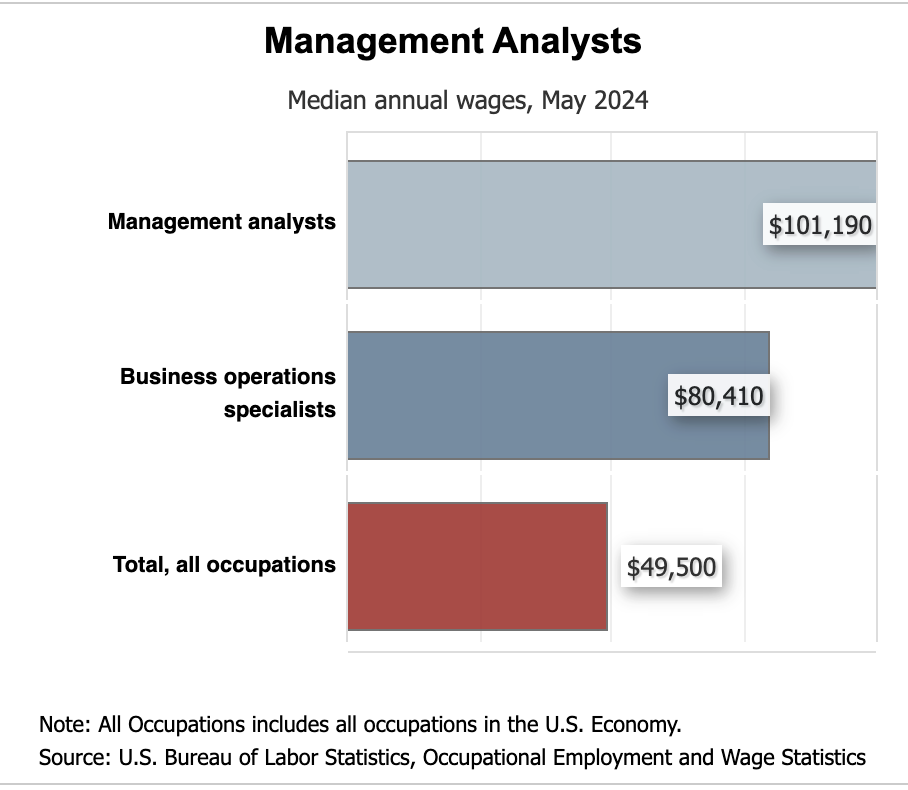
✅ The US Bureau of Labor Statistics tracks marketing consultants under “management analysts,” reporting a median wage of $101,190 in May 2024 and projected 9% employment growth from 2024-2034, much faster than the average for all occupations.
✅ The global marketing consulting market is estimated at $36.65 billion in 2026 and projected to reach $45.52 billion by 2031, per Mordor Intelligence, with digital marketing consulting leading at 31% of total share.
✅ When a marketing consultant has enough experience to own strategy, hire and manage teams, set budgets, and be accountable for revenue, they typically reposition as a Fractional CMO. That’s not a title upgrade for vanity; it’s a different scope of work with different pricing and expectations.
✅ The single biggest mistake businesses make is hiring an execution-level consultant when they actually need strategic leadership, or paying for strategic leadership when they really just need someone to run their email campaigns.
What Is a Marketing Consultant, Exactly?
A marketing consultant is an external marketing professional who advises businesses on how to improve their marketing, working independently or through a consultancy rather than as a full-time employee. They typically engage on a project, hourly, or monthly retainer basis, and their scope ranges from narrow specialist help (SEO, paid ads, email) to broad strategic guidance across the entire marketing function.
That definition is intentionally wide because the role itself is wide. Coursera, in its overview of the marketing consultant role, describes a marketing consultant as someone who advises companies on how to reach consumers in a target market and convert them into paying customers. That’s accurate but generic. In practice, two consultants with the same title can do completely different work.
Some marketing consultants are tactical specialists. They run your SEO, manage your paid social, write your email funnels. The same role exists across specializations: there are SEO consultants, social media consultants, paid media consultants, email consultants, and so on, each focused on a single channel or function. Others are strategists who never touch a campaign but rebuild your positioning, channel mix, and team structure. The reason “marketing consultant” can mean either of those is that the consulting market hasn’t agreed on a clean taxonomy, so the title gets used for everyone from a 22-year-old freelancer on Upwork to a former CMO with 25 years of operating experience.
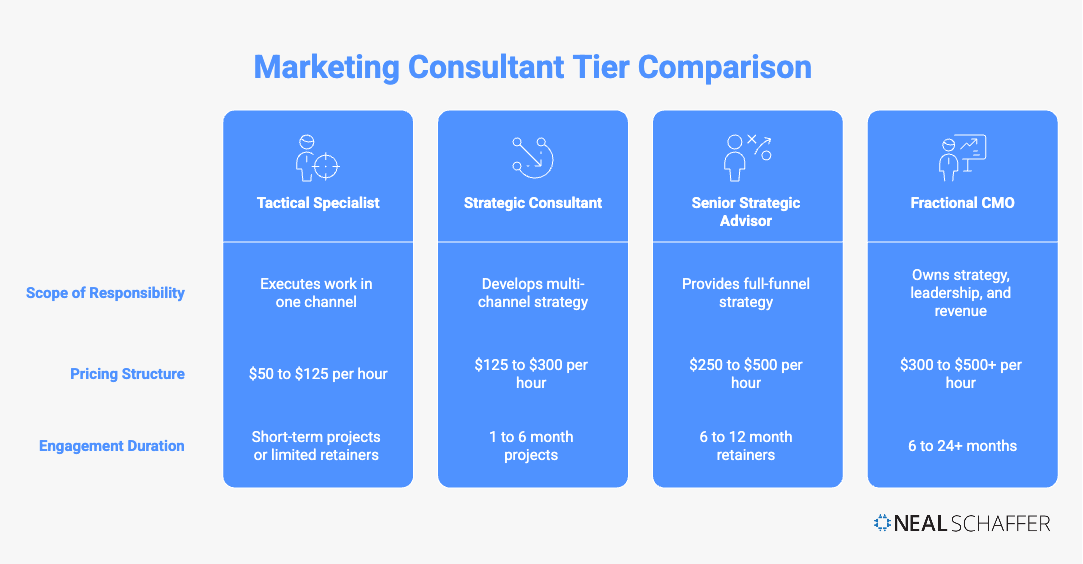
Here’s a useful way to think about the spectrum, with rate ranges synthesized from Invoicebloom’s 2026 consulting rates benchmark and freelance marketing consultant benchmarks discussed below:
| Consultant Type | Typical Scope | Hourly Rate Range (US, 2026) | Engagement Length |
|---|---|---|---|
| Tactical specialist | One channel (SEO, paid, email, social) | $50-$125 | Project or short retainer |
| Strategic consultant | Multi-channel strategy, audits, plans | $125-$300 | 1-6 month project |
| Senior strategic advisor | Full-funnel strategy, team coaching | $250-$500 | 6-12 month retainer |
| Fractional CMO | Strategy + leadership + accountability | $300-$500+ (or $3K-$18K/mo retainer) | 6-24+ months |
The further right you go on that spectrum, the less the work looks like “consulting” in the classic sense (advise and disappear) and the more it looks like embedded leadership. That’s where the Fractional CMO label takes over, and I’ll come back to that distinction in detail below.
What Does a Marketing Consultant Actually Do?
A marketing consultant assesses a company’s current marketing, identifies gaps and opportunities, and recommends or executes solutions, depending on scope. The typical day-to-day involves audits, strategy documents, channel recommendations, performance reviews, and (for hands-on engagements) campaign oversight or execution. The work varies dramatically by seniority level and engagement type.
Across my own engagements over the years, the work usually breaks down into a handful of repeating activities:
Audit and discovery. Look at what’s already happening: traffic sources, conversion data, content inventory, paid media performance, email lists, social channels, tech stack, agency relationships. By the end of the discovery phase, a good consultant should understand your marketing better than your internal team does. That sounds like a tall claim. It’s also the job.
Strategy and planning. Define the marketing strategy: positioning, target segments, channel mix, content priorities, budget allocation, KPIs. This is the deliverable most clients think they’re buying, and it’s where most engagements either succeed or quietly fail.
Channel and campaign recommendations. Pick the channels that matter for the business, kill the ones that don’t, and define what each channel needs to do. A B2B SaaS company with a 12-month sales cycle needs a very different channel mix than a DTC ecommerce brand selling $40 candles.
Execution oversight. Manage in-house staff, agencies, freelancers, and contractors to actually deliver the work. Many engagements stop at recommendations. Better ones include accountability for whether those recommendations get implemented.
Is Your LinkedIn Not Delivering Results?
Just released: my new book to help professionals, entrepreneurs, and business owners maximize LinkedIn for real growth.
With years of LinkedIn expertise, Maximizing LinkedIn for Business Growth offers actionable steps to build your brand, expand your network, and drive results.
Start leveraging LinkedIn like never before—grab your copy now! Click the cover or button below to buy on Amazon.

Coaching and training. Upskill the in-house marketing team so they can run more of the work themselves over time. The best consultants leave their clients more capable than they found them.
Reporting and iteration. Track what’s working, kill what isn’t, adjust quarterly. If a consultant can’t show you a clear picture of what’s improving and what isn’t, they’re not really doing the job.
In my own practice, I try to design engagements so the early months are heavy on strategy and discovery, and the middle months shift toward execution and team-building. By the late months, I’m doing less hands-on work and more advising while the team I’ve helped build runs the day-to-day. A successful Fractional CMO engagement means that I “graduate” from a client engagement knowing they are in good hands. That arc reflects how senior consulting actually delivers value: not by being a permanent extension of your headcount, but by building the systems and team that eventually don’t need you as much.
Marketing Consultant vs. Agency vs. In-House Marketer
Marketing consultants, agencies, and in-house marketers all support marketing, but they do fundamentally different jobs. Consultants advise and sometimes oversee strategy. Agencies execute campaigns in defined channels. In-house marketers run day-to-day work as employees. Confusing these three is the single most expensive hiring mistake I see businesses make when scaling marketing.
People conflate these three constantly, and the conflation costs money. Here’s a cleaner comparison:
| Model | Works Like | Best For | Typical Cost Range (2026) |
|---|---|---|---|
| Marketing consultant | Advisory and/or strategic ownership, project or retainer | Companies needing strategy, audit, or fractional leadership | $1,500-$15,000+/mo retainer or $5K-$50K project |
| Marketing agency | External team executing campaigns in specific channels | Companies with strategy set, need hands to execute | $2,500-$25,000+/mo per channel |
| In-house marketer | Full-time employee | Companies with steady, predictable marketing needs | $75K-$200K+/year fully loaded |
The biggest mistake I see: a company hires an agency hoping for strategy, then complains they only got tactical execution. Agencies execute. Consultants strategize and sometimes oversee. In-house marketers do whatever you hire them to do, but the cost of having multiple in-house specialists adds up fast.
A second mistake: hiring an in-house marketing manager when the company doesn’t yet have a marketing strategy. That manager becomes a one-person production line generating outputs without a coherent plan behind them. A consultant who builds the strategy first, then helps you hire the right in-house role, often saves the company a year of wasted salary.
I cover the agency-vs-consultant question more concretely in my Fractional CMO services overview, but the short version is: pick the model that matches what you actually need, not the one that feels safest.
How Much Does a Marketing Consultant Cost in 2026?
Marketing consultant pricing in 2026 ranges from $50 per hour (or cheaper, depending on your location and local talent market) for entry-level freelancers to $500+ per hour for senior strategists, with most strategic engagements falling between $150-$300 per hour or $3,000-$15,000+ per month on retainer. The spread is wide because experience, specialization, geography, and engagement type all vary.
Per Talo’s freelance marketing consultant rates analysis, freelance marketing consultants typically charge $65-$150/hour, with most small businesses paying around $75/hour as a national average, though seasoned consultants with niche expertise can command $200-$300+/hour. Mid-level consultants who can develop plans, manage cross-channel campaigns, and provide data-driven recommendations typically charge $65-$125/hour, while consultants working directly with C-suite executives and founders on overarching strategy charge $125-$350+/hour.
For employed marketing consultants (those working at consulting firms), median compensation is lower. ZipRecruiter’s May 2026 data shows the average annual pay for a marketing consultant in the United States at $74,852, or roughly $36/hour, with salaries ranging from $48,500 at the 25th percentile to $101,500 at the 75th percentile. That gap (between employee compensation and freelance/independent rates) is real and tells you something important: independent consultants charge more because they’re also covering their own overhead, taxes, benefits, and downtime.
The most useful breakdown I’ve seen in recent benchmarks comes from Jen McFarland’s 2026 marketing consultant cost analysis, which notes that the market split into two halves around late 2024. Execution costs dropped (AI tools collapsed the time it takes to write content, build basic creative, or generate analytics summaries), but strategy costs went up. The reason: everyone has access to the same AI tools now, so the differentiator is the person who knows what to produce, where to put it, and how to make it connect to business outcomes. Strategic consultants charge more now because they’re solving the meta-problem of “how do I do effective marketing without burning out my team.”
Here’s how the pricing actually breaks down by engagement type:
| Engagement Type | Typical Cost | Best Fit |
|---|---|---|
| One-off hourly consult | $150-$500/hr | Specific question, audit, or second opinion |
| Project (audit + strategy) | $5,000-$25,000 | Need a plan and a roadmap, not ongoing support |
| Light retainer | $1,500-$3,000/mo | Ongoing advisory, 4-8 hours/month |
| Standard strategic retainer | $3,000-$8,000/mo | Strategy + light oversight, 8-16 hours/month |
| Senior strategic retainer | $8,000-$15,000+/mo | Full-funnel strategy, team management, 16-32+ hours/month |
A note on hourly billing: it sounds cheap until it isn’t. Most consultants I respect, myself included, prefer monthly retainers because retainers align both sides on outcomes rather than hours. If a consultant is watching the clock, neither of you is doing your best work.
And a hidden cost most clients miss: a good marketing consultant will almost always recommend expanding your total marketing spend in some direction (tools, hires, ad budget, content investment). That’s not the consultant trying to bill more; it’s usually the right call. Don’t be surprised when a $5K/month retainer leads to a $25K/month total marketing investment. If the strategy is right, that’s usually a good sign.
When Does a Marketing Consultant Become a Fractional CMO?
A marketing consultant becomes a Fractional CMO when scope shifts from advising to leading: setting strategy, hiring and managing the team, owning channel decisions, controlling the budget, and being accountable for revenue outcomes. It’s a different job entirely. Most senior consultants I know have rebranded as Fractional CMOs because the label reflects what they actually do.
Here’s the honest version. The “marketing consultant” label works well for project-based or specialist work: someone hires you to audit their SEO, build a content strategy, launch a campaign, or train their team for a quarter. The engagement has a clear scope, deliverables, and end date. You advise. They decide. They execute.
The “Fractional CMO” label works better when the engagement looks like real leadership: you embed in the company, you sit in the executive meetings, you hire the marketing team, you manage the agencies, you set the budget, you report to the CEO on revenue. You’re accountable for outcomes, not just deliverables. Those are two very different shapes of work, and lumping them under “marketing consultant” misleads everyone, especially the client.
I made this transition myself back in 2019, and there’s a specific moment behind it. At a conference in Tokyo in 2018, I met Hideki Ojima, the well-known Japanese author of Community Marketing, who described himself as a “Fractional CMO,” rendered in katakana, the Japanese script used for foreign loanwords. He was serving as the marketing leader for multiple companies simultaneously, reporting directly to each CEO on all things digital marketing while owning the strategy, the implementation, the team management, and the agency relationships. That was the work I was already doing for several of my own clients, and “marketing consultant” had stopped describing it accurately. I started using “Fractional CMO” myself the following year, well before the term commercialized into what it is today, when seemingly everyone with a LinkedIn profile claims the title. Here’s the part most of those people skip: a real Fractional CMO has to have the leadership experience to actually lead marketing inside an organization, not just advise on it. If you’re hiring one, that’s the most important thing to ask about.

If you’re a business owner trying to figure out which one you need, ask yourself three questions:
- Do I need someone to give me a plan, or someone to own outcomes? If it’s the first, you need a consultant. If it’s the second, you need a Fractional CMO.
- Do I have a marketing team I need someone to lead? Consultants advise teams. Fractional CMOs lead them.
- Am I prepared to give someone real authority over marketing decisions and budget? Consultants make recommendations. Fractional CMOs make calls.
If the answer to questions 2 and 3 is yes, you’re looking for a Fractional CMO even if you’ve been calling it “marketing consulting” in your head. For the full breakdown of how the Fractional CMO model works, what it costs, and how to choose one, I wrote a dedicated guide to hiring a Fractional CMO that walks through engagement structures, retainer ranges from roughly $1,500 to $18,000 per month depending on scope, and the realistic 30/60/90-day arc of an engagement.
If you’re considering a Fractional CMO instead of a traditional consultant, my Fractional CMO services page explains what that looks like in my own practice.
When Should You Hire a Marketing Consultant?
Hire a marketing consultant when you need outside expertise, an objective view, or specialist help for a defined problem your in-house team can’t deliver in a reasonable timeframe. The best triggers are a specific gap (SEO isn’t working, paid ads aren’t converting), a transition (new product, market entry, fundraise), or a strategic question you can’t answer from inside the building.
In my experience, the clearest “yes” signals are:
- You have specific marketing problems that haven’t budged in 6+ months despite effort
- You’re entering a new market, launching a new product, or repositioning the brand
- You need a senior perspective once a quarter rather than full-time leadership
- Your in-house team is competent at execution but stuck on strategy
- You’re preparing for a fundraise, sale, or major board review and need the marketing story tightened
- You’re a founder who’s been running marketing yourself and you know you’ve become the bottleneck
And the clearest “no” signals (cases where a marketing consultant is the wrong answer):
- You don’t have product-market fit yet (no amount of marketing solves that)
- You need someone to actually run your day-to-day campaigns (you need an agency, freelancer, or in-house hire, not a consultant)
- You’re hoping one person will fix everything, including problems that aren’t really marketing problems
- You aren’t ready to actually implement recommendations (this is the most common reason engagements fail)
- You want a “yes person” who validates your assumptions (a good consultant should push back on at least one thing in every meeting)
One more case worth flagging: if you genuinely need strategic leadership but only want to pay consultant rates and avoid the responsibility of an ongoing engagement, you’re probably going to be disappointed in whatever you hire. Strategic leadership requires accumulated context, and context takes months to build. That’s why the better senior consultants moved to Fractional CMO retainers in the first place.
How to Find and Choose the Right Marketing Consultant
Choosing a marketing consultant comes down to fit, not credentials. You want someone whose experience pattern matches your specific problem, who has a clear point of view, who will push back when you’re wrong, and who has a track record with similar companies. Most clients pick on price or chemistry, which are weak predictors of actual engagement success.
Here’s what to evaluate:
1. Real operating experience, not just titles. Plenty of people call themselves “marketing consultant” after one short engagement. Look for someone with a track record of running their own practice for years, with multiple client references willing to speak candidly about how the work went. Ask specifically: “What problem did you solve for them, and how long did it take?” Vague answers are a warning sign.
2. Industry and stage pattern-matching. You don’t necessarily need someone who’s worked in your exact industry, but you do need someone who’s seen patterns in businesses like yours. A B2B SaaS consultant who’s scaled 10 different SaaS startups is more useful than a generalist who’s done one of everything.
3. Channel depth that matches your reality. If your growth depends on organic search and content, hiring a paid-media specialist is a mismatch. If you sell enterprise through events and outbound, a social-media-focused consultant won’t serve you well. Match depth to what actually drives revenue for your business.
4. Willingness to disagree with you. On a discovery call, a good consultant should push back on at least one assumption you have about your business. If they’re nodding and flattering, keep looking. As I argue in Digital Threads, the consultants who deliver real value are the ones willing to tell you the thing you don’t want to hear.
5. Clear scope and deliverables. Before signing, ask exactly what the first 30, 60, and 90 days will look like. If they can’t describe it, they haven’t done enough of these engagements.
6. Reporting and communication cadence. Weekly async updates, monthly syncs, quarterly business reviews. If the cadence isn’t defined upfront, it’s going to be a problem later.
7. Track record of published work and teaching. This one’s underrated. Consultants who publish (books, articles, podcasts, speaking engagements) and teach (at universities, in executive programs) tend to have deeper, more durable expertise than those whose CV is just a list of client logos. The ones who teach the material tend to know it best.
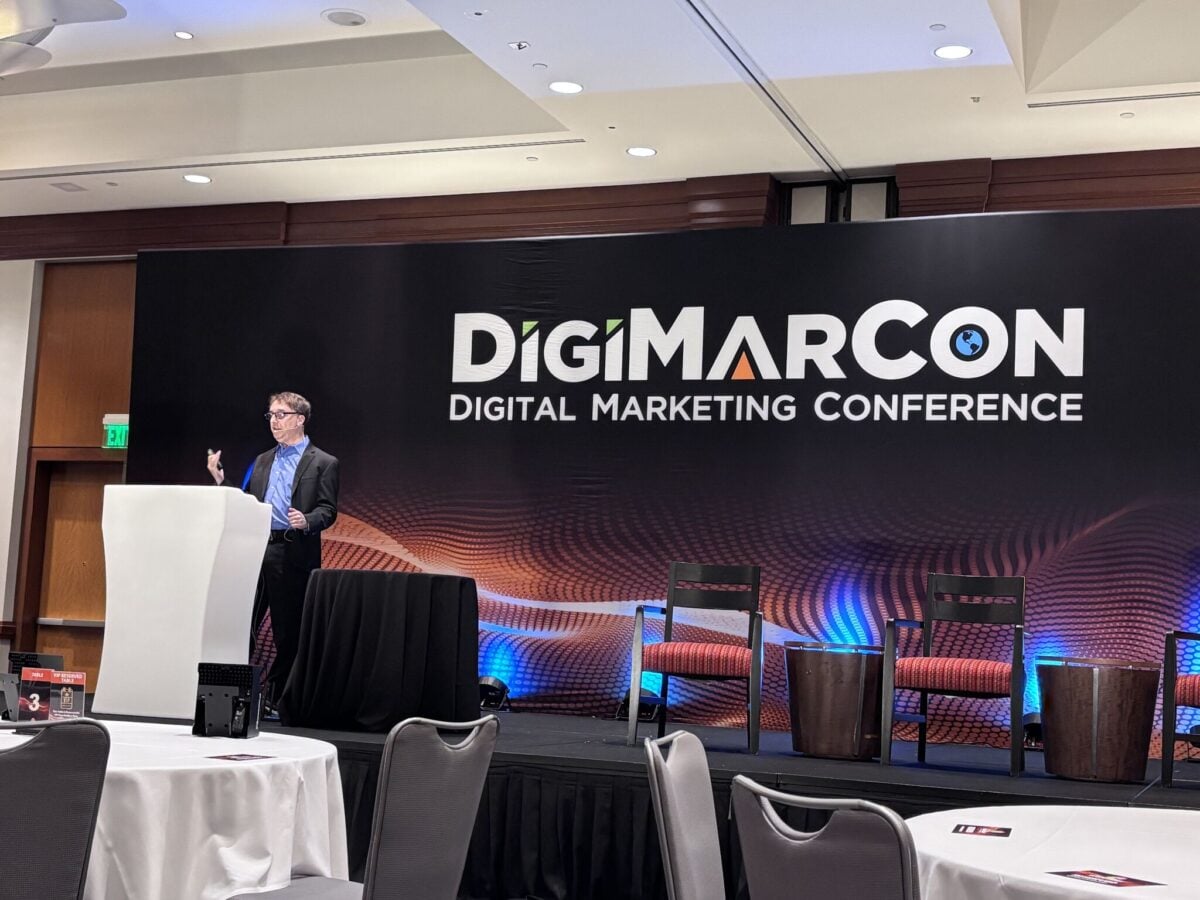
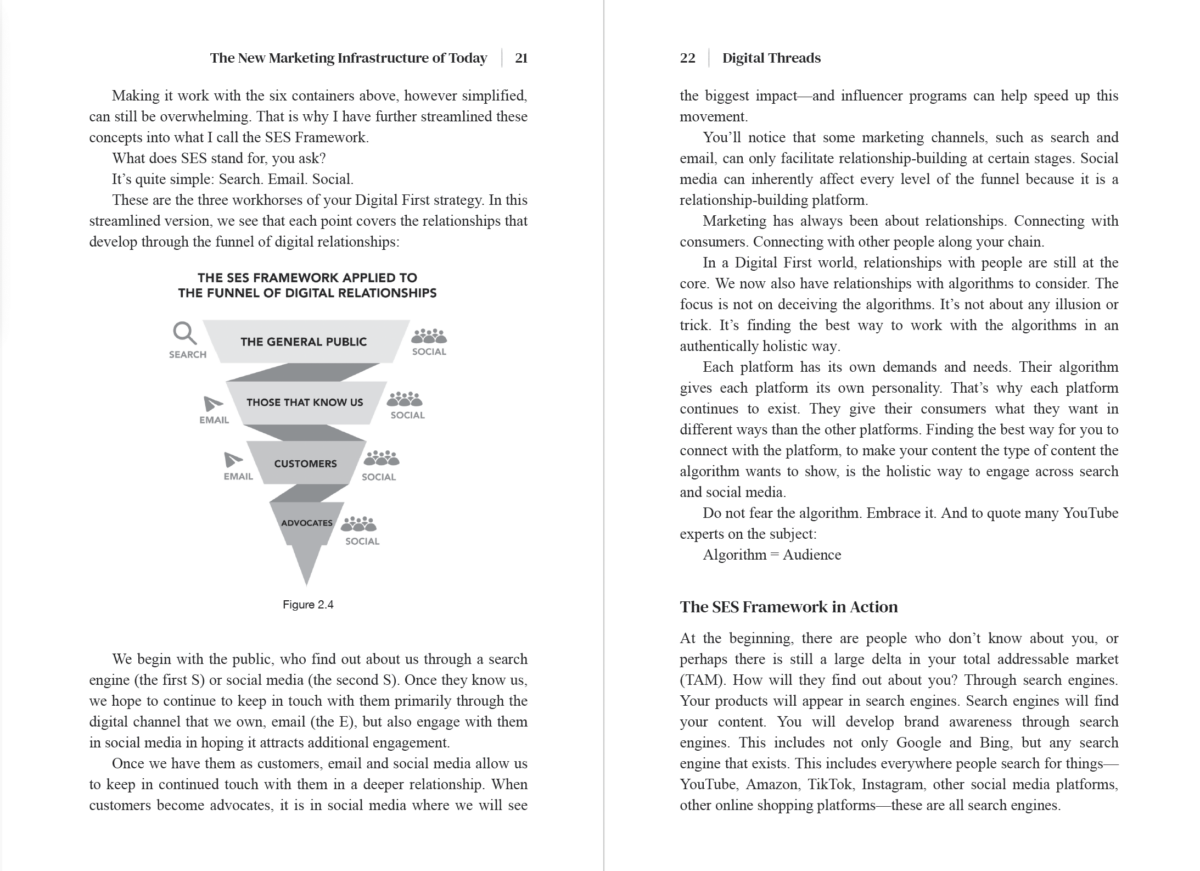
8. Ask whether they have their own framework for digital marketing. This is one of the most underused questions in the hiring process, and it’s the one that separates senior consultants from everyone else. A real Fractional CMO has spent enough years across enough engagements to see the same patterns repeatedly, and at some point they should have codified those patterns into a framework they can teach. The framework doesn’t have to be famous, and it doesn’t have to be published in a book. But it should exist. If a consultant can’t walk you through their own model for how digital marketing works (and why they make the recommendations they make), they’re probably running on intuition rather than a system. Intuition is great for tactical work; for strategic leadership, you want both. As one example, I built the SES Framework — Search, Email, Social — across more than a decade of Fractional CMO engagements, and I published it in Digital Threads so my clients (and future clients) can see exactly how I think about channel strategy before they ever hire me.
A practical tool worth using: the Clutch directory of digital marketing agencies and consultancies I maintain has vetted firms and consultants you can browse by service area, budget, and location. It’s a faster starting point than blind LinkedIn searches.
The Marketing Consulting Industry in 2026
The global marketing consulting market is large, growing, and being reshaped by AI. The 2026 market sits at roughly $36.65 billion and is projected to reach $45.52 billion by 2031 at a 4.42% CAGR per Mordor Intelligence, with digital marketing consulting leading and small/micro enterprises growing fastest, partly because fractional models have made senior consulting newly accessible.
A few structural trends are worth knowing about if you’re hiring (or becoming) a marketing consultant in 2026:
The role is splitting into “strategy” and “execution,” and the gap is widening. As covered above, AI made tactical execution cheaper, but strategy got more valuable. Consultants who can do both at a high level command the highest fees. Consultants who can only do execution are competing with AI tools and offshore labor. The shift is most visible in social media, where budget is moving toward channels and formats AI can’t fully automate. If you want a sense of where that budget is actually going, the latest social media marketing statistics tell most of the story.
AI changed what marketers expect from senior consultants. Per HubSpot’s 2026 State of Marketing Report, 86.4% of marketers now use AI tools and 61% believe marketing is experiencing its biggest disruption in 20 years because of AI. But only 47% of marketers say they understand how to use AI strategically. That gap (between AI access and AI fluency) is exactly where a senior marketing consultant earns their fee. Three years ago, a 15-hour-a-month consultant could set strategy and barely manage execution. Today, with AI-powered content workflows, AI in digital marketing tools, and AI-assisted analytics, that same consultant can oversee significantly more output. But this cuts both ways. A 2026 marketing consultant who doesn’t actually understand AI workflows is running a 2019 playbook in a 2026 market. When you’re evaluating consultants, ask them directly how they’re using AI in their own practice. If the answer is vague, keep looking.
CMOs are increasingly asking for outside help on speed and clarity. In PwC’s May 2025 Pulse Survey, 63% of CMOs said they were missing opportunities because they couldn’t make decisions fast enough, and unclear ownership plus limited access to data and tools were named the top barriers to delivering strategy. That’s a textbook description of where a senior outside consultant or Fractional CMO adds value: bringing speed, clarity, and pattern-matching from prior engagements.
Outcome-based and risk-sharing engagement models are growing fast. Per Mordor, outcome-based contracts are growing at 6.55% CAGR, faster than any other engagement model. CMOs increasingly want fees tied to revenue lift or specific KPIs rather than billable hours. This shift rewards consultants who can actually measure what they deliver.
Fractional engagement is the fastest-growing piece. The fractional executive model has roughly doubled in size since 2022 across the entire C-suite. As one HBR analysis from Amy Bonsall (former IDEO and Old Navy executive, now fractional chief product officer) put it on HBR’s On Leadership podcast:
“If you’re leading a growing organization but can’t justify the cost of full-time executives, there’s another way.” (Amy Bonsall, former exec at IDEO and Old Navy, fractional chief product officer)
Her broader point is that fractional leadership isn’t a downgrade from full-time. It’s a different structure that fits a specific stage of business, and it works best when both sides treat it as real leadership, not a discount consulting engagement. That matches what I’ve seen in my own practice exactly. The engagements that fail are the ones where the CEO never really delegates marketing. The ones that succeed are the ones where the CEO treats the Fractional CMO as a real executive.
The supply side is being reshaped by independents. Per the US Bureau of Labor Statistics, management analysts (the category that includes most marketing consultants) numbered roughly 1.08 million in 2024, with 14% self-employed. Employment is projected to grow 9% from 2024 to 2034, much faster than the average for all occupations. The median annual wage is $101,190, but the spread is wide: the top 10% earn more than $174,140, and the freelance and Fractional CMO tier earns substantially more than that.
Frequently Asked Questions
A marketing consultant advises, plans, and sometimes oversees marketing work. A marketing agency executes the actual work, usually in a specific channel (paid social, SEO, email, etc.). Consultants think and recommend. Agencies build and run. The biggest mistake I see is hiring an agency expecting strategy, then being disappointed when you get tactical execution. If you need strategy, hire a consultant or Fractional CMO. If you need hands to execute an existing strategy, hire an agency.
It depends on the problem. A small business with under $500K in revenue often doesn’t need ongoing consulting; they need a one-time strategy and audit (probably $5,000-$15,000) and then someone to execute, whether that’s an agency, freelancers, or a single in-house hire. A small business between $1M and $5M in revenue often benefits enormously from a light retainer ($1,500-$3,000/month) because they’re at the stage where strategic mistakes get expensive but they can’t yet afford full marketing leadership.
Projects run 1-6 months. Light retainers run 3-12 months. Strategic retainers and Fractional CMO engagements often run 12-36 months, sometimes longer. The shortest engagements tend to be channel-specific audits or campaign launches. The longer ones reflect ongoing strategic leadership, which compounds value over time and doesn’t deliver its full payoff in 90 days.
Yes. Most marketing consulting in 2026 happens remotely, with periodic in-person sessions for kickoff, quarterly reviews, or major strategy work. The geographic constraints that used to limit consulting are mostly gone, which is one reason the Fractional CMO model exploded after 2020. The exception: if your team is largely in-office and needs hands-on cultural integration, a fully remote consultant may be a worse fit than a hybrid arrangement.
Honest answer: it’s wildly variable, and any consultant who quotes you a generic ROI figure is selling something. A good engagement should pay for itself in one of three ways: revenue lift, cost savings (often from killing wasted marketing spend), or risk avoidance (not building the wrong team or signing the wrong agency contract). The ROI is highest when the consultant’s recommendations actually get implemented, which depends as much on the client as on the consultant. The engagements where clients quietly ignore the recommendations are the ones where ROI looks bad on paper.
The simplest filter: if you need someone to give you a plan and answer questions, you need a consultant. If you need someone to own the marketing function (strategy, team, budget, accountability for revenue), you need a Fractional CMO. The Fractional CMO costs more month-to-month but typically delivers more durable results because they’re embedded as leadership rather than acting as an external advisor.
Ready to Find the Right Marketing Consultant for Your Business?
A marketing consultant can be one of the highest-return hires you make, or one of the most wasteful. The difference comes down to two things: matching the right scope to your actual problem, and choosing someone with the operating experience to back up the strategy. Cheap consultants who only execute aren’t really solving your problem; expensive strategists you don’t implement aren’t either. The right fit usually sits in the middle, and the right fit at the senior end often ends up looking less like consulting and more like fractional leadership.
If you’ve gotten this far and you suspect you may actually need a Fractional CMO rather than a traditional marketing consultant, I’d genuinely love to talk. You can learn more about my Fractional CMO services or reach out directly to start a conversation. And whether we end up working together or not, I’d recommend grabbing a free preview of Digital Threads, which walks through the exact digital marketing framework I use with my own clients. For ongoing insights, my weekly newsletter covers practical strategies and trends I’m seeing across my engagements.
If you’re still in the diagnosis phase, the right next step is usually a single strategy call rather than a long engagement. The right marketing leadership, at the right stage, can change the trajectory of a business. The wrong model, or the wrong person in the right model, can set you back a year or more. Take the time to figure out which one you actually need. Then move fast.
Actionable advice for your digital / content / influencer / social media marketing.
Join 13,000+ smart professionals who subscribe to my regular updates.