




We don’t know if the theorized primordial black holes (PBH) are real. If they are, they formed in the very early Universe when physics were much different. They had no stellar progenitors, and were created by direct collapse of densely-packed subatomic matter. Theorists have wondered if PBH could be dark matter, or a component of dark matter.
The size of these hypothetical objects is up for debate, but by some estimates, PBH are in the range of asteroids, small enough to be engulfed by stars. How would that work, and what would happen to the stars? How could this be detected?
New research examines the issue. It’s titled “The Life and Death of Stars That Capture Primordial Black Holes,” and it’s available at arxiv.org. The lead author is Ore Gottlieb, from the Department of Physics and Kavli Institute for Astrophysics and Space Research at MIT.
There are different lines of thinking about the mass of PBHs based on how they could contribute to dark matter. One result says they have to have stellar masses or above, while another says they have to be much smaller. In between those ranges is a middle range where PBHs could span from asteroid size to lunar size.
“Stars provide a qualitatively different and complementary probe of this remaining parameter space,” the authors write. ” If PBHs constitute a significant fraction of the DM, their number density in galactic environments would be vastly larger than that of stellar origin BHs, implying frequent close encounters with stars, making capture by stellar systems a plausible outcome.”
Gottlieb and his colleagues wanted to test that idea. “We develop the first global framework for the evolution of stars that capture PBHs,” they write, adding that their framework includes models of stellar evolution and 3D magnetohydrodynamic simulations.
The first thing they found was that PBH capture by a star is far more likely in a three-body system. “We find that direct one-pass capture of asteroid-to-sublunar mass PBHs by dynamical friction inside a star is negligibly rare,” they write. “In contrast, three-body interactions with planetary companions provide a viable channel for capture onto bound, star-crossing orbits, followed by inspiral through repeated dissipative stellar transits.”
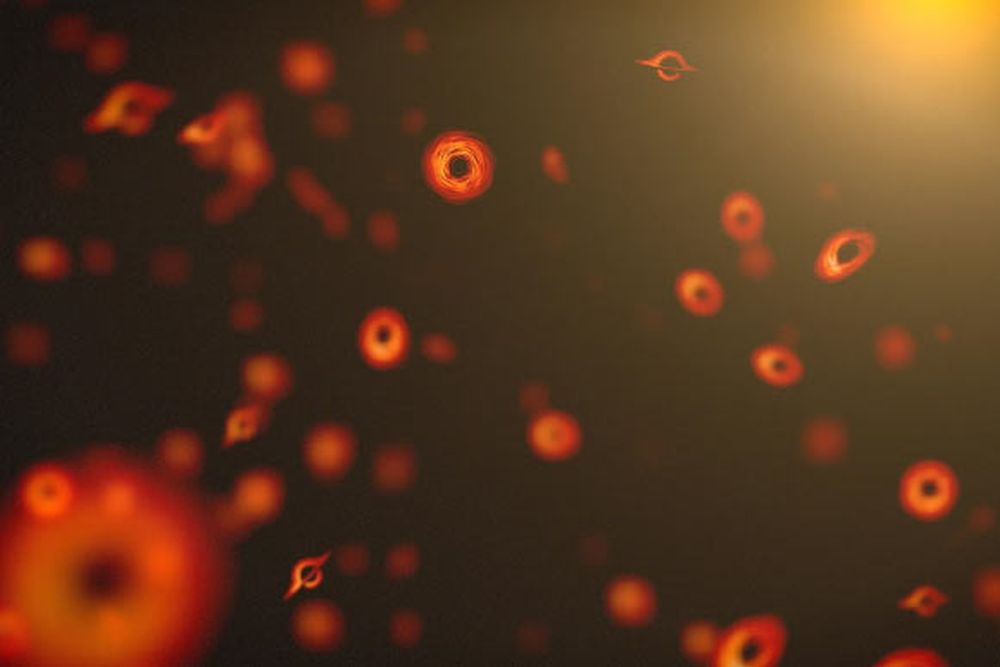
*This image is an artist’s interpretation of what primordial black holes could look like. If they’re real, they formed in the Universe’s first moments, when physics were much different. They had no stellar progenitors and formed via direct collapse from subatomic matter. They could comprise some or all dark matter. Image Credit: NASA*
When a star captures a PBH, the PBH finds its way to the stellar core. Once there, it accretes material from the star’s interior, having a dramatic effect on the star’s evolution. “The resulting object, a “Hawking star”, provides a natural laboratory for studying the growth and feedback of PBHs embedded in dense, rotating media,” the authors explain. What happens once a PBH reaches the center of a star depends on accretion and feedback.
There are two diverging paths post engulfment, and both are terminal. In the first, the PBH finds its way to the center of the star and accretes stellar material at a Bondi-like rate. This forms an accretion disk and generates feedback, which dooms the star to destruction. In this case, “disk winds and relativistic jets can disrupt the star, producing an explosive Hawking-star transient powered by a rapidly spinning primordial black hole,” the authors explain.
If feedback moderates the disk accretion, then the star could exist in a quasi-steady state, altering its luminosity, it’s lifetime, and its internal structure without being rapidly destroyed. This leaves “a PBH with mass of order the consumed stellar mass and little or no bright diskpowered emission,” the authors write.
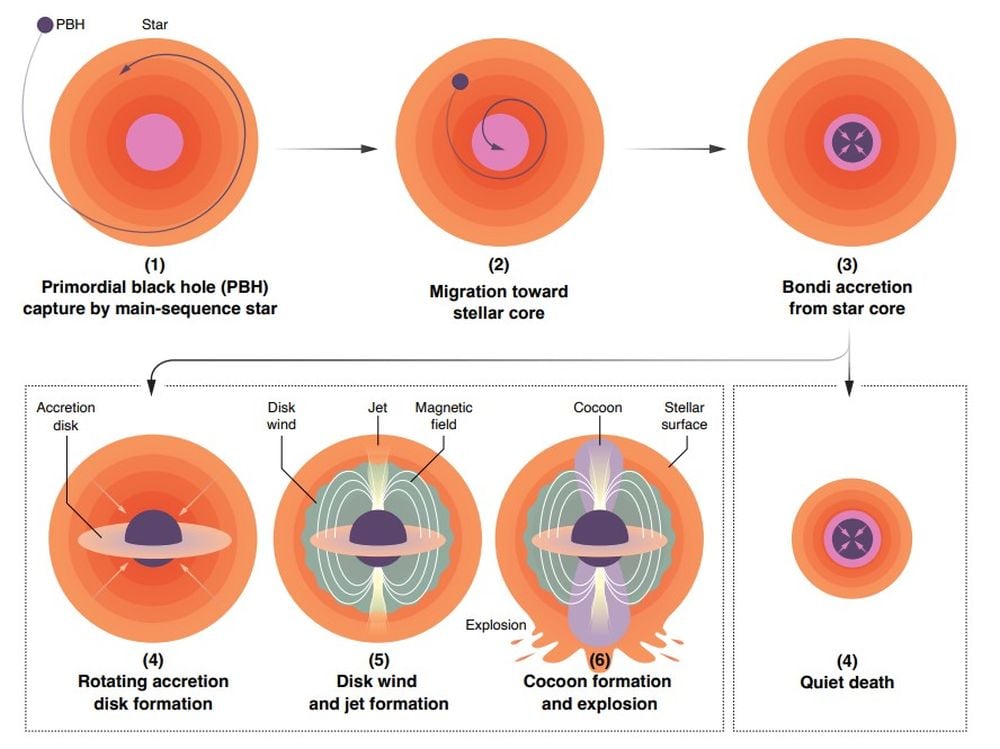 This image shows the two outcomes for a star that engulfs a PBH. If the PBH accretes the stellar material fast enough, a disk forms. Feedback in the form of disk winds and jets is strong, leading to an explosion that destroys the Hawking star. If accretion is slow enough, no disk forms, and the PBH slowly and quietly consumes the star. Image Credit: Gottlieb et al. 2026.
It’s all about disk formation, which is governed largely by angular momentum. Above a certain threshold, accretion is rapid, and powerful feedback destroys the star. If accretion is slow and steady, the Hawking star can survive. “Disk formation is the point of no return,” the authors write. When the disk winds and relativistic jets from the disk are powerful enough, they disrupt the star within a few minutes.
This means there are two branches, the explosive branch and the quiet terminal branch. The two cases lead to separate observational possibilities. “Our results carry important observational implications across both electromagnetic and GW channels,” the researchers write.
“The electromagnetic counterpart of the explosive branch is expected to be multicomponent,” the authors explain. It would feature an x-ray flash followed by a fast UV/blue cooling transient that could last as long as one day. If a relativistic jet breaks out, it could create a signal similar to a low luminosity gamma-ray burst that lasted around one minute. A synchrotron afterglow would follow. This is similar to what a supernova might look like, but the authors explain that “These explosions do not share the progenitors, timescales, or radioactive tails of core-collapse supernovae.”
The quiet terminal branch potentially produces gravitational waves (GWs). While the explosive branch leaves behind a low-mass, rapidly spinning BH, “the quiet branch leaves a remnant with mass of order the consumed host,” the researchers write. “Any future GW detection of a compact binary containing a subsolar or otherwise anomalous low-mass BH would be a striking signature of nonstandard compact-object formation.”
The remnants from both branches are valuable probes of PBH. “Their rates, environments, and electromagnetic signatures could constrain the PBH contribution to dark matter,” write the authors. The systems that quietly consume the star leave behind more massive remnants, while the explosive one leave behind BHs with rapid spins and subsolar masses.
Even though the quiet terminal branch can potentially produce GWs in the future, that’s not the most fruitful way to search for them because the mergers that produce them aren’t likely to be common. “The key observable is therefore how the Hawking-star population divides between quiet and explosive fates,” the authors explain, and that depends on the mass of the star, the BH’s mass, the capture age, and the companion architecture.
There are lot of questions around this issue, and the authors acknowledge that almost every phase of what they’ve outlined can serve as the basis for more dedicated research. The capture of a BH, the feedback inside of stars, and everything else should be the subject of its own research.
“In this sense, the present work should be viewed as a roadmap: it identifies the key bottlenecks and bifurcation points that determine whether Hawking stars die quietly, explode electromagnetically, or leave behind low-mass, high-spin compact remnants,” the authors conclude.