




The creator economy is worth roughly $250 billion in 2025, up from $210 billion a year earlier, according to the 2025 Creator Earnings Report from Influencer Marketing Hub and NeoReach. That is a serious number. But it hides a harder truth that I want you to see clearly before you read another headline: most of the people inside that $250 billion are barely making rent money from their content.
I have watched this play out from a few different seats. I teach Personal Branding and Influencer Marketing at UCLA Extension, I wrote a book on influence called The Age of Influence, and as a Fractional CMO I help brands decide whether to spend real budget on creators. So when the numbers say the market is exploding while half of creators earn under $15,000, I do not read that as a contradiction. I read it as the actual shape of the thing.
This is what the market really looks like right now, drawn from current primary data: how big it is, who is making money, and who is not.
Key Takeaways
✅ The creator economy is about a $250 billion market in 2025, up from $210 billion in 2024, and Goldman Sachs projects it could approach half a trillion dollars by 2027.
✅ More than half of creators earn less than $15,000 a year, and 57% of full-time creators earn below the US living wage of $44,000.
✅ The professionals are doing very well. For creators running this as a full-time business, the 2025 median reached $133,000, up about a third from the year before.
✅ Diversification, not brand deals, predicts income. No single income source dominates anymore, and creators running three or more revenue streams earn roughly $75,000 more a year than single-stream creators.
✅ The platforms are paying out at scale. YouTube has sent creators and partners more than $100 billion over four years, and Patreon has paid out more than $10 billion across 25 million-plus memberships.
How big is the creator economy in 2026?
The creator economy reached roughly $250 billion in 2025, up from $210 billion in 2024, and long-range forecasts put it on a path toward $1 trillion-plus within the decade. Estimates vary by firm and by how each one defines a “creator,” but every credible 2025 source agrees on the direction and the rough size: a quarter-trillion-dollar market growing more than 20% a year.
1. The creator economy is worth about $250 billion in 2025, up from $210 billion in 2024
The creator economy reached approximately $250 billion in 2025, up from $210 billion in 2024, according to the 2025 Creator Earnings Report from Influencer Marketing Hub and NeoReach, which surveyed more than 3,000 creators. That report frames the figure as the current scale of the broader influencer and creator market.
What this means for you: a quarter-trillion-dollar market is big enough that you no longer have to justify the creator economy to anyone. The question is no longer whether it is real. The question is where you fit inside it, which for most people starts with the fundamentals of how to become a content creator.
2. One research estimate pegs the 2024 market at $205 billion, growing to $1.35 trillion by 2033
Grand View Research estimated the global creator economy at $205.25 billion in 2024 and projects it will reach $1.35 trillion by 2033, a compound annual growth rate of 23.3%. Different research firms land between roughly $180 billion and $254 billion for 2025, depending on what they count, but the growth rate clusters tightly in the low-20% range.
What this means for you: do not get hung up on which firm’s headline number is “right.” They are measuring slightly different things. The signal that matters is the consistency of the growth rate. A market compounding above 20% a year rewards people who plant early and stay, which is the entire argument for treating content like a long game rather than a lottery ticket.
3. Goldman Sachs projects the creator economy could approach half a trillion dollars by 2027
Goldman Sachs Research projects that the creator economy could approach half a trillion dollars by 2027, roughly doubling from its early-decade size. Goldman ties that growth to platform monetization tools, brand spend, and the expansion of direct-to-fan payments.
What this means for you: when an investment bank models your industry doubling in four years, the brands you might want to work with are reading the same reports. That is part of why influencer marketing keeps pulling a larger slice of marketing budgets. The money flowing toward creators is not a fad cycle. It is a planned reallocation.
4. The market grew about 19% in a single year
The creator economy grew 19.05% from 2024 to 2025, per the Influencer Marketing Hub and NeoReach report. That growth brought millions of new creators into the space, which is part of why average earnings have not climbed at the same pace.
What this means for you: rapid market growth and stagnant individual earnings can happen at the same time, and right now they are. More money is entering the system, but more people are competing for it. That math is why standing out matters more than showing up, and it is the reason I push everyone I advise toward a defined niche instead of general “content.”
| Source | Year | Market size | Notes |
|---|---|---|---|
| Influencer Marketing Hub / NeoReach | 2025 | ~$250 billion | Up from $210 billion in 2024 |
| Grand View Research | 2024 | $205.25 billion | Projected $1.35 trillion by 2033 |
| Goldman Sachs | 2027 (proj.) | ~$480 billion | “Approaching half a trillion” |
Source: Influencer Marketing Hub & NeoReach 2025 Creator Earnings Report; Grand View Research, 2025; Goldman Sachs Research, 2023.
Who makes up the creator economy?
Creators are younger, more North American, and more central to the economy’s revenue than most people assume. Individual creators, not brands or agencies, generate the majority of the money in the market, and the typical creator is a Millennial or Gen Z. This is a workforce, not a hobby class, even if most of its members are not yet paid like professionals.
5. North America generates the largest share of creator economy revenue at 34.2%
North America accounted for the largest regional share of creator economy revenue, at 34.2% in 2024, according to Grand View Research. The same analysis notes Asia Pacific as the fastest-growing region.
What this means for you: if you create in English for a North American audience, you are competing in the most monetized and most crowded part of the market. That cuts both ways. The brand budgets are biggest here, and so is the competition, which again points back to niche specificity as your edge rather than raw reach.
6. Individual creators generate 58.7% of the market’s revenue
Individual content creators, rather than businesses or brands, accounted for 58.7% of creator economy revenue in 2024, the largest end-use segment in Grand View Research’s analysis. The remainder flows through brands, agencies, and platforms.
What this means for you: the majority of the value in this economy is created by people, not companies. That is the whole premise of the user-generated content creator role, where brands pay individuals to make content because audiences trust a person more than a logo. If you are a creator, you are not a vendor to the economy. You are the product.
7. Millennials and Gen Z make up more than 90% of creators
More than 90% of surveyed creators are Millennials or Gen Z, with the majority between 18 and 34, based on the Influencer Marketing Hub and NeoReach survey of 3,000-plus creators. The report expects Gen Alpha to start showing up in future surveys.
What this means for you: the creator workforce skews young, but that is not a reason for older professionals to count themselves out. In my experience the most underserved niches are the ones where the audience is over 40 and almost nobody is creating for them. Age is a positioning advantage if you let it be one.
Is Your Digital Marketing All Over the Place?
My latest book helps small businesses, entrepreneurs, and marketers bring search, email, and social together into one digital marketing strategy that actually compounds.
Drawing on my work as a Fractional CMO, Digital Threads turns complicated tactics into a clear, practical plan you can follow, whatever your budget or team size.
Grab your copy on Amazon and start weaving your own digital threads. Click the cover or the button below to get started.

How much do creators actually earn?
Most creators earn very little, while a small professional class earns a great deal. More than half make under $15,000 a year, and most full-time creators earn below a US living wage. Yet among established full-timers who treat content as a business, six-figure incomes are now common. Which arm of this K-shaped economy you land on depends more on strategy than on follower count.
8. More than half of creators earn less than $15,000 a year
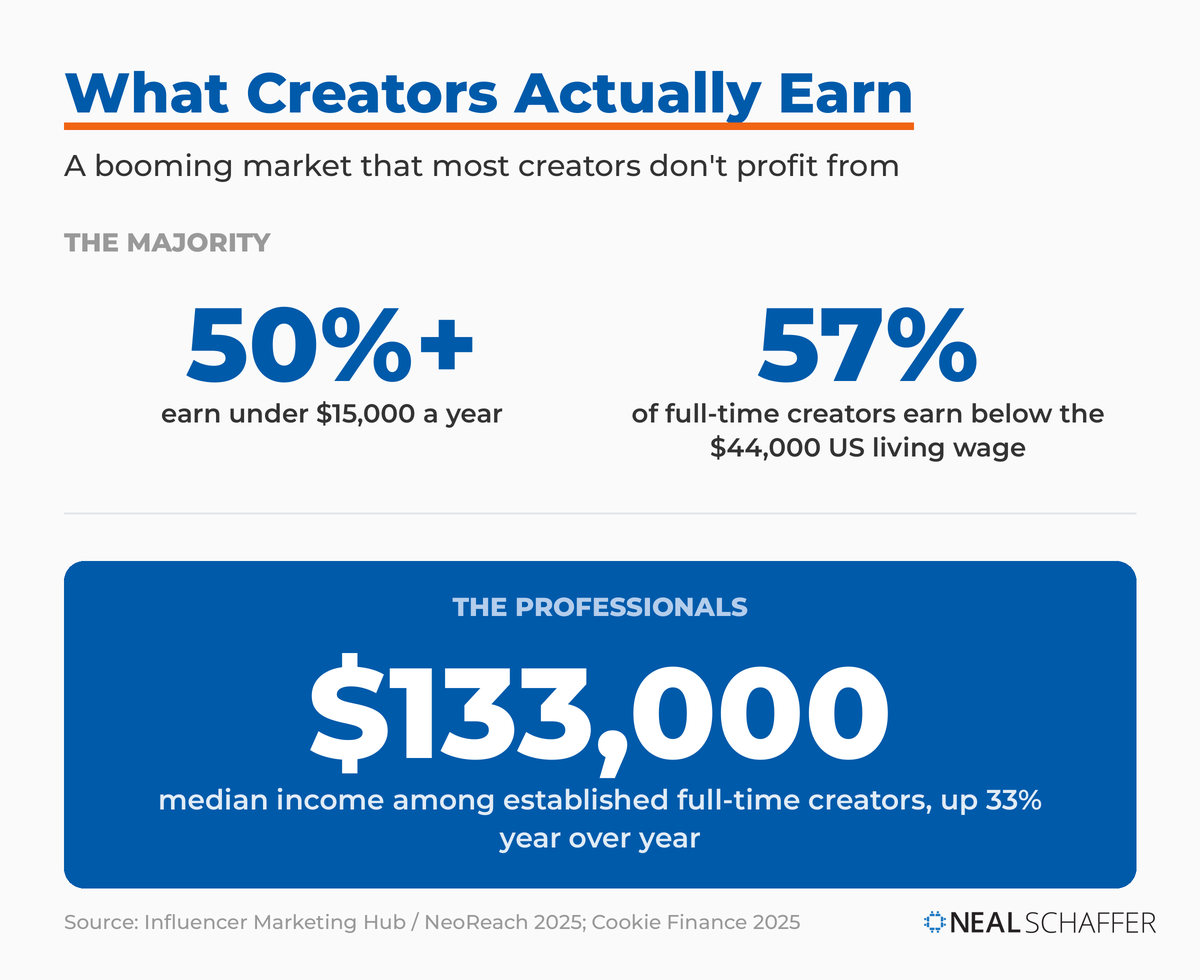
More than half of creators earn under $15,000 annually, according to the 2025 Creator Earnings Report, up from 48% in 2023. Influencer Marketing Hub and NeoReach call the $15,000 mark a “monetization barrier,” the threshold where income growth tends to accelerate once a creator crosses it.
What this means for you: if you are earning under $15,000 from content, you are not failing. You are in the majority. But the data also says that crossing that line is less about going viral and more about being structured to monetize at all. The creators who break through usually have a deliberate plan for how much an influencer can make and build toward it on purpose.
9. 57% of full-time creators earn below the US living wage
Nearly 57% of full-time creators earn less than the US living wage of $44,000 from content creation alone, the Influencer Marketing Hub and NeoReach report found. That group includes seasoned creators who have been active for multiple years, not just beginners.
What this means for you: going full-time is not the finish line people imagine. Quitting your job to create does not raise your income by itself. I have seen creators do better financially as committed part-timers with one strong revenue stream than as full-timers spread thin across five weak ones. Be honest about the math before you make the leap.
10. Among established full-time creators, median income reached $133,000 in 2025
Look at the people who do this as their main job and the picture flips. Across the 1,000-plus creators Cookie Finance examined, each clearing at least $60,000 a year, the 2025 median sat at $133,000, a third higher than a year earlier. That group is the professionalized top of the market, not the typical creator.
What this means for you: the ceiling in this economy is high and rising for people who run their content like a business. The gap between the $15,000 majority and the $133,000 professional class is not mostly talent. It is operating like a company: tracking money, formalizing the business, and reinvesting. This is the shift I try to push every creator client to make.
11. About 18% of creators now earn more than $100,000 a year
Roughly 18% of creators have crossed the $100,000 earnings threshold, according to ConvertKit’s 2024 State of the Creator Economy report, a survey of more than 1,000 creators. The same report found a third of creators expected to earn even more the next year, with men and women reaching six figures at an equal rate.
What this means for you: the top of the creator economy is real and reachable, not a closed club. Close to one in five creators clears six figures, and the ones who get there usually run content like a business with a repeatable model instead of chasing a single viral hit. You do not need to be the next MrBeast. You need a system you can run again next month.
How are creators making money?
Brand deals still matter, but they are no longer the center of gravity. The creators earning the most are the ones who diversify across several revenue streams and lean into affiliate and commerce income rather than depending on sponsorships alone. Reliance on a single income source is now the riskiest position a creator can hold.
12. Live streaming, ad revenue, and fan subscriptions each account for close to 30% of creator income
The top creator income sources in 2025 sat within a few points of each other: live streaming at 32%, ad revenue at 29%, and fan subscriptions at 27%, according to Epidemic Sound’s Future of the Creator Economy Report 2025, a survey of 3,000 creators across the US and UK. The same report found 95% of creators now earn through direct-to-fan models rather than ad income alone.
What this means for you: no single income source dominates anymore, and that is the point. When live streaming, ads, and subscriptions each carry roughly a third of the load, one platform’s bad month does not sink you. This is the practical version of understanding how influencers make money across the full menu of options, and it is why I push every creator I advise to build a second and third stream before they need them.
13. Creators with three or more revenue streams earn about $75,000 more
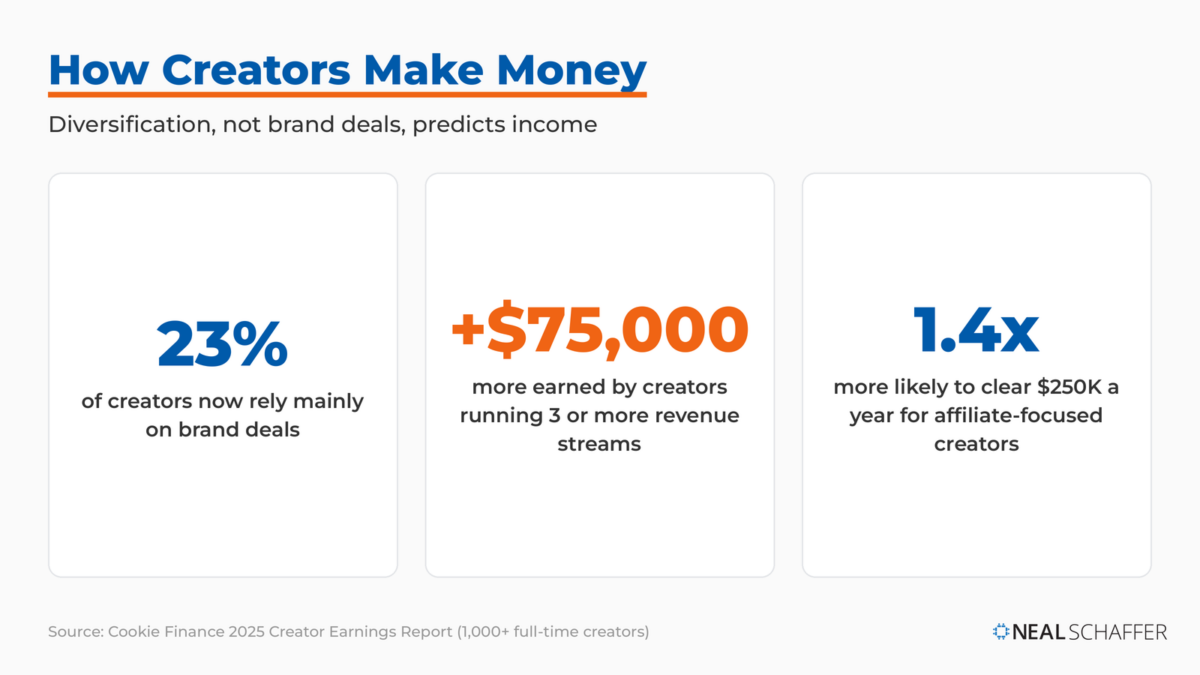
Spreading income across several sources turned out to be one of the clearest signs of a higher earner. About a quarter of the full-time creators Cookie Finance studied ran at least three income streams in 2025, and that group out-earned single-stream creators by roughly $75,000 a year on average.
What this means for you: diversification is the single highest-return move available to most creators, and it does not mean being on every platform. It means layering revenue types, such as ad share, affiliates, a digital product, and brand deals, often within one platform you already understand. Depth beats spread. Pick your platform, then stack income on top of it.
14. Creators drove more than $5 billion in sales on a single affiliate platform in 2024
LTK creators generated more than $5 billion in retail sales in 2024, according to LTK, which works with creators in more than 150 countries. That figure reflects a single creator-commerce platform, one channel in a fast-growing shift toward shoppable creator content.
What this means for you: affiliate and commerce income scales with audience trust, not with how many brand deals you can sign. When your followers buy what you actually recommend, you earn on volume instead of on a fixed sponsorship fee. Programs like the Amazon Influencer Program let you monetize recommendations you are already making, and those earnings compound as your catalog of trusted picks grows.
15. Substack passed 5 million paid subscriptions in 2025, up from 4 million four months earlier
Substack reached more than 5 million paid subscriptions in March 2025, less than four months after it crossed 4 million, the company announced. Paid newsletters and similar direct-subscription tools let creators earn recurring income straight from their audience instead of through an ad market.
What this means for you: a paid subscription is the most durable dollar in the creator economy, because it does not depend on an algorithm or an ad auction. Even a few hundred true fans paying monthly can outperform reach you do not own. If you already have an email list or an engaged community, you are closer to recurring revenue than you think.
Which platforms pay creators the most?
The major platforms are paying creators at a scale that did not exist a few years ago, led by YouTube. But where you build matters to your wallet, not only your craft, because each platform pays on its own terms and each carries its own swings in income.
16. YouTube has paid creators more than $100 billion over four years
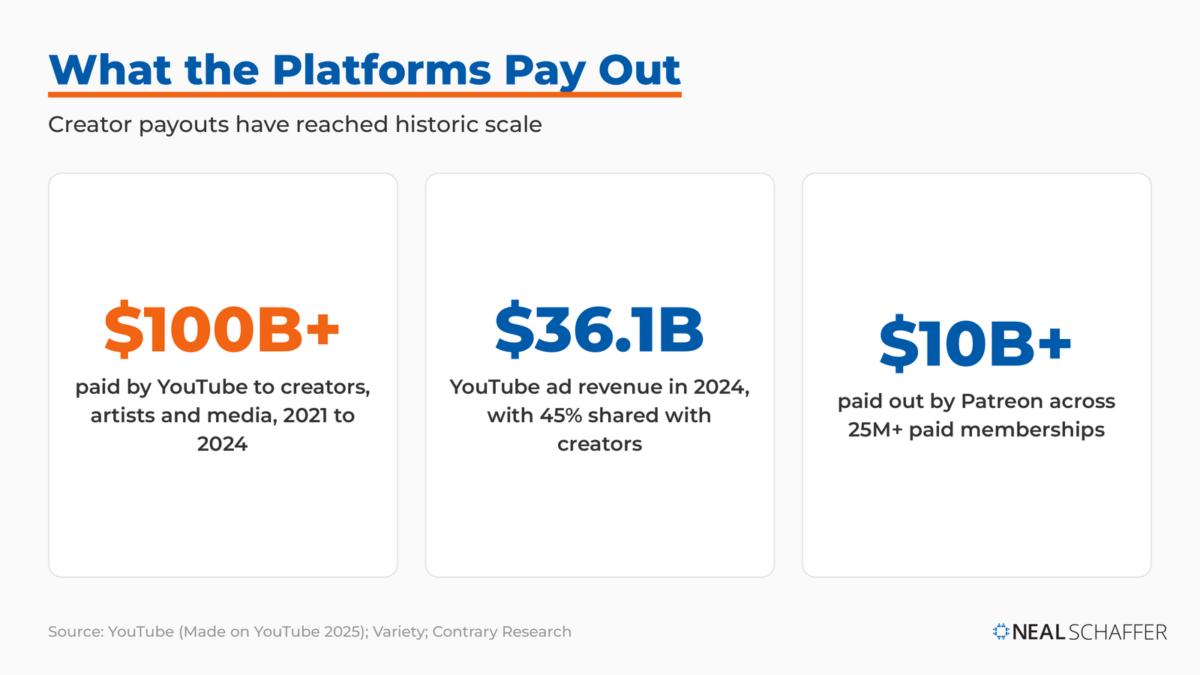
YouTube has paid more than $100 billion to creators, artists, and media companies over the past four years, the company announced at its 2025 Made on YouTube event. The number of channels earning more than $100,000 from TV screens alone jumped 45% year over year.
What this means for you: YouTube remains the deepest monetization engine in the creator economy, and its push onto living-room TV screens is opening earnings for creators who never planned for it. If you are choosing where to plant a long-term content business, the platform writing the biggest checks deserves serious weight.
17. YouTube’s ad revenue hit $36.1 billion in 2024
YouTube’s advertising revenue rose 15% in 2024 to $36.1 billion, as reported from Alphabet’s earnings by Variety, and YouTube shares 45% of ad revenue with the channel owners who produce the content. That revenue share is the mechanism behind the $100 billion in creator payouts.
What this means for you: the 45% split is why ad revenue alone rarely makes a creator wealthy, and why the brand-deal layering in the data matters so much. Ad share is a floor, not a ceiling. Treat it as the baseline you build other income on top of, not the destination.
18. Patreon has paid creators more than $10 billion across 25 million memberships
Patreon creators have surpassed $10 billion in cumulative payouts and more than 25 million paid memberships as of 2025, according to Contrary Research. The platform sits in the direct-to-fan membership segment, where fans pay creators directly rather than through advertising.
What this means for you: direct fan payments are the most stable income in the creator economy because they do not depend on an ad market or an algorithm’s mood. Newsletter and membership platforms have quietly built a multibillion-dollar layer of recurring creator revenue. If you have even a small, loyal audience, a paid membership can outperform chasing reach.
19. TikTok creators see the most volatile income, swinging 58% month to month
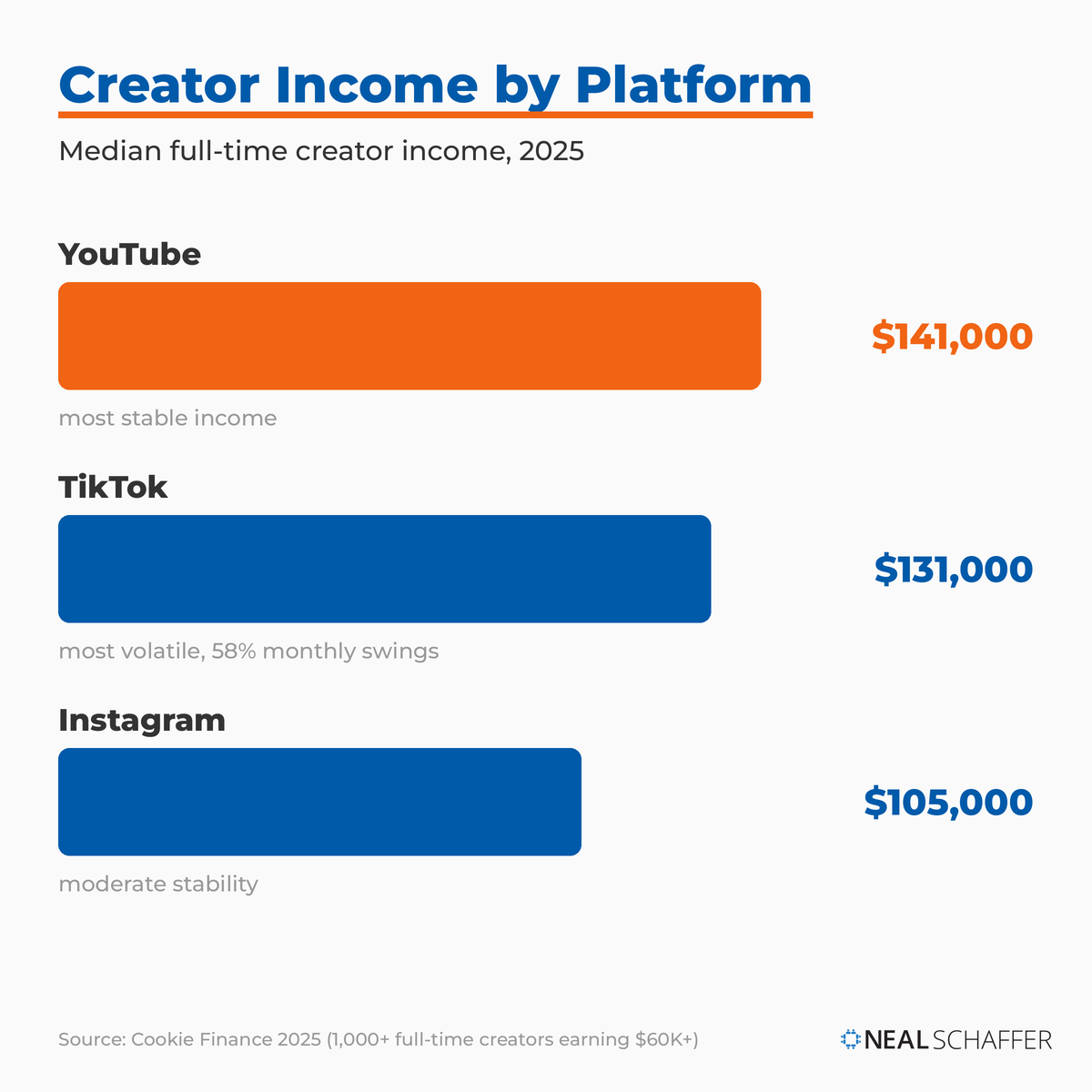
A typical TikTok creator’s pay bounces by roughly 58% from one month to the next, the widest gap of any major platform, per Cookie Finance. A lot of that comes from TikTok Shop, where attention turns into sales fast but in uneven bursts.
What this means for you: TikTok can pay well, but the income is lumpy, so do not budget your life around a good month. If TikTok is your main platform, understanding how much TikTok pays and building a savings buffer matters more than it would on a steadier platform. Volatility is the price of TikTok’s speed.
20. Full-time creator median earnings vary widely by platform
Broken out by platform, the 2025 medians Cookie Finance reported covered a wide band: $141,000 for YouTube, $131,000 for TikTok, and $105,000 for Instagram. YouTube’s earnings stayed the steadiest of the three, while TikTok’s moved around the most.
What this means for you: where you build is now as much a money call as a creative one, and the gap between platforms is real. None of them wins in the abstract. YouTube rewards consistency and evergreen discovery, while TikTok rewards speed and commerce with more risk attached. Pick the risk profile that fits your temperament and your runway, not the platform that looks most exciting.
| Platform | Median income, full-timers (2025) | Income stability |
|---|---|---|
| YouTube | $141,000 | Most stable |
| TikTok | $131,000 | Most volatile (avg 58% monthly swing) |
| $105,000 | Moderate |
Source: Cookie Finance, 2025 Creator Earnings Report (1,000+ full-time creators).
Frequently Asked Questions
The creator economy reached roughly $250 billion in 2025, up from $210 billion in 2024, according to Influencer Marketing Hub and NeoReach. Goldman Sachs projects it could approach half a trillion dollars by 2027, and long-range forecasts put it on a path toward $1 trillion-plus within the decade.
Most creators earn very little. More than half make under $15,000 a year, and 57% of those working full-time still fall below the $44,000 US living wage. A professional class does much better: among creators working full-time, the 2025 median reached $133,000.
There is no longer one dominant channel. Creator income now spreads fairly evenly across live streaming, ad revenue, and fan subscriptions, each carrying close to 30%. The top earners lean into that mix: creators running three or more income streams earn roughly $75,000 more a year than those relying on one.
By 2025 median income, YouTube led the field near $141,000, TikTok came in around $131,000, and Instagram around $105,000. YouTube’s pay was the steadiest, while TikTok’s swung the hardest, moving about 58% from month to month.
No. The market is still growing more than 20% a year, and the high end is real: about 18% of creators now earn more than $100,000. The realistic path is treating content as a business with multiple revenue streams rather than chasing a viral moment.
Start Treating Your Creator Numbers Like a Business
The headline is easy to misread. Yes, the creator economy is a quarter-trillion-dollar market growing toward half a trillion. And yes, most people in it are not making real money yet. The gap between those facts is not luck or follower count. It is whether you operate like a business: a defined niche, several revenue streams, and a real monetization plan.
If you want to see how the wider influencer market is moving alongside these creator numbers, the latest influencer marketing statistics are worth bookmarking next to this page. And if you are building real income from your audience and want a community working through the same questions, take a look at my Digital First Mastermind, or grab a free preview of The Age of Influence for the deeper playbook on turning influence into a business.
Actionable advice for your digital / content / influencer / social media marketing.
Join 13,000+ smart professionals who subscribe to my regular updates.