




Whenever I speak on influencer marketing, one question comes back more than any other: which tool should I buy? Marketers want a single name. A shortcut. The one platform that finds creators, runs the campaign, pays everyone, and proves ROI, all from one login.
I wish I could hand you that name. But after teaching influencer marketing at UCLA Extension, writing a book on it, and sitting in on platform decisions as a Fractional CMO, I’ve learned the honest answer is messier. There is no one tool that does everything well. The brands that get value from this software pick the right category first, then the right tool inside it. The brands that waste money buy a flashy all-in-one before they know what they actually need.
This post is the brand side of the question. If you’re a creator looking to land collaborations, the apps you want are different, and that’s the world of influencer apps. Everything below is for the marketer who has to find creators, manage them, and report on the results. I wrote a chapter on this in The Age of Influence, and I keep this page current because the market changes fast. Half the tools I recommended a few years ago have been renamed, absorbed, or shut down. I’ll point those out so you don’t waste a demo call on a product that no longer exists.
Key Takeaways
✅ There is no single best influencer marketing tool. Pick the category that matches your bottleneck (discovery, management, measurement, or payments) before you pick a product.
✅ Brand-side platforms and creator-side apps are different software. Platforms help brands find and manage creators; apps help creators land brand deals. Don’t buy the wrong one.
✅ Most influencer programs now run in-house. Among brands answering Influencer Marketing Hub’s 2026 benchmark survey, 66.3% run their programs entirely in-house, which is exactly why the right software matters.
✅ The market is consolidating. AspireIQ became Aspire, Mavrck became Later Influence, Tagger is now part of Sprout Social, and Activate was absorbed by impact.com. Several older “best tool” picks no longer exist as standalone products.
✅ If you run two campaigns a year, you probably don’t need an enterprise platform at all. A spreadsheet, a discovery tool, and a contract template will get you further than a five-figure annual contract.
Influencer marketing tools are software platforms that help brands find creators, run campaigns, track performance, and handle the operational work of a program. On the brand side, they cluster into four jobs: discovery (finding creators), management (briefs, contracts, approvals), measurement (proving ROI), and payments. Some tools own one job; the bigger platforms try to own all four.
That four-job framing matters because it’s the fastest way to figure out what you actually need. A brand that already knows its creators but drowns in spreadsheets has a management problem, not a discovery problem. A brand launching its first program has a discovery problem and almost no measurement problem yet. Buy software to solve the wrong job and you end up paying for an expensive search engine you never use. Or a discovery database with no way to run the campaign once you’ve found people.
One more distinction trips marketers up constantly. The software brands use is not the same as the apps creators use. Creators sign up for apps to get discovered and get paid. Brands buy platforms to do the discovering and the paying. They look similar from the outside, and a few products serve both sides, but you should know which side of the marketplace you’re standing on before you swipe the card.
An influencer marketing platform is an all-in-one system that handles the full campaign lifecycle, from creator discovery through payment and reporting, inside a single product. A “tool” can mean that, but it also covers narrower, single-job software like a discovery search engine or a fake-follower checker. Every platform is a tool; not every tool is a platform.
I’m calling this distinction out because “influencer marketing platforms” is the higher-volume search and the more expensive purchase, so it deserves its own answer. The platform layer is where the money is. Grand View Research values the global influencer marketing platform market at roughly $45.2 billion in 2026, growing to about $116.2 billion by 2033, with large enterprises accounting for about three-quarters of that spend. Search and discovery is still the single largest slice of what brands pay for.
So why are brands pouring money into platforms instead of agencies? Because they’re bringing the work in-house. The data backs this up. In Influencer Marketing Hub’s 2026 survey, the dominant operating model was running the program entirely in-house. The brands planning the most aggressive budget growth weren’t outsourcing. They were buying software. When you own the program internally, the platform is your team. That’s a very different reason to buy than “the agency told me to.”
How Do I Choose an Influencer Marketing Platform?
Start with your bottleneck, not the feature list. Identify which of the four jobs (discovery, management, measurement, payments) is actually slowing you down, then shortlist tools that lead on that job. Match the tier to your campaign volume, not your ambition. And treat any platform that hides pricing behind a demo call as a warning sign.
I walk brands through a quick test before they book a single demo. Answer these five questions first:
- What’s your commerce setup? If you sell physical products on Shopify, a Shopify-native platform with product seeding and affiliate tracking will pay for itself. If you don’t, those features are dead weight.
- How many creators will you manage at once? Ten creators a quarter is a spreadsheet. A hundred ambassadors on rolling contracts is a real management problem worth paying to solve.
- Who has to see the report? If a CFO signs off on the budget, you need defensible measurement and clean attribution, not a vanity dashboard.
- Do you need the platform to pay creators? Some handle global, multi-currency payouts. Others leave payment entirely to you, which is fine until you’re cutting fifty checks by hand.
- Can you actually cancel? Most enterprise platforms lock you into annual, sometimes multi-year contracts. Know the exit before you sign the entry.
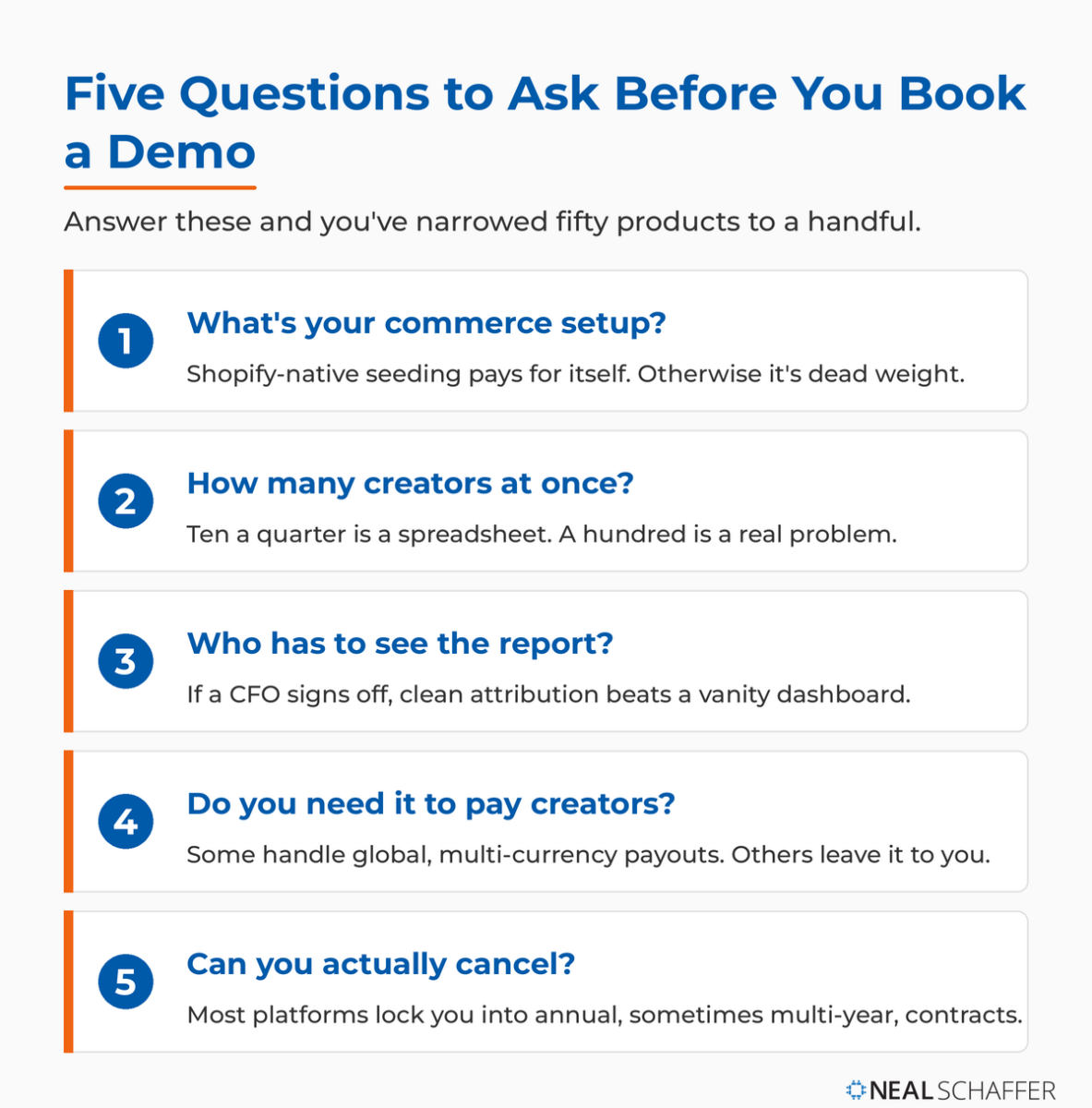
If you can answer those five questions, you’ve already narrowed a market of fifty products down to a handful. That’s the whole point of the exercise. The tool doesn’t make the strategy; your influencer marketing strategy tells you which tool to buy.
The Brand-Side Platforms I Recommend
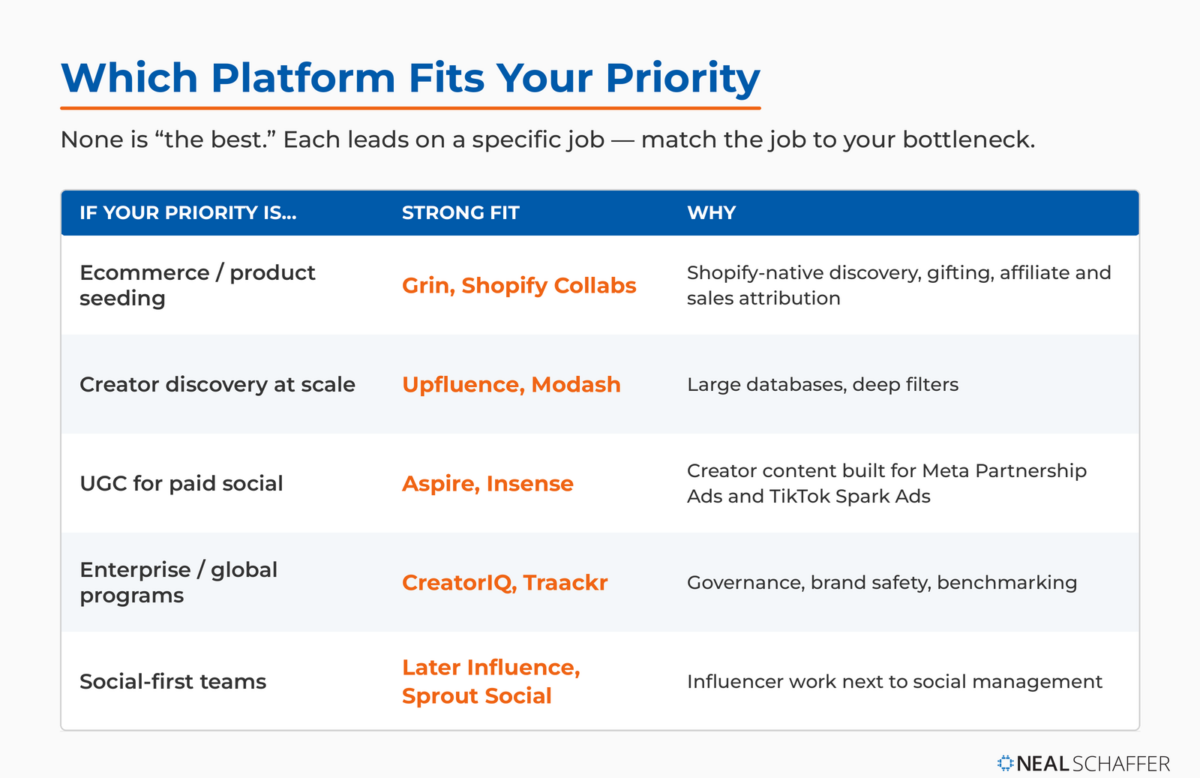
The platforms worth your shortlist in 2026 are Grin, Upfluence, Aspire, CreatorIQ, Traackr, Later Influence, Sprout Social, and Modash. None is “the best.” Each leads on a specific job, and the right pick depends entirely on the answers you gave above. This is how I’d map them.
For ecommerce brands that ship physical products, Grin is built around the assumption that you sell online and need creators to show the product off. Its Shopify integration runs deep, with product seeding and affiliate tracking that tie a sale back to the creator who drove it. The known trade-off, widely reported by users, is weaker built-in creator discovery and PayPal-centric payouts that complicate international campaigns. If you’re a smaller Shopify merchant who isn’t ready for Grin’s price tag, Shopify Collabs handles discovery, gifting, affiliate links, and payouts natively inside your Shopify admin, and it’s free to install.
Upfluence leads on discovery. Its searchable creator database and large filter set are the reason discovery-first brands choose it, and it ties influencer activity to revenue through ecommerce and Amazon attribution. The recurring complaint is module-based pricing on long contracts, so know which modules you need before you sign.
Aspire (formerly AspireIQ) takes a dual approach to finding creators: AI search plus an inbound marketplace where creators apply to your campaigns directly. That makes it a strong fit for brands that lean on user-generated content for paid social rather than just organic posts. If your goal is narrower still, purely sourcing UGC to feed Meta and TikTok ads, Insense is built specifically for that, with creator whitelisting, Partnership Ads, and Spark Ads support baked in.
CreatorIQ is the enterprise pick. It’s built for large brands and agencies running high-volume programs that need brand-safety controls, deep platform integrations, and global reporting. The flip side is a real learning curve and enterprise pricing, so it’s overkill for a team running its first few campaigns.
Traackr is the data and benchmarking choice. It’s strong on discovery and analytics and on ranking creators by ROI, but it expects you to handle payments outside the platform. Later Influence (formerly Mavrck, now part of Later) suits social-media-first teams that want influencer work living next to their broader social management. And Sprout Social folded the well-regarded Tagger platform into its suite, which makes it a natural fit for brands already running their social on Sprout.
If your bottleneck is purely clean discovery data, Modash is a straightforward, transparently priced option with solid fake-follower detection, and it expects you to manage the campaign elsewhere.
| If your priority is… | Strong fit | Why |
|---|---|---|
| Ecommerce / product seeding | Grin, Shopify Collabs | Shopify-native discovery, gifting, affiliate and sales attribution |
| Creator discovery at scale | Upfluence, Modash | Large databases, deep filters |
| UGC for paid social | Aspire, Insense | Creator content built for Meta Partnership Ads and TikTok Spark Ads |
| Enterprise / global programs | CreatorIQ, Traackr | Governance, brand safety, benchmarking |
| Social-first teams | Later Influence, Sprout Social | Influencer work next to social management |
I’ll be honest about the limits of my own experience here. I’ve spent real time inside Traackr, Modash, and Later Influence, and not enough inside the others to give you a lab-grade teardown of every one. Traackr is one of the originals in this space, and it’s worth knowing it carries a CRM-like layer for managing creator relationships, which speaks to a point most comparison charts miss. Later Influence and Sprout Social both grew out of social media management tools, so they feel native to teams already living in a social dashboard.
Make LinkedIn Your Best Source of Clients
My latest book helps professionals, entrepreneurs, and business owners turn LinkedIn from a static profile into a real source of clients and growth.
Maximizing LinkedIn for Business Growth gives you clear, practical steps to build a profile that gets noticed and a network that actually sends business your way.
Grab your copy on Amazon and put it to work this week. Click the cover or the button below to get started.

What I’ve learned is that the decision rarely comes down to a feature checklist. It comes down to fit, and fit only reveals itself in a trial. When I’m evaluating one of these platforms, four things tell me almost everything:
- Does the interface actually work for you? You’ll live in this tool daily. If it fights you in the demo, it won’t get better after you sign.
- Does the pricing and business model fit how you operate? Module-based, seat-based, and annual-contract models all behave very differently once you’re a year in.
- How good is the database for your niche? Run real searches during the trial. See how easily the filters surface enough relevant creators for the campaigns you actually run, not the demo’s cherry-picked example.
- How much of your work can live inside the tool? A platform that handles discovery, outreach, briefs, contracts, and reporting in one place is worth more than a great search engine you have to bolt five other things onto. Traackr’s CRM layer is a good example of this dimension.
As for the one platform I’d tell every brand to buy, I don’t have it, and I’d be suspicious of anyone who claims they do. The honest answer is to trial for the four things above. The one shortcut I will hand you: if you already run Sprout Social or Later as your social media dashboard, extending into their influencer platform is close to a no-brainer. You keep one login, one vendor relationship, and influencer work that sits next to the social management you’re already doing.
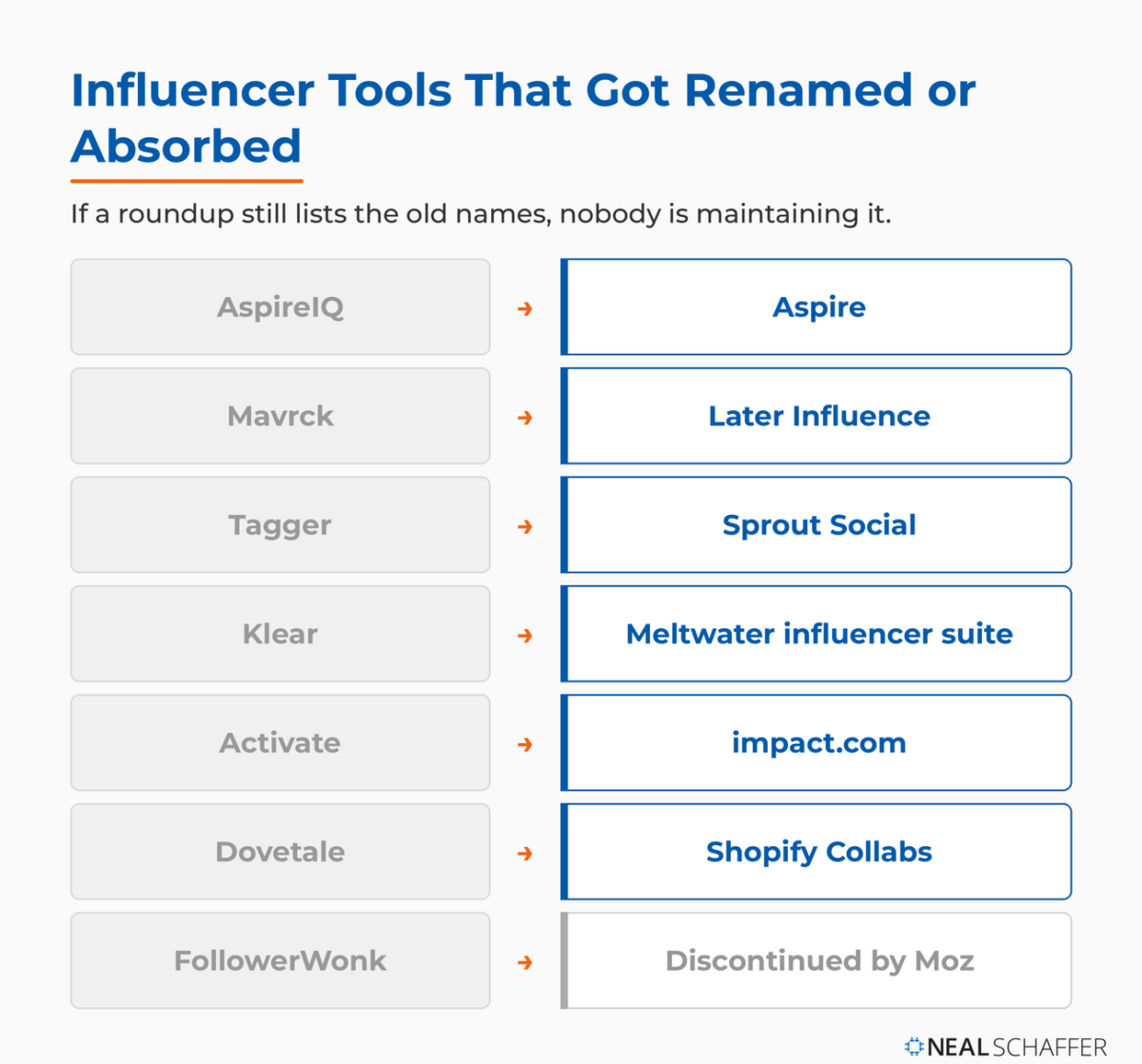
Skip the tools that no longer exist as standalone products, and skip the all-in-one platform entirely if you only run a couple of campaigns a year. A surprising number of “best influencer tool” lists still recommend products that have been renamed, absorbed, or discontinued, which is a quick way to spot a list nobody actually maintains.
A few that have changed since these roundups were first written: AspireIQ is now Aspire. Mavrck rebranded and merged into Later Influence. Tagger was acquired by Sprout Social. Klear now lives inside Meltwater’s influencer suite. Activate was absorbed by impact.com. Dovetale became Shopify Collabs. And FollowerWonk, a Twitter-era analytics tool, was discontinued by Moz years ago. If a list still presents these as distinct products to evaluate, treat the whole list with caution.
| Old name you’ll still see listed | What it actually is now |
|---|---|
| AspireIQ | Aspire |
| Mavrck | Later Influence (part of Later) |
| Tagger | Sprout Social (Tagger by Sprout Social) |
| Klear | Meltwater’s influencer suite |
| Activate | impact.com |
| Dovetale | Shopify Collabs |
| FollowerWonk | Discontinued by Moz |
The bigger thing to skip is software you don’t need yet. If you run two influencer campaigns a year, an enterprise platform on an annual contract is a tax on a problem you don’t have. A discovery tool, a contract template, and a spreadsheet will take you surprisingly far. Buy the platform when the manual work becomes the bottleneck, not before. You can always start by learning to find influencers manually and graduate to a paid influencer database once volume justifies it.
What Else Belongs in Your Influencer Marketing Stack
Beyond the core platform, most brands end up adding a few specialized tools to round out the program: social listening, outreach, contracts and rate cards, measurement, and content production. No single platform nails all of these, which is why I keep telling people to build a stack rather than chase one product.
Social listening is where I’d start, because your customers may already be talking about you, and your best creators are sometimes hiding in your own mentions. Outreach is the next gap. For relationship-driven, blogger outreach style campaigns, a dedicated outreach tool beats trying to bend a discovery platform into doing it. Respona is the one I’ve reached for most recently, and they keep building out functionality, so it’s where I’d look first.
On the operations side, the boring tools earn their keep. A solid influencer contract template and a clear sense of the going influencer rate card rates will save you more money than any discovery filter. For proving the program works, get your influencer marketing ROI measurement in place early, before the budget conversation, not after.
Compliance is the piece brands skip until it bites them. The FTC’s endorsement guides put the disclosure burden on both the brand and the creator, and the rules are stricter than most marketers assume. I’ve broken down what actually matters in my post on FTC influencer guidelines, and it’s worth baking the requirements into your briefs from day one.
Then there’s content. Influencer campaigns generate a flood of user-generated content, and you’ll want to repurpose it into branded assets for ads and your own channels. For that, I lean on Adobe Express over Canva for turning creator UGC into on-brand graphics quickly. (Disclosure: I’m an Adobe Express Ambassador, so take that as a genuine preference rather than a neutral ranking.) Both work; I find Express fits the way I move between formats.
Who Influencer Marketing Platforms Are NOT For
If you fall into any of these buckets, hold off on buying a platform. You’d be spending money to solve a problem you don’t have yet, and an annual contract will outlast the need. The four disqualifiers below cover the brands I most often talk out of a purchase, at least for now.
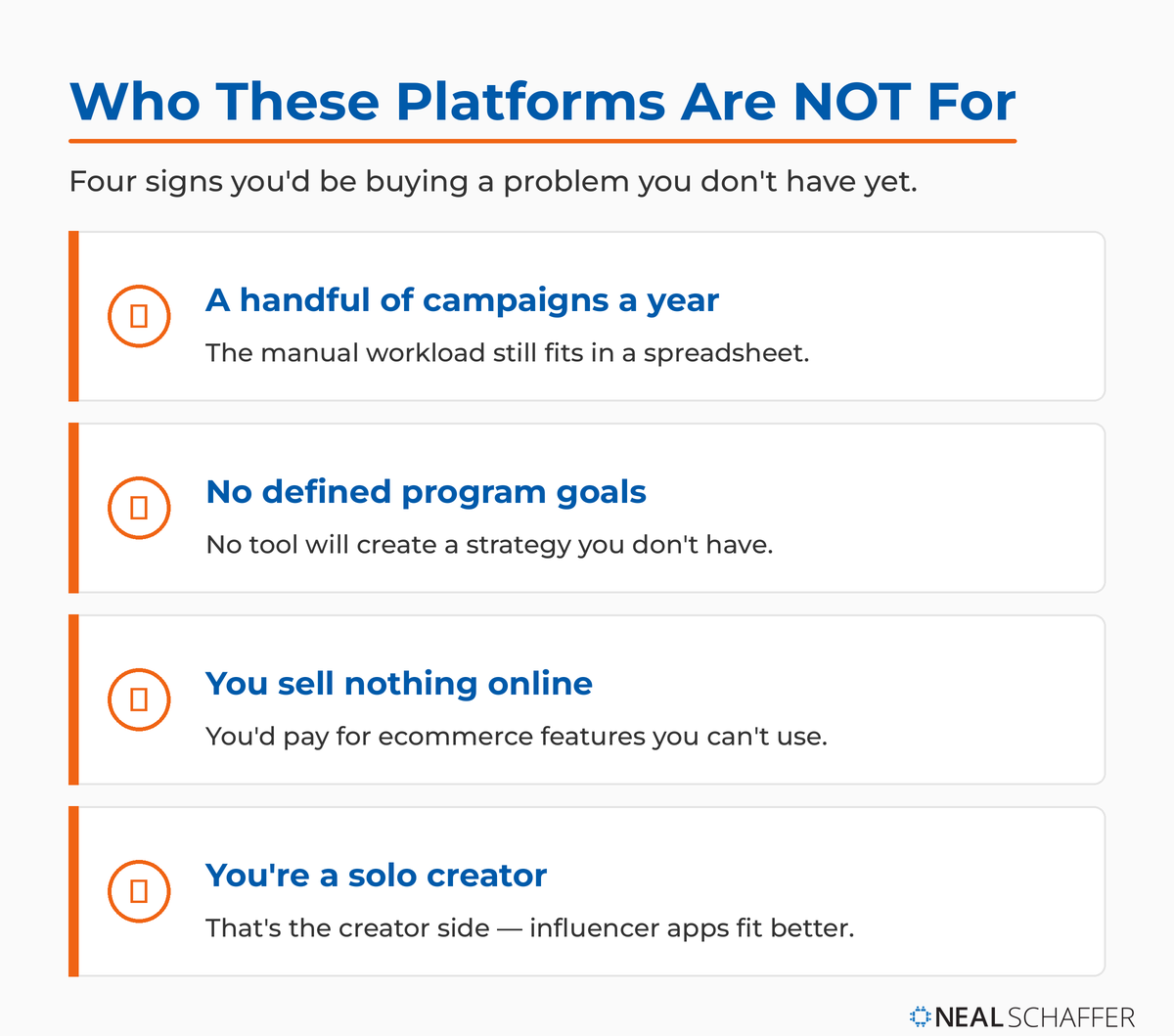
This software is not for you if you run only a handful of campaigns a year, because the manual workload is still small enough to handle in a spreadsheet. It’s not for you if you haven’t defined your influencer program goals yet, because no tool will create a strategy you don’t have. It’s not for you if you sell nothing online and have no commerce integration to plug into, since you’d be paying for ecommerce features you can’t use. And it’s not for you if you’re a solo creator hoping to land brand deals. That’s the creator side of the marketplace, and the influencer apps built for that job will serve you far better.
There’s no shame in not being ready. The brands that get burned are the ones who buy the enterprise platform first and reverse-engineer a strategy to justify it. Do it the other way around.
Frequently Asked Questions
There isn’t one. The best platform is the one that leads on your specific bottleneck. Grin is strong for ecommerce product seeding, Upfluence and Modash for discovery, Aspire for UGC, and CreatorIQ or Traackr for enterprise programs. Define your job first, then choose.
It ranges widely. Discovery-focused tools can start around $99 a month, while enterprise platforms typically run on custom, quote-based annual contracts that often start above $1,000 a month. Many platforms hide pricing behind a demo call, so budget for at least a four-figure monthly commitment if you’re going enterprise.
A marketplace connects brands with creators who have opted in to collaborate, usually through an application process. A platform is a broader toolkit covering discovery, outreach, campaign management, analytics, and payments. Marketplaces are one feature; platforms aim to run the whole influencer marketing campaign.
No, especially early on. You can run your first campaigns with manual discovery, a contract template, and a spreadsheet. Buy software when the manual work becomes the constraint, not before. The platform should remove a bottleneck you’ve actually hit.
Sometimes, but usually not the enterprise ones. A small business running a steady program may get real value from an affordable discovery tool, while the same business running two campaigns a year is better served by free options and manual work. Match the spend to your volume.
Build the Stack Before You Buy the Platform
Don’t start with the software. Start with the job you need done, the volume you’re running, and the report someone will eventually ask you for. Once you know which of the four jobs is your real bottleneck, the right tool more or less picks itself, and you’ll skip the expensive mistake of buying an all-in-one you grow into.
If you want to ground that decision in where the market is actually heading, the latest influencer marketing statistics and the broader creator economy data are worth bookmarking before you commit budget. And if you’d rather have a second set of eyes on the whole program, that’s exactly the kind of thing I help brands sort out through my Fractional CMO services. Or start with a free preview of The Age of Influence and get the strategy straight first.
Actionable advice for your digital / content / influencer / social media marketing.
Join 13,000+ smart professionals who subscribe to my regular updates.