




Kate Renshaw-Lewis’ “Busy Bodies” is the kind of film I love to program for a shorts block, but it’s not the easiest to write about. Six minutes long, abstract, and open to interpretation, the film is a compelling, weird delight that I have watched many times and still find something odd and new each time. (Unfortunately, I couldn’t find a spot for it at this year’s festival. That happens, too.)
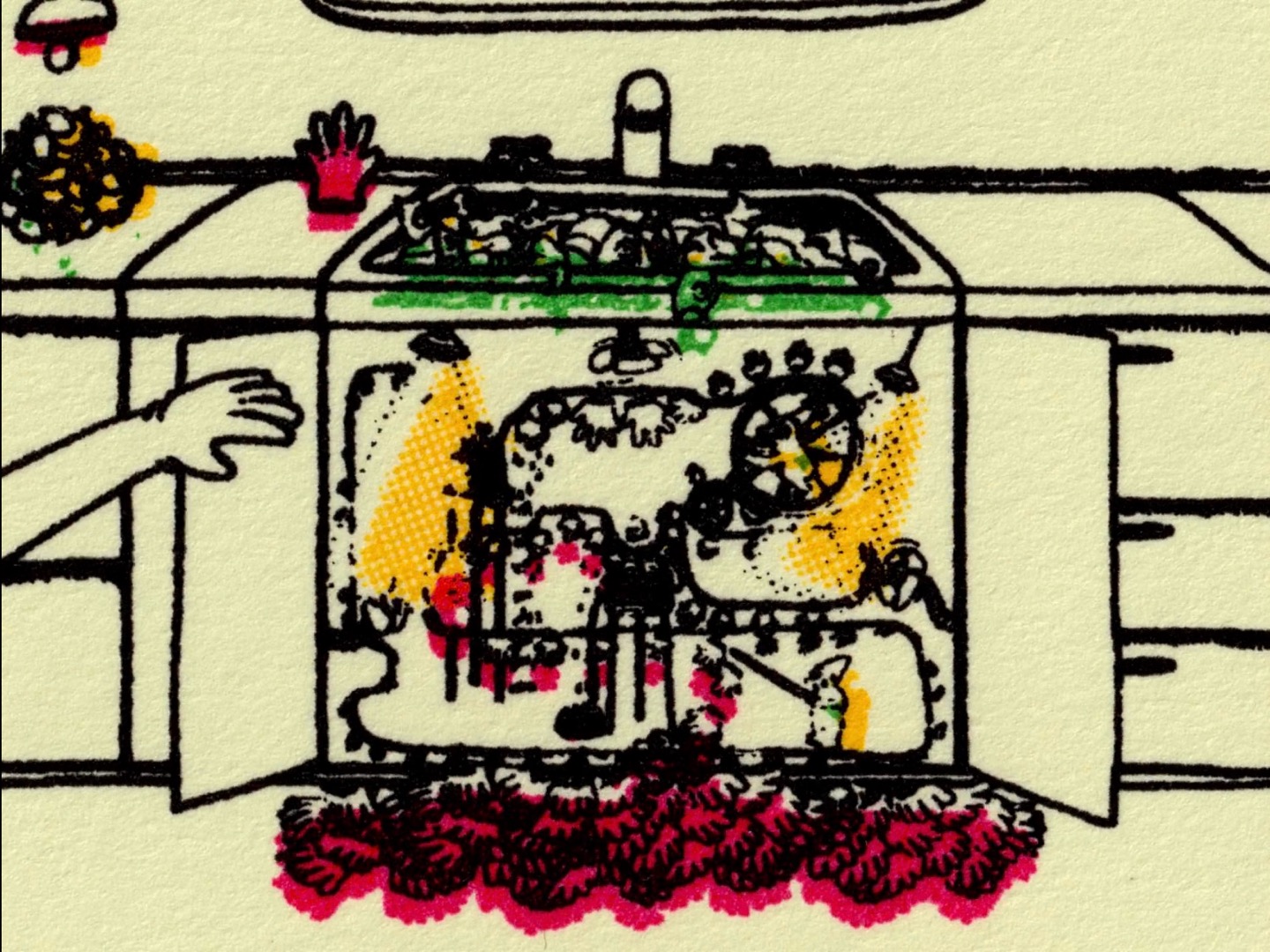
Using hand-drawn animation combined with “inkjet and screen printing techniques,” “Busy Bodies” is a wordless exploration of machines. At first, we think we might be watching a film about our bodies, specifically, our valves, tubes, and veins we have inside us, doing all this unseen busy work. The film can still be about that, with each new mechanism relying on another to exist. The synopsis suggests it’s about producing rubber gloves.
Could it be both? Or more? Of course. Shorts like this are more about the mood, the texture, the movement and the artist’s sole vision. Renshaw-Lewis’ film remains a compelling watch and feels like a series of paintings that, when looked at together, make a single statement that is completely up to the viewer. There is also something inherently satisfying about what is seen here. Machines are just machines making everything happen, but always at the mercy of bigger hands. The constant flow of work has a kind of soothing, hypnotic quality we can associate with a film like “Koyaanisqatsi.”
Perhaps “Busy Bodies” is about life in balance: every part of a machine working harmoniously together to create and deliver in a timely manner. Like, say, your latest Amazon purchase. Maybe our minds and bodies are so entwined with ordering stuff from Amazon and the like that we forget about what an unforgiving, ominous, indifferent machine goes into making that happen, but we’re all part of it. Maybe this movie is bleaker than I thought. Whatever the case, I enjoy its style, its inventive worldview and, of course, its efficiency.
Q&A with director Kate Renshaw-Lewis
How did this come about?
The film started with an opportunity to pitch a project to Ackzilla Entertainment. At the time, I was working with a local print shop in LA and experimenting with printed animation. The choice of medium, which is a combination of inkjet and silkscreen printing, came first, and I wanted to tell a story that was deeply connected to the very mechanical step-by-step process of printed animation.
My mind immediately went to the hidden mechanisms and production processes behind everyday, mundane items. Things that tend to go by without recognition of how they got there, for example, the abundantly packed and daily stocked aisles of the grocery store. The idea for the film came to me while I was grabbing lunch during my lunch break, and I noticed a small sticker on my pre-packaged tuna wrap that said, “made by hand.” I started wondering: Whose hand? How did they make it? Will I ever know what goes on behind the fluorescently illuminated presentation of the grocery store?
You went with hand-drawn animation, inkjet, and screen printing techniques. Can you tell me what went into that decision? Has that always been your preferred style?
Hand-drawn animation is my style of choice; it feels very natural to me and is one of my favorite activities. Printed animation was new to me, and I got into it through experimentation and free access to a print studio. I had experience screen printing still images and items like T-shirts, and I had seen some really lovely printed animations using risograph printing. My first test of printed animation was a quick rotoscope loop of my pet rabbit, Friday, jumping around, which I printed on a risograph printer.
My next test was a short for the screening group I co-run, LA Loft Movie Club, that used screen printing. I loved the specific texture screen printing added, and how much the paper texture was emphasized when I printed very small frames. Initially, Busy Bodies was intended to be fully screen printed, but due to budget and time constraints, I ended up printing the first part of the film on an inkjet printer and the second part with screen printing. This decision added important weight to the narrative. The ending of the film, the deterioration, was also an unexpected result of screen printing.
I’m sure you’ve seen lots of responses and interesting takes for the film. Can you share an overall reaction or one that stands out?
I really love it when someone shares that they also think about the process behind mundane objects. A friend shared that when they take a shower, they spend the entire time thinking about how the water reaches their specific faucet. An interesting response that I wasn’t expecting was the comparison to Dr. Seuss.
I have also heard a few times, and really enjoy hearing, that the film feels like it’s from a different era. One of the first ever screenings of Busy Bodies was at the Philosophical Research Society as part of a vintage animation festival. I was so happy to hear that although Busy Bodies was the only modern film, it felt in place. I’m a big fan of 60s and 70s experimental hand-drawn animation, and I think there’s a softness and whimsy that feels so deeply intertwined with that world of film.
I’m very curious as to why the film thanks the Museum of Jurassic Technology.
I work at the Museum of Jurassic Technology part-time, as well as freelance animation work. The Museum is a truly wonderful place and a deep inspiration. I actually storyboarded the film during downtime while working front-of-house shifts at the museum.
I also would bring the film in at various stages of production to get feedback and thoughts from my friends and coworkers. The Museum has a small theater, which is where I first ever screened the final version of Busy Bodies. If you’re ever in LA, I really recommend visiting it.
And the music (being such a big part of this) was recorded at the Vintage Synthesizer Museum? It’s incredible to me that it exists.
Yes, it’s so incredible! I had heard of the museum, but going to record for Busy Bodies was my first time there. It is such an amazing collection and library of very well-maintained vintage synthesizers. I went with two friends and wonderful musicians, Arius Ziaee and Alex Edgeworth, and we spent 2 straight hours recording a whole library of synthesizer sounds. It got a bit intense because we got so hypnotized that we didn’t take any breaks, and we came out in a complete daze of beeps and boops.
What’s next for you?
I’m currently working on another film with Ackzilla Entertainment. It is a much more ambitious film, so we’re working on a pitch deck right now. It’s a return to hand-drawn and painted multiplane animation. The story is pretty loose, but it’s about someone desperately trying to sleep and the stories my grandparents told me about the overwhelming experience of growing up in small houses with 12 siblings.