




Britain’s King Charles III continued his nine-day tour of the Caribbean Thursday under mounting pressure to issue a formal apology for the U.K. royal family’s historic role in the transatlantic slave trade and to support calls for reparations.
Charles was to visit Guyana on Thursday before traveling to Antigua and Barbuda for a meeting of heads of state of British Commonwealth nations, where leaders are expected to discuss the legacy of slavery.
His tour began Tuesday in the Bahamas, where the king addressed hundreds of young Bahamians and acknowledged Britain’s colonial past.
“Some of what is best in Bahamian culture today, the most joyful, the most hopeful, the most bright, was born out of darkness,” he said. “It is only right that we should acknowledge the great suffering and injustices of the past in these islands and beyond, even as we rejoice in the successes of the present and build new opportunities for the future.”
On Wednesday, the king embraced the country’s vibrant culture, joining a colorful Junkanoo street parade in Nassau surrounded by performers in elaborate costumes and feathered headdresses.
But around the celebrations, protesters held placards declaring: “Pay us what you owe us,” demanding compensation for Britain’s involvement in centuries of transatlantic slave trade.
Charles’ remarks appeared to do little to satisfy campaigners who have long called for a formal apology and reparations.
Speaking to The Guardian newspaper on Wednesday, Dr. Niambi Hall Campbell-Dean, chair of the Bahamas National Reparations Committee, dismissed the monarch’s remarks as “hollow platitudes” and said, “we deserve so much more than what was offered.”
Buckingham Palace has said Charles will not offer a formal apology for slavery, saying such decisions are for the British government, not the royal family, but that he will not shy away from broader discussions about the U.K.’s involvement.
Experts say the royals are concerned that issuing a formal apology could open the door to legal claims for reparations, potentially exposing the family, and/or the British government, to substantial financial demands.
“The reason why he doesn’t go further is that he’s aware [of] what it will mean to actually apologize, in terms of the legal obligation to make reparation,” Esther Stanford-Xosei, a lawyer and reparations expert, told CBS News in 2023, as Charles’ second son Prince Harry’s book “Spare” acknowledged the family had profited from the slave trade.
Stanford-Xosei said the family feared a formal apology could end up costing the monarchy, “not only money, but status … He will be exposing the criminality of this institution.”
Calls for reparations
Between the 15th and 19th centuries, approximately 5 million enslaved Africans were transported to the Caribbean, including more than 2 million to British colonies, where they endured brutal conditions working in sugar, coffee and cotton plantations.
Historians have documented the monarchy’s direct involvement in the trade, including investments by King Charles II and his brother James in the Royal African Company, which trafficked enslaved Africans across the Atlantic.
When slavery was abolished across most of the British Empire in 1834, the government allocated £20 million ($23 billion in today’s money according to one estimate) to compensate slave owners, but not the enslaved. The compensation was part of a political compromise that helped secure abolition’s passage by British lawmakers.
Britain subsequently played a significant role in suppressing the international slave trade during the 19th century, deploying the Royal Navy and investing substantial resources in abolition efforts. Its West Africa Squadron seized more than 1,600 slave ships and freed approximately 150,000 Africans between 1808 and 1869. One study estimated that Britain’s wider anti-slavery efforts cost the equivalent of 1.8% of its national income annually over that period.
The debate over reparations has intensified in recent years, particularly following the global Black Lives Matter protests in 2020, which prompted renewed scrutiny of Britain’s colonial past and the royal family’s historical connections to slavery.
Barbados Prime Minister Mia Mottley has been among the leading voices calling for reparations, including investment in education, healthcare and economic development.
Speaking to The Guardian, the head of the Caribbean Community Reparations Commission, Hilary Beckles, said people in the Caribbean wanted “proprietary justice, beginning with remorse” from British leaders.
She urged Charles to “dig deep within his consciousness” and to offer young people he meets on his visit “the empowerment that he would give to his own children.”
Isabel Infantes-Pool/Getty 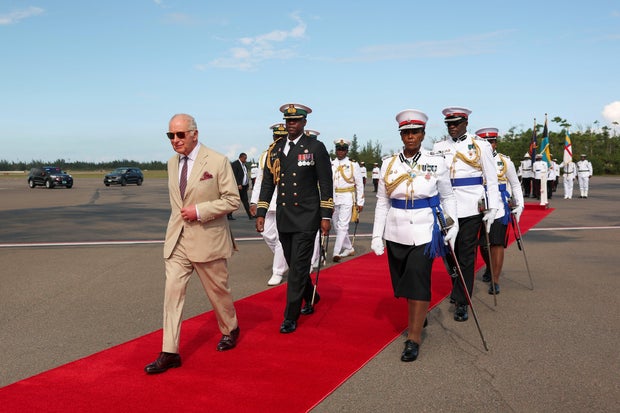
Not everyone in the Caribbean supports the idea of direct reparations, however.
Rasheed Griffiths, a Barbadian economist, told CBS News that “Caribbean leaders have consistently refused to implement prudent fiscal policies over the last few decades, which has led to the decay of Caribbean economies. But instead of realizing they have all the power to turn these countries around they prefer to seek scapegoats.”
“The calls for reparations from the U.K. are nothing more than Caribbean leaders attempting to externalize their own failures,” Griffiths said. “It should not be taken seriously by anyone, least of all the U.K. public.”
Charles previously described slavery as an “appalling atrocity” that “forever stains our history” during Barbados’ transition to a republic in 2021.
During a Caribbean tour in 2022, heir to the British throne Prince William and his wife Kate also faced protests over slavery and demands for reparations. William expressed his “profound sorrow” and described slavery as “abhorrent,” but stopped short of a formal apology.
Many of the Caribbean nations Charles is visiting are former British colonies and several, including the Bahamas and Antigua and Barbuda, remain constitutional monarchies, which, despite them having gained independence decades ago, makes Charles their official head of state.