




Ask ten SEO companies how to build links and you get roughly the same answer. Make something great. Email people about it. Then you look at the backlink profiles those companies spent fifteen years building, and the advice starts to sound like a millionaire telling you to invest early.
I have been running nealschaffer.com since 2008. The blog now sits at over 700 posts, and for the past eighteen months I have been rebuilding it category by category after Google’s helpful content system knocked it down. That work forced me to look hard at which links do something and which ones I was collecting out of habit.
I have written six books on digital marketing. The one closest to this topic is *Digital Threads*, where I argue that search, email and social only compound when you weave them together. Search is the thread small businesses drop first, and it is the diagnosis I hand clients most often in my Fractional CMO work.
So below are the tactics that still earn links in 2026, what each one costs, and where I would start with no budget and no team.
Key Takeaways
✅ Links still move rankings, but fewer than you think. Google’s Gary Illyes said in April 2024 that very few links are needed to rank a page, as Search Engine Land reported
✅ Digital PR is the tactic professionals rate highest, chosen by 48.6% of 518 SEO specialists surveyed by Editorial.Link, well ahead of guest posting at 16%
✅ The guest post marketplace is mostly junk. BuzzStream analyzed 257,267 sites and found 96.2% of them low quality
✅ Internal links are the free half of this, and the half almost every small business ignores completely
✅ Two-thirds of surveyed specialists say a page can rank without backlinks at all, which changes where a small site should spend its first hundred hours
✅ Backlinks do not earn AI citations directly. They earn rankings, and rankings are what AI assistants retrieve from, so the AI benefit is real but second-hand and shrinking
What Is Link Building, and Does It Still Work in 2026?
Link building is the practice of getting other sites to link to yours, through content worth citing, relationships, and direct outreach. Google still counts those links, though less than it once did. Its spam policies treat manipulative link schemes as grounds for ranking a site lower or dropping it entirely.
The state of play is that links matter and are no longer decisive. Gary Illyes said in September 2023 that people overestimate links and that they had not been a top-three factor for some time. In March 2024 Google removed the word “important” from how its spam policy described links, both documented by Search Engine Land.
That does not make link building pointless. It changes what you are buying. A link from a relevant, trafficked site still brings referral visitors and still puts your name in front of an editor. It also helps Google and AI systems find pages they would otherwise never crawl.
Before spending money chasing links, know exactly what one passes and what it does not. I get into that in my post on what backlinks are in SEO.
Which raises the objection I hear more than any other right now.
Do Backlinks Still Matter If Everyone Is Using AI Search?
Backlinks do not directly drive AI citations. They work on AI indirectly. Assistants pull live results from search indexes through retrieval augmented generation, which Ahrefs describes as how models enrich their training data, and links help you rank in those indexes. So the effect is real and getting weaker.
The overlap is real, and it is shrinking
Most guides quote a single number here, and it has moved a long way in a year. These four measurements were gathered by Search Engine Journal:
| Study | When | Share of AI Overview citations ranking in the top 10 |
|---|---|---|
| Ahrefs, 1.9M citations | July 2025 | 76.1% |
| BrightEdge | October 2025 | 54% |
| Ahrefs, 863K keywords and 4M URLs | Early 2026 | 38% |
| BrightEdge | February 2026 | About 17% |
Two caveats before anyone builds a strategy on that trend. Ahrefs improved its parsing between its two studies, so part of the change is better detection rather than Google behaving differently, and the two datasets are not directly comparable. The BrightEdge figures come from different methodology again.
Even at the low end, the direction is the same. Ranking well still raises your odds of being cited, and it does so less reliably than it did a year ago.
Links are the wrong lever for AI, and the right one for search
For AI citation specifically, mentions beat links. In the Editorial.Link survey cited earlier, 80.9% of specialists believed unlinked brand mentions influence organic rankings, and 73.2% believed backlinks influence the chance of appearing in AI search results at all. Being talked about matters more to an assistant than being linked to.
That sounds like a reason to stop building links. I would argue it is not. Links remain one of the better ways to earn a ranking, a ranking is still one of the better ways to get retrieved, and the same outreach that earns a link usually earns the mention alongside it.
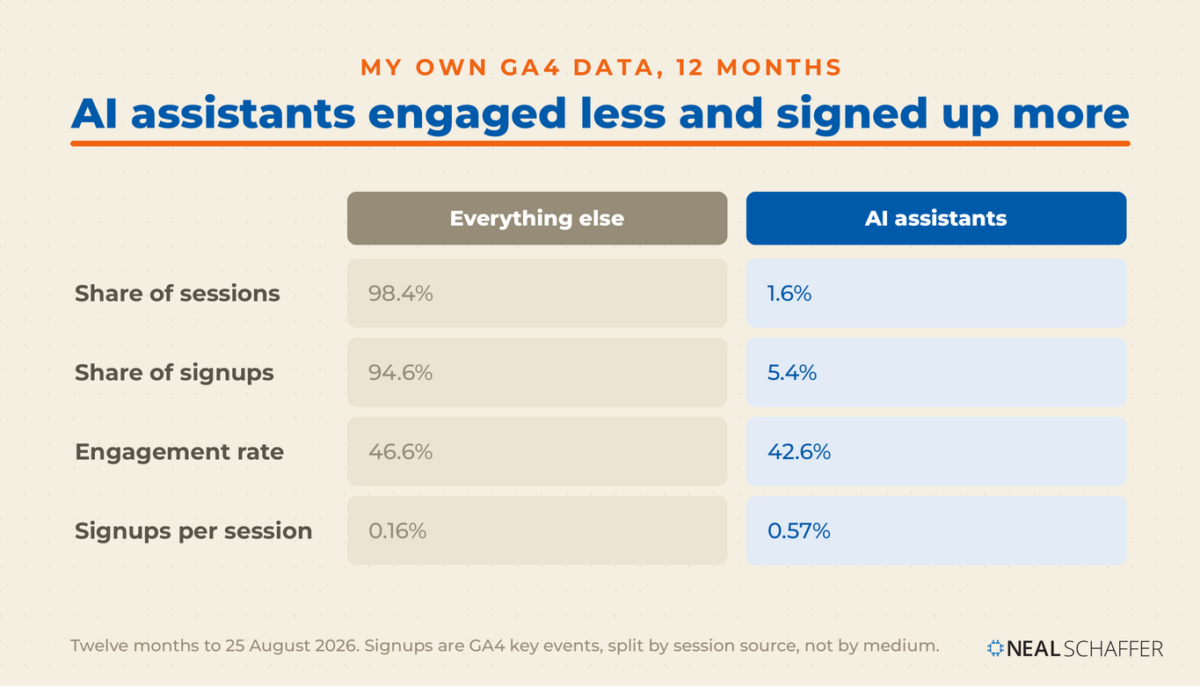
The volume argument does not hold up either. Across the last twelve months, AI assistants sent 1.6% of my sessions and 5.4% of my email signups. That is roughly three and a half times their share of traffic. ChatGPT alone was about two-thirds of those sessions, with Perplexity, Gemini, Copilot and Claude splitting the rest.
The part I did not expect is that those visitors engage slightly less than my site average, not more. They sign up anyway, at several times the rate of everyone else. I broke the rest of it down in my post on AI search engine optimization.
So the framing I use with clients is this. Build links for traditional search, where the effect is direct and measurable. Count AI citation as the second-order benefit that follows from ranking, not as something links buy you on their own.
The bigger question is what any of this is worth on a small site. I have eighteen months of my own data on that.
Make LinkedIn Your Best Source of Clients
My latest book helps professionals, entrepreneurs, and business owners turn LinkedIn from a static profile into a real source of clients and growth.
Maximizing LinkedIn for Business Growth gives you clear, practical steps to build a profile that gets noticed and a network that actually sends business your way.
Grab your copy on Amazon and put it to work this week. Click the cover or the button below to get started.

What Rebuilding 700 Posts Taught Me About Links
Working through a 700-post archive category by category changed how I rank link building against everything else in my SEO strategy. Internal links gave me faster and more readable movement than any external link I chased, and they cost nothing but attention. External links still matter. They just sit third on my list now.
Internal links were the biggest win, and they were free
Before I sent a single outreach email during the rebuild, I set a rule for the whole site. Every post I want to rank has to carry at least two inbound internal links from other posts. Not a suggestion. A floor I check against a crawl report every time I run a linking pass.
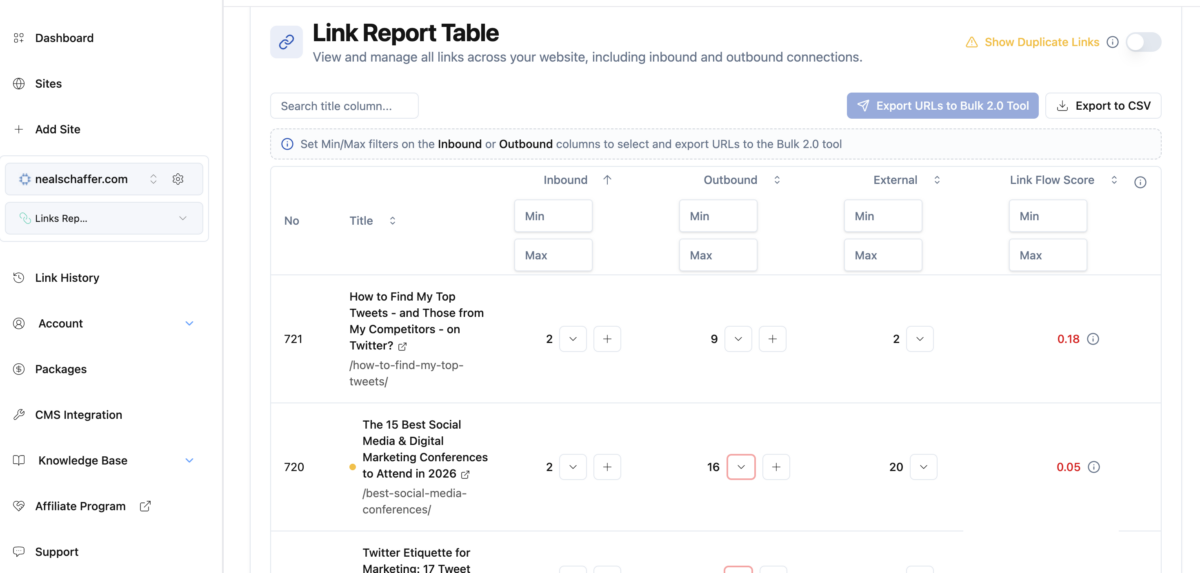
Most small business sites fail this badly. They publish for years, link out to sources generously, and never link across their own library. The result is a set of pages Google reaches only through the sitemap, with nothing telling it which ones matter.
The quickest version takes an afternoon. Search `site:yourdomain.com “topic phrase”` in Google, open the three most relevant results, and add the link inside the prose where it genuinely helps the reader. Repeat for your ten most important pages. My post on internal linking has the rest.
I raise it here because it changes the order of everything below. A small site that has not done this is chasing external links to pages its own site does not vouch for, which is expensive work aimed at the wrong bottleneck.
The tools I pay for, and the ones I dropped
I currently pay for Yoast, Ubersuggest and LinkBoss, alongside Google Search Console and Google Analytics. LinkBoss is the one I would defend hardest. It finds the orphaned and under-linked pages across the site, which is the report I actually act on.
I used to pay for Frase, LinkWhisper and Jasper. All three lapsed. Not because they are bad, but because I stopped opening them once the workflow settled into research, write, link, measure.
What I stopped doing
I stopped chasing links to individual blog posts. Almost every hour I now spend on external links goes toward pages that either convert or get cited. That matches what the professionals report: in the same Editorial.Link survey, 52.7% named service and product pages as the most important link targets, ahead of blog posts.
None of that means links stopped working. It means the order changed. So here is the order I would actually work through.
Which Link Building Strategies Actually Work in 2026?
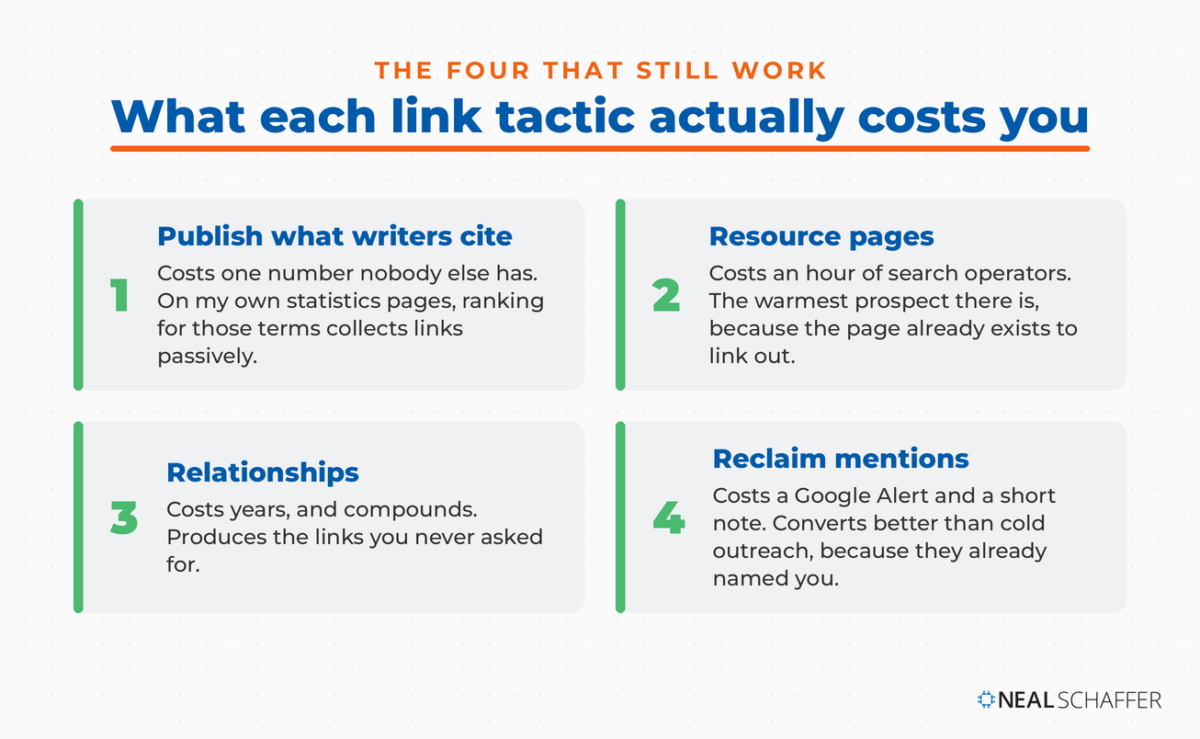
The strategies that still work fall into three groups. Publish something other writers need to cite. Ask people who already list resources like yours. Build relationships that produce links as a byproduct. Digital PR leads the professional rankings at 48.6%, as noted above, ahead of guest posting and linkable assets.
1. Publish something writers need while they are drafting
Some keywords get searched almost entirely by people writing something else. Statistics, templates, benchmarks, “how many X in 2026.” From what I have seen on my own statistics pages, ranking for those collects links passively, because the searcher wants a citation rather than a purchase.
Ahrefs tested this directly. They built a statistics page, sent 515 outreach emails, and earned 36 backlinks from 32 websites, a 5.71% conversion rate on delivered mail. The page then ranked first for its target term and kept attracting links without further outreach.
That pattern is why I keep my own page of SEO statistics updated instead of letting it go stale. A statistics page carrying numbers from four years ago stops earning citations, which is the only reason the page exists.
You do not need Ahrefs’ budget to run this. You need one number nobody else has. Survey your customers, publish your own results, or count something in your industry that nobody has counted. Turning that into a shareable graphic is a twenty-minute job in Adobe Express, and my post on finding content ideas helps with picking which one to run.
2. Resource pages and broken links, which are one motion
Resource pages exist to link out. That makes them the warmest prospect available, because you are asking someone to do the thing their page already does rather than asking them to write about you.
Find them with these Google searches, swapping in your topic:
- `inurl:resources “your topic”`
- `inurl:links “your topic”`
- `intitle:”your topic” resources`
Then run each page you find through a broken link checker. Any dead link on a resource page gives you a second and much better reason to email, because you are reporting a problem and offering the replacement in the same message. That pitch beats a cold “please link to me” by a wide margin, and it costs one extra minute per prospect.
3. Relationships, which produce the links you did not ask for
This is the slowest tactic and the one that compounds. Comment on people’s work, share it, introduce them to each other, say yes to podcasts. Sam Dunning, founder of Web Choice, gave me the prospecting rule for this. He told me on my podcast to “think of companies that complement your industry, but aren’t direct competitors.”
That is the same logic behind influencer marketing strategy, and the psychology is identical. Give first, at a scale where giving costs you something, and the asking gets much easier later.
4. Reclaim what you already earned
Set a Google Alert for your brand name and your product or book titles. Every few weeks you will find someone who mentioned you without linking. A short, friendly note asking for the link converts far better than cold outreach, because that person already decided you were worth mentioning.
The same pass should catch your own broken inbound links. Any page of yours that returns a 404 while other sites still link to it is equity sitting on the floor, and a redirect recovers it in about thirty seconds.
That leaves the one tactic everybody asks about, and the one I have the longest history with.
Is Guest Posting Still Worth It in 2026?
Guest posting still earns links, and the marketplace built around it has degraded badly. BuzzStream analyzed 257,267 guest post sites and found only 1.37% qualified as high quality or top tier, with the average domain rating across the whole marketplace sitting at 24. Pitch a few good publications directly instead of shopping.
Fifteen years of watching this from the other side of the inbox
I have watched this from the other side of the inbox. I launched Maximize Social Business in 2009 and accepted my first guest post, from an American nonprofit marketer, almost immediately. Between then and around 2015 I had fifteen to twenty regular contributors, each publishing monthly.
Mark Traphagen, Ann Smarty and Peg Fitzpatrick all wrote for me in those years. They were professionals building their own thought leadership, and it showed in the work. Nobody was there for a link.
Almost none of it survives here, for three reasons worth knowing before you pitch anybody. Mark wrote about Google Plus and Ann started on SlideShare, and neither category exists anymore. Several contributors did not want their work moved across to what had become a personal Neal Schaffer site. And I have pruned hard since, my own posts included.
What changed was not the writing. Applications got more numerous and more random, and most people sending them wanted one placement rather than a relationship. The pitches came increasingly from writers building links for a client or for themselves. I kept saying yes, and I kept quietly lowering my own bar.
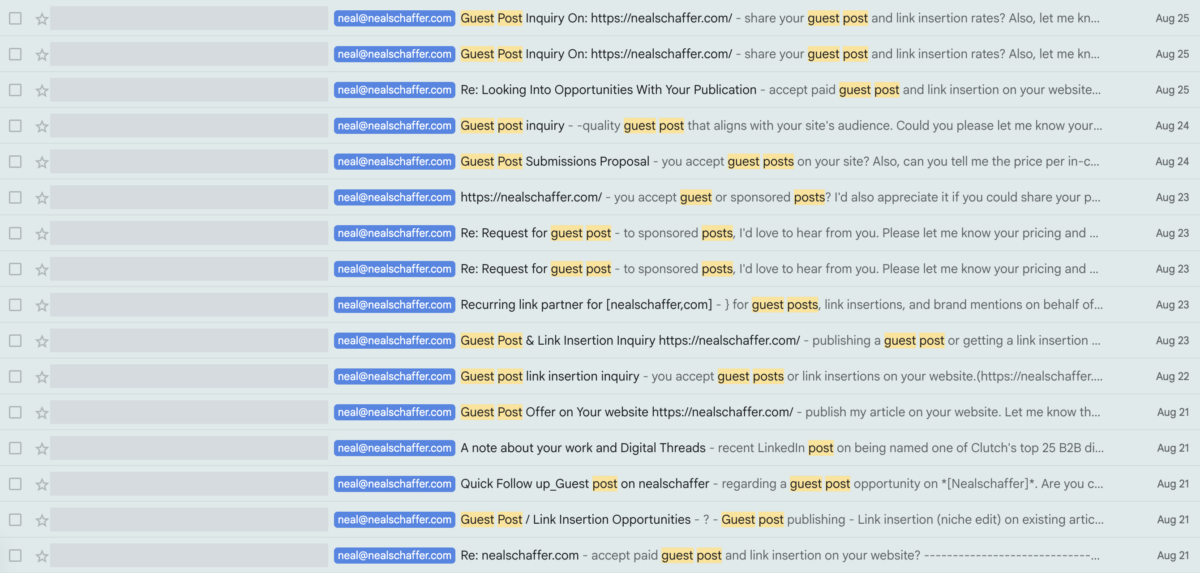
The quality drop was specific, and it took me too long to name it. These were not badly researched articles. They were articles with nothing firsthand in them, written by people who had never done the thing they were describing. That is the gap I read the helpful content system as built to find, and I was publishing it monthly for years.
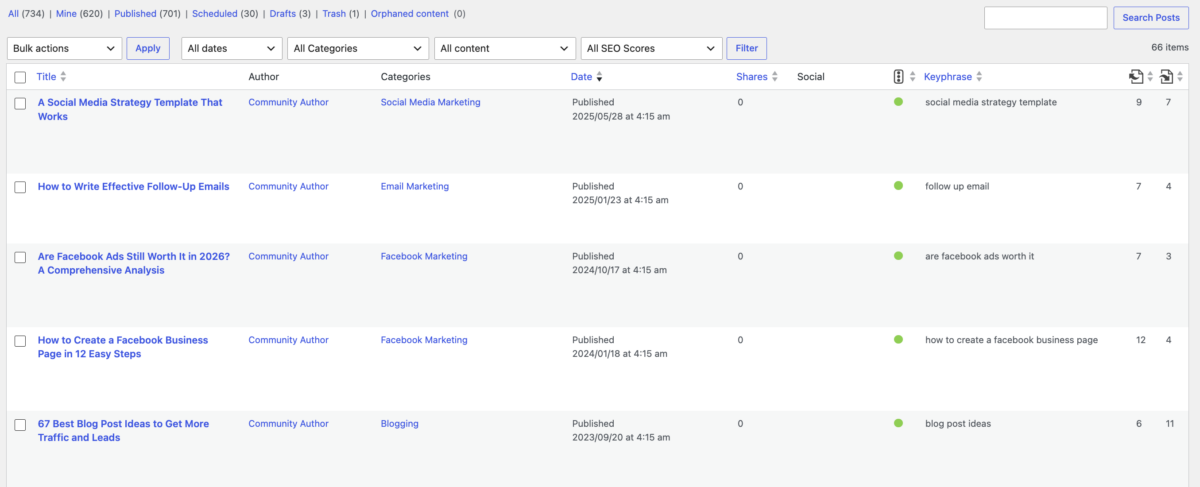
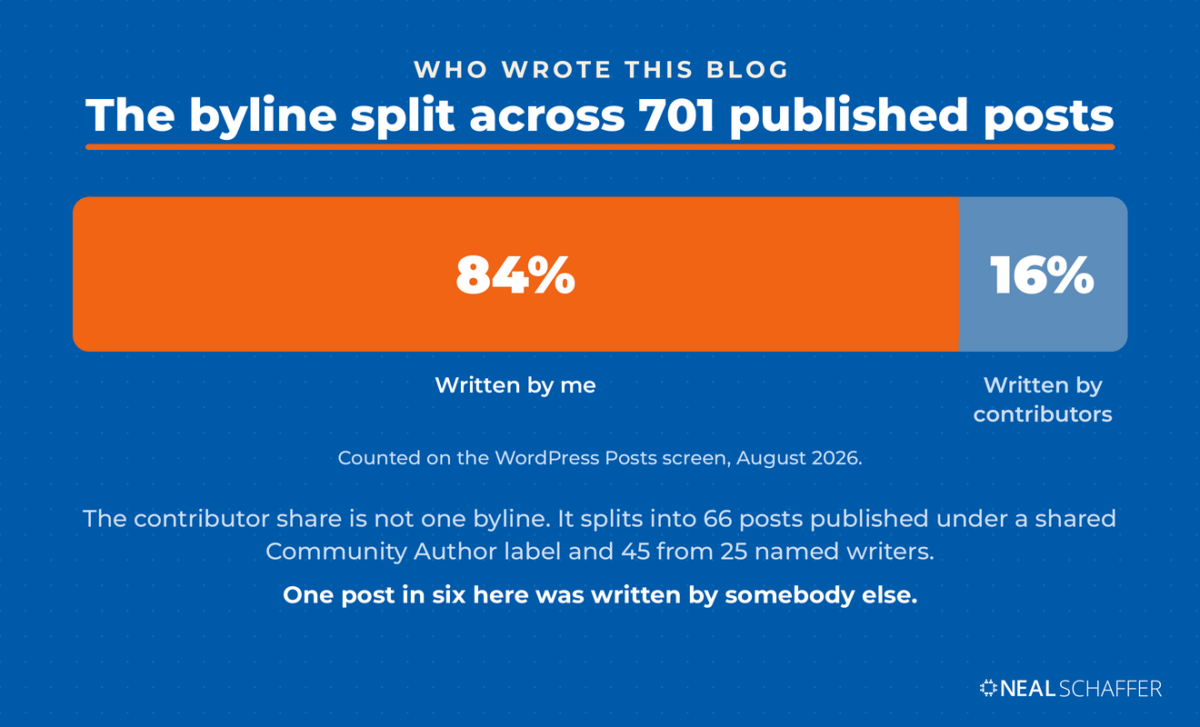
So this year I closed my site to guest contributions entirely. The evidence that settled it came out of the rebuild. Around 84% of my published posts are mine and 16% came from contributors, and working category by category, the posts I keep pruning or rewriting come out of that 16% far more often than the split would predict.
How to pitch one, from someone who read the pitches
Which points at what you should actually do. Do not shop for guest posts. Pick three publications your actual customers read, and pitch the editor something only you could write: your own numbers, your own failure, your own process. Back when I was reading those pitches, that was the thing that separated the yes pile from the no pile, and it is still the one thing an editor cannot get from anybody else. Go in knowing the placement is not permanent. It sits on someone else’s site, subject to their pruning, their migrations and their bets on which platforms last. My contributors did nothing wrong and most of their posts are gone anyway. Expect a handful of placements a year rather than a hundred. My post on guest blogging goes through how to pitch one.
Two kinds of site have their own version of this playbook, and both come up constantly in my client work.
How Do You Build Links to Ecommerce Product Pages?
Product and category pages rarely earn editorial links, because nobody writes an article to cite a product listing. Partner pages are the practical route instead. Suppliers, manufacturers and retailers often run “where to buy” or “stockists” pages built to point at products like yours. Getting listed is a request they are already set up to grant.
Work your existing relationships first. Go through your supplier and partner list and check which of them have a website. Search each site for “where to buy,” “stockists,” “retailers” or “partners.” If a page exists and you are not on it, email your account contact rather than the webmaster. It is an account question, not an SEO favor.
Beyond that, the gains on an ecommerce site are usually internal. Category pages that link sensibly to their products, and buying guides that link to categories, tend to move more than a handful of hard-won external links. I walk through that structure in my Shopify SEO checklist.
Businesses serving one city have a different opening, and an easier one.
How Do You Build Local Links for a Small Business?
Local link building works through people who are near you and not competing with you. The most reliable version is publishing a piece that features other nearby businesses, then telling each one it is live. They get exposure, and you get a promotion network that shares the piece for you.
Ask for their buy-in before publishing so you know who will share it.
Concretely: a veterinary practice publishes a guide to pet-friendly coffee shops in its city. A hotel writes up the best independent cafes within walking distance. Email each business first, tell them you are including them, and ask for a photo. The photo request is what turns a listing into a relationship.
My own read, from client work rather than a study, is that this works because these are the only sites that have a reason to link to a business with no national profile. A chamber of commerce, a supplier, a sponsored youth team and the neighborhood paper will all link to you. A national publication will not.
So round it out with the unglamorous stuff. Chamber membership, local sponsorships, supplier directories, and making yourself easy for the local paper to quote. My post on local SEO puts those alongside the rest of the local picture.
Whichever route you take, the filtering question stays the same.
What Makes a Backlink Worth Having?
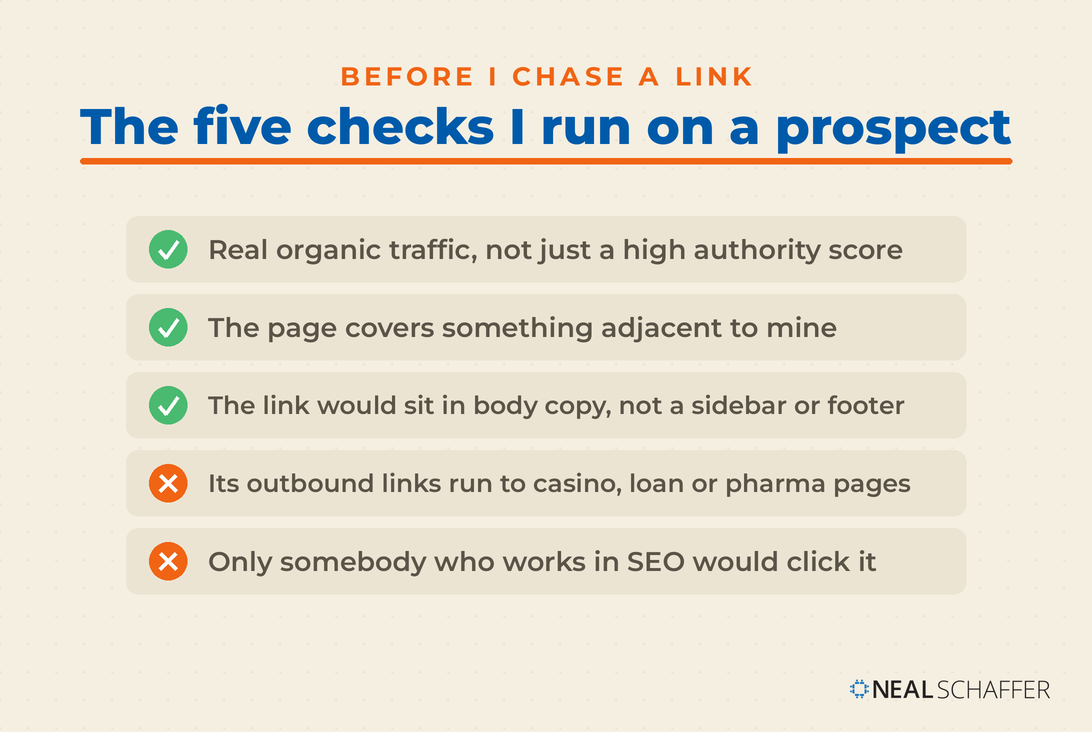
A backlink is worth having when the linking page is topically related to yours, carries real traffic, and links to you inside its body copy rather than a sidebar or footer. Relevance beats raw authority most of the time. Spammy outbound links are the single biggest red flag for the specialists in the Editorial.Link survey, named by 89% of them.
Here is the check I run before pursuing a link, in order:
| Question | What to look for | Where to check |
|---|---|---|
| Does the site get traffic? | Any organic traffic at all; many link-selling sites have none | Ahrefs, Semrush or Ubersuggest |
| Is it about my topic? | The linking page covers something adjacent to my page | Read the page |
| Where would the link sit? | Inside an article’s body, not a sidebar, footer or author box | Read the page |
| Does it link out to junk? | Scan outbound links for casino, loan or pharma spam | Read the page |
| Would a human click it? | The link makes sense to a reader who has never heard of SEO | Judgment |
Authority scores from Ahrefs, Moz, Majestic and Semrush are useful shorthand and nothing more. None of them is a Google metric. Traffic is harder to fake than an authority score, so where the two disagree, I trust traffic.
Knowing what a good link looks like matters less than knowing which ones get you in trouble.
Which Link Building Tactics Should You Avoid?
Google’s spam policies name specific practices as link spam, and the list is more specific than most people realize. Buying or selling links for ranking purposes is on it. So is exchanging goods or services for links, including sending someone a product in return for a write-up. That last one catches a lot of well-meaning small businesses.
What Google names as link spam includes:
- Paying for links, or trading goods, services or product samples for them
- Excessive link exchanges, and partner pages that exist only for cross-linking
- Automated tools or services that generate links to your site
- Requiring a link as a condition of your terms of service
- Advertorials and sponsored articles carrying links that pass ranking credit
- Low-quality directory and bookmark listings
- Links buried in widgets distributed across other sites, or in site-wide footers
- Forum comments with optimized links in the post or signature
The same policy page says outright that buying and selling links is a normal part of the web economy, and that such links are fine as long as they are marked. The mechanics are simple. Add `rel=”sponsored”` to any paid or advertising link, and `rel=”ugc”` to user-generated links like blog comments. Google’s documentation on qualifying outbound links now prefers `sponsored` over `nofollow` for paid placements, and states that links carrying any of these attributes will generally not be followed.
There is a newer trap worth naming. The site reputation abuse section of that same spam policy targets third-party content published on a host site mainly to borrow the host’s ranking strength. If someone offers to place your article on a large publication that has nothing to do with your industry, that is the pattern being described.
Assuming you steer clear of all that, the next question is what a real program costs.
What Does Link Building Cost, and How Do You Measure It?
Link building costs either money or time, and the money numbers run higher than most small businesses expect. Surveyed SEO specialists put the average acceptable price for one high-quality backlink at $508.95, and 80.9% of them expect costs to keep climbing over the next two to three years.
Buying placements costs more than that headline suggests once quality enters the picture. In the BuzzStream marketplace analysis cited earlier, the average vendor price for a guest post was $461, rising to $3,130 for a high-quality site and $6,018 for top tier.
What to spend instead of money
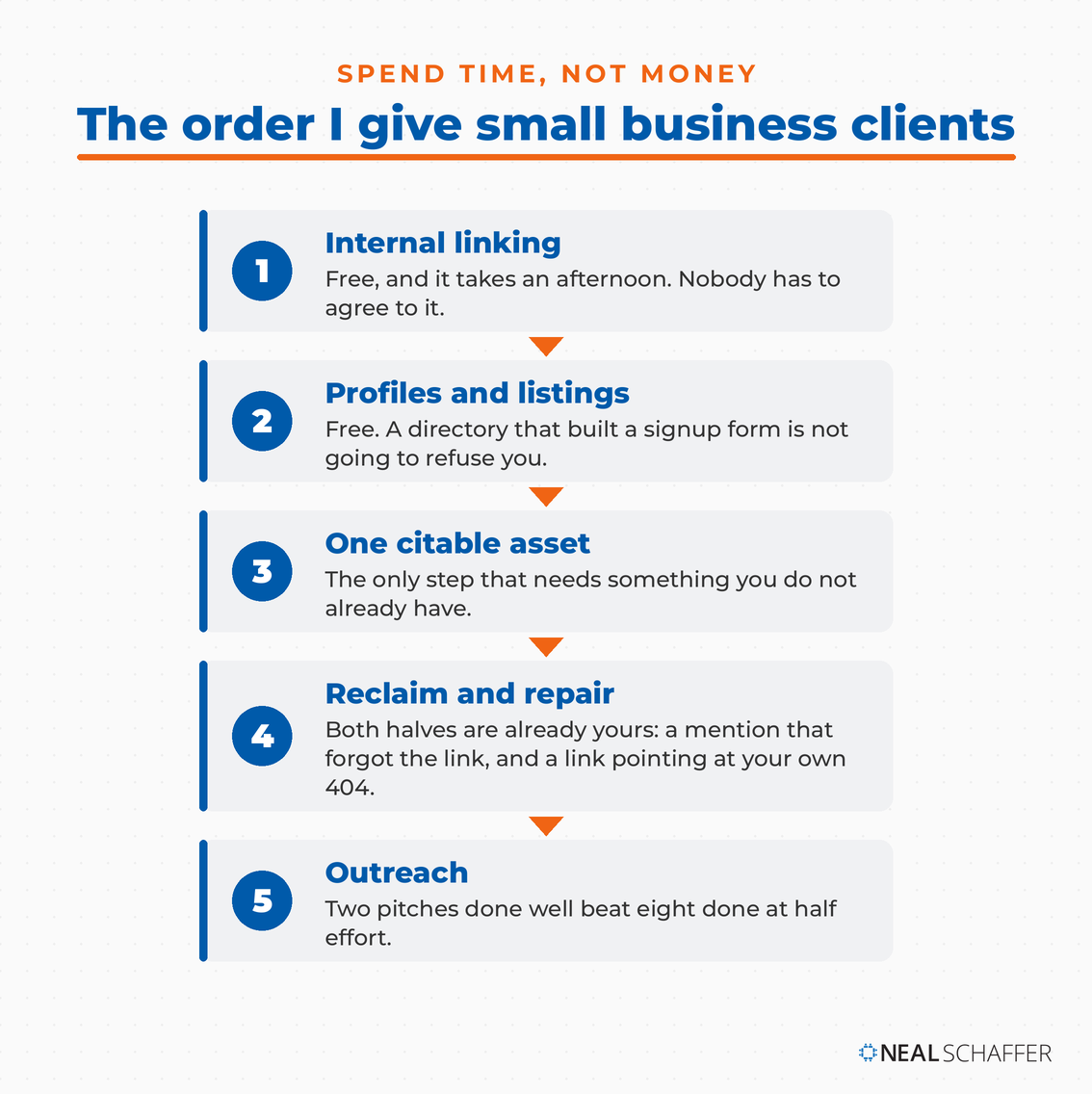
My advice to small business clients is that you do not buy links. You spend the time instead, in this order:
- Fix internal linking across the site you already have
- Claim and complete every profile that will list you
- Publish one thing per quarter that a writer would want to cite
- Reclaim unlinked mentions and fix broken inbound links
- Only then, run outreach
That order is not arbitrary. The first four cost nothing but hours and nobody can refuse them, so you can finish all four inside a quarter. Outreach is the only step whose result depends on a stranger saying yes, which is why it goes last rather than first.
Here is what I would actually put in the toolkit for each stage, and what you can skip:
| Stage | Tool | Note |
|---|---|---|
| See who already links to you | Google Search Console | Free, and the only first-party link data you get |
| Find orphaned and under-linked pages | LinkBoss, or Screaming Frog for a manual crawl | LinkBoss audits orphan and dead-end pages at no cost |
| Check a prospect’s traffic and authority | Ahrefs, Semrush, Moz or Majestic | Pick one; four subscriptions is money wasted |
| Make a linkable graphic | Adobe Express | Where I build every chart and infographic on this site |
| Catch unlinked brand mentions | Google Alerts | Free, and the reclamation pass depends on it |
| Find a contact’s email | Hunter.io | Skip if the site lists an editor address |
| Answer journalist queries | Qwoted, Featured, Help a B2B Writer | Sign up for all three; the queries differ |
| Find what content already earns links | BuzzSumo | Only worth it once you are pitching regularly |
How to tell whether it is working
Track referral traffic and ranking movement on the specific pages you built links to, not your total backlink count. A backlink number that climbs while nothing else moves is a vanity number. If email signups or enquiries are the goal, watch those on the target page, because that is the outcome the links are supposed to produce.
Frequently Asked Questions About Link Building
Expect three to six months before ranking movement is readable. In the Editorial.Link survey cited above, 57.1% of specialists said they expect results within one to three months. My own experience skews toward the slower end, especially on a site with existing pages competing for the same terms.
Often, yes. In the same survey, 64.9% of specialists said a website can rank high on Google without backlinks, and low-competition long-tail terms are where that happens most. This is why a small site should exhaust its on-page and internal linking work before spending on outreach.
They drive referral traffic, build awareness, and keep your link profile looking natural. As noted in Google’s documentation on rel attributes, links marked `nofollow`, `sponsored` or `ugc` will generally not be followed, so do not count on ranking credit from them. A healthy profile carries a mix.
Buying links to influence rankings violates the Google spam policies covered above. Paying for advertising or sponsored placement is fine when the link carries `rel=”sponsored”`, but treat it as brand exposure rather than SEO work.
Probably not. Only 39% of the surveyed specialists still use the disavow tool, and Google recommends it for extreme cases. Disavowing links you did not build is a good way to remove something that was helping you.
Start With the Links You Already Control
Pick one page you want to earn links to, and one thing you can publish this quarter that a writer would want to cite. Your own numbers, your own testing, something you counted that nobody else has counted. That single asset does more for you than a year of outreach with nothing behind it.
Then pick three publications your customers actually read and pitch one of them properly. Two things done well beat eight done at half effort.
Before either of those, spend an afternoon making sure your ten most important pages each carry two internal links. It costs nothing and nobody has to say yes, and skipping it means paying for external links to pages your own site never vouched for.
Backlinks are one part of a wider picture that also takes in brand mentions, partnerships and unlinked citations, and my post on off-page SEO puts them in one frame.
Want help building a search strategy that connects to the rest of your marketing instead of sitting in a silo? Download a free preview of Digital Threads, or get in touch about Fractional CMO services.
Actionable advice for your digital / content / influencer / social media marketing.
Join 13,000+ smart professionals who subscribe to my regular updates.