




LinkedIn has come a long way from the days of being a job search site. It is now a good place to see and be seen, exchange ideas, and build a business. From what I have seen, though, most people still treat it as a stiffer version of Instagram. They post whatever they happen to have that week, then wonder why nothing happens. What they are missing is not effort. It is a LinkedIn strategy.
Something changed in the past year that makes that approach more expensive. AI answer engines started pulling from LinkedIn heavily. Profound analyzed 1.4 million citations and found that by February 2026, LinkedIn was the most-cited domain for professional queries across all six AI platforms it tested. It measured that with a synthetic prompt basket built to mimic how professionals search.
So what you publish there is no longer feed content with a 24-hour shelf life. It is a source your buyers might run into six months from now without ever opening LinkedIn.
That is the case for a real LinkedIn marketing strategy rather than a posting habit. I have written three books on LinkedIn. The most recent came out in a second edition on January 1, 2026, and I teach social media marketing to executives at Rutgers Business School.
I also get to watch this play out from the other side. Ask ChatGPT cold, logged out, which book to buy if you want to treat LinkedIn as a business, and it names mine and cites my own site as the source. I ran that three times in three fresh sessions and got the same answer each time. That is the mechanism this post is about, working at the level of a whole domain rather than a single page.
Below is the framework I use with clients, and the one I built a university keynote around earlier this year.
Key Takeaways
✅ A LinkedIn marketing strategy is a written plan connecting goals, audience, page, content, and budget to a measurable outcome. A list of LinkedIn tips is not a strategy.
✅ Think of your presence as an engine with four cylinders: profile, network, content, and relationships. Most people are running on one or two.
✅ Your personal profile should carry most of the work, because the two AI engines B2B buyers lean on cite individual members far more often than Company Pages.
✅ A LinkedIn content strategy starts with two or three topics tied to what you sell. Original long-form articles earn more AI citations than any other LinkedIn content type, so the article you keep postponing is the one worth writing.
✅ Pick one cylinder and fix it over 30 days rather than rebuilding everything at once, because a half-fixed engine still sputters.
What Is a LinkedIn Marketing Strategy?
A LinkedIn marketing strategy is a written plan for using LinkedIn to reach specific business goals. It covers what you want (leads, hires, awareness), who you are trying to reach, how your profile and Company Page are set up, what you publish and how often, how you build relationships, and what you spend on ads.
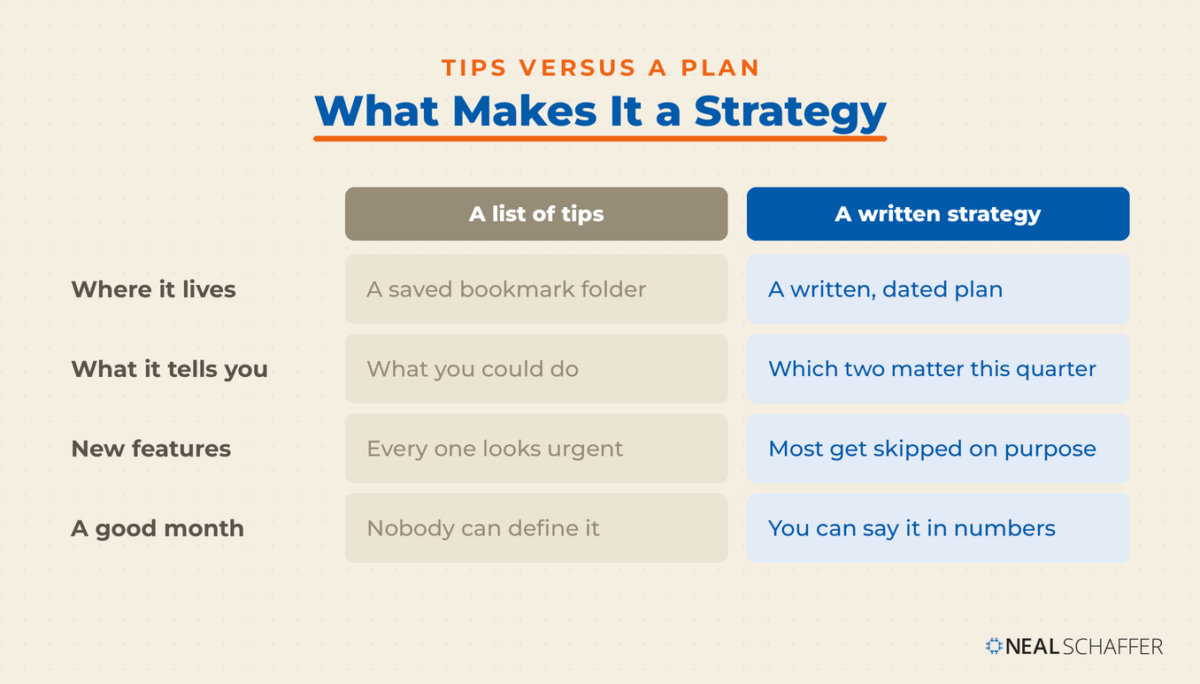
The word doing the work there is “written.” Most of what passes for LinkedIn strategy is a pile of LinkedIn marketing tips somebody collected, and tips with no goal behind them are just activity. Tips tell you what to do. A strategy tells you which ones matter for you this quarter and in what order. From what I have seen, if you cannot say what a good month on LinkedIn looks like in numbers, you do not have a strategy yet.
A plan also stops you chasing every new feature. LinkedIn ships things constantly, and a plan tells you which of them matter for your goal and which you can ignore this quarter without guilt.
So before any of the tactics, it is worth knowing why LinkedIn earns this much planning attention when your other social channels probably do not.
Why Does LinkedIn Need Its Own Strategy in 2026?
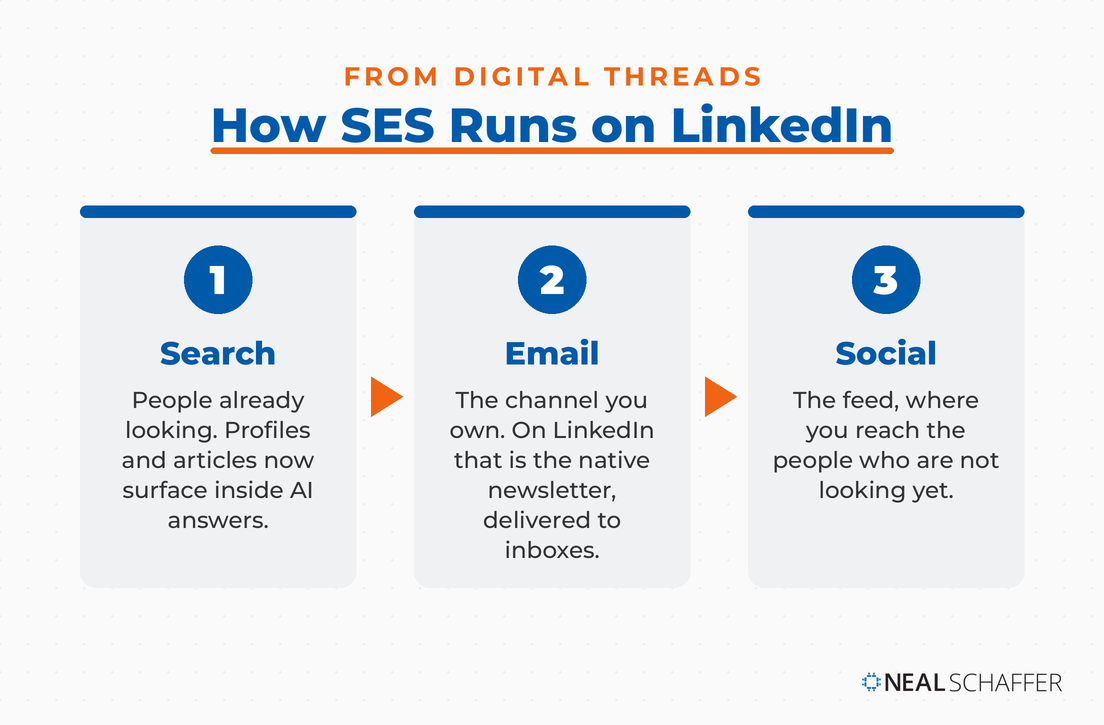
LinkedIn now does three jobs at once. AI engines cite it heavily for professional questions, which makes it a search surface. Native newsletters give it an email channel. And it is still social. Over 1.2 billion professionals use it, including 98% of Fortune 500 CEOs.
In Digital Threads I call this the SES framework: search, email, and social are the three threads that move a small business forward. Search captures demand, email converts it, social amplifies it. LinkedIn is the one place where all three run at once, which is why it earns a plan of its own rather than a slot in a general social calendar.
The search part is what most marketers have not absorbed yet. Semrush studied 325,000 prompts across ChatGPT Search, Google AI Mode, and Perplexity in early 2026 and found LinkedIn ranked second among cited domains in its dataset, appearing in 11% of AI responses on average. Second, in a dataset that put it ahead of Wikipedia, YouTube, and every major news publisher.
Worth saying plainly that this is a platform-level finding, not a promise about your account. I spent an afternoon running fifteen prompts across my own LinkedIn newsletters and articles, and not one of them came back with a LinkedIn citation for me. So treat this as a reason to publish there deliberately and then measure, rather than a result you can assume.
Before you commit budget, the wider figures on reach, audience makeup, and engagement benchmarks are worth a look, and I keep them current in my LinkedIn statistics post rather than repeating them here.
That is the why. The rest of this is the how, and it starts with a way of looking at your presence that gets people unstuck fast.
What Are the Four Cylinders of a LinkedIn Marketing Strategy?
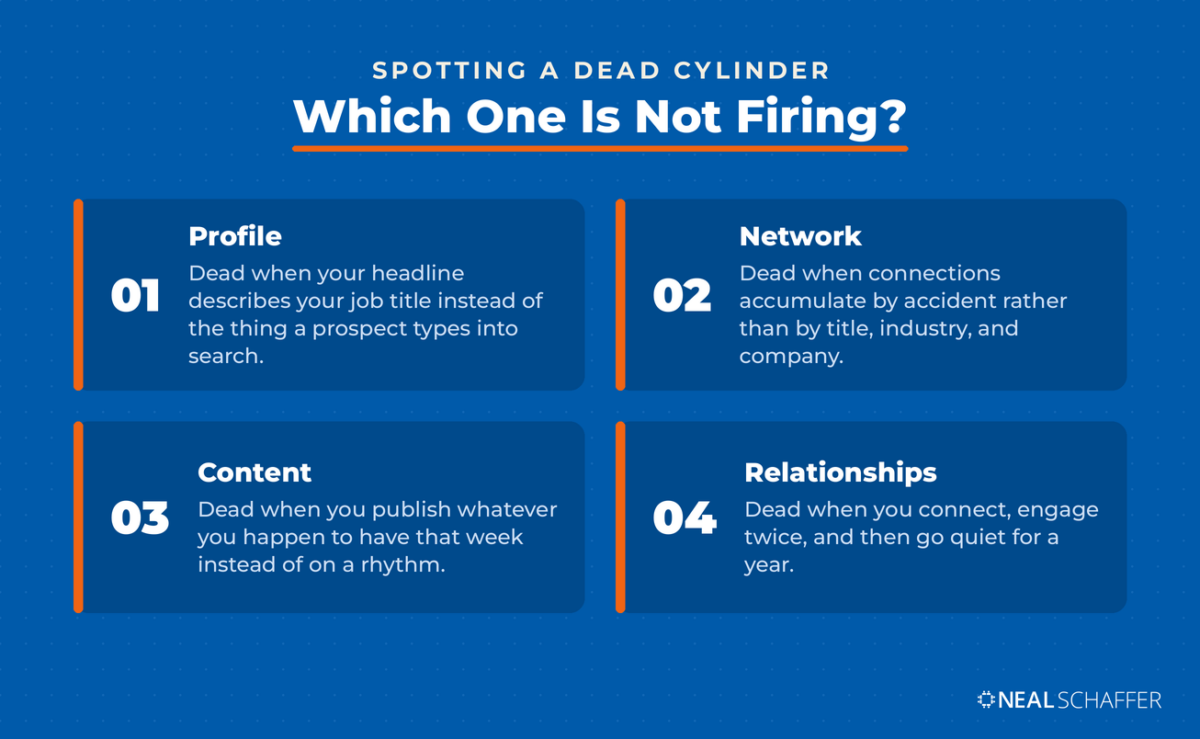
Your LinkedIn presence works like an engine, and I count four cylinders: profile, network, content, and relationships. Most of the people I work with have one or two of them firing. A decent profile but nothing published, or plenty of content but no deliberate network building. The engine moves, but it sputters.
I laid this out in full on a recent episode of my podcast Your Digital Marketing Coach, which came out of a keynote I gave at the Digital Marketing Summit at Nova Southeastern University. Each cylinder does a different job.
| Cylinder | What it is | The question it answers |
|---|---|---|
| Profile | An inbound landing page, not a resume | Does the right person understand what you do in five seconds? |
| Network | Deliberate architecture around who you want to reach | Are you connected to people who could buy or refer? |
| Content | A publishing rhythm that builds authority | Would a stranger learn something from your last five posts? |
| Relationships | A follow-up system | What happens after someone accepts? |
Cylinder One: Your Profile
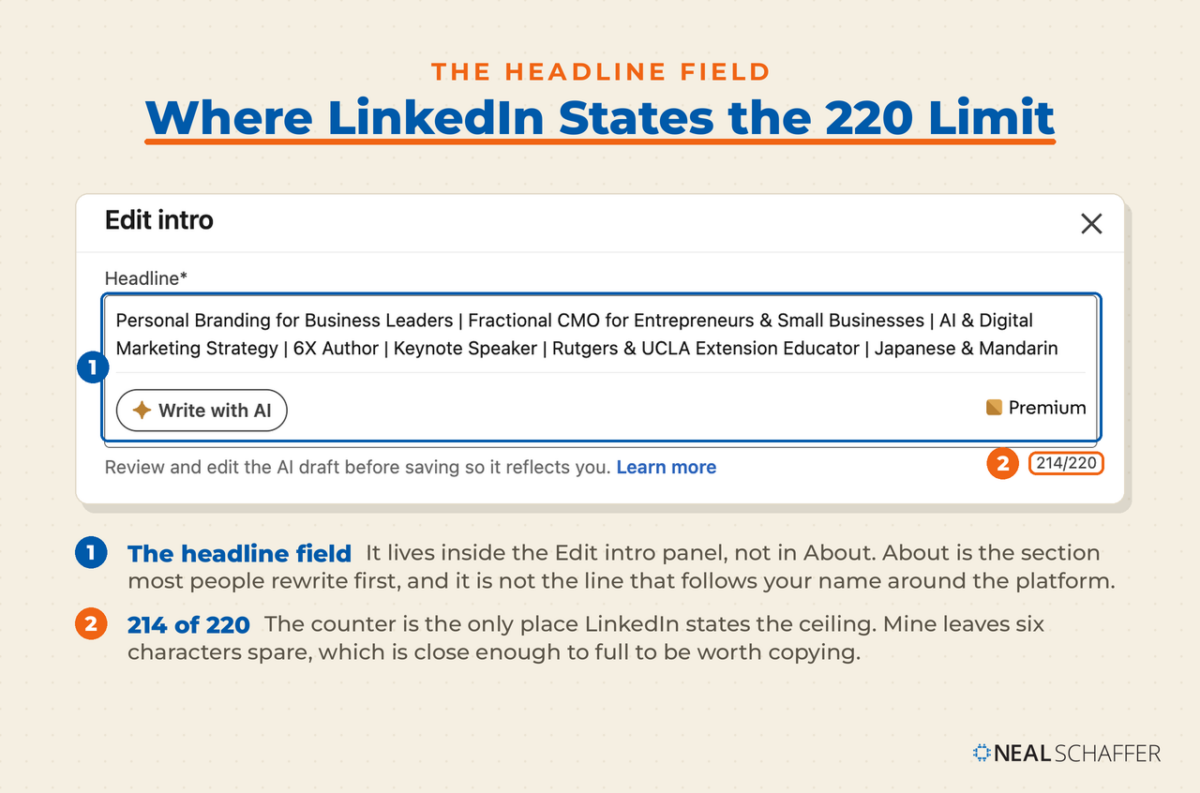
Treat your profile as an inbound landing page. Your cover photo is a billboard. Your headline is 220 characters of elevator pitch. Your About and Experience sections are searchable text, so use the words your prospects type rather than your internal jargon.
Run this check right now. Open LinkedIn search, type what you do the way a prospect would say it, and see whether you appear. If you do not, your keywords need work.
Is LinkedIn Actually Bringing You Business?
My latest book helps professionals, entrepreneurs, and business owners turn LinkedIn from a static profile into a real source of clients and growth.
Maximizing LinkedIn for Business Growth gives you clear, practical steps to build a profile that gets noticed and a network that actually sends business your way.
Grab your copy on Amazon and put it to work this week. Click the cover or the button below to get started.

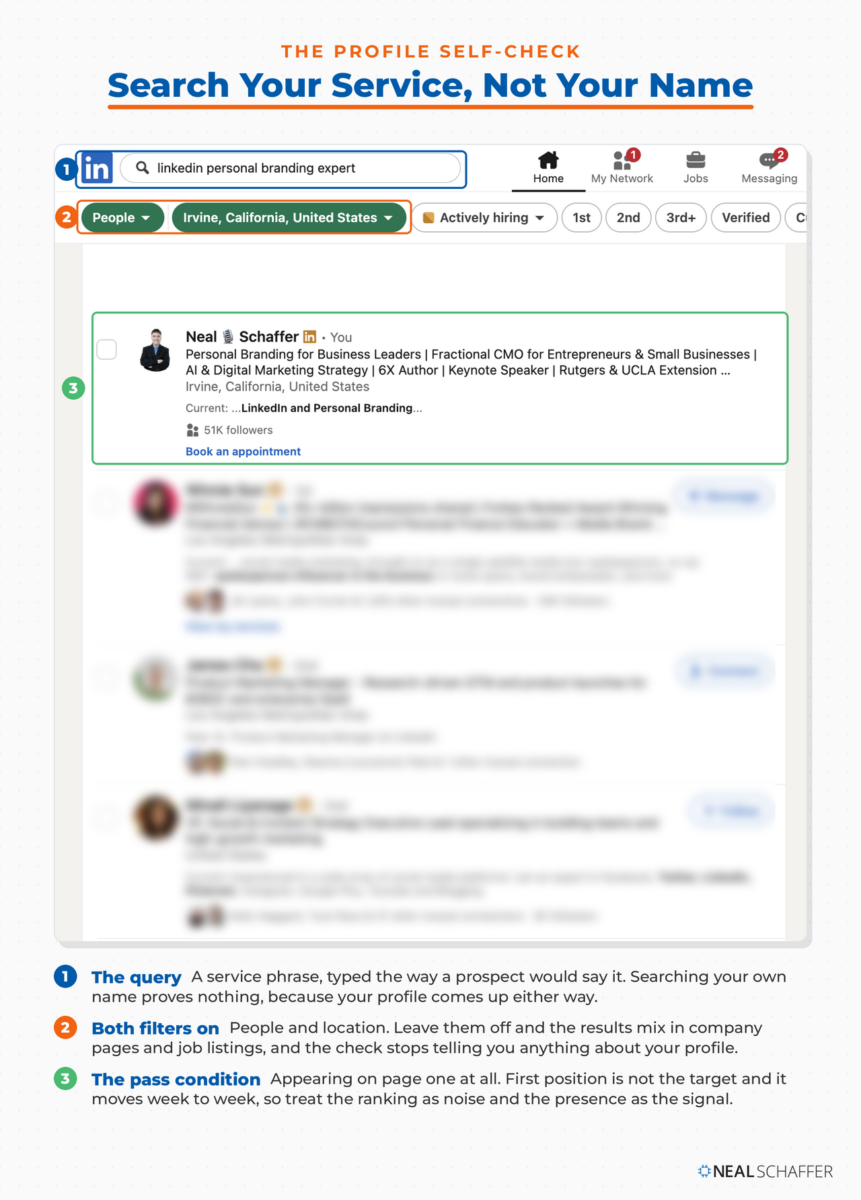
My post on creating a LinkedIn profile that gets you noticed covers each field in order, and if the headline is where you are stuck, these LinkedIn headline examples give you something to work from.
Cylinder Two: Your Network
Connections are architecture, not a scorecard. Decide which titles, industries, and companies you want represented, then build toward that on purpose. Boolean operators make this far less tedious, and I cover the syntax in my post on LinkedIn Boolean search.
Introductions beat cold requests. An invitation from a stranger risks being ignored or reported, and enough of those can get your account restricted. For a repeatable approach, start with how to grow your LinkedIn network and my method for connecting with people outside your network.
Cylinder Three: Your Content
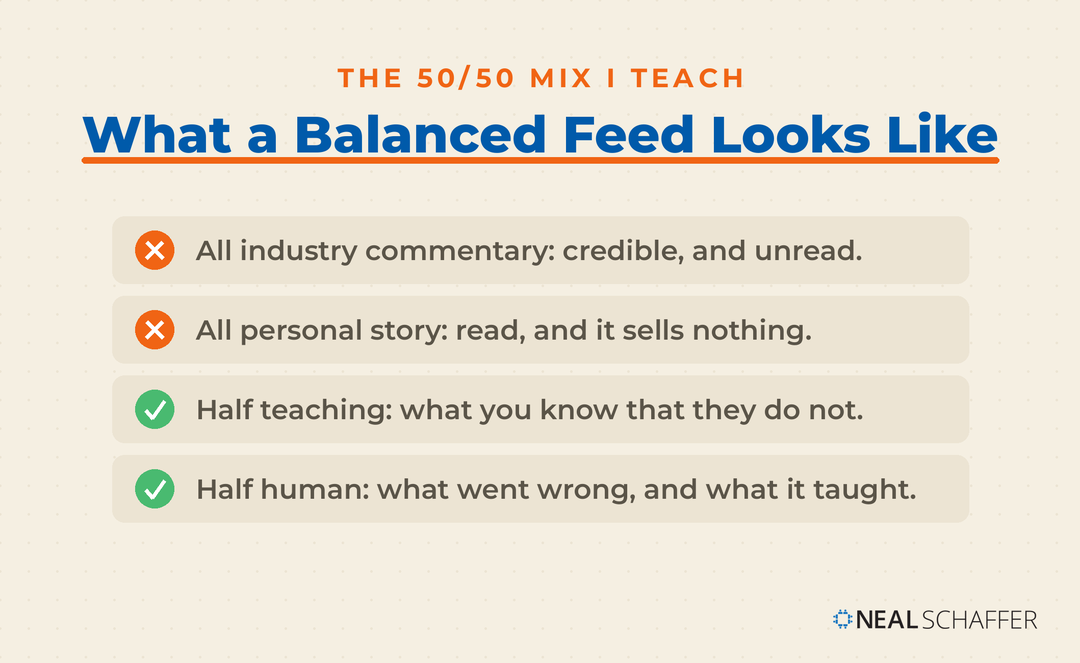
The biggest mistake I see is going all business or all personal. Neither works. I teach a 50/50 mix: half professional content like industry insight and how-to advice, half engagement content like personal stories, lessons learned, and mistakes made. Both halves need to be there, because the professional half earns you credibility and the personal half is what makes anyone read it.
Cylinder Four: Your Relationships
Most people connect, engage once or twice, then disappear. The difference between networking and pipeline is a follow-up system, and that system can be a spreadsheet. It does not need to be software. What matters is that nobody falls through the cracks.
With the four parts named, the next question is how you know whether any of them are working.
How Do You Set LinkedIn Goals You Can Actually Measure?
Name the outcome first, then pick two or three numbers that track it. Brand awareness maps to impressions and follower growth. Recruiting maps to job page views and applications. Sales maps to profile views, connection acceptance, and inbound conversations. Campaigns with no target rarely return the budget they consume.
Consider what goes wrong without this. Plenty of hospitals are dealing with a nursing shortage. One I looked at was running recruitment ads across several networks including LinkedIn. The targeting appeared to be adults under a certain age within a geographic radius, with no filter for medical background. So a lot of people with no clinical training at all were seeing ads for nurses. Clear goal, undefined audience, expensive combination.
Once the numbers are chosen, check them monthly rather than daily. LinkedIn analytics gives you the raw figures on your page and posts. Reach is the metric people misread most often, so it helps to know exactly what an impression on LinkedIn counts as before you build a target around it.
Knowing what to measure raises a second question: where should the activity happen in the first place?
Should Your Company Page or Your Personal Profile Carry the Strategy?
Your personal profile should carry roughly 90% of your LinkedIn activity and the Company Page about 10%. Semrush found that on ChatGPT Search and Google AI Mode, individual members account for 59% of cited LinkedIn content, while Perplexity inverts that and pulls 59% from Company Pages. Trust gets built by people. The page supports.
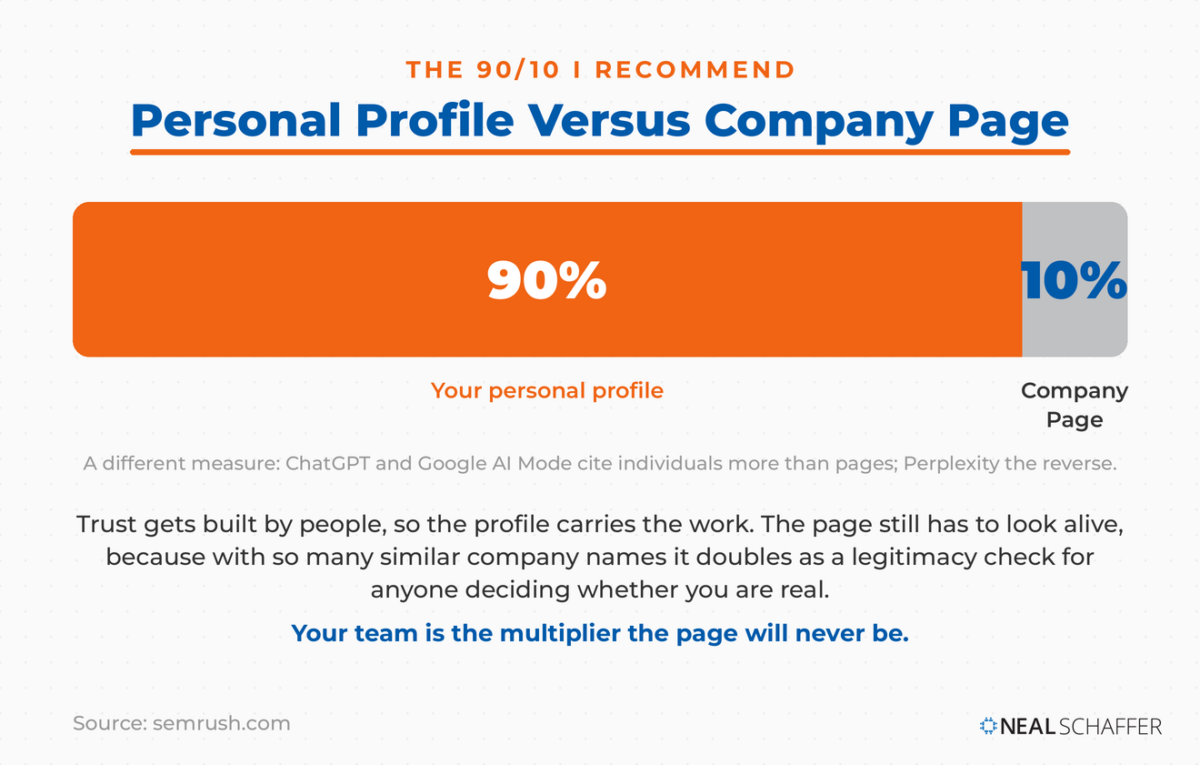
In the LinkedIn book I put this as company page equals supporting cast, not the star, and none of it means neglecting the page. It still needs your logo, a clear description, the words people actually search, and enough recent activity to look alive, because with so many similar company names it doubles as a legitimacy check. My post on how to create a company page on LinkedIn covers the setup fields.
Your team is the multiplier. Every socially active employee has influence inside a network your page will never touch, and I would argue employee advocacy is a form of influencer marketing you already have access to. Content Marketing Institute’s survey of 1,015 B2B marketers found 37% report that fewer than 5% of their employees with real expertise contribute to thought leadership at all. That is a lot of unused reach sitting in the building.
Which brings us to the part everybody asks about first and should probably ask about fourth.
How Do You Build a LinkedIn Content Strategy?
A LinkedIn content strategy is a written plan for what you publish, why, and how you judge whether it worked. It sets two or three topics tied to what you sell and a mix of teaching and personal posts. It also sets a rhythm you can keep every week and a measure tied to business goals instead of reactions.
Start with the topics. If someone reads three of your posts in a month, they should come away knowing what you do and who you do it for. Posts that keep circling the same two or three topics make that easy. The 50/50 mix from the content cylinder above then decides how each topic gets told.
Make the work original, because that is what the AI engines pick up. In Semrush’s dataset, roughly 95% of cited LinkedIn posts were original rather than reshared, and articles accounted for 50% to 66% of cited LinkedIn content depending on the engine, with the 500 to 2,000 word range cited most.
Which Formats Should Carry Your Content?
Below is how the main formats sort out, and what each one is good for.
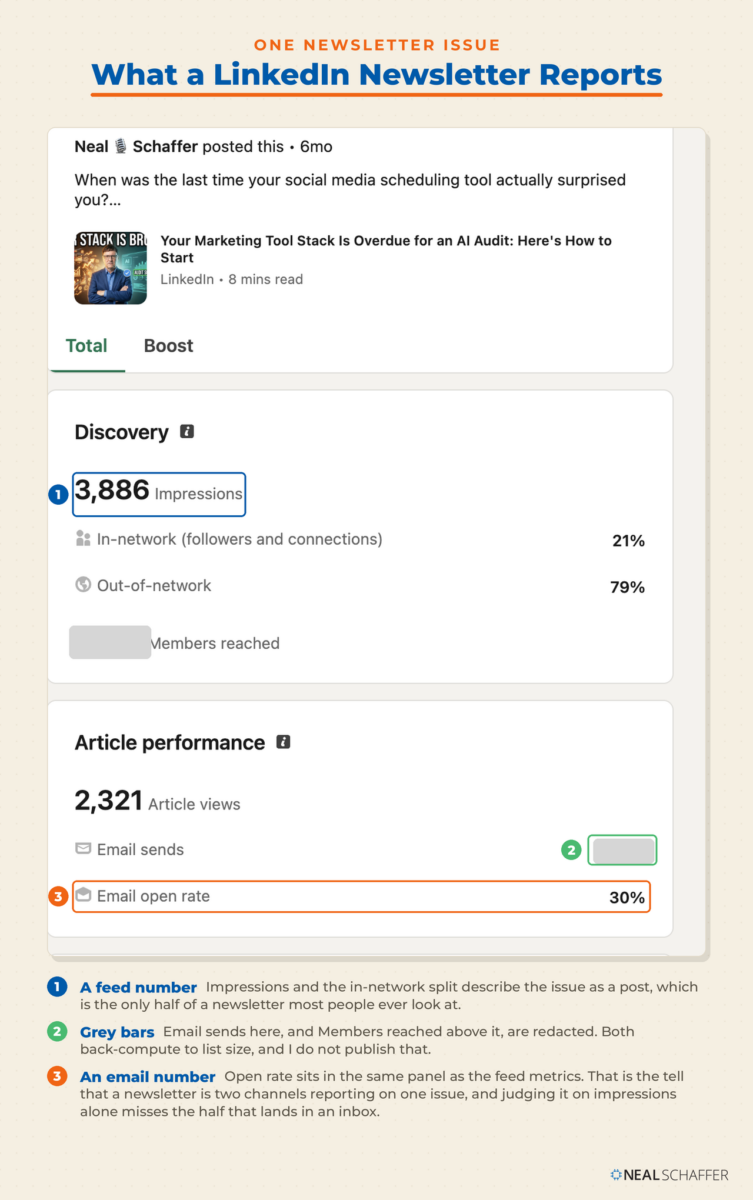
Newsletters deserve a specific mention, because they are the closest thing LinkedIn has to email. Mine runs right around 30%: I checked three issues published across eight months and they came in at 30%, 31%, and 32%. That consistency is why I have shifted more of my own publishing toward articles and newsletters rather than short posts alone.
Do not assume your own work is too dull to film, either. A factory floor tour, a build process, a day inside the operation. You think nobody wants to see your factory? Think again.
When you publish, LinkedIn hashtags help categorize what you post for the right audience, and the best time to post on LinkedIn is worth testing against your own analytics rather than taking on faith. Judge the strategy as a whole the same way, once a month, against the goals you set. A post that starts a conversation with a likely buyer probably did more for you than one that collected a hundred reactions from peers.
Publishing consistently is what makes the next part possible, because you cannot convert an audience you have not earned.
How Does a LinkedIn Marketing Strategy Turn Into Leads?
Leads come from relationships built before anyone is ready to buy. LinkedIn’s B2B Institute frames this as the 95-5 rule: at any moment, about 95% of your potential buyers are not in the market. Your job is being the name they already trust when they finally are.
That reframes almost every connection request people send. You are not selling on the first touch. You are getting into consideration early enough to be the obvious call later, which is why patient content beats aggressive outreach here.
Ty Heath, director of market engagement at The B2B Institute at LinkedIn, described the compounding effect in Content Marketing Institute’s 2026 B2B research: “Each high-quality, actionable piece of thought leadership earns you compound trust and compound credibility.” That is the mechanism. It is slow, and then it is not.
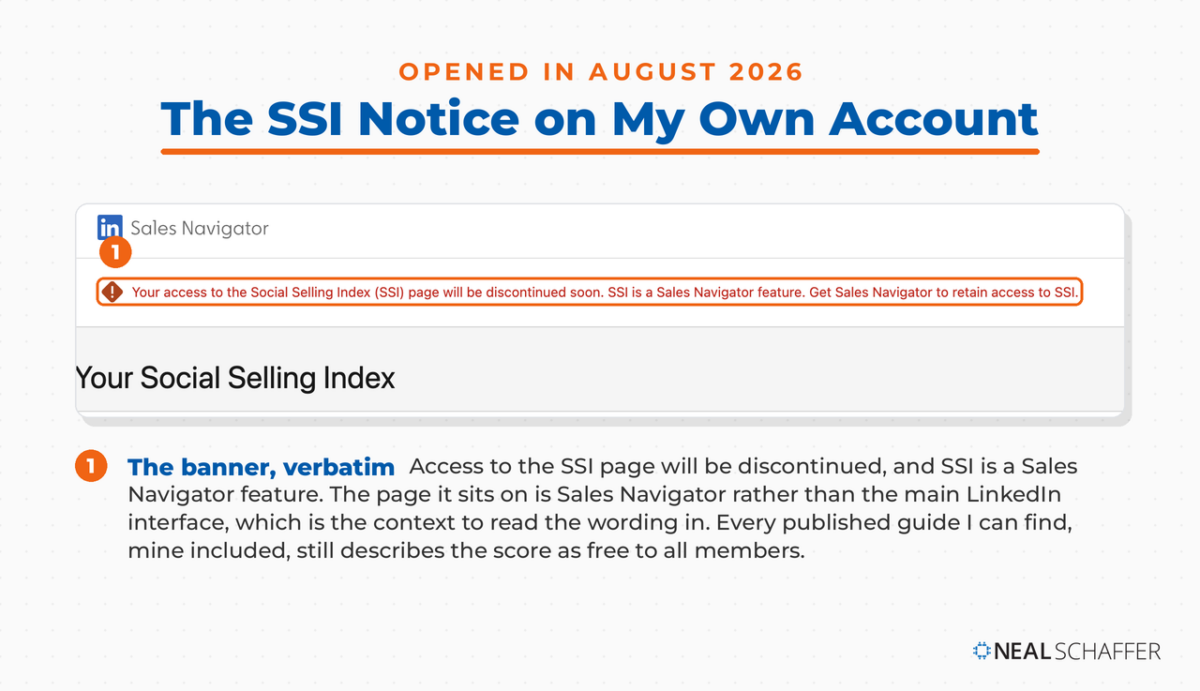
Three things make the conversion side work, and the first one comes with a warning. Your LinkedIn social selling index is worth one look as a rough read on whether all four cylinders are firing, but do not build a strategy on it. LinkedIn now says on its own Sales Navigator page that the SSI score no longer reflects the modern sales environment and is steering sellers toward AI tools instead. When I opened my own SSI page in August 2026, I found a notice saying my access would be discontinued and that SSI is a Sales Navigator feature. So check it if you are curious, and pick a metric you control for anything that matters.
The other two are steadier. Research prospects quietly first, which is what LinkedIn private mode is for. And once organic activity tells you which messages land, put budget behind those specific messages with LinkedIn ads rather than guessing from a blank campaign.
One more thing worth knowing before you build the pipeline side. Edelman and LinkedIn found that more than 40% of B2B deals stall because of misalignment inside the buying group. Your champion is rarely the only person who has to say yes, so publish for the finance, legal, and operations people who never reply but read everything. My approach to LinkedIn lead generation goes through the sequence in order.
All of that is a lot to take on at once, so here is the sequence I would use for the first month.
What Should Your First 30 Days Look Like?
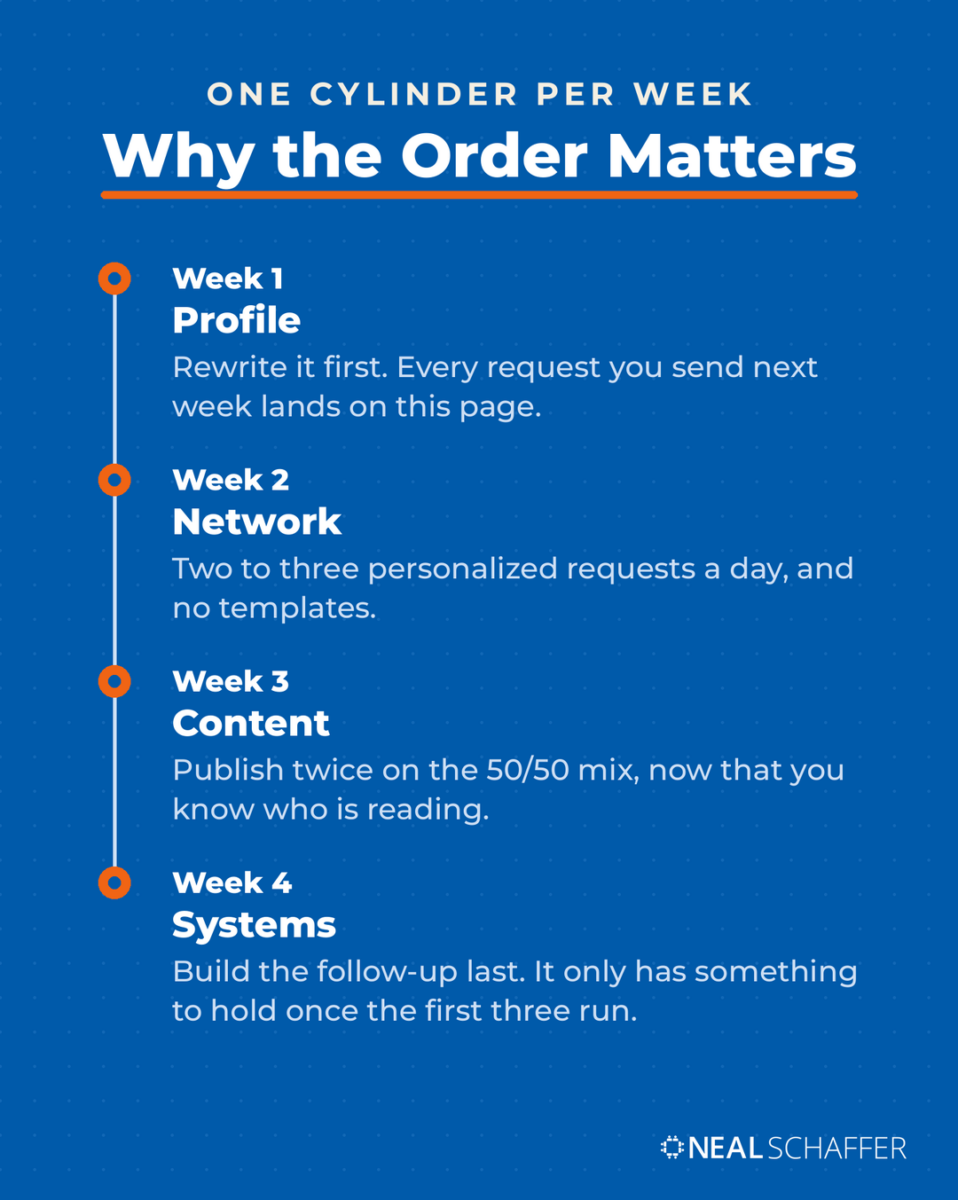
Fix one cylinder per week rather than all four at once. A profile rewrite in week one makes every connection request in week two land better, and a defined network in week two gives your content in week three someone specific to write for. The order matters because each week feeds the one after it.
| Week | Focus | What you actually do |
|---|---|---|
| 1 | Profile | Rewrite the headline, cover photo, and About section using your prospects’ words. Search your own service and confirm you appear. |
| 2 | Network | Send two to three personalized connection requests per day. No templates. |
| 3 | Content | Publish twice using the 50/50 mix. One teaching piece, one story. |
| 4 | Systems | Build the spreadsheet CRM and set a daily 5 to 15 minute routine for comments and follow-ups. |
Thirty days will not finish the job. It will probably tell you which cylinder was holding you back, which beats another year of guessing.
Frequently Asked Questions About LinkedIn Marketing
It is a deliberate plan for using LinkedIn to reach business goals, covering your objectives, target audience, profile and page setup, content calendar, engagement approach, and ad budget. The plan connects every post and every connection to a measurable outcome instead of leaving results to chance.
Yes, particularly for B2B and for professional services. LinkedIn concentrates decision-makers in one place and lets you target by industry, title, and company. For recruiting, thought leadership, and lead generation, no other social platform offers a comparably professional context. My guide to B2B social media marketing treats LinkedIn as the anchor and everything else as a deliberate second bet.
Start free. Optimize the profiles of your founders and staff, post useful content on a consistent schedule, and have your people engage from their personal accounts, since people follow people more readily than logos. Add targeted ads once organic activity has told you which messages resonate.
A sustainable rhythm of several posts a week beats sporadic bursts. Consistency trains both your audience and the algorithm to expect you. In the same Semrush study cited above, around three-quarters of the authors whose LinkedIn posts got cited by AI had published more than five times in the previous four weeks, so frequency compounds beyond the feed.
Start with two or three topics tied to what you sell and a mix of teaching posts and personal posts. Add a publishing rhythm you can keep every week, the formats that suit each topic, and a monthly check against your business goals. Write it down, so it still holds when a busy month hits.
Yes. Professionals build personal brands the same way companies do: deliberate network growth, regular engagement with other people’s content, and relationship management. A strong personal presence compounds with your company’s page, because prospects and recruiters check both before deciding whether to engage.
Put Your LinkedIn Marketing Strategy to Work
Pick the cylinder that is most obviously broken and give it a week. Then give the next one a week. That sequence beats collecting more LinkedIn marketing strategies, because you find out fast which part of your engine was the actual problem.
If you want the full system behind this framework, download a free preview of Maximizing LinkedIn for Business Growth, which goes deeper on profile, prospecting, and content than any post can. For the strategic case for the platform itself, my piece on using LinkedIn for business is the natural next read.
And if you would rather have someone build and run this alongside your other channels, that is what my Fractional CMO services are for.