




Completing a complex upgrade five years in the making, two spacewalking astronauts on Thursday mounted an eighth and final roll-out solar wing on the International Space Station, boosting the lab’s power output to compensate for the age-related degradation of its original arrays.
NASA began the power-system upgrade in 2021 when two spacewalkers installed the first ISS roll-out solar array, or IROSA, at the base of one of the original eight wings. Six additional panels were attached during subsequent spacewalks, with the most recent installation carried out last week during a spacewalk by NASA astronaut Anil Menon and Canadian astronaut Joshua Kutryk.
The duo ventured back outside Thursday to install the eighth and final IROSA on the far right end of the station’s power truss, beginning the extravehicular activity, or EVA — NASA speak for “spacewalk” — at 8:36 a.m. ET.
The final two IROSAs were delivered to the station aboard a SpaceX Cargo Dragon capsule earlier this month, with each one folded in half and stowed in the ship’s unpressurized trunk section. The lab’s robot arm mounted both rolled-up blankets on the left side of the station’s power truss to await installation.
Attachment and extension of the seventh panel last week was relatively straightforward because the 58-foot-long robot arm could easily carry Menon, holding onto a new IROSA, to its nearby installation point on a fixture at the base of an inboard left-side solar wing.
NASA TV 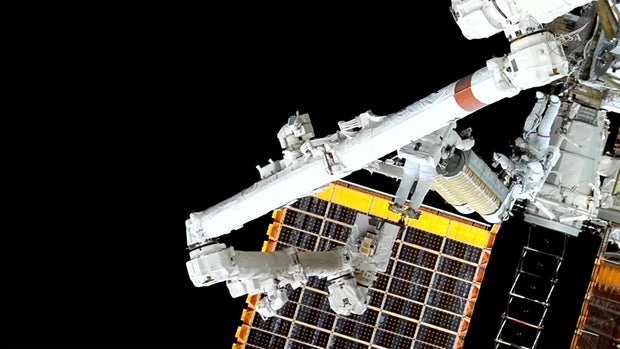
But the Canadarm II does not have the reach to carry Menon and the final blanket directly to the far right end of the power truss as required, so he and Kutryk handed it off to each other leapfrog fashion to get it all the way out to a waiting support frame.
Once mounted on the base of the outboard array, Menon and Kutryk unfolded the new IROSA, bolted it in place, and connected power and data cables during orbital darkness when no sunlight was available to generate electricity.
As the station moved back into sunlight, flight controllers noticed one of the two still-rolled-up blankets did not appear to be generating a small amount of electricity as expected. The spacewalkers then waited for another night pass to double-check the connections. The problem was resolved, and the final IROSA blankets were extended to their full length of 63 feet.
NASA TV 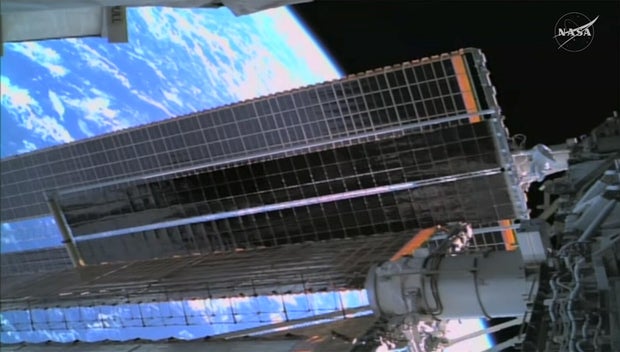
“These solar arrays are incredible, half the size of the old ones. It’s delivering 40% more power,” Menon said after returning to the airlock. “It’s really empowering all this research that we do and everything that we do to transform space and open the doors to the future.”
The six-hour, 59-minute spacewalk ended at 3:35 p.m.
The IROSAs were designed to offset age-related degradation that has reduced the power output of the station’s original arrays over more than two decades of use in the harsh space environment.
The new panels are smaller but more efficient, featuring state-of-the-art solar cells. Even though they shade portions of the arrays they are mounted on, they still provide a net boost in power.
Before the first IROSA was installed, the original arrays were generating about 160 kilowatts of power. The eighth and final IROSA was expected to boost the total power output to some 215 kilowatts, enough to sustain the lab through its planned retirement and de-orbiting in 2030, powering life support systems, computers, research and visiting vehicles.