




When it comes to literary allegories, Venus is about as close to Dante’s description of hell as one can get! Its atmosphere is 93 times as dense as Earth’s, which is equal to the pressure found 900 m (3,000 ft) underwater, enough to crush the human body. It’s also the hottest planet in the Solar System, with temperatures reaching 467 °C (872 °F), which is hot enough to melt lead. Unlike Earth, its surface is not composed of tectonic plates that are constantly shuffling around, but a single-piece crust.
Until recently, scientists believed that this meant Venus was geologically inactive, though recent findings have challenged this. According to a new study by ETH researchers, Venus is not only geologically “alive” but hosts many active volcanoes. This is evident from Venus’ rift valleys (aka chasmata), lowland features similar to those on Earth that form when tectonic plates move apart. These features show that Venus also experiences tectonic activity, creating rifts that can measure up to 10,000 km (~6,200 mi) in diameter.
The research was led by Xi Yang, a graduate student from the Department of Earth and Planetary Sciences (DEPS) at ETH Zürich as part of his Master’s studies. He was joined by Taras V. Gerya, a Professor of Geodynamics in the DEPS (and Yang’s supervisor), and Dr. Anna J. P. Gülcher, a Geosciences researcher from the University of Freidburg and the Center for Space and Habitability at the University of Bern. Their results are published in a paper that appeared in Nature Geosciences.
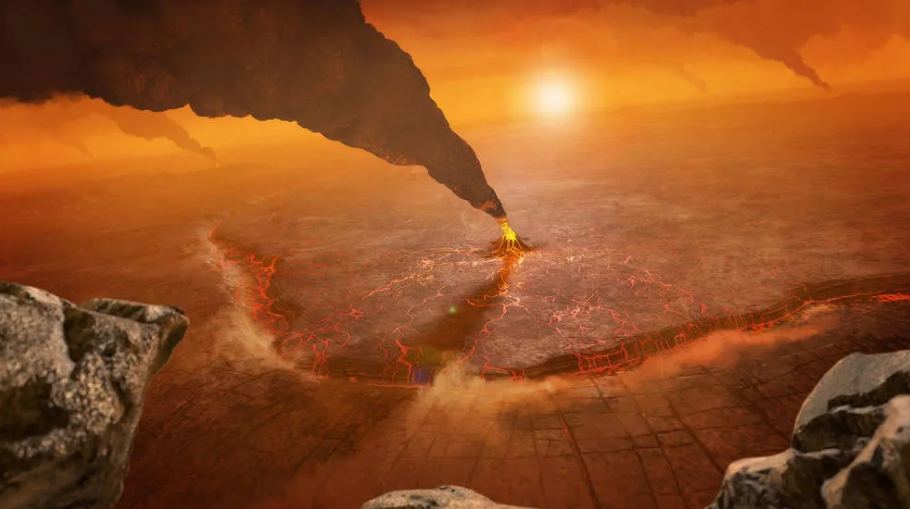
Current research reveals that Venus is not only geologically active, but has active volcanoes on its surface. Credit: NASA/JPL-Caltech/Peter Rubin
Previous models of Venus’ geological evolution, along with data provided by NASA’s Magellan probe (which observed Venus between 1990 and 1994), have confirmed that large rift valleys exist on Venus. Previous models indicated that broad ridges (rift flanks) form along the edges of rift valleys when they are geologically young and are either still moving or have only recently ceased.
Until now, geoscientists believed that they formed more than 100 million years ago, but this has remained unconfirmed. What’s more, earlier models had relied on simplified material assumptions and been mostly two-dimensional. As a result, the question of whether Venus is still geologically active or not has remained unresolved.
To address this, Yang and his team employed a new computer model to create the first high-resolution 3D models of Venus’ surface, focusing on the Ganis, Dali, and Devana Chasmata.
This allowed them to accurately replicate these rift structures and provide better explanations of their formation. Their model shows that rift flanks on Venus tend to flatten rapidly after movement ceases, meaning that systems become less steep and narrow their flanks with age. Unlike Earth, where erosion gradually wears down features, Venus’s flanks subside due to crustal relaxation. Their simulations also suggest that these rifts widen at a rate of 3 to 10 cm (~1.2 to 4 inches) a year, which is faster than previous models suggested.
Based on their modeling and observational data from Magellan and other missions, the researchers conclude that Venus remains geologically active and has a more dynamic interior than previously thought. “The results help us to better assess the tectonic activity on Venus,” says Gerya. This is particularly important considering that NASA and the ESA are preparing multiple missions to explore Venus’ atmosphere, surface, and interior structure in the near future.
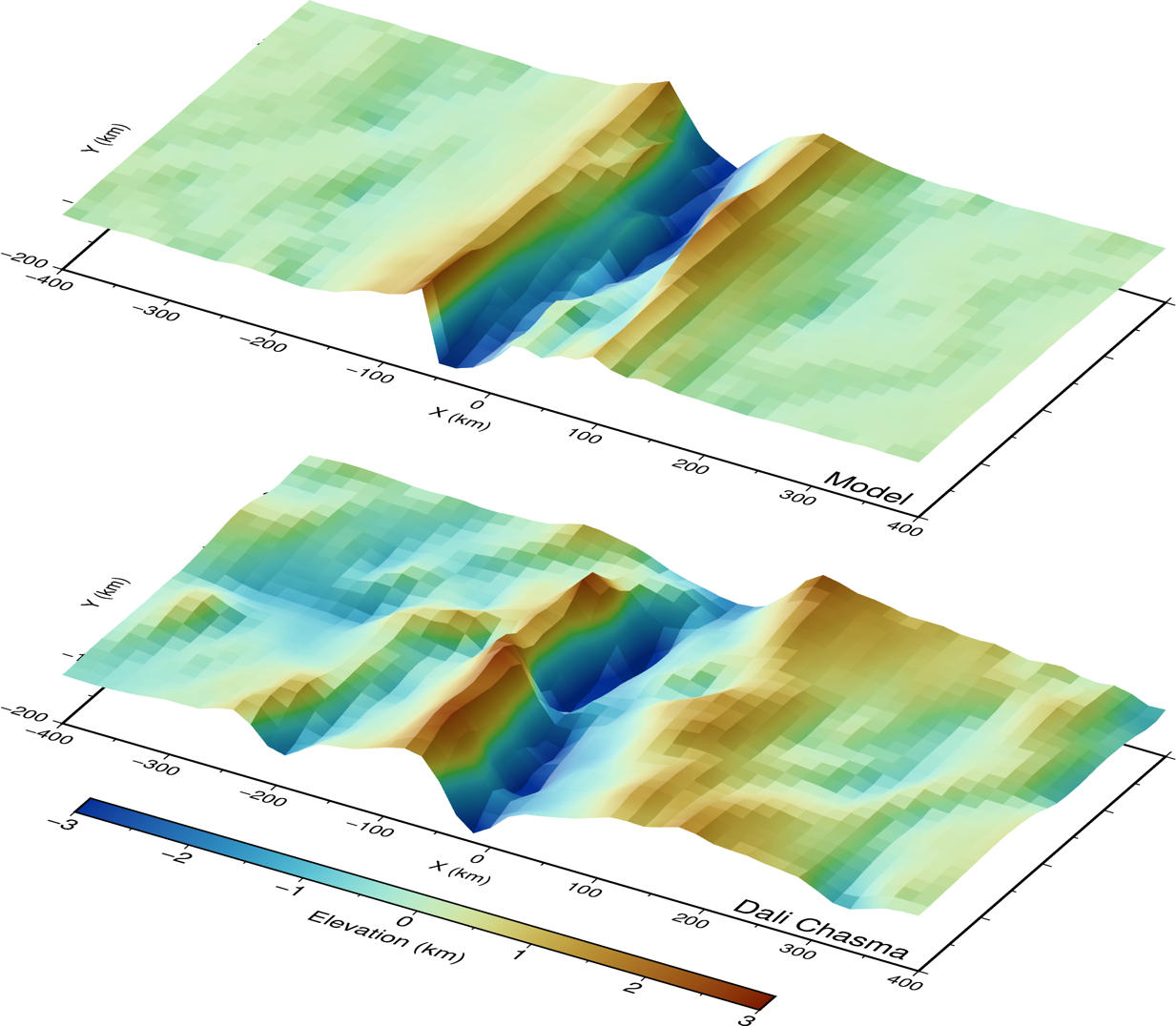 Comparison between the crustal model at 700,000 years (top figure) and the actual Dali Chasma rift system (bottom). Credit: Xi Yang/ETH Zürich
The results of their model could help mission planners pinpoint geologically active regions for these missions to study. Interestingly, Taras Gerya and fellow ETH geophysics professor Paul Tackley (and their colleagues) are participating in mission planning for ESA’s EnVision mission, a probe that is scheduled to launch in the 2030s to study Venus’ atmosphere, surface and interior, and how they interact with each other.
Similarly, the team’s findings are shaking up what scientists know about how rocky planets in our Solar System formed, and could have applications in the search for habitable exoplanets.
Further Reading: ETH Zurich, Nature Geoscience